Taiwan A-Z
L is for Legal Sovereignty: Deconstructing China’s Ideological Trojan Horse Through a Forensic Audit of Taiwan’s Title (1895–1996) 法理主權:以台灣產權司法鑑識拆解中國意識型態木馬
The Property Liquidation of Taiwanese Sovereignty: Anything Outside De Jure Title is Mere Ideology
台灣主權的產權清算:法理產權之外的 都是意識形態
On the twentieth-century and twenty-first-century sandbox of global politics, the Taiwan Strait has long been defined by the international community as “the most dangerous flashpoint on Earth.” Throughout this eighty-year standoff, the government in Beijing has continuously spun its massive state apparatus to market a historical narrative to the world: that “Taiwan has belonged to China since ancient times,” and that “the Taiwan Strait issue is purely an internal affair of China.” Meanwhile, Taiwan’s domestic sphere has long been mired in irrational Blue-versus-Green infighting, reunification-versus-independence rhetoric, and the cognitive conditioning of its identity narratives.
在二十一世紀全球政治的沙盤上,台灣海峽長期被國際社會定義為「地球上最危險的引爆點」。在這場長達八十年的對峙中,北京政府天天開動龐大的國家機器,向全球推銷「台灣自古屬於中國」、「台海問題是中國內政」的歷史敘事;與此同時,台灣內部則長期陷入非理性的藍綠惡鬥、統獨口水、與身分認同的認知制約。
Yet, if one blows away this political smoke screen that has blanketed Taiwan for over half a century and looks directly at the cold, rigorous realities of international treaty law, property jurisprudence, and the causal chains of global geopolitics, a stark truth emerges: the essence of the cross-strait dispute is not a mythic ethnic feud. It is, in fact, the longest-running, highest-stakes, and most civilizationally consequential “property rights lawsuit of the century” in human history.
撥開籠罩在台灣上空半個多世紀的層層政治煙幕,直視冰冷而嚴謹的國際條約法、財產權法學、以及全球地緣政治的因果鏈結,會發現兩岸之間的所有爭端,其本質根本不是一場「神話式的民族恩怨」,而是一場人類歷史上「跨時最長、牽涉資本最巨、影響文明生死存亡的世紀產權訴訟」。
The political chaos of the “cross-strait issue” stems from a core pathology: the bad debts of history have never been coldly and thoroughly liquidated. To clarify the lineage of Taiwan’s sovereignty, we must act like accountants liquidating a bankrupt corporation—dissecting the black-and-white text of historical contracts, confiscating all illegal claims, and completing a decolonial establishment of title and sovereignty.
兩岸問題的政治混亂,核心病灶在於歷史的呆帳從未被冷酷地清算。要釐清台灣主權的來龍去脈,就必須像會計師清算破產公司財產一樣,逐一解剖歷史契約的白紙黑字,沒收所有非法宣稱,完成去殖民化的「主體性確權」。
This luxury estate situated in a prime geopolitical location, named Taiwan—in whose hands is its title deed actually registered? Is it held by that long-bankrupt company in Nanjing, whose shareholders fled long ago (the Republic of China)? Is it held by that tyrannical bully in Beijing, waving a kitchen knife at the doorstep, brandishing a forged deed of assignment in a desperate attempt at a hostile takeover (the People’s Republic of China)? Or does it belong to the twenty-three million residents on this land who work tirelessly every day, guarding their home with their ballots and silicon technology?
這棟位在全球精華地段名為台灣的豪華大樓,它的產權證書到底登記在誰的手裡?是南京那個早已破產、股東逃亡的舊公司(中華民國)?是北京那個拿著偽造讓渡書、天天在門口揮舞菜刀企圖強行併購的惡霸強權(中華人民共和國)?還是這片土地上,兩千三百萬每天辛勤工作、用選票和科技守護家園的實質住民?
Stripping away the filters of political victimhood and ideology, and employing the cold realism of geopolitics as our scalpel, we see that the essence of sovereignty has never been a nebulous ethnic totem. It is a forensic legal investigation into “the lawful acquisition, transfer, and localized registration of territorial title.”
抽離政治悲情與意識形態的濾鏡,以地緣政治的冷峻現實主義為刀,主權的本質從來不是虛無縹緲的民族圖騰,而是一場關於「領土資產所有權(Title)的合法取得、移轉、與在地登記」的司法鑑識。
The evolution of Taiwan’s true status under international law since the end of World War II in 1945 is by no means an ideological soap opera of “returning to the motherland.” Rather, it is a masterfully clear history of trust conveyance. Initiated by the Allied Powers with the United States military at its core, Taiwan was initially placed under the “temporary administration” of an exiled military legal person; ultimately, through a definitive “localized equity restructuring” and the “actualization of popular sovereignty” in the 1990s, this trajectory culminated in the local populace’s “acquisition by prescription” and absolute, finalized title confirmation.
從 1945 年二戰結束至今,台灣在國際法上的真實身分演變,並不是一場「回歸祖國」的意識形態肥皂劇,而是一場由國際盟國發起、以美軍為主要核心、將台灣交由流亡軍事法人「代管」後,最終在 1990 年代透過「股權落地重組」實現「主權在民」,走向在地住民「時效取得」與實質確權的信託流轉史。
In this text, we shall serve as the forensic expert witnesses in this geopolitical lawsuit of the century. We will cut through the legal lies woven jointly by the Great China historical narrative and the Nationalist-Communist duopoly, placing them under the microscope of international treaty law for the strictest judicial scrutiny.
在這篇文章中,我們將擔任這場世紀地緣產權訴訟的司法鑑定人,逐一割開大中國史觀、與國共兩黨聯手編織的法理謊言,在國際條約法的顯微鏡下進行嚴格的司法鑑定。
Dear readers, please temporarily shed all your past political biases and the toxins left behind by cross-strait historical textbooks. You are about to enter a forensic legal scene devoid of sentimentality—one ruled solely by evidence and air-tight, deadlocked logic.
讀者諸君,請暫時卸下你過往所有的政治成見、兩岸編織的歷史教科書,你即將進入的,是一個沒有溫情、只看證據、邏輯閉環死鎖的司法鑑識現場。
This is an indictment declared openly to the court of global geopolitics; it is a final liquidation of the truth in an eighty-year-old lawsuit. Once this forensic assessment is complete, you will see with absolute clarity why the “unification-versus-independence, Blue-versus-Green” confrontation is nothing more than a psychological operation by a Chinese Communist Party that lost the game but refuses to accept the verdict. It is a desperate, pathetic attempt to administer artificial respiration to a Beijing framework that was already shattered to pieces by Lee Teng-hui in 1996.
這是一份向全球地緣政治開庭宣告的起訴書,也是一場長達八十年世紀訴訟的真相清盤。當這場司法鑑定完成,讀者諸君將徹底看清,為什麼「統獨對決、藍綠對立」是中共願賭不服輸之下的操作,是在幫那個在 1996 年已被李登輝震碎的「北京框架」狼狽地進行人工呼吸。
The judge has taken the bench. The plaintiff and the defendant are in their positions. The final judicial trial of cross-strait geopolitical title is now in session.
法官已經入座,原告與被告各就各位。兩岸地緣產權的終審大審判,現在開庭。
Chapter 1: The Principle of Prior Chain of Title: You Cannot Inherit an Asset Absent from the Master Inventory of the Qing Dynasty
第一章 產權的「前手因果」你無法繼承大清總清冊裡沒有的資產
To untangle the legal blind spots surrounding the Taiwan Strait, one must tear away the historical revisionism painted over textbook narratives by both the Chinese Nationalist Party (KMT) and the Chinese Communist Party (CCP). By directly cross-referencing international treaties and diplomatic archives, we can lay bare the facts through the lens of forensic legal analysis.
要解開台海的法理盲區,必須掀開中國國民黨與中國共產黨各自塗抹的歷史教科書,直接對照國際條約與外交檔案,以司法鑑識來說分明。
Does Taiwan “historically belong to China”? Before answering this question, we must first clarify a more contemporary property claim: both the Republic of China (ROC) and the People’s Republic of China (PRC) assert that they inherited the Qing Dynasty’s title to Taiwan, and therefore possess sovereignty over it.
台灣自古屬於中國嗎?在回答這個問題之前,我們先釐清一個更近代的產權主張:無論是中華民國或中華人民共和國,都宣稱他們繼承大清帝國對台灣的產權,所以它們都擁有台灣。
The Beijing government continuously deploys its state apparatus to repeat the historical myth that “the PRC succeeded the ROC, the ROC succeeded the Qing Dynasty, and therefore Taiwan belongs to China.” However, under international treaty law, this seemingly logical “chain of succession” suffers from a fatal, unresolvable break in the chain of title—a truth that both the KMT and CCP have desperately conspired to conceal.
儘管北京政府不斷開動國家機器複誦「中華人民共和國繼承了中華民國,中華民國繼承了大清帝國,所以台灣屬於中國」的歷史神話。然而,這套看似順理成章的「繼承連鎖」,在國際條約法下,存在著一個致命的、無法修補的產權斷裂,也是國共聯手亟欲掩蓋的真相。
In property law, the most fundamental ironclad rule is the “Principle of Prior Chain of Title.” To prove your legal ownership of an asset, you must present an unbroken, complete record of transfer stretching all the way back to the original legal acquirer.
在財產法學中,最根本的鐵律叫作「產權前手因果鏈」。你要證明你合法擁有一項資產,你就必須拿出一條完整、沒有斷裂的過戶紀錄,一路追溯到最初的合法取得者。
The 1895 Treaty of Shimonoseki: Taiwan Permanently Expunged from the Qing Dynasty’s Master Inventory
1895 年《馬關條約》:台灣從大清帝國的「資產總清冊」中被徹底註銷
First, let us examine Exhibit A: the Treaty of Shimonoseki. [🔗] In 1895, the Qing Empire concluded the Treaty of Shimonoseki with Japan. Acting as the legitimate legal owner of Taiwan at the time, the Qing Empire stipulated in black and white that sovereignty and administrative rights over the entire island of Taiwan and the Pescadores (Penghu) were to be “ceded in perpetuity and full sovereignty to Japan.”
首先我們檢視證物 A:《馬關條約》。大清帝國在 1895 年與日本簽訂《馬關條約》,作為當時台灣的合法所有人,大清帝國以白紙黑字將台灣全島、澎湖列島的主權與統治權「永久讓與日本」。
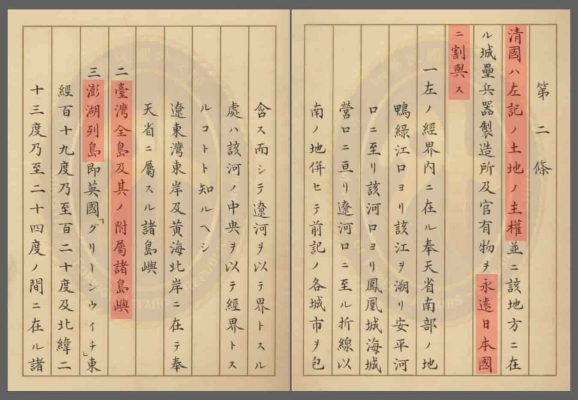
This means that no matter how the KMT, the Beijing government, or pro-unification factions in Taiwan attempt to obscure the facts, the Qing Empire’s chain of title over Taiwan underwent an irreversible legal transfer in 1895. The asset comprising Taiwan and Penghu was officially re-registered and transferred into Japanese hands, completely expunged and struck off from the Qing Dynasty’s master asset inventory.
無論國民黨、北京政府、在台統派如何編織團團迷霧,這意味著大清帝國對台灣的產權鏈結,在 1895 年就發生了不可逆的法律移轉:台灣與澎湖這筆資產自此正式變更登記、轉移到日本手中,從大清帝國的「資產總清冊」中被徹底註銷、劃掉。
In international law, this constitutes a complete, lawful, and binding transfer of property possessing supreme legal authority. It signifies that the title to Taiwan was legally “purged,” severing all legal ties with China. For the two subsequent “Chinese corporate entities,” this created a definitive rupture in the prior chain of title.
在國際法上,這是一次完整、合法、且具備最高法律效力的產權移轉,也代表台灣的產權在法律上被完全「淨化」,與中國不再有任何法理上的瓜葛,對後來的兩個「中國法人」來說,是謂「產權前手因果鏈斷裂」。
When Sun Yat-sen and others founded the Republic of China in 1912, Taiwan had already been legally held by Japan for 17 years. Furthermore, when the Last Emperor (Xuantong) abdicated in 1912, issuing the Imperial Edict of Abdication to transfer the complete territories of the Manchu, Han, Mongol, Hui, and Tibetan lands to the newly formed Republic of China, Taiwan was already absent from the imperial inventory of the Qing realm. During liquidation, it is legally impossible for an asset holder to package, donate, or pass down an item that was legally sold and transferred to a different party 17 years prior to a newly formed corporate entity.
當孫文等人於 1912 年創立中華民國時,台灣已在日本手裡合法持有了 17 年。當大清宣統帝 1912 年頒布《清帝退位詔書》,宣告將「滿、漢、蒙、回、藏之完整領土」移交給新成立的中華民國時,大清皇室名下的江山總清冊裡早已沒有台灣。一個資產持有人在進行清算時,絕無可能將一件 17 年前已合法變賣並完成過戶的物品,打包贈與或繼承給新的法人。
The ROC’s Impossibility of Inheritance: Masking Legal Realities with Greater China Ideology
中華民國對台灣無從繼承起 只好用大中國意識形態掩蓋法理事實
To use an analogy from family politics—a concept deeply favored in Chinese culture: the Republic of China founded in 1912 could not possibly inherit a house that no longer belonged to its father (the Qing Empire). Since the father had already sold the building in 1895, how could he hand it down to the ROC 17 years later in 1912?
以中華文化酷愛的家庭政治來比喻:1912 年創立的中華民國絕不可能繼承一間產權早就不屬於他父親(大清帝國)的房子,因為他父親早在 1895 年就賣掉這棟大厦,是要如何在 17 年後的 1912 年讓中華民國得以繼承?
Similarly, the People’s Republic of China, born in 1949, could not inherit a house its father never owned. The grandfather never left this particular piece of inheritance to the son, let alone to the grandson, or to any rival faction claiming to be the sole legitimate eldest son.
而 1949 年出生的中華人民共和國,更不可能繼承一間他父親從未擁有的房子,因為他祖父根本就沒有留下這筆遺產給兒子,遑論是再給孫子,或任何宣稱自己才是正宗嫡長子的集團。
Legally speaking, both the ROC and the PRC—these two “subsequent companies”—are merely independent third parties to the property transaction that took place between the Qing Empire and the Empire of Japan.
因此,以法律來說,無論是中華民國或是中華人民共和國,這兩個「後來的公司」,在法律上都是大清帝國與日本帝國之間財產交易的「獨立第三人」。
Yet, to prevent the people of Taiwan and China from grasping this cold reality of a ruptured chain of title, both the KMT and CCP launched highly sophisticated “historical erasure projects” in their respective textbooks, employing two distinct but functionally identical methods of cognitive castration.
但為了不讓台灣人與中國人看懂這個「前手產權早已斷裂」的冰冷事實,國共兩黨在各自的歷史教科書中,開動了極其精密的「歷史抹除工程」,採取了兩種完全不同、卻殊途同歸的「認知閹割」術。
In the Kuomintang-authorized textbooks published by the National Institute for Compilation and Translation during Taiwan’s martial law era, the treatment of the Treaty of Shimonoseki was heavily manipulated to hyper-inflate the “national humiliation and grievance” of the Qing Empire, branding it strictly as an “unequal treaty”—as if the Qing’s own violent conquest and occupation of Taiwan had been an exercise in equality. This rhetorical framing was designed to saturate the minds of Taiwanese people with a “victim mentality awaiting redemption” and a calculated “ethnic hatred” toward Japan. Concurrently, these text books maintained an absolute radio silence on the international legal reality of the words “cede in perpetuity”—the ultimate purification of legal title ensuring that in 1895, Taiwan’s property deed was completely and legally liquidated from China, severing all remaining accounts.
在台灣戒嚴時期的國民黨編定版(國立編譯館)教科書中,對於《馬關條約》的處理是無限放大大清帝國的「國恥與悲情」,將此條約定義為「不平等條約」(但難道大清攻打台灣、佔據台灣就很平等嗎?)好讓台灣人的腦袋裡充滿「受害者等待救贖」與對日本的「民族仇恨」,但對於《馬關條約》中「永遠讓與」這四個字在國際法上的「產權淨化」效力——台灣在 1895 年就已經在法律上與中國完全結清、不再有關聯,則絕口不提。
After exhausting the narrative of grief surrounding the 1895 treaty, the history textbooks enacted a temporal leap, jumping directly to 1945: “Taiwan’s retrocession and return to the bosom of the motherland.” The intervening 50 years were glossed over as if the outcome were a legal inevitability, framing the Nationalist government’s military entry in 1945 as a “sacred return of property to its rightful owner.” This narrative deliberately concealed the fact that the Cairo Declaration was merely a press communique, entirely devoid of binding legal force.
國民黨歷史課本在講完 1895 年馬關條約的悲憤之後,就發動歷史任意門,直接跳到 1945 年「台灣光復,重回祖國懷抱」,中間那 50 年全部一筆帶過,彷彿這是一個法理上的必然,呈現出:1945 年國民政府軍事進駐台灣是一場「神聖的物歸原主」,以合法化國民黨政府對台灣的主權強奪、經濟榨取、威權統治,對於《開羅宣言》則絕不指出那只是一份新聞公報,完全不具法理效力。
While mobilizing nationalist sentiments may be understandable as a political tactic, legal sovereignty remains the single most critical historical fact. Indeed, any review of history books published outside the jurisdiction of the two Chinese governments reveals this unassailable legal reality: the Qing Empire permanently ceded the sovereignty of Taiwan and the Penghu Islands to Japan in 1895. When the Republic of China (ROC) entered Taiwan in 1945, its legal status was merely a “trusteeship of administrative authority” under the command of the Allied Powers. The legal title to Taiwan remained vested in Japan until 1951, when Japan—under the auspices of the United States—signed the legally binding Treaty of San Francisco, officially relinquishing its property deeds to Taiwan.
操作民族情緒或許可以理解,但法理主權仍是最重要的史實。事實上只要翻閱兩個中國政府之外所出的歷史書,對這段法理史實都是如此呈現的:大清帝國自 1895 年將台灣與澎湖的主權永久割讓給日本;1945 年中華民國進駐台灣時,在法理上只是奉盟軍命令的「代管治權」,台灣的主權仍在日本;直到日本於 1951 年在美國主導下簽署具有法律效力的《舊金山和約》放棄對台灣的產權為止。
The PRC’s Impossibility of Inheritance: Inventing Rogue Logic
中華人民共和國對台灣無從繼承起 所以自己發明流氓邏輯
The CCP’s textbooks are even more riddled with falsehoods. They assert that the Treaty of Shimonoseki was an “unequal treaty” forced upon China by imperialism. They claim that following the Pearl Harbor incident in 1941, when the Nationalist government in Chongqing declared war on Japan and announced the “nullification of all Sino-Japanese treaties,” the Treaty of Shimonoseki automatically became void—ergo, sovereignty over Taiwan automatically reverted to China in 1941.
中共的教科書更是謊話連篇,強調「《馬關條約》是帝國主義強加給中國的不平等條約」,宣稱在 1941 年珍珠港事變後,重慶國民政府對日宣戰時,就宣布「廢除一切中日條約」,因此《馬關條約》自動失效!台灣主權在 1941 年就自動回歸中國了!
This theory is nothing short of rogue nonsense in an international court of law. In international law, a treaty of territorial cession possesses a dispositive nature (Dispositive Treaty). Once executed and the border changes are registered, the legal act is concluded and terminated. It cannot be undone through unilateral declarations such as “nullifying all past treaties.”
中共這套理論,在國際法庭上完全是無賴。在國際法中,「領土割讓條約」具備處分性,一旦執行完畢、辦理完國界變更登記,其法律行為就已經宣告終結,沒辦法以「廢除一切條約」這樣的自說自話一筆帶過。
This is akin to selling your house to someone in 1895. You cannot simply declare during an argument in 1941: “The sales contract we signed back then was unequal. I now declare it null and void, so the house automatically reverts to my grandfather. Since my dad inherited my grandfather’s estate, and I beat my dad in a fight, the house is now mine.”
當你在 1895 年把房子賣掉,就不能在 1941 年跟人吵架時,單方面聲稱「我們以前簽的買賣契約是不平等的!我現在宣布它作廢!所以你的房子現在自動變回我祖父的!而我爸繼承我祖父!我又打贏我爸!所以房產現在是我的!」
If this rogue logic of reclaiming territory via unilateral treaty cancellation held true, China could unilaterally declare the Treaty of Aigun “unequal” today and demand that Russia return Vladivostok. Does the CCP dare to do so? Would Russia comply? The spirit of contract is the foundation of modern civilization. What kind of regime teaches its students that tearing up treaties requires no validation from an international court, but operates purely on a “because I said so” basis?
如果這種「單方面宣布廢約就能收回領土」的流氓邏輯能成立,中國今天也可以單方面宣布《璦琿條約》不平等,要求俄羅斯讓海參崴回歸中國,中共敢嗎?俄羅斯會聽嗎?契約精神是所有現代文明的基礎,什麼樣的政權會教導學生「撕毀所有條約不用上國際法庭爭取法理認可,只要我說了就算」?
In its officially mandated textbooks, the Chinese Communist Party directly weaponizes ideology by branding the Treaty of San Francisco—the supreme 1951 legal instrument that determined Taiwan’s sovereignty—as an “illegal and void treaty born of American imperialism conspiring with Japan.” Within China’s history curriculum, this paramount legal charter has been rendered practically “extinct from the ledger,” completely wiped from the historical record.
中共的「教科書」還將 1951 年定奪台灣主權的最高法律《舊金山和約》直接定性為「美帝國主義勾結日本的非法無效條約」,在歷史課本裡幾乎將其「人間蒸發」。
Forensic Conclusions: The Invalidity of Sovereign Claims by Both Chinas
司法鑑識結果:兩個中國對台灣的主權聲張都無效
The results of our forensic legal analysis are clear: The People’s Republic of China has never had the slightest connection to the title of Taiwan. Even its claims of inheriting the Qing Empire’s legacy fall flat—the property in question had already changed hands 17 years prior to the succession, leaving any successor entity with zero legal right to claim it.
司法鑑識結果極其斬截:中華人民共和國自始至終就跟台灣這處產權沒有半丁點關係,就算它宣稱繼承大清帝國遺產也是一樣:台灣這處產權在中華民國要繼承時早已移出 17 年,任何繼承者都無權主張。
This explains why Beijing fears more than anyone else the exposure of Article 2 of the Treaty of San Francisco, wherein Japan merely “renounced” its title to Taiwan without specifying a recipient state. Once this reality enters the light, the PRC’s lie of having inherited sovereignty over Taiwan cannot stand for even a single second. They are forced to rely on a counterfeit “Cairo Press Communique” to forcefully eclipse a formal, binding international peace treaty.
這就是為什麼中共比誰都害怕,害怕中國人與台灣人看到《舊金山和約》第二條日本僅宣布「放棄台灣產權」、但沒有交給中國的事實。因為一旦這個事實曝光,中共宣稱的「中華人民共和國繼承了台灣主權」的謊言就連一秒鐘都掛不住,所以他們必須用山寨版「開羅新聞稿」去強行覆蓋正式的國際和平條約。
Consequently, when the Republic of China (founded in 1912) and the People’s Republic of China (founded in 1949) point at property legally transferred and held by another nation since 1895, frantically shouting “This is our ancestral property since ancient times,” it amounts to nothing more than malicious manipulation of history and a total violation of the privity of contract.
所以當 1912 年成立的中華民國、1949 年成立的中華人民共和國,這兩個新法人成天指著別人在 1895 年就已經依法過戶、合法持有的財產,瘋狂叫喊著「這是我家自古以來的祖產」時,這在法律地緣鑑識上,純屬惡意操縱史實,也是對契約相對性的踐踏。
In 1951, recognizing Taiwan as a monumental asset occupying the critical choke point of the Western Pacific island-chain defense, the majority shareholders of the Allied Powers sought to block either of the two Chinese regimes from illegally expropriating the island. Consequently, in the Treaty of San Francisco—the sole international legal instrument with the authority to determine the status of Taiwan—they deliberately left Taiwan’s sovereignty suspended, freezing it within a vacuum of “undetermined” status. This was, in essence, a legal firewall engineered by the United States to safeguard Taiwan.
1951 年,台灣作為西太平洋島鏈防線咽喉點的巨大資產,同盟國大股東們為了防堵兩個中國非法侵佔台灣,在定奪台灣主權誰屬的唯一有國際法效力的《舊金山和約》裡,刻意將台灣的主權懸浮、凍結在「未定」的真空狀態,這是美國為台灣設計的一道「法理防火牆」。
Sovereignty over Taiwan does not belong to the ROC, nor has it ever for a single second belonged to the PRC. The title deed to this grand edifice called Taiwan was hung high in the skies of the Western Pacific by international treaty law in 1951, waiting for the truly lawful owners of the property to come forward and complete their local title registration.
And that wait would endure until 1996.
台灣的主權既不屬於中華民國,更從未有一分一秒屬於過中華人民共和國。這棟名為台灣的豪華大厦,它的產權證書在 1951 年被國際條約法高高懸掛在西太平洋上空,等待真正合法的產權擁有人前來辦理在地登記。
而這個等待,將一直持續到 1996 年。
Chapter 2: Letters of Intent Possess No Authority to Transfer Title; The Peace Treaty Holds Supreme Legal Hierarchy
第二章:意向書無權轉移產權 和平條約才是最高位階
The primary legal cornerstones invoked by both the CCP and the KMT to assert that Taiwan belongs to China are a trio of wartime documents: the late 1943 Cairo Declaration, the July 1945 Potsdam Declaration, and the September 1945 Japanese Instrument of Surrender.
國共兩黨最喜歡拿來當作台灣屬於中國的「法理依據」,就是 1943 年底的《開羅宣言》、1945 年 7 月的《波茨坦宣言》、與 1945 年 9 月的日本《降伏文書》。
Since the plaintiffs present these three items as an “invincible, fatal three-punch combination” that definitively secures their de jure ownership over Taiwan, let us turn the forensic spotlight on these pieces of evidence and cross-examine them one by one.
既然告訴人提出這三項事證,聲稱對台灣的法理擁有權將是「無敵連環拳、三擊斃命」,我們就打開司法鑑識聚光燈檢視這三項證物。
Can the Sovereignty of Taiwan Be Determined Based on the Cairo Declaration?
可以依據《開羅宣言》決定台灣主權誰屬嗎?
In property law, the doctrine of “Unauthorized Disposition” (Nemo dat quod non habet) dictates that when an entity lacking legal title to an asset purports to legally dispose of it, such a disposition is entirely void ab initio (void from the beginning).
在財產法中,「無權處分」指的是「不擁有財產所有權的人,擅自對該財產進行法律上的處分」,這種處分在法律上是徹底無效(Void ab initio)。
In late 1943, amid the flames of World War II, the heads of state of the United States, the United Kingdom, and the Republic of China—President Franklin D. Roosevelt, Prime Minister Winston Churchill, and Chairman Chiang Kai-shek—convened in Egypt for the Cairo Conference. Upon returning to their respective nations, they issued a joint press communique. It proclaimed that the three major Allies would maintain prolonged military operations to compel Japan’s unconditional surrender; strip Japan of all islands in the Pacific seized since 1914; restore territories “stolen from the Chinese” (including the four northeastern provinces, Taiwan, and the Pescadores/Penghu) to the Republic of China; and ensure that in due course, Korea would become free and independent.
1943 年底,第二次世界大戰期間,美英中三國首腦:美國總統羅斯福、英國首相邱吉爾、中華民國國民政府主席蔣中正,在埃及舉行開羅會議,三人各自回國後發布聯合新聞公報,宣示三大盟國將堅持長期作戰,迫使日本無條件投降;剝奪日本自 1914 年起在太平洋奪得之一切島嶼,並將日本竊取於中國的領土(包括東北四省、臺灣、澎湖群島等)歸還中華民國;基於朝鮮人民所受之待遇,決定在相當時期內使朝鮮自由與獨立。
The Forensic Assessment of the Cairo Declaration: It Is Simply Not a Treaty
《開羅宣言》的司法鑑定:它根本不是條約
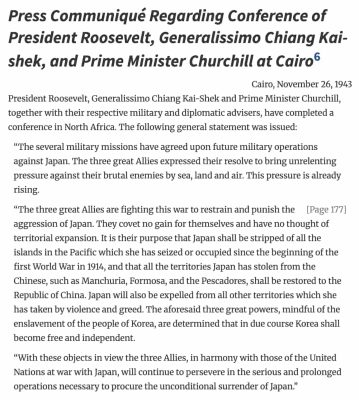
The official title of the 1943 document commonly referred to as the “Cairo Declaration” is actually the “Cairo Communiqué.” [🔗]
Void of Signatures: At the actual historical venue, not one of the three leaders—Roosevelt, Churchill, or Chiang—signed this document. It was merely a press release distributed to major newspapers by the secretariat after the conference.
Absent Congressional Ratification: In constitutional democracies like the US and the UK, any treaty involving territorial alterations must be submitted to the legislature (such as the US Senate) for formal ratification under constitutional processes. The Cairo Communiqué was never submitted to any parliament or congress; under domestic and international law, it belongs strictly to the category of “an executive expression of political intent at a diplomatic venue.”
In public international law, the lawful transfer of territorial sovereignty must adhere to the “Principle of Prior Chain of Title.” By virtue of the 1895 Treaty of Shimonoseki, Taiwan had already been legally and completely transferred from the Qing Empire to the Empire of Japan. Consequently, to alter the title deed of Taiwan, the only entity clothed with the dispositive authority to act upon this asset was the legitimate owner—Japan.
Defect of Dispositive Authority: At the time of the 1943 Cairo Conference, World War II was far from over. Yet, these three Allied leaders carved up and partitioned a property (Taiwan) that was still legally registered under the name of an absent owner (Japan) and heavily garrisoned by Japanese forces. Declaring that “Japan shall restore Taiwan to the ROC” constitutes a textbook case of Unauthorized Disposition. The actual asset holder, Japan, was completely absent from the table. This was a unilateral declaration by creditors. Because the debtor (Japan) neither consented nor signed, no transfer of title occurred. A press release issued by three external third parties possesses absolutely zero legal efficacy to transfer property.
Forensic Verdict on the Cairo Declaration: The Cairo Declaration is a press communiqué issued as a statement of political intent. It is neither a binding treaty nor a deed of title. In international law, a press release cannot transfer a single square inch of territorial sovereignty.
1943 年的《開羅宣言》其官方正式名稱叫作「開羅新聞公報」。
無人簽字:這份文件在當年的歷史現場,羅斯福、邱吉爾、蔣介石三個人都沒有在上面簽字。它只是事後由秘書處發給各大報社的一篇「新聞稿」。
未經國會批准:在民主國家(如美、英),涉及領土變更的條約必須送交國會(如美國參議院)依憲法程序批准。開羅新聞公報從未送交任何國會審議,它在法律上屬於「行政首長在外交場合的政治意向表達」。
在國際法中,領土主權的合法移轉,必須遵循「前手因果律」。台灣在 1895 年《馬關條約》中,已經由大清帝國合法「過戶」給日本帝國。因此,要變更台灣的產權,唯一能處分這筆資產的,只有業主本人——日本。
處分權瑕疵:1943 年開羅會議時,二戰還沒打完,三個同盟國領袖卻對著一塊當時還在日本合法名下、且被對方重兵防守的財產(台灣)進行分贓規劃,說「日本應將台灣歸還中華民國」,這在財產法上叫作「無權處分」,此時資產持有者日本根本不在場,這只是債權人的單方面宣告,債務人(日本)沒點頭、沒簽字,產權就沒有移轉。三個外人發的新聞稿,完全不具備轉移財產的法律效力。
《開羅宣言》司法鑑定結果:該宣言是為「意向聲明」而發出的新聞公報,不具法律效力更不是權狀,在國際法上,新聞公報無法移轉任何一寸領土的主權。
Can the Sovereignty of Taiwan Be Determined Based on the Potsdam Declaration?
可以依據《波茨坦宣言》決定台灣主權誰屬嗎?
In July 1945, Roosevelt, Churchill, and Chiang (with the Soviet Union joining later) convened in Potsdam, near Berlin, and proclaimed the Potsdam Declaration.[🔗] Article 8 of this document declared: “The terms of the Cairo Declaration shall be carried out and Japanese sovereignty shall be limited to the islands of Honshu, Hokkaido, Kyushu, Shikoku and such minor islands as we determine.”
The textbook syllogism peddled by both the KMT and CCP operates as follows: Since the Potsdam Declaration stated that the terms of the Cairo Declaration “shall be carried out,” and since Japan subsequently signed the Instrument of Surrender on September 2, 1945, accepting the Potsdam terms, the title to Taiwan must have automatically reverted to the ROC in 1945. And since the CCP defeated the ROC in 1949, Taiwan—having reverted to the ROC—automatically passed to the PRC.
Under the scrutiny of international treaty law, this deduction is completely hollow.
1945 年 7 月,羅斯福、邱吉爾、蔣介石在鄰近柏林的波茨坦召開會議,後來蘇聯也加入,並發表《波茨坦宣言》,其中第 8 條聲明:「《開羅宣言》之條件必將實施,而日本之主權必將限於本州、北海道、九州、四國及吾人所決定之其他小島之內。」
國共的教科書邏輯是:既然《波茨坦宣言》說「開羅新聞公報之條件必將實施」,而日本又在 1945 年 9 月 2 日簽署了《降伏文書》宣告接受《波茨坦宣言》,那麼台灣產權不就自動在 1945 年歸給中華民國了嗎!而既然 1949 年共產黨擊敗中華民國,歸給中華民國的台灣不就自動歸給中華人民共和國了嗎!
這套推論,在國際條約法的司法鑑定下依然是千瘡百孔。
The Forensic Assessment of the Potsdam Declaration: It Too Is Not a Treaty
《波茨坦宣言》的司法鑑定:它依然不是條約
Public international law maintains strict functional classifications for state documents. The Potsdam Declaration was, in its essence, an ultimatum and a unilateral listing of “military surrender terms.” At that precise moment, Japan had not yet formally capitulated. The opposing parties had not sat down to negotiate or execute a legally binding treaty of territorial cession.
If the Cairo Declaration was legally just an executive memorandum of intent, then the Potsdam Declaration’s clause asserting that the Cairo terms must be carried out amounts to nothing more than a “secondary restatement of political intent.” Photocopying or restating a non-binding promise does not automatically transmute it into a real estate deed. It remains a promise, regardless of how many times it is duplicated.
Furthermore, when the Allies and Japan eventually executed the ultimate settlement, the Chinese Communist Party was still sequestered in the loess caves of Yan’an, entirely detached from the legal theater.
在國際公法中,文件是有嚴格的功能分類的。《波茨坦宣言》在本質上是一份「最後通牒」與單方面開出「軍事投降條件」清單,此時日本甚至還沒正式投降,雙方根本還沒有坐下來簽署具有法律效力的領土讓渡條約。
《開羅宣言》在法律上只是董事長的「政治意向書」,《波茨坦宣言》說「開羅新聞公報的意向書條件必須實施」,在法理上它就只是「第二次重申政治意向」。你把一封沒有法律效力的承諾書複印、重抄了一遍,它依然只是一份承諾書,不會因為你抄了兩遍就突然自動升格為「土地所有權狀」。
再者,當盟軍與日本最終進行地緣產權的終極清算與條約簽署時,中國共產黨還在延安的黃土窯洞裡,與這場國際法理的博弈劇場完全脫節,根本毫無置喙之餘地。
The Assessment of the Instrument of Surrender: Armistice vs. Peace Treaty
《降伏文書》的效力鑑定:停戰協定 vs. 和平條約
On September 2, 1945, an 11-member Japanese delegation boarded the USS Missouri anchored in Tokyo Bay. During the capitulation ceremony, they signed the Instrument of Surrender,[🔗] formally conceding military defeat. The text referenced the Potsdam Declaration, which in turn referenced the Cairo Declaration.
The singular purpose of an Instrument of Surrender is capitulation. It states, in effect: “I surrender and cease military resistance; if the conditions you have laid out are codified into a future peace treaty, Japan promises to accept them.” It represents a commitment to submit unconditionally to the ultimate disposition arranged by the Allies.
The distortion engineered by the KMT-CCP historiography lies in their deliberate conflation of an Armistice/Surrender Agreement with a Peace Treaty under international law.
【THE EXECUTORY STAGE】
Instrument of Surrender (1945) ───► A military covenant: Terminates combat operations and secures a promise of future compliance.
【THE EXECUTED STAGE】
Treaty of San Francisco (1951) ───► A diplomatic covenant: Permanently alters boundaries and executes the final liquidation of title.
Forensic Legal Findings:
The Instrument of Surrender is Merely an Armistice: In international law, this is an instrument of a strictly military character. Its function is to terminate active hostilities and govern surrender protocols. The definitive, comprehensive liquidation of the war must be carried out via a formal peace treaty. When Japan declared in the Instrument of Surrender that it “accepts the provisions set forth in the declaration… at Potsdam,” it meant: “I agree to cease resistance, and I promise to surrender Taiwan in the future.” The formal legal alteration was held in abeyance until the 1951 peace settlement—the Treaty of San Francisco—where Japan formally signed the deed: “Japan renounces all right, title and claim to Formosa and the Pescadores.”
1945 年 9 月 2 日,日本投降代表團共 11 人登上了停泊在東京灣的美國軍艦密蘇里號,在受降儀式中簽署《降伏文書》,正式無條件投降。內容有提及《波茨坦宣言》,而《波茨坦宣言》內容有提及《開羅宣言》。
《降伏文書》的目的是投降,是表示「我投降停戰,你們提出的條件如果有寫在和平條約,日本願意接受。」意即日本會無條件接受同盟國最終處置安排。
國共史觀的歪曲,在於混淆了「停戰協定(Armistice/Surrender)」與「和平條約(Peace Treaty)」在國際法上的根本區別。
【執行中階段】
《降伏文書》(1945年)───► 軍事契約:終止軍事對抗,並確保前手對未來條約履行之承諾。
【已執行階段】
《舊金山和約》(1951年)───► 外交和約:永久變更國界,並完成領土產權之終極清算與過戶。
司法鑒定:
《降伏文書》只是「停戰協定」:這在國際法上屬於軍事性質的文件,它的作用是終結軍事戰鬥、規範受降程序,而戰爭真正的總清算將透過和平條約來進行。日本在《降伏文書》中寫道:「茲接受……波茨坦宣言內所載之條款」,這代表日本承諾:「我願意放棄對抗,並答應未來會交出台灣。」正式的法律變更,是等到 1951 年和平協議《舊金山和約》才進行,日本在《舊金山和約》正式簽字:「我今天正式在法律上登出、放棄台灣產權。」
The Distinction Between Executory and Executed States: The Instrument of Surrender represents the executory stage (the promise), whereas the ratification of the peace treaty represents the executed stage (the performance). Therefore, title to Taiwan did not transfer in 1945. Prior to the execution of a peace treaty, the state of war does not legally conclude, and occupied lands retain the legal status of “Military Occupation” under international law.
Custody Under General Order No. 1: This explains why, when the military forces of the ROC Nationalist Government entered Taiwan in 1945, they did so pursuant to General Order No. 1 issued by Supreme Commander for the Allied Powers, Douglas MacArthur. The order commanded Chiang Kai-shek’s forces to proceed to Taiwan solely to “accept the surrender of the Japanese forces.”
Trusteeship Is Not Ownership: Chiang Kai-shek was acting under a mandate from the Allied Supreme Commander, representing the entirety of the Allied Powers to enforce a “military trusteeship” over Taiwan. The title deed to Taiwan did not magically transfer to Chiang in 1945; it was held in trust, awaiting a final peace treaty.
「執行中狀態」與「權利已確立」之區別:《降伏文書》屬於承諾階段,簽署和平協議才是執行終局階段。所以台灣的產權並未在 1945 年移轉,在和平條約簽署之前,戰爭狀態在法理上尚未結束,被占領的領土在國際法上屬於「軍事占領」。
盟軍發布《一般命令第一號》:這就是為什麼 1945 年中華民國(國民政府)軍隊進駐台灣時,是由麥克阿瑟將軍發布《一般命令第一號》(General Order No. 1),命令蔣介石的軍隊前去台灣「接受日軍投降」。
代管絕非擁有:蔣介石是奉盟軍總司令之命,代表「全體同盟國」去台灣執行「軍事代管」,台灣的產權並未在 1945 年歸給蔣介石,而是有待和平協議再說。
Final Adjudication Overrides: The Peace Treaty Extinguishes Wartime Declarations
終局裁決覆蓋:和平協議讓任何戰時宣言徹底無效
Even if we indulge the groundless claims of the KMT and CCP and treat wartime press releases like Cairo and Potsdam as “treaties,” they are instantly defeated by a foundational canon of international treaty law: “Lex Posterior Derogat Priori” (the later law supersedes the earlier law).
就算我們退一萬步說,讓國共兩黨把《開羅宣言》、《波茨坦宣言》新聞稿硬拗成「條約」,在國際條約法中,還有一個鐵律:「後法優於前法」。
Regardless of what you loudly broadcasted in a 1943 press release regarding the future recipient of an asset, when all interested sovereigns finally sit down in 1951 to sign the definitive Peace Treaty that formally concludes the war, everything is superseded and governed by that latest, highest-ranking instrument. If this were not the case, the negotiation of a peace treaty would be an exercise in legal redundancy.
不論你 1943 年在新聞稿裡聲稱產權以後要送給誰,到了 1951 年,當大家正式坐下來簽署終結戰爭的最終「和平條約」時,一切都要以最新、位階最高的和平條約為準,否則何必協調「和平條約」?
Let us examine the supreme legal evidence: Article 1 of the Treaty of San Francisco explicitly declares: “The state of war between Japan and each of the Allied Powers is terminated.” This single sentence signifies that all prior wartime press communiqués, memoranda, and military orders were legally purged and overridden by this final accord.
讓我們來檢視這份終極的和平條約鐵證,日本簽署的《舊金山和約》第一條就明文宣告:「日本與各同盟國之間的戰爭狀態正式結束」,這代表過去所有戰時的新聞公報、備忘錄、軍事命令,在法理上通通被這份終局條約「清理並覆蓋」。
The Treaty of San Francisco was formally signed by forty-eight victorious Allied nations and the defeated nation, Japan, through their plenipotentiary representatives. It was subsequently ratified by the US Senate, the National Diet of Japan, and the legislatures of over forty other nations. Its procedural integrity is flawless and unassailable.
《舊金山和約》由 48 個戰勝國同盟國與戰敗國日本,白紙黑字由各國全權代表正式簽署簽署後,並送回美國參議院、日本國會以及其餘四十多個國家的立法機關正式批准,程序完備合法無可挑剔。
Even if one unilaterally insisted that the political commitments made in the 1943 Cairo press release remained valid, they were completely extinguished and eclipsed by the Treaty of San Francisco. To state it plainly: The 1943 Cairo Declaration was merely an expression of intent recorded at a board meeting; the 1951 Treaty of San Francisco was the final, executed contract signed with the property owner (Japan).
就算要單方面堅持 1943 年那份《開羅宣言》新聞公報裡的政治承諾有效,在此時也會被《舊金山和約》徹底覆蓋、失效。再說一次:1943 年的《開羅宣言》只是一次董事會上的意向,1951 年的《舊金山和約》才是與當事人日本白紙黑字的終局契約。
Furthermore, Article 8 of the 1945 Potsdam Declaration stated that Japanese sovereignty would be restricted to its four main islands and “such minor islands as we determine.” This phrasing explicitly dictated that the ultimate fate of territories previously ceded by the Qing Empire, such as Taiwan and Penghu, was left to a future, definitive adjudication by the Allies. The Treaty of San Francisco was precisely that final adjudication.
何況 1945 年的《波茨坦宣言》第八條也寫得很清楚:日本主權必將限於四個大島,以及「吾人所決定之其他小島之內」。這意味著,台灣、澎湖這些被大清割讓出去的島嶼命運,有待「同盟國未來做出終局裁決」,而《舊金山和約》就是那個終局裁決。
The Supreme Treaty of San Francisco Confirms: Taiwan Does Not Belong to Any China
最高位階的《舊金山和約》確定:台灣不屬於任何中國
At the final venue where the title deeds were settled, the Allied powers made a deliberate choice: Japan renounces Taiwan, and the space for the new owner is left blank. Even with the sovereignty of Taiwan left unassigned, the legal effect remains absolute: Taiwan was completely “de-Japanized” while its sovereign status was “frozen in abeyance.”
雖然在最終的權狀移轉現場,同盟國做出了決定「日本放棄台灣,權狀保持空白」,但即便台灣的主權保持空白,在法理上依然有效:台灣被徹底「去日本化」並「凍結地位」。
Crucially, within the text of the Treaty of San Francisco—the sole instrument with the international legal authority to determine the fate of Taiwan’s sovereignty—Taiwan was neither transferred to the Republic of China nor to the People’s Republic of China. The ambitions of both Chinas to legally acquire Taiwan failed completely.
最重要的是,在攸關台灣主權誰屬的《舊金山和約》中,既沒有把台灣移交給中華民國,也沒有移交給中華人民共和國,兩個中國爭取台灣的企圖至此都宣告徹底失敗。
The forensic legal analysis is unequivocal: the Cairo Declaration, the Potsdam Declaration, and the Instrument of Surrender possess zero legal authority regarding the transfer of Taiwan’s sovereignty. This was not a “fatal three-punch combination” delivered by the two Chinas; rather, it was a case of three wooden wartime rafts completely incinerated by the legal fire of the Treaty of San Francisco.
司法鑒定的結果很斬截,《開羅宣言》、《波茨坦宣言》、《降伏文書》對台灣的主權歸屬一點法理性也沒有,這不是「連環拳、三擊斃命」,而是三艘連環船被《舊金山和約》的法理之火一把燒光。
The Absurdity of the Greater China Ideological Narrative
中國意識形態史觀之荒謬
Furthermore, if the CCP wishes to elevate a joint press communiqué issued by a handful of nations to the status of binding international law, are they prepared to concede that whatever the US and UK say at a press conference constitutes indisputable international truth and legal reality? It is worth noting that both the US and the UK formally protested when the Nationalist government unilaterally declared Taiwan a province of the ROC following the war.
更何況,中共如果要將某幾國的聯合新聞公報,位階抬高到法理的程度,那是否等於中共肯認當時的美國、英國只要開記者會說了什麼,就成為無可置疑的國際真理與法理依據?那麼就必須指出,當時美國與英國對於國民政府單方面將台灣設為中華民國一省,可是提出嚴厲抗議的。
Similarly, if an Instrument of Surrender possessed the power to automatically transfer sovereignty, then every piece of Axis territory occupied by Allied forces after World War II would have automatically and legally become the sovereign property of the United States. Does any state operate under such a standard?
再說,如果降伏文書能轉移主權,二戰後所有被盟軍佔領的軸心國土地主權不就通通自動歸於美國?
Both the KMT and the CCP hold fast to a 1945 demand letter—the Potsdam Declaration—in their textbooks, screaming, ‘This house already belongs to me!’ Yet, they willfully conceal from their people the finalized property title liquidation issued by the court’s notary office in 1951: the Treaty of San Francisco. In the realm of geopolitical forensics, this is a textbook case of narrative manipulation and title forgery.
國共兩黨各自在教科書裡抱著 1945 年的律師函(波茨坦宣言)大喊「房子已經是我的了」,卻完全不敢讓人民看到 1951 年法院公證處發出的正式清算產權書(舊金山和約),這正是地緣政治上教科書級的偽造產權範例。
Chapter 3: The Republic of China Never Recovered the Sovereignty of Taiwan; It Merely Exercised Military Trusteeship on Behalf of the Allied Powers
第三章 中華民國沒有光復台灣主權 只是為盟軍軍事代管台灣
Before we place General Order No. 1, issued by the Supreme Commander for the Allied Powers, onto the forensic examination table, we must first reconstruct the deeply tragic psychological and historical milieu of Taiwan in the autumn of 1945.
在我們正式將同盟國最高統帥發布的《一般命令第一號》(General Order No. 1)送上司法鑑定台之前,必須先還原 1945 那年秋天,發生在台灣的那段極具悲劇色彩的心理時空。
In August 1945, following the deployment of two atomic bombs by the United States on the Japanese mainland, Japan surrendered, bringing World War II to a close. As Emperor Showa broadcasted the unconditional surrender through the Gyokuon Hōsō (Jewel Voice Broadcast), Taiwanese people were transformed overnight from “second-class subjects of the Japanese Empire” into “second-class subjects of a defeated nation.”
1945 年 8 月,美國在日本本土投下兩顆原子彈,日本投降,二戰結束。隨著昭和天皇在「玉音放送」中宣告無條件投降,台灣人在一夜之間,從日本帝國的「二等臣民」,變成了「戰敗國的二等臣民」。
Faced with the utter devastation left by relentless Allied bombings and the looming dread of postwar retribution, a Taiwanese society desperate for peace underwent a desperate shift in identity to secure safe harbor—a phenomenon best described as a “psychological regression to find kinship.” This was a period characterized by a collective blind spot, born out of a total vacuum of historical information and acute identity anxiety.
面對盟軍無情轟炸後留下的滿目瘡痍,以及對戰後清算步步逼近的集體恐懼,當時極度渴望和平的台灣社會,為了尋求避風港,在身分認同上經歷了一場絕望的轉向——這種現象可被形容為一種「為了尋求親情認同的集體心理退化」,那是一個在歷史資訊完全真空、急性身分焦慮之下,所共同形塑出的集體失明心理。
Fifty years of political oppression as second-class citizens under the Japanese colonial apparatus, coupled with the forced erasure of their Sinitic cultural lineage during the wartime Kōminka (Imperialization) movement, had led many Taiwanese to privately romanticize China as the “Fatherland.” Due to the psychological law that distance breeds enchantment, and ignorance fosters veneration, the Taiwanese imagined the Republic of China (ROC)—under the leadership of Generalissimo Chiang Kai-shek—to be one of the “Five Great Powers” that had valiantly vanquished the Japanese Empire. To them, it was the “Heroic Fatherland” that had birthed their cultural heritage.
在日本殖民體制下承受 50 年的「二等公民」政治壓迫,又在戰爭末期被強迫抹去漢文化血脈,讓不少台灣人私下將中國視為「祖國」。因為距離產生美感,因為無知而產生崇拜,在當時的台灣人想像中,中華民國是在蔣介石將軍領導下擊敗日本帝國的「世界五大強國」之一,是孕育文化母體的「英雄祖國」。
Furthermore, severed from global communications by eight years of strict Japanese wartime censorship, the Taiwanese were completely oblivious to the reality across the strait: that China’s economy had thoroughly collapsed, hyperinflation was rampant, and its society was fractured and destitute.
更嚴重的是,被日本新聞管制切斷世界資訊長達 8 年的情況下,台灣人當時完全不知道對岸的中國經濟早已全面崩潰、通貨膨脹泛濫、社會滿目瘡痍。
Furthermore, under Japanese colonial rule, Taiwan’s indigenous elites—doctors, lawyers, and landlords—faced a rigid political glass ceiling that barred them from the inner sanctum of the Government-General’s decision-making power. For decades, they fought within the system for equal autonomy, only to be forcibly subjected to an identity-erasing Kominka (Japanization) movement in the final years of the war.
而且在日本統治時期,台灣本土菁英(醫生、律師、地主)在政治上受到了嚴重的玻璃天花板限制,無法進入總督府的核心權力決策圈。他們在體制內爭取「平等的自治權」,卻在戰爭末期被強推入「抹殺主體性的皇民化」。
Trapped in this highly suffocating deadlock, they ultimately made a fatal projection in 1945, mistaking the Republic of China’s takeover as the ultimate fulfillment of their political ideals: they believed that by merely proclaiming themselves ‘Chinese,’ they could instantly emancipate themselves from the humiliation of ‘Japanization’; and that by actively facilitating the ROC government’s takeover and displaying fervent patriotic zeal, they could finally realize their long-sought ideal of ‘Taiwanese autonomy’ within a future ‘Taiwan Provincial Government’ framework.
這種高度壓抑的夾縫困境,最終導致他們在 1945 年將中華民國的接收,錯誤投射為政治理想的終極出路:以為只要宣稱自己是「中國人」,就能從「皇民化」的屈辱中解脫;如果積極協助中華民國政府接收台灣、展現強烈的「愛國」熱忱,那麼在未來的「台灣省政府」架構下,他們就能實現「台灣自治」的政治理想。
Driven by these illusions, numerous Taiwanese gentry took the lead in establishing “Committees to Welcome the National Government,” organizing Mandarin language institutes and teaching the ROC national anthem across the island. Sponsored by local elites, this fervor of “joyfully welcoming the Fatherland” swept through the entirety of Taiwanese society.
帶著這樣的幻想,許多台灣士紳紛紛帶頭成立「歡迎國民政府籌備會」,在全台各地開辦「華語講習班」、教唱中華民國國歌。在本土菁英的帶頭下,「喜迎祖國」的狂熱被推向整個台灣社會。
In mid-October 1945, the Port of Keelung was ablaze with lanterns and festive decorations. Tens of thousands of Taiwanese gathered in their finest holiday attire, waving hastily homemade Blue Sky, White Sun, and Wholly Red flags. To the thunderous beat of gongs and drums, they surged toward the piers, eager to extend a grand, triumphant welcome to the ‘Motherland’ that had finally defeated Japan.
1945 年 10 月中,基隆港張燈結綵,聚集了成千上萬的台灣民眾穿著節日的盛裝,揮舞著臨時趕製的青天白日滿地紅旗幟,敲鑼打鼓、湧向碼頭,他們要歡迎終於擊敗日本的「祖國」。
They craned their necks, fixing near-fanatical gazes upon the horizon, prepared to welcome the ‘Nationalist Army of the Motherland’ with the highest echelon of enthusiasm. At this pivotal moment, they were utterly oblivious that they were destined to become an over-extracted rear base, bled dry by the KMT to bankroll the Chinese Civil War. Nor could they possibly foresee that the 40,000 Old Taiwan Dollars they held in the bank would, overnight, be brutally liquidated into a single New Taiwan Dollar.
他們伸長脖子,用近乎狂熱的眼神注視著海平線,準備用最高規格的熱情歡迎「祖國軍」。此時的他們渾然不知,台灣將成為國民黨超額榨取、以支援中國內戰的後方基地。也不可能預先知曉,他們此刻存在銀行裡的 4 萬元台幣,日後會在一夜之間變成新台幣 1 元。
As the first U.S. warship drifted slowly against the pier, the troops setting foot on Taiwanese soil were anything but the formidable, majestic lions of a great power the locals had envisioned. Instead, they were greeted by a procession of gaunt, hollow-faced KMT soldiers—balancing shoulder poles, clad in straw sandals, and clutching cooking pots on their backs. Their shambolic discipline and demeanor left a Taiwanese society, thoroughly baptized by modernization, utterly dumbfounded.
當第一艘美軍軍艦緩緩靠岸,踏上台灣土地的,不是他們想像中威武雄壯的「強國雄師」,而是一群面容枯槁、挑著扁擔、甚至穿著草鞋、背著煮飯鍋,紀律與儀態都令受過現代化洗禮的台灣人瞠目結舌的國民黨士兵。
This was a exhausted force plagued by broken discipline, high illiteracy, and a total absence of rudimentary modern hygiene.
這是一支紀律渙散、文盲率高、毫無現代衛生觀念的疲憊之師。
For the Taiwanese, who possessed zero real understanding of contemporary China and who had sought only to leap from the humiliation of the vanquished to the pride of the victor, it was already too late to pivot toward an independent statehood.
對當時的中國毫無認識的台灣人,想要從屈辱的戰敗國民一躍成為驕傲戰勝國民的台灣人,此時要再追求獨立建國,已經來不及。
Within the span of a single year, the popular idiom describing the transition became “The dogs have left, and the pigs have arrived.” Military and police lawlessness ran unchecked; bureaucratic corruption became systemic; local rice and coal reserves were requisitioned at depressed prices to be sold for windfall profits in Shanghai; hyperinflation ravaged the island; and cholera and smallpox—diseases previously eradicated under Japanese administration—returned to plague the population.
隨後短短一年多內,「狗去豬來」的軍警橫行、官僚貪腐、稻米與煤礦被低收高賣到上海去、全島惡性通膨,原本在台灣絕跡的霍亂與天花又重新肆虐。
In their utter bewilderment, the Taiwanese could not have known that the textbooks later co-authored by the Kuomintang and the Chinese Communist Party would deliberately freeze the frame at that singular second on the Keelung docks—capturing only the moment they waved those flags—and permanently codify it as “Taiwanese Rejoicing in Retrocession,” distorting it into historical “proof” that the Taiwanese people had voluntarily and irrevocably surrendered their sovereignty to China for generations to come.
台灣人當時也不知道,之後國民黨與共產黨寫的教科書,將聯手把他們在 1945 年基隆港碼頭上揮舞旗幟的那一秒定格,定義為「台灣人喜迎光復」,並扭曲成「台灣人世世代代自願歸順中國的證據」。
This catastrophic disillusionment—which began with celebratory lanterns and ended in the bloodbath of the 228 Purge—had a distinct legal trigger. It was contained entirely within a document tucked inside the pocket of the commanding general leading those soldiers with shoulder poles: a military mandate issued by the Allied Powers.
而這場從「張燈結綵」走向「二二八大清洗」的徹底幻滅,其最初的法理導火線,正是帶領那群挑著扁擔士兵的將軍,口袋裡的一份來自美軍的「軍事委託書」。
Let us now turn the forensic spotlight onto this piece of historical evidence. We shall anatomize the document that brought Chiang Kai-shek’s forces to Taiwan, an instrument that both the CCP and the KMT have systematically misrepresented as a “deed of sovereignty transfer”—General Order No. 1.
接著,就讓我們打開司法鑑識的聚光燈,徹底解剖這份將蔣介石軍隊送上台灣、卻被國共兩黨嚴重歪曲為「主權轉移證書」的歷史鐵證——《一般命令第一號》。
The Allied Powers Mandated Chiang Kai-shek to Administer Taiwan: General Order No. 1 of General MacArthur
盟軍授權蔣介石代管台灣:麥克阿瑟將軍一般命令第一號
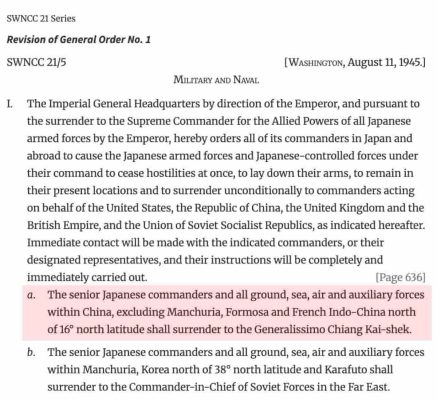
Following Japan’s capitulation on August 15, 1945, General Douglas MacArthur, the Supreme Commander for the Allied Powers (SCAP), issued the historic General Order No. 1 [🔗] on September 2, 1945. Regarding the China, Taiwan, and Vietnam theaters, the directive explicitly decreed: “The senior Japanese commanders and all ground, sea, air and auxiliary forces within China (excluding Manchuria), Formosa and French Indo-China north of 16 degrees north latitude, shall surrender to Generalissimo Chiang Kai-shek.”
Despite this explicit language, the Chiang Kai-shek regime unilaterally proclaimed the “Retrocession of Taiwan and its restoration as a province of China.” In 1946, the regime went further, issuing a decree arbitrarily declaring October 25, 1945, as the date on which the Taiwanese populace “restored” their Chinese nationality—compulsorily altering the nationality of all Taiwanese citizens from Japanese to Chinese.
1945 年 8 月 15 日日本投降,同年 9 月 2 日,盟軍最高統帥麥克阿瑟將軍發布了著名的《一般命令第一號》(General Order No. 1)。這份命令關於中國戰區、台灣戰區、越南戰區是這麼說的:「在中國(滿洲除外)、台灣、及北緯十六度以北法屬印度支那(越南)境內之日軍高級指揮官及所有陸海空軍及輔助部隊,應向蔣介石將軍投降。」
但蔣介石政權卻隨即單方面宣布「台灣光復、恢復為中國一省」,並於 1946 年發布命令,逕自公告將 1945 年 10 月 25 日定為台灣民眾「回復中國」國籍之日,強制將所有台灣民眾的國籍由日本籍變更為中國籍。
Forensic Legal Assessment:
In public international law, “military occupation” and the “transfer of sovereignty” are two fundamentally distinct legal concepts. On October 25, 1945, when the military forces of Chiang Kai-shek’s Nationalist Government accepted the Japanese surrender at the Taipei City Public Hall, the precise legal characterization of this event was as follows: Chiang’s forces were acting strictly under the appointment of General Order No. 1, issued by SCAP, to accept the military surrender of Japanese forces and execute a temporary “military trusteeship/occupation” of Taiwan.
The issuing authority of General Order No. 1 was General MacArthur, representing the entirety of the Allied Powers. When Chiang Kai-shek dispatched troops to the Taipei City Public Hall to accept the surrender of Rikichi Andō, the Japanese Governor-General of Taiwan, his legal status was strictly that of a “trustee.” Chiang’s army entered Taiwan on behalf of the Allied Powers; under international law, this is designated as a mandated military occupation.
In official Allied legal instruments, “Formosa (Taiwan)” was listed parallel to, and separate from, “China” and “French Indo-China.” Had Taiwan been recognized as de jure Chinese territory at that time, the Allied Powers would have merely decreed that “Japanese forces within China shall surrender to Chiang Kai-shek.” There would have been absolutely no legal necessity to list Formosa as a distinct geographical entity. This parallel listing directly confirms that in 1945, the Allied Powers viewed Taiwan as a separate legal entity whose sovereign status remained distinct from China, awaiting final determination in a subsequent peace treaty.
The legitimacy of all actions undertaken by Chiang’s forces upon entering Taiwan—changing the locks, posting new nameplates, and disarming the Japanese military—derived exclusively from this Allied mandate. This was an administrative act of trusteeship. The Allied Powers never, under any circumstances, transferred or conveyed the “Title (Sovereignty)” of Taiwan to the Republic of China within General Order No. 1.
The Scope of Administrative Jurisdiction: The authority exercised by the Nationalist Government over Taiwan at this juncture was strictly “administrative jurisdiction” granted to an occupying force under the laws of war. This was a temporary, custodial power designed solely to maintain public order and effectuate demobilization. Legal sovereignty remained vested in the prior owner—Japan—until a formal peace treaty could be executed.
司法鑑識:
在國際法中,「軍事佔領」與「主權移轉」是兩個完全不同的法律概念。1945 年 10 月 25 日,蔣介石的國民政府軍隊在台北公會堂接受日本投降,這在法理上的定性是:蔣介石部隊是奉「盟軍最高統帥」麥克阿瑟將軍的《一般命令第一號》的指派,前往台灣接受日軍投降並執行「軍事代管/佔領」。
《一般命令第一號》的主體發布者是同盟國最高統帥麥克阿瑟。蔣介石之所以能派兵到台北公會堂接受日本台灣總督安藤利吉的投降,他的法理身分是「受託人」,蔣介石的軍隊是奉「全體同盟國」的命令前去台灣,在國際法上,這叫作受託軍事佔領(Military Occupation)。
在盟軍的法律公文中,台灣(Formosa)是與「中國(China)」、以及「法屬印度支那(越南)」並列出現。如果台灣當時在法理上屬於中國,盟軍只需寫「中國境內之日軍向蔣介石投降」即可,根本不需要特地把台灣獨立羅列出來。這個並列,在國際法上直接證實了:同盟國在 1945 年,將台灣視為一個與中國主權分離、地位有待後續和平條約確認的獨立法律實體。
蔣介石部隊進入台灣,換鎖、貼名牌、收繳日軍武器,這一切行為的正當性完全來自盟軍的授權。這是一個代管的法律行為,盟軍從未在《一般命令第一號》中將台灣的「主權(Title)」轉讓或過戶給中華民國。
治權的範疇:此時國民政府在台灣擁有的,是戰時法授予佔領軍的「行政管轄權」。這是一種臨時性的、代管性質的權力,目的是維持社會秩序、解除日軍武裝。主權依然保留在前業主(日本)手中,直到和平條約簽署為止。
Forensic Verdict:
The Chiang Kai-shek regime’s unilateral declaration of the “Retrocession of Taiwan” and its attempt to unilaterally register Taiwan’s sovereignty under the Republic of China constitutes, under international treaty law, a classic case of “a property manager fraudulently altering the title deed.” It stands as a unilateral, legally void assertion; at that historical moment, the sovereignty of Taiwan remained legally vested in Japan.
This explains why the two principal stakeholders of the Allied Powers—the United States and the United Kingdom—immediately dispatched formal diplomatic notes of protest to the Nationalist Government, declaring that the Republic of China had no legal authority to unilaterally alter the sovereignty of Taiwan prior to the signing of a formal peace treaty.
The rationale behind the Anglo-American refusal to recognize the transfer was clear: the asset inventory of the Qing Empire had completely ceased to include Taiwan following its lawful cession to Japan via the 1895 Treaty of Shimonoseki. The Republic of China did not inherit Taiwan, and the Chiang government, acting merely as an administrative manager for the Allies, possessed no legal authority to alter Taiwan’s sovereignty.
Under public international law, the period between Japan’s surrender in 1945 (when the Allies assumed trusteeship) and the signing of the Treaty of San Francisco in 1951 is legally defined as “Japanese territory under Allied military occupation.” According to the foundational international law doctrine that “occupation does not transfer sovereignty,” the occupied state retains legal title over the territory until a peace treaty is finalized; the occupying power enjoys only de facto administrative control.
【THE PROPERTY LAW ANALOGY】
The Allied Powers (The Condominium Board / Owner’s Assembly)
└──► Appoints Chiang Kai-shek’s Forces (The Security Guard / Property Manager)
└──► To secure a foreclosed mansion: “Taiwan”
鑑識結論:
蔣介石政權單方面宣布「台灣光復、恢復為中國一省」,將台灣主權片面登記在中華民國之下,這在國際條約法上完全屬於「物業經理人私自變造產權登記」的單方面無效主張,此時的台灣主權仍在日本。
這也是為什麼當時盟軍的兩大核心股東——美國與英國,當時立即發出外交照會提出嚴厲抗議,指出在正式和約簽署前,國府無權單方面變更台灣主權。
英美拒絕承認的理由很清楚,大清帝國的資產總清冊早在 1895 年《馬關條約》將台灣合法割讓給日本後,就徹底不包含台灣,中華民國並沒有繼承台灣,而為盟軍代管台灣的蔣政府,也沒有更動台灣主權的權利。
根據國際公法,從 1945 年日本投降,台灣由盟軍代管,到 1951 年簽署《舊金山和約》之間的這段期間,狀態叫作「盟軍軍事佔領下的日本領土」。根據國際法的「佔領不轉移主權」原則,在和平條約簽署之前,被佔領國對該領土仍保有法律上的主權,佔領國僅享有實質的統治權。
【產權法學類比】
盟軍(社區管理委員會/區分所有權人大會)
└──► 指派蔣介石部隊(大樓保全/物業經理)
└──► 前去接管一棟被法院強制執行的豪宅:「台灣」
To use a property analogy: the Allied Powers (the condominium board or owners’ assembly) appointed Chiang Kai-shek’s forces (the security guard or property manager) to take custody of a foreclosed mansion (Taiwan). The manager moved into the mansion, changed the locks, and even affixed his own nameplate to the front gate (renaming it “Taiwan Province”). However, the deed to the mansion remained registered under the name of the prior owner (Japan). The manager’s presence, mandated by the Allies, did not cause the title deed to automatically transfer to him.
The prior owner’s (Japan’s) title had not been deregistered in 1945. Yet, the temporary property manager (the Nationalist Government) unilaterally declared the collective restoration of Chinese nationality for Taiwanese citizens and the transfer of sovereignty the following year (1946). In international law, this represents an unauthorized disposition and a forced, illegal transfer of title.
Because Japan retained sovereignty over Taiwan between 1945 and 1951, internal classified memoranda within both the Nationalist and U.S. governments acknowledged this reality with absolute clarity. Supreme evidence of this is found in a confidential cable dispatched by Chiang Kai-shek on January 12, 1949, to Chen Cheng, then-Chairman of the Taiwan Provincial Government. The message confirms that Chiang was fully aware that “the Nationalist Government was merely an administrator, and Taiwan remained Japanese territory.” We submit this historical evidence directly:
Chiang Kai-shek reprimanded Chen Cheng in the telegram, stating: “The legal status and sovereignty of Taiwan, prior to the conclusion of a peace treaty with Japan, is merely that of a mandated territory under our trusteeship. The Taiwanese government is by no means a formal government of our nation.”
以比喻來說,就是盟軍(可理解為管委會或業主大會)指派蔣介石部隊(可理解為保全或物業管理員)去接管一棟被強制執行沒收的豪宅(台灣)。管理員進駐了豪宅、換了鎖、甚至在大門口貼上自己的名牌(自己改名為「台灣省」),但豪宅的產權依然在前業主(日本)的名下,管理員受盟軍指派進駐豪宅,並不等於產權會自動過戶給管理員。
前任業主(日本)的產權在 1945 年並未登出,前來代管的物業管理員(國府)卻在隔年(1946 年)片面宣布台灣人集體恢復中國國籍、宣布台灣主權已移轉,這在國際法上是一次「無權處分」的強行非法過戶。
正因為 1945 到 1951 年間日本對台灣仍有主權,當時的國民政府與美國政府在內部的機密公文中呈現得非常明白,證據之一是 1949 年 1 月 12 日,蔣介石在給「台灣省主席」陳誠的機密電報中,證實他非常清楚「國府只是代管,台灣仍是日本領土」,我們直接呈上這份歷史證據:
蔣介石在電報裡訓斥陳誠:「台灣法律地位與主權,在對日和會未成以前,不過為我國一託管地帶性質,台灣政府更非我國之正式政府。」
The “1945 Retrocession of Taiwan,” which both the KMT and CCP routinely employ as the foundational myth of their legitimacy, is stripped of its fabrications when placed against the unassailable evidence of General Order No. 1. Declassified imperial archives confirm that Chiang Kai-shek was fully aware that no lawful transfer of sovereignty had occurred, but rather a military trusteeship undertaken by order of the Allies. The “Taiwan Sovereignty Deed” fabricated by Great China historiography is nothing more than a self-referential political lie, entirely void of legal effect.
Furthermore, if the CCP and its aligned media insist upon the logic that “whichever force accepts the surrender of an army automatically acquires sovereignty over that land,” then by this bizarre reasoning, the sovereignty of North Korea and Northeast China (Manchuria)—where Japanese forces surrendered to the Soviet army under Allied command—would have automatically reverted to the Soviet Union. Under such a double standard, the establishment of the PRC in Northeast China and the founding of North Korea would both constitute unlawful infringements upon Soviet sovereignty. Before the text of General Order No. 1, this legal hypocrisy instantly collapses into bankruptcy.
國共兩黨天天拿來當作統治合法性基石的「1945年台灣光復」,在《一般命令第一號》這份鐵證面前,被還原了其地緣產權的真實位階,解密的蔣介石機密公文也證實他完全清楚:那不是主權的合法移轉,而是一場奉盟軍之命的軍事代管。大中國編織的「光復台灣權狀」,只是一場自說自話的政治謊言,無效。
而如果中共與統媒主張「日軍向誰投降,那塊土地的主權就自動歸誰」。那麼依此神仙邏輯,北韓與中國東北的主權奉盟軍統帥之命是向蘇聯投降的,那不就自動屬於蘇聯了?中共在東北,以及北韓的建國,豈不都成了侵犯蘇聯主權的非法行為?這種雙重標準的法理錯亂,在《一般命令第一號》面前一樣當場破產。
Chapter 4: The Outbreak of the Korean War in 1950 and the U.S. Anti-Communist Firewall: The Undetermined Status of Taiwan
第四章 1950 年韓戰爆發 美國為台灣設立抗共防火牆:台灣地位未定
In 1949, the Republic of China (ROC) government collapsed entirely in the Chinese Civil War. This entity, which had functioned as the “Allied administrative trustee,” lost its foundational territory (mainland China) and fled to the very island it was merely administering. In doing so, it morphed into a classic case of a “government-in-exile.” To anchor his regime in Taiwan, Chiang Kai-shek desperately sought to forge this temporary “administrative trusteeship” into permanent “right of ownership.” However, the outbreak of the Korean War thoroughly ignited the cold realism of Cold War geopolitics.
1949 年,國民政府在中國內戰中徹底潰敗。這個原本的「盟軍代管法人」在失去了母體領土(中國大陸)後,流亡到了它正在代管的台灣,形成歷史上罕見的「流亡政府」。蔣介石為了在台灣站穩腳跟,瘋狂地想將「代管權」強行變造為「所有權」。然而,韓戰的爆發徹底激發了冷戰的現實主義制衡。
Prior to the Korean War, U.S. President Harry S. Truman had issued a statement in January 1950 declaring a policy of non-intervention in the Taiwan Strait and the Chinese Civil War. At the time, the Washington establishment was profoundly disaffected by the rampant corruption of the “Chiang-Soong-Kung” oligarchic cliques, viewing continued financial subsidization of the Chiang regime to combat the Chinese Communists as an exercise in futility. Furthermore, Washington feared that American intervention in China’s civil strife would drive Beijing completely into the embrace of the Soviet Union, precipitating a monolith of Communist expansion.
原本在韓戰爆發前,美國總統杜魯門於 1950 年 1 月發表「不介入台灣海峽爭端、不介入中國內戰」的聲明,當時美國政府對「蔣宋孔」家族的貪腐非常不滿,認為繼續資助蔣政權打擊中國共產黨只是浪費。同時也顧忌,如果美國介入中國內戰,會讓中共進一步倒向蘇聯、合流共產勢力。
However, the outbreak of the Korean War in June 1950 and the subsequent entry of the Chinese Communist forces shattered these calculations. Beijing’s total strategic alignment with Moscow dismantled the U.S. defense posture that had previously excluded Taiwan and South Korea from its Pacific security perimeter. Gazing at the map, General Douglas MacArthur, the legendary World War II commander, defined Taiwan’s strategic value to the free world for the first time, branding it an “unsinkable aircraft carrier.” Should this strategic hub fall into Communist hands, MacArthur warned, it would serve as a “launchpad for authoritarian expansion.”
但 1950 年韓戰爆發,中國共產黨參戰,北京在戰略上全面倒向莫斯科,打破了美國原本將台灣與韓國排除在太平洋防衛圈之外的設想。美國二戰名將麥克阿瑟將軍凝視著地圖,首次為台灣在自由世界的戰略位置定調——「不沉的航空母艦」,台灣若落入共產黨手中,這座戰略樞紐將成為「威權擴張的跳板」。
President Truman immediately ordered the U.S. Seventh Fleet to neutralize the Taiwan Strait. To render this military deployment “legally unassailable” and neutralize international accusations of interfering in China’s domestic affairs, Truman delivered his historic declaration on June 27, 1950, formally establishing the “Undetermined Status of Taiwan”[🔗] as a geopolitical firewall of the Cold War:
“The occupation of Formosa by Communist forces would be a direct threat to the security of the Pacific area and to United States forces performing their lawful and necessary functions in that area. Accordingly, I have ordered the Seventh Fleet to prevent any attack on Formosa… The determination of the future status of Formosa must await the restoration of security in the Pacific, a peace settlement with Japan, or consideration by the United Nations.”
杜魯門立刻下令第七艦隊協防台灣海峽。為了讓美軍開進台灣海峽「名正言順」,不被國際社會質疑是「干涉中國內戰」,杜魯門在 1950 年 6 月 27 日發表了著名的《台灣地位未定論》宣言,正式將「台灣地位未定論」確立為冷戰的地緣防線:
「台灣若遭共產黨軍隊佔領,將直接威脅太平洋地區的安全及在該地區執行合法與必要職務的盟軍。因此,我已命令第七艦隊阻止對台灣的任何進攻……至於台灣未來的地位,必須等待太平洋安全的恢復、對日和平條約的簽訂、或經由聯合國的考慮。」
The legal subtext of Washington’s declaration was absolute: Taiwan did not constitute Chinese territory. Because it was not Chinese soil, the deployment of the U.S. Seventh Fleet into the strait was not an intervention in a domestic civil war, but rather an international allied operation preventing Communist aggression and safeguarding a territory whose final disposition remained legally unresolved.
美方這段話在法理上的潛台詞是:台灣不是中國的領土。既然不是中國領土,美軍開進海峽就不是干涉中國內戰,而是國際盟軍在防範共產擴張、維護「未定領土」的安全。
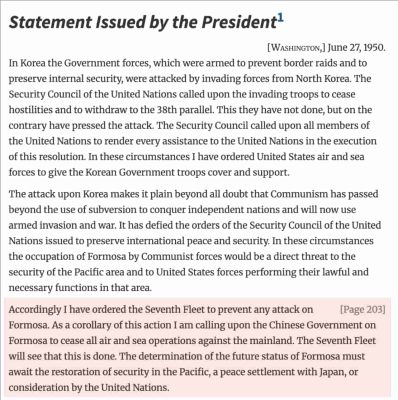
The true intent of this declaration under public international law was to sever the legal nexus by which the People’s Republic of China (PRC) claimed the right to annex Taiwan as a “successor state inheriting the spoils of civil war.” The United States explicitly informed the global community that Taiwan was not an internal Chinese matter. Because the title deed to Taiwan had never been conveyed out of Japanese hands, the island had become an international trust sanctuary under the de facto protection of the U.S. Seventh Fleet.
這份聲明在國際法上的真正意圖是:切斷中共(PRC)宣稱透過「繼承內戰勝果」來吞併台灣的法理鏈結。美國明確告訴世界:台灣不是中國的內政,因為台灣的產權根本還沒從日本手中過戶出來,現在是由美國第七艦隊實質介入的國際信託保護區。
For Chiang Kai-shek, whose regime hung by a thread, the deployment of the Seventh Fleet was a life-saving elixir; yet, from a legal perspective, it was a razor-sharp scalpel slicing through his claims of sovereignty.
美國派遣第七艦隊協防台灣,對當時命懸一線的蔣介石而言,是一劑「救命仙丹」,卻也是一把「法理的割肉刀」。
Forensic analysis of declassified archives from this era reveals that while Chiang was internally gripped by profound panic and rage, he executed a masterclass in “Janus-faced political rhetoric” and “legal damage control.” His official pronouncements, classified diplomatic communications, and private diaries reconstruct the authentic legal battleground of a defeated litigant facing the imminent confiscation of his claimed title by the United States:
在司法鑑識的歷史檔案中,蔣介石當時的內心極度驚恐與憤怒,但他展現了極其高超的「雙面人政治修辭」與「法理止損術」。我們可以從他的官方聲明、機密外交照會、以及他的親筆日記,還原這位敗訴者在面臨產權可能被美方沒收時的真實司法現場:
I. The Public Theater: Expressing “Gratitude for Defense” While Rejecting “Undetermined Status”
In his public posture, Chiang practiced a meticulous strategy of “decoupled inheritance”—he greedily devoured American military protection while spitting out the American legal definition that enabled it.
The day after Truman’s declaration, ROC Foreign Minister George Yeh, acting under Chiang’s strict dictation, issued an official statement. This document stands as a masterclass in diplomatic tightrope walking:
Acceptance of the Military Arrangement: The ROC government stated that it accepted “in principle” the military arrangement of the “neutralization of the Taiwan Strait,” which barred both Communist forces from invading Taiwan and Nationalist forces from launching a counter-offensive against the mainland.
Ironclad Protest Against the Legal Characterization: Regarding Truman’s assertion that Taiwan’s status was undetermined, Yeh’s statement fiercely counter-argued: “That Taiwan is a part of Chinese territory is a matter of international consensus [the Cairo Declaration]… The Government of the Republic of China cannot accept any formulation in the U.S. President’s statement concerning the future status of Formosa that alters the sovereignty of the Republic of China over said territory.”
Chiang Kai-shek was fully aware that the 1943 Cairo Declaration was merely a non-binding press communique, as evidenced by his earlier reprimand to Chen Cheng on January 12, 1949: “The legal status and sovereignty of Taiwan… is merely that of a mandated territory under our trusteeship.” Yet, Chiang knew with absolute clarity that if he acquiesced to the “Undetermined Status of Taiwan,” he would be admitting before the international community that his years of hyper-exploitation on the island and the military suppression of the 228 Incident constituted an unlawful belligerent occupation. Consequently, he clung fiercely to the Cairo Declaration, attempting to brand an administrative receipt as an ultimate title deed.
一、 官方演戲:對外「感謝協防」,但絕對不認「地位未定」
在對外的官方姿態上,蔣介石玩了一手精密的「切片繼承法」——他要吞下美國的軍事保護,但吐出美國的法理定性。
杜魯門聲明發表的隔天,中華民國外交部長葉公超奉蔣介石之命發表了官方聲明。這份聲明堪稱法理上的外交通諜:
接受軍事代管的安排:對於美國派第七艦隊不准共軍攻台、也不准國軍反攻大陸的「台海中立化」軍事安排,國府表示「原則接受」。
對法理產權進行鋼鐵抗議:對於杜魯門定調「台灣地位未定」,葉公超在聲明中反駁稱:「台灣為中國領土之一部分,此在國際成就(開羅宣言)上已極昭然。……本國政府對於美總統聲明中關於台灣未來地位之說法,不變更中華民國對該項領土之主權。」
蔣介石當然知道 1943 年的《開羅宣言》只是一份沒有法律效力的新聞公報,證據就是 1949 年 1 月 12 日蔣介石訓斥陳誠「國府只是代管,台灣仍是日本領土」「台灣法律地位與主權,在對日和會未成以前,不過為我國一託管地帶性質,台灣政府更非我國之正式政府」。但蔣介石很清楚,如果他默認了「台灣地位未定」,就等於承認自己這幾年在台灣的橫徵暴斂、二二八事件的軍事鎮壓,在國際法上都是非法強佔。所以他仍緊咬《開羅宣言》,把「代管收據」當成「終極權狀」。
II. The Forensic Reality: Confidential Communications Reveal the Compromise of a Tenant
While the public theater was staged for domestic and international consumption, the confidential negotiations with the principal stakeholder—the United States—revealed the deep insecurity of a regime fully aware that its presence was merely a custodial assignment. In a classified Aide-Mémoire transmitted by Wellington Koo, the ROC Ambassador to the U.S., to the Department of State, Chiang’s administration conceded the following points:
- The ROC accepted U.S. military defense of Taiwan strictly as a “temporary, emergency measure for collective anti-communist defense.”
- Provided that the United States did not transfer the sovereignty of Taiwan to the “Chinese Communists” or place it under a “United Nations Trusteeship,” the ROC government was prepared to completely surrender military operational command to the U.S. forces under General MacArthur.
In property law, this is designated as an “implied tenancy.” In private, Chiang conceded that his continued survival as a sub-landlord in this property (Taiwan) depended entirely on the fact that the primary landlord (the United States), seeking to bar a burglar (the PRC), had temporarily handed him a weapon and a nightstick. Fully aware that his own title deed was fatally flawed, he bowed completely in the presence of the true master of the estate.
二、 司法現形:對美機密照會,暴露出「寄人籬下」的產權妥協:然而,官方聲明是演給島內和國際看的,在與大股東(美國)的機密談判中,國府的用詞完全洩漏了他們知道自己只是「非法代管」的心虛,在駐美大使顧維鈞轉交給美國國務院的機密備忘錄(Aide-Mémoire)中,蔣介石在機密照會中對美國表示:
- 國府接受美國對台灣的軍事防衛,是基於「共同防共的臨時緊急措施」。
- 只要美國不把台灣的主權移轉給「中共」或是「聯合國託管」,國府願意在軍事指揮權上全面聽從美軍(麥克阿瑟)的調度。
這在產權法學上叫作「默示的租賃關係」。蔣介石在私底下承認,他能繼續在這棟大樓(台灣)裡當二房東,完全是因為大房東(美國)為了防堵強盜(中共),臨時發給他一把槍和警棍。他自知產權有瑕疵,所以在產權所有人(美國)面前,只能乖乖聽話。
III. The Soliloquy of the Soul: Anger and Humiliation in Chiang’s Private Diaries
To perceive the authentic calculations of this historical actor, the most unassailable evidence remains the Diaries of Chiang Kai-shek. In the days following Truman’s declaration, Chiang recorded confessions of profound agony, humiliation, and utter impotence:
“The U.S. Commander-in-Chief Pacific has formally notified our Ministry of National Defense that the Seventh Fleet has been ordered to protect Taiwan, prohibiting the Communists from launching a counter-offensive, while likewise prohibiting our forces from launching a counter-offensive against the mainland… The damage this inflicts upon our diplomacy and international standing could not be more catastrophic.” — Diary of Chiang Kai-shek, June 28, 1950
In his private entries, Chiang characterized Truman’s “Undetermined Status of Taiwan” and the prohibition against reclaiming the mainland as a “brutal violation and insult to the sovereignty of the Republic of China.” He furiously wrote that the United States was practicing “imperialist power politics,” attempting to “sever Taiwan completely from the map of China (the ROC).”
“The [American] intent lies in keeping the status of Taiwan undetermined, thereby deploying their fleet to occupy Taiwan under the guise of protecting it. This manner of foreign policy represents a humiliation unparalleled since the founding of our nation.” — Diary of Chiang Kai-shek, July 1950
三、 靈魂告白:蔣介石日記裡的憤怒與恥辱
要看穿這個歷史角色的真實盤算,最無可爭議的證物就是《蔣介石日記》。在杜魯門發表「台灣地位未定」後的幾天內,蔣介石在日記裡留下了極其痛苦、屈辱、卻又無能為力的自白:
「美太平洋總司令正式通知我國防部,第七艦隊已奉令保護台灣,不准共黨反攻,亦不准我軍反攻大陸。……此舉對我外交與國際地位,其損害之大,莫過於此。」 ——《蔣介石日記》1950 年 6 月 28 日
蔣介石在日記裡,把杜魯門的「台灣地位未定論」與「不准反攻大陸」定性為「美國對中華民國主權的粗暴侵犯與侮辱」。他憤怒地寫道,美國這是在搞「帝國主義的強權政治」,試圖「把台灣從中國(中華民國)的版圖中生生割裂出去」。
「(美國)其用心在使台灣地位未定,而使其派艦隊佔領台灣,以達其保護台灣之目的。此種對外政策,實為我建國以來未有之恥辱。」 ——《蔣介石日記》1950 年 7 月
Epilogue: How the KMT’s “Settled Sovereignty” Myth Became the CCP’s Noose Around Taiwan
國民黨的「光復已定論」成為中共對台灣聲索主權的絞刑繩
Chiang Kai-shek’s vehement resistance to Truman’s “Undetermined Status of Taiwan” in 1950 ultimately manifested as a supreme historical boomerang. To safeguard his constitutional myth of “representing the whole of China,” Chiang fanatically doubled down on the Cairo Declaration, insisting that Taiwan had been fully “retroceded” and restored to China in 1945.
He could never have dreamed that the “Great China Sovereignty Narrative” he clung to solely to bolster his personal regime’s legitimacy would, over half a century later, become the core ancestral asset weaponized by the CCP to claim a right to annex Taiwan, and by Beijing-aligned media to engineer political polarization on the island: The logic of Beijing’s trap is simple: If the Republic of China truly inherited the estate of the Qing Empire (which it did not, as the Qing estate did not include Taiwan in 1912), and if it “achieved full retrocession of Taiwan and restored its sovereign ownership over the island in 1945,” then the People’s Republic of China, as the sole lawful successor state representing China, automatically inherits the title deed to Taiwan.
【THE PSEUDO-SUCCESSOR STATE NOOSE】
KMT Historical Myth: “Sovereignty fully transferred to the ROC in 1945”
▼
CCP Legal Claim: “The PRC has now lawfully superseded the ROC”
▼
Conclusion: “Therefore, the PRC inherits title to Taiwan” (International Law Trap)
蔣介石在 1950 年對杜魯門「台灣地位未定論」的激烈反抗,在歷史的長河中,形成了一個極其諷刺的歷史迴力鏢。當時的蔣介石為了捍衛他「代表全中國」的憲政神話,瘋狂咬死《開羅宣言》,堅稱台灣在 1945 年就已經「光復」並回歸中國。
但蔣介石做夢也沒有想到,他當年為了個人政權合法性而死命抱住的「大中國產權敘事」,在半個多世紀後,竟然成為中共跨海併吞台灣、統媒在島內操作藍綠統獨對決的核心祖產:「既然中華民國繼承大清帝國遺產(事實上沒有,大清帝國的遺產不包含台灣),並在 1945 年『光復了台灣、恢復了擁有台灣的主權』,那麼如今合法代表中國的中華人民共和國,當然擁有台灣的主權。」
【國家繼承之偽法理絞索】
國民黨歷史神話:台灣主權已於 1945 年完全移轉給中華民國
▼
中共法理主張:中華人民共和國如今已依法全面取代中華民國
▼
結論:因此,中華人民共和國繼承了台灣的產權(國際法陷阱)
Chiang Kai-shek’s furious protests in 1950 were, in essence, the exasperation of an old company manager holding a counterfeit deed, being told by the majority shareholders (the U.S. and the UK) that “you are merely an administrator; the title has not been transferred.” For the sake of vanity and domestic control, he forcefully institutionalized the myth of “settled retrocession” across Taiwan. In doing so, he manufactured the very “One China Noose” that the CCP would spend the next several decades tightening around the sovereignty of Taiwan.
蔣介石在 1950 年的憤怒抗議,本質上是一個拿著山寨權狀的舊公司總經理,在被美英等大股東當庭宣告「你只是代管,產權尚未過戶」時的惱羞成怒。他為了面子與統治合法性,強行在台灣宣傳「光復已定論」,反而為海峽對岸的中共,留下了未來幾十年用來勒斃台灣主權的「一個中國」的一條「偽法律絞刑繩」。
Chapter 5: The Ultimate Legal Authority Presiding Over Taiwan’s Title: The Treaty of San Francisco and the Strategic Masterstroke of the Century
第五章 定奪台灣產權的最高法理《舊金山和約》 與美國的世紀法律戰略
As a forensic legal expert must repeatedly emphasize before the court, within the domain of public international law governing property transactions, wartime communiqués such as the Cairo Declaration, wartime statements of intent such as the Potsdam Declaration, and post-armistice surrender protocols such as the Instrument of Surrender possess a legal hierarchy equivalent merely to a “Letter of Intent.” They are utterly devoid of the statutory authority required to effectuate a transfer of territorial sovereignty.
Under international law, the core mechanism of title transfer relies exclusively upon a formal Peace Treaty—duly signed, ratified, and enacted by the principal sovereign states in the post-war era.
正如司法鑑定人在庭上一再強調的,在國際公法的產權交易中,戰時的新聞公報《開羅宣言》、大國的意向公告《波茨坦宣言》、和軍事停戰以降的切結書《降伏文書》,在法律位階上通通屬於「意向書」,完全不具備轉移領土主權的法定效力。
國際法上最核心的產權轉移,只看戰後由當事國正式簽署、批准並生效的「和平條約」。
On September 8, 1951, the Allied Powers and Japan formally executed the Treaty of San Francisco.[🔗] Within Article 2(b) of this definitive legal architecture, which determined the postwar redistribution of East Asian titles, lies the most critical legal adjudication of the century regarding the Taiwan Strait:
“Japan renounces all right, title and claim to Formosa and the Pescadores.”
1951 年 9 月 8 日,二戰同盟國與日本正式簽署《舊金山和約》(Treaty of San Francisco)。這份決定二戰後東亞產權分配的終極法律文件,在第二條第二款寫下了台海法理最關鍵的世紀判詞:
「日本放棄對台灣及澎湖群島的一切權利、權利名義與要求。」
Forensic Legal Verdict:
Japan, the original titleholder, declared the “renunciation” of its ownership but left the transferee entirely unblemished. The title was deregistered but never re-registered elsewhere. In the jurisprudence of international property law, this is designated as a “Limbo Cession.”
This was no historical oversight. As a supreme strategic asset serving as the choke point of the Indo-Pacific, Taiwan’s sovereignty was deliberately suspended and frozen under public international law within a vacuum known as “Undetermined Status.” This was a legal firewall collectively engineered by the principal majority shareholders of the Allied Powers to neutralize the unlawful encroachment of “China”—irrespective of whether it claimed governance from Beijing or Taipei.
The grand strategy orchestrated by the United States was systematic: first, divest the title deed from Japan while deliberately maintaining a blank space on the transferee line. Neither the Republic of China (ROC), which had retreated to Taiwan, nor the newly minted People’s Republic of China (PRC) obtained a transfer of Taiwan’s title under the Treaty of San Francisco.
司法鑑識結論:
日本作為原產權擁有人,宣布「放棄」所有權,但沒有寫明過戶給誰,產權「只登出,不登入」,在國際產權法學中,這叫作「懸空割讓」。
這不是歷史的疏漏,台灣作為印太戰略咽喉點的巨大資產,主權在國際法上被刻意地懸浮、凍結在了「地位未定」的真空狀態。這是同盟國大股東們為了防堵中國(不論是北京還是台北)非法侵佔台灣,而共同設計的一道「法理防火牆」。
美國主導的總體戰略是:先把產權從日本手中剝離,並刻意保持產權的「留白(真空狀態)」,不管是退守台灣的中華民國(ROC),還是新成立的中華人民共和國(PRC),都沒有在《舊金山和約》中獲得台灣的產權轉移。
For decades, the CCP and Taiwan-based pro-unification media outlets have relentlessly conditioned the public with the narrative that because China was excluded from the Treaty of San Francisco, the treaty is null and void regarding Chinese claims. Consequently, they argue, the sovereignty of Taiwan automatically reverted to China in 1945 based on the Cairo Declaration (which, as established, lacks legal efficacy).
中共與台灣統媒數十年來瘋狂洗腦大眾,宣稱中國沒有參與簽訂《舊金山和約》,所以該和約對中國無效!所以台灣主權早在 1945 年就依「開羅新聞公報」(沒有法律效力)回歸中國!
However, a forensic examination of historical archives summarily confiscates this falsehood. The official record of the San Francisco Peace Conference preserves, in unassailable black and white, the precise rationale of the principal Allied shareholders for refusing to assign Taiwan’s sovereignty to China:
Statement of the British Representative (1951): “The treaty itself does not determine the future of these islands [Taiwan and the Pescadores]. The treaty merely terminates Japanese sovereignty formalizing it, leaving the status of Formosa to be resolved by future international procedures.”
The Legal Characterization by U.S. Delegate John Foster Dulles: Dulles openly noted at the conference that explicitly designating the transfer of Taiwan’s sovereignty to China would trigger profound legal and military chaos across the Taiwan Strait. Therefore, the most rigorous approach under international law was to compel Japan to renounce the title first, placing the sovereignty of Taiwan in a status of international trust and undetermined resolution.
然而,歷史檔案的司法鑑定直接沒收了這個謊言。當時同盟國大股東們不把台灣主權寫給中國,在對日和會的官方議事錄(Official Record)中留下了震聾發聵的白紙黑字:
英國代表的當庭陳詞(1951年):「(舊金山和約)該條約本身並未決定這些島嶼(台灣與澎湖)的未來。條約僅正式終結了日本的主權,而將台灣的地位留待未來的國際程序來解決。」
美國代表(後來的國務卿)杜勒斯(John Foster Dulles)的法理定性: 杜勒斯在和會上公開指出,如果把台灣主權直接寫給中國,將會引發海峽兩岸進一步的法律與軍事混亂。因此,最嚴謹的國際法處理方式,就是讓日本先放棄產權,使台灣主權處於「國際共同託管與未定狀態」。
The intent of the primary shareholders was absolute: We issued a nightstick to the Nationalist Government (the sub-landlord) to administer the estate; that does not mean ownership of the estate transfers to you. Still less could we permit a rogue, newly formed corporate entity across the strait (the CCP)—which openly threatens to drown Taiwan in blood—to run over and inherit this asset.
大股東們的意思很清楚:我們發給國民政府(二房東)警棍讓你去代管大樓,不代表這棟大樓就變成你的;更不可能讓海峽對岸那個剛成立、天天喊著要血洗台灣的流氓新公司(中共)跑來繼承這筆資產。
The Treaty of San Francisco represents a supreme piece of legal engineering unparalleled in human history: a precise execution of “Limbo Cession,” leaving the sovereignty of Taiwan suspended under international law, awaiting the final self-determination of its native inhabitants.
《舊金山和約》是一次人類歷史上絕無僅有、極其精密的「主權懸空割讓」,台灣主權從此在國際法上「法律懸空」,等待在地住民的自決。
The Undetermined Status of Taiwan as an Anti-PRC Shield
台灣主權未定 就是為防範落入中華人民共和國手中
That the sovereignty of Taiwan was left unresolved in the 1951 Treaty of San Francisco was not due to American neglect. On the contrary, it was precisely because Taiwan’s geographical positioning was of such paramount importance that the U.S. Department of State, which led the drafting of the treaty, calculated with clinical precision to erect a geopolitical firewall around the island.
The United States could not permit Taiwan to fall into the hands of the People’s Republic of China. Following the outbreak of the Korean War, the rationale was blindingly apparent: should Taiwan fall to the CCP, this vital strategic hub in the Western Pacific—the “unsinkable aircraft carrier”—would be weaponized as a launchpad for totalitarian expansion against the free world.
台灣的主權,在 1951 年的《舊金山和約》確定懸空,這是美國不重視台灣嗎?不,就是因為台灣的地理位置太重要,所以當時主導起草《舊金山和約》的美國國務院,經過精準法律計算,極高明地為台灣設計起一道「地緣政治防火牆」。
美國不允許台灣落入中華人民共和國手中,理由在韓戰爆發後就非常清楚:台灣的地理位置太重要,萬一落入中共手中,將成為極權進攻自由世界的跳板。
Concurrently, the United States refused to assign Taiwan to the Republic of China based on three distinct, cold, and realistic legal and strategic calculations:
Reason I: Preventing the Lawful Annexation of Taiwan by the PRC (The Successor Trap)
In October 1949, Mao Zedong proclaimed the establishment of the People’s Republic of China (PRC) in Beijing, while Chiang Kai-shek’s ROC government suffered a total rout and fled to Taipei. This triggered an intense “battle for diplomatic recognition” in international law and geopolitics.
The Doctrine of Government Succession: Under public international law, if a new regime completely decimates a predecessor regime and exercises effective control over the vast majority of that nation’s territory and population, the new regime can invoke the Doctrine of Government Succession. This empowers it to assume control of all international assets, liabilities, and territorial titles legally held by the predecessor state.
The Fatal Chain Reaction: Had the United States explicitly written into the 1951 Treaty of San Francisco that “Japan transfers the sovereignty of Formosa to the Republic of China (ROC),” a lethal legal trap would have been sprung. The moment the rump ROC regime in Taipei was politically eclipsed or unseated from the United Nations (which manifested in 1971), the PRC in Beijing could invoke the Doctrine of Government Succession to rightfully and lawfully inherit that very title deed bearing the ROC’s name.
The American Legal Seal: To deprive Beijing of any lawful mechanism to inherit Taiwan, the United States deployed the “Keep it open” strategy in drafting the treaty. The text stipulated only that Japan “renounced” title, not to whom it was surrendered. Because the ROC never obtained a formal title registration within an international peace treaty, the Communist regime, even if it were to completely extinguish the ROC, could never “inherit” an asset that the ROC itself never legally owned.
美國同樣不允許台灣歸給中華民國,背後則有三個層層遞進、冷酷而現實的法理與戰略理由:
理由一:防止台灣被「中華人民共和國」合法吞併(繼承人陷阱)
1949 年 10 月,毛澤東在北京宣布成立「中華人民共和國」(PRC),而蔣介石的中華民國(ROC)政府兵敗如山倒,逃亡到台北。當時在國際法與地緣政治上,發生了嚴重的「政府承認爭奪戰」。
國際法的「政府繼承」原則:在國際法中,如果一個政權徹底擊敗了前一個政權,並實質統治了該國絕大部分的領土與人民,這個新政權就可以主張「政府繼承」——全盤接管前政權在國際法上的所有資產、負債與領土主權。
以防致命的連鎖反應: 如果美國在 1951 年的《舊金山和約》中,白紙黑字寫下「日本將台灣主權移交給中華民國(ROC)」。那麼,一旦未來中華民國在台北的偏安政權被中共消滅,或者在外交總決戰中被聯合國除名(這在 1971 年真的發生了),北京的中華人民共和國(PRC)就可以依據「政府繼承原則」,名正言順、合法地繼承這份寫著中華民國名字的「台灣主權 deed(產權書)」。
美國的法理封印: 為了不給北京任何「合法繼承台灣」的法理依據,美國在起草《舊金山和約》時,採取了「產權留白」的策略。合約只寫日本「放棄」,不寫歸給誰。既然中華民國從未在國際條約中獲得台灣的「過戶登記」,那麼共產黨就算消滅了中華民國,也無法從中華民國手裡「繼承」一筆中華民國從未真正擁有的財產。
Reason II: Post-Korean War Interventions and the Efficacy of the Undetermined Status
理由二:韓戰爆發後的「台灣地位未定論」與軍事干涉合法性
With the onset of the Korean War and the PRC’s subsequent military intervention, Beijing aligned itself fully with Moscow. For Washington, preventing Taiwan from becoming a springboard for authoritarian expansion became a paramount security mandate.
To render the deployment of the Seventh Fleet legally unassailable and insulate it from accusations of interfering in China’s internal affairs, Truman’s June 27, 1950 declaration explicitly signaled that Taiwan did not constitute Chinese territory. Because it was not Chinese soil, the fleet’s presence was not an intervention in a domestic civil war, but an international operation safeguarding an unresolved territory.
Consequently, by the time the Treaty of San Francisco was finalized in 1951, the U.S. had to remain legally consistent: it could not assign Taiwan to the ROC without completely invalidating the legal justification that permitted the defense of the strait in 1950.
1950 年韓戰爆發,中國共產黨參戰,北京在戰略上全面倒向莫斯科,對美國來說,台灣若落入共產黨手中,這座西太平洋上的「不沉航母」、戰略樞紐將成為「威權擴張的跳板」。
杜魯門除了立刻下令第七艦隊協防台灣海峽外,為了讓美軍開進台灣海峽「名正言順」,不被國際社會質疑是「干涉中國內戰」,杜魯門在 1950 年 6 月 27 日發表了著名的《台灣地位未定論》宣言,表明台灣不是中國的領土。而既然不是中國領土,美軍開進海峽就不是干涉中國內戰,而是國際盟軍在防範共產擴張、維護「未定領土」的安全。
因此到了 1951 年簽署《舊金山和約》時,美國必須言行一致,不能把台灣劃給中華民國,否則就是自己打臉 1950 年美軍進駐海峽的法理正當性。
Reason III: Factional Divisions Among the Principal Allied Shareholders
理由三:同盟國大股東的強烈反對(美英妥協的唯一公約數)
The United States was not the sole creditor of World War II. During the preparatory phases of the peace treaty, the two primary shareholders of the Allied Powers—the United States and the United Kingdom—split profoundly over the question of Chinese representation.
The British Position: Seeking to protect its vast commercial interests in Hong Kong, the United Kingdom recognized the PRC as the sole lawful government of China in January 1950, severing ties with the ROC. Consequently, London vehemently opposed permitting Chiang Kai-shek’s ROC to sign the treaty or receive title to Taiwan.
The American Position: Washington continued to recognize the ROC in Taipei as the sole lawful government of China and fiercely rejected allowing the Communist regime in Beijing any proximity to the treaty or Taiwan.
With the two primary shareholders deadlocked—the UK blocking the ROC and the U.S. blocking the PRC—U.S. special envoy John Foster Dulles deployed an exceptional display of diplomatic jurisprudence, introducing the celebrated Dulles Formula:
【THE DULLES FORMULA】
Excl. ROC (UK demand) + Excl. PRC (US demand)
▼
Resolution: Neither China invited; Japan renounces title blindly.
▼
Result: Sovereignty Left Open (Unanimous Consensus of 48 Nations)
This double negation successfully dissolved the Anglo-American diplomatic impasse, emerging as the sole formula capable of securing the signatures of all 48 ratifying nations.
二戰的債權人不是只有美國一家。在對日和約的籌備過程中,同盟國的兩大股東——美國與英國,在「誰代表中國」的問題上產生了嚴重的分裂。
英國的立場:英國因為在香港有龐大的商業利益,為了討好北京,英國在 1950 年 1 月就正式承認了中華人民共和國(PRC),並與中華民國斷交。因此,英國強烈反對由蔣介石的中華民國來簽署和約並接收台灣。
美國的立場:美國當時依然承認台北的中華民國(ROC)是中國唯一合法政府,堅決反對讓北京的共產黨政府碰觸對日和約與台灣。
兩大股東吵得不可開交,英國不讓 ROC 簽,美國不讓 PRC 簽。最後,美國的談特使杜勒斯(John Foster Dulles,後來的美國國務卿)展現了高超的法律外交手腕,提出了著名的「杜勒斯公式(Dulles Formula)」:「那就兩個中國都不要邀請!日本只需在和約中宣布放棄台灣,至於台灣歸誰,留給以後再說。」
【杜勒斯公式:產權防火牆】
排斥中華民國(英國要求) + 排斥中華人民共和國(美國要求)
▼
解決方案: 兩岸政權皆未獲邀;日本「盲目放棄」台灣產權(不指定受益人)
▼
最終結果: 台灣主權地位未定(全球 48 個戰勝國的集體共識)
這個「產權留白」的雙重否定,成功化解了美英之間的外交僵局,成為 48 個戰勝國全體簽字通過的唯一公約數。
The 1952 Treaty of Taipei: The Legal Exposure of a Ghost Corporation
1952 年《台北和約》:舊公司的「法理穿幫」
Beholding the sovereignty of Taiwan left completely open by the Treaty of San Francisco, the ROC government—marooned in Taipei and facing international accusations of unlawful belligerent occupation—was compelled to execute a separate bilateral treaty with Japan in 1952: the Treaty of Sino-Japanese Amity (commonly known as the Treaty of Taipei).
眼看《舊金山和約》將台灣主權懸空,退守台灣、命懸一線的中華民國政府,為了解決自己在外國法律上的「非法強佔」指控,於 1952 年被迫與日本單獨簽署了《中日和約》(又稱《台北和約》)。
Both the KMT and the CCP frequently cite this bilateral instrument as conclusive evidence that Taiwan belongs to the ROC. Yet, opening Article 2 of the Treaty of Taipei exposes a most embarrassing legal reality for both regimes:
“It is recognized that under Article 2 of the Treaty of Peace with Japan signed at the city of San Francisco on September 8, 1951, Japan has renounced all right, title and claim to Taiwan (Formosa) and Penghu (the Pescadores)…”
The operative text of the Treaty of Taipei merely records an acknowledgment that Japan had already renounced its title within the prior San Francisco instrument. When signing the document in Taipei, the Japanese plenipotentiaries steadfastly refused to insert any language transferring the sovereignty of Taiwan to the Republic of China.
In the law of contracts, this is known as a “Declaratory Clause.” The fugitive corporation known as the ROC spent its remaining diplomatic capital only to sign a document that amounted to nothing more than a certificate stating: “The prior homeowner has vacated the premises, but the title has still not been transferred to the current occupant.”
國共兩黨經常拿這份條約來當作台灣屬於中華民國的「證據」。然而,只要翻開《台北和約》的第二條,就呈現出對國共兩黨最難堪的法理穿幫:
「茲承認依照公曆千九百五十一年九月八日在美利堅合眾國舊金山市簽訂之對日和平條約第二條,日本國業已放棄對於台灣及澎湖群島以及南沙群島及西沙群島之一切權利、權利名義與要求。」
《台北和約》的主文,居然是「承認日本在舊金山和約裡放棄了產權」,日本人在台北簽約時,依然悍然拒絕在條約裡寫下「將台灣主權轉讓給中華民國」。
這在法律上叫作「確認性條款」。中華民國這家逃亡到台灣的舊公司,折騰了半天,最後親手簽字蓋章拿到的正式國際條約,依然只是一張「證明前任屋主已經放棄房子,但依然沒把房子過戶給我」的法理認證書。
The Price of Truth: Death for “Undetermined Status”
指出事實的代價:主張「台灣地位未定」者死
When the Treaty of Taipei (the Sino-Japanese Peace Treaty) was signed in 1952, the Kuomintang (KMT) regime was navigating its most precarious crisis of legitimacy following its retreat to Taiwan. Confronted by the doctrine of the “Undetermined Status of Taiwan” codified by the Treaty of San Francisco, the Chiang Kai-shek regime deployed a highly sophisticated apparatus of political rhetoric and forensic whitewashing for both domestic and international consumption.
Orchestrated primarily through Foreign Minister George Yeh and the core state machinery, this whitewashing campaign was sustained by four “strategic distortions” designed to obfuscate the legal vacuum:
I. The Sleight of Hand: Substituting a “Declaratory Clause” for the “Unresolved Reality”
Under public international law, Article 2 of the Treaty of Taipei merely recognized Japan’s renunciation of its title over Taiwan and the Pescadores within the San Francisco instrument; it did not designate the Republic of China (ROC) as the transferee. To conceal this fatal blank space on the title deed, the KMT authorities activated a rhetoric of “implied title transfer” through state-controlled media, such as the Central Daily News:
The Official Narrative: The KMT asserted that because Japan had executed the peace treaty with the “Republic of China,” and had formally “acknowledged” its renunciation of Taiwan before the ROC government on ROC-controlled soil (Taipei), this operation inherently implied that Japan was “restoring” sovereignty to the counter-party of the treaty—the ROC.
The Forensic Reality: During negotiations, the Japanese Plenipotentiary, Juhei Kawada, fiercely held the line dictated by Tokyo, refusing to concede a single millimeter beyond the boundaries set by the Treaty of San Francisco. Following the conference, the Japanese government explicitly clarified before its National Diet: “Japan merely renounced sovereignty; it possessed no authority to determine to whom Taiwan and the Pescadores belonged.” The KMT systematically re-branded this mandatory Japanese legal neutrality as the “definitive legal restoration born of victory in the War of Resistance.”
1952 年《台北和約》(中日和約)簽訂時,國民黨政權正面臨撤退台灣初期「合法性」最脆弱的生死關頭。面對國際上因《舊金山和約》而確立的「台灣地位未定論」,國民黨對內、對外採取了一套高度精密的政治修辭與法理粉飾。
根據當時外交部長葉公超以及蔣介石政府的操作,這套粉飾工程主要透過以下四大「戰略性扭曲」來矇混與包裝:
一、 偷換概念:用「宣告條款」粉飾「未定事實」
在國際法上,《台北和約》第二條只是「認可」日本在舊金山和約中放棄台澎主權,並沒有把主權轉移給中華民國。為了掩蓋這個致命的空白,國民黨當局在黨媒《中央日報》與官方宣傳中,啟動了「默示轉移」的法律修辭:
官方論述: 國民黨宣稱,日本是與「中華民國」簽訂和約,而日本既然在中華民國的領土(台北)向中華民國政府「承認」放棄台澎,這在法理上就意味著日本是將主權「歸還」給條約的相對人——中華民國。
事實真相: 當時日本全權代表河田烈在談判時守得極死,奉東京之命絕不跨過《舊金山和約》的底線。日本事後在國會報告中明確表示:「日本只是放棄主權,並無權決定台澎歸屬於誰。」國民黨將這種日本的「法律被迫中立」,在國內宣傳中粉飾為「抗戰勝利的法理終局復歸」。
II. Linguistic Gymnastics: Weaponizing the “Legal Fiction” of Article 10
Article 10 of the Treaty of Taipei, which addressed the nationality of the island’s inhabitants, contained a precise formulation in its official English text:
“…Taiwanese inhabitants shall be deemed to be nationals of the Republic of China…”
The Law of “Deeming”: In legal jurisprudence, the term “deemed” establishes a legal fiction (construct). It signified that for pragmatic purposes—such as facilitating international travel and property management—Taiwanese inhabitants were to be treated as ROC nationals. This precise phrasing was deployed precisely because Taiwan’s sovereignty was unresolved, making it impossible to directly declare them de jure citizens.
The KMT’s Whitewashing: The KMT translated “shall be deemed to” directly into domestic law and propaganda as “shall be recognized as possessing Chinese nationality.” Within its domestic political indoctrination, the regime magnified this transitional administrative clause—designed merely for passport issuance—into absolute “proof” that the international community recognized the total restoration of ROC citizenship to the island’s population.
二、 文字遊戲:利用條約第十條的「擬制國籍」
《台北和約》第十條是關於台灣居民國籍的條款,其英文版原文用詞是:
“…Taiwanese inhabitants shall be deemed to be nationals of the Republic of China…”
Deemed 在法律英文中是「視為」、「擬制」的意思。也就是說:在「處理國際事務與旅行便利」的務實需求下,將台灣人「當作」中華民國國民,這正是因為台灣主權未定,無法直接在法理上定義其國籍。
國民黨的粉飾: 國民黨將 “shall be deemed to”(應視為)直接翻譯並宣傳為「應認為具有中國國籍」,在國內政治文宣中,將這條「為了方便核發護照和財產處理的過渡性條款」,無限放大為「國際社會普遍承認台灣島民全面恢復為中華民國國民」的鐵證。
III. Fabricating the Legal Legitimacy of “Reclaiming the Mainland”
The most humiliating concession for the KMT during the negotiations resided within the Protocol of Territorial Scope attached to the treaty. Under intense American pressure, Japan agreed to sign a bilateral treaty with Taipei, but to preserve its future options, Tokyo adamantly insisted upon an explicit limitation within the exchange of notes: The terms of the present Treaty shall, in respect of the Republic of China, be applicable to all the territories which are “now” or which may “hereafter” be under the control of its Government. This clause dealt a devastating blow to the KMT’s constitutional myth of “representing the whole of China,” effectively downgrading the ROC within international law to a rump island regime ruling only Taiwan, Penghu, Kinmen, and Matsu.
To mask this humiliation, the Chiang regime engineered an exceptional piece of political spin:
The KMT’s Formulation: The state propaganda apparatus redirected the collective gaze entirely onto the word “hereafter.” Official pronouncements proclaimed that this word proved Japan and the broader international community recognized the ROC’s legitimate authority to “reclaim its mainland territories in the future.” The moment the KMT’s counter-offensive succeeded, they argued, the efficacy of the treaty would automatically expand to encompass all of China. Through this maneuver, a severe international restriction of territorial scope was magically transformed into a psychological booster shot certifying the legality of reclaiming the mainland.
三、 創造「反攻大陸」的法理合法性
這場談判中,最讓國民黨難堪的是《台北和約》的〈適用範圍議定書〉。日本在美國壓力下雖然選擇與台北簽約,但為了留有餘地,堅持在換文中加上限制:本條約之條款,在中華民國方面,應適用於「現在」或「將來」在其控制下之全部領土。這條款直接打臉了國民黨自稱「代表全中國」的合法性,等於在國際法上把中華民國「降格」為一個僅統治台澎金馬的島國政權。
為了粉飾這層屈辱,蔣介石政權採取了極具創意的政治包裝:
國民黨的定調: 宣傳機器將焦點放在「將來」這兩個字上。官方宣傳聲稱,這證明日本與國際社會承認中華民國擁有「未來收復大陸國土」的合法權力,只要國民黨「反攻大陸」成功,條約效力就自動擴及全中國。這成功將一個「領土被限縮」的國際現實,粉飾成「國際認證反攻大陸合法性」的強心針。
IV. Ironclad Domestic Suppression: Coding “Undetermined Status” as a Capital Taboo
In private, Chiang Kai-shek was fully cognizant of the unresolved reality governing Taiwan’s legal status. As early as his January 12, 1949 cable to Chen Cheng, he stated explicitly: “Taiwan is merely a mandated territory under our trusteeship.” In his private diaries, he likewise conceded that maintaining a ambiguous legal status for Taiwan to invite American defensive deployment was the “median strategy for countering the Communist bandits.”
Yet, this internal lucidity was strictly barred from reaching the populace of Taiwan. The KMT enforced a ruthless two-pronged strategy:
The Cult of Constitutional Legitimacy: In school textbooks and newspapers across Taiwan, the regime chained the Cairo Declaration, the Potsdam Declaration, and the Treaty of Taipei into a pseudo-legal narrative proclaiming that Taiwan unalterably belonged to the ROC.
Iron-Fisted Censorship: Any intellectual, legal scholar, or dissident within the island who dared to scrutinize the unredacted text of the Treaty of San Francisco, or who introduced the doctrine of the “Undetermined Status of Taiwan” or advocated for an “International United Nations Trusteeship for Taiwan,” was summarily targeted by the Taiwan Garrison Command. The state machinery weaponized draconian charges such as “disseminating rebel propaganda” and “subverting military morale” to crush this ideological heresy. Victims were systematically rounded up, forcefully exiled to the notorious penal colonies of Green Island, or in many instances, condemned by military tribunals to arbitrary execution.
四、 國內高壓禁言:將「台灣地位未定」列為政治禁忌
蔣介石在私底下,其實對「台灣法律地位未定」的現實心知肚明。在1949年他致陳誠的電文中就曾直言:「台灣不過為我國一託管地之性質。」在日記中他也認同,台灣地位模糊化、複雜化,引入美國力量防禦,是「對付共匪的中策」。
但這套「心知肚明」絕不允許台灣島內的百姓知道。國民黨當時採取了兩手策略:
對內製造「法統狂熱」: 在台灣的教科書、報紙中,將《開羅宣言》、《波茨坦宣言》與《台北和約》串聯成一條「台灣必然屬於中華民國」的偽法律傳播鏈。
鐵腕鎮壓異議:任何在島內敢深入研讀《舊金山和約》原文、提出「臺灣地位未定論」、或倡議「臺灣由聯合國國際託管」的知識分子、法學學者與異議人士,一律成為臺灣警備總司令部精準清洗的目標。國家機器悍然動用「傳播叛匪言論」與「動搖軍心」等嚴厲罪名,鐵腕鎮壓這類意識形態異端。受害者遭到系統性搜捕,強行送往惡名昭彰的綠島集中監禁,在諸多案例中,甚至直接被軍事法庭判處極刑。
A forensic analysis of the military judgments handed down during this era of the White Terror exposes a chilling judicial uniformity. The “rationale for judgment” fabricated by the military judges of the Taiwan Garrison Command remained rigidly consistent: the tribunals invariably accused the defendants of “willfully ignoring the immutable fact that the territory of Taiwan had already been restored to the Republic of China pursuant to the Cairo Declaration and the Sino-Japanese Peace Treaty [Treaty of Taipei].”
By proposing that Taiwan’s status remained legally unresolved, or by advocating for a United Nations trusteeship and plebiscite-driven self-determination, the defendants were adjudged to be “conspiring to split the national territory and plot the subversion of the government.” In the eyes of the regime, a rigorous academic discussion on international treaty law was re-characterized as an act of capital treason—proving that the KMT relied entirely on state terror and systemic incarceration to insulate its fabricated sovereignty myth from legal reality.
司法鑑定這段白色恐怖時期的軍法判決書,暴露出軍法官在判決理由上令人毛骨悚然的高度一致性。警備總部軍法官所虛構的「判決理由」高度雷同:他們皆指控被告「無視開羅宣言及中日和約(臺北和約)領土已歸還中華民國之鐵證事實」。
判決書直指,被告妄稱臺灣法律地位未定、主張聯合國託管或實行住民自決住民自決之行為,本質上皆屬於「陰謀分裂國土、圖謀顛覆政府」。在獨裁政權眼中,一場針對國際條約法進行的嚴謹學術討論,被直接入罪為顛覆國家的死罪——這在法理上血淋淋地證實了,國民黨政權當年完全是仰賴國家暴力與系統性監禁,強行將其虛構的法統神話與真實的法律現實徹底隔離。
A Masterclass in Political Illusion
極致粉飾的一場政治幻術
The KMT’s whitewashing campaign of 1952 was a political illusion of “swallowing humiliation abroad while synthesizing myths at home.”Trapped within the legal fissures between Washington and Tokyo, the regime managed to extract nothing more than a “lease agreement” devoid of title registration (the Treaty of Taipei). Yet, turning back to face a Taiwanese population completely stripped of information freedom, the regime held up this piece of paper and proclaimed: “Behold! This is the ultimate title deed issued to us by the international community!”
國民黨當年的粉飾,是一場「對外吞下委屈,對內轉化為神話」的政治幻術。它在美國與日本的法律夾縫中,勉強擠出了一張沒有產權登記的「租賃證明」(台北和約),然後轉過身來,對著島內被奪去資訊自由的台灣人民,高舉這張紙大喊:「看,這就是國際社會發給我們的領土所有權狀!」
Conclusion: The Forensic Lock on a Century of Unresolved Accounts
When the forensic examination of the 1951 Treaty of San Francisco is finalized, the legal chain of logic forms an ironclad, closed circuit:
The Qing Empire executed the Treaty of Shimonoseki in 1895, transferring the sovereignty and administrative domain of Taiwan and the Pescadores to Japan in perpetuity. Japan’s lawful title remained unbroken until 1951.
Consequently, when the Republic of China inherited the territory of the Qing Empire in 1912, Taiwan was not part of that inheritance. Likewise, when the People’s Republic of China won the civil war in 1949, Taiwan was not part of its inheritance.
The Cairo Declaration and the Instrument of Surrender routinely invoked by Beijing and Taipei function in law merely as receipts of temporary trusteeship; they are incapable of conveying sovereign title.
The Treaty of San Francisco—the sole instrument possessing supreme international legal efficacy—refused to award Taiwan to either the ROC or the PRC. It deregistered Japan’s title and left the sovereignty of Taiwan suspended.
The sovereignty of Taiwan does not belong to the Republic of China, and it has never, for a single fraction of a second, belonged to the People’s Republic of China. The title deed to this magnificent estate known as Taiwan was hoisted high into the international legal stratosphere by treaty law in 1951, awaiting the arrival of its true, lawful owners to execute a domestic registration. That vigil would remain unbroken until the year 1996.
結論:歷史呆帳的法理死鎖
當我們將 1951 年《舊金山和約》的司法鑑定完成,法理邏輯鏈便形成了鐵血閉環:
清帝國在 1895 年與日本簽訂《馬關條約》,白紙黑字將台灣全島、澎湖列島的主權與統治權「永久讓與日本」,日本擁有台灣的合法狀態,持續到 1951 年為止。
所以當 1912 年中華民國繼承大清帝國領土時,並沒有繼承台灣。當 1949 年中華人民共和國打贏中國內戰建國時,也沒有繼承台灣。
國共兩黨口中的《開羅宣言》與《降伏文書》,在法律上只是代管收據與停戰切結書,無法移轉主權。
而唯一且最高法律效力的《舊金山和約》,沒有將台灣判給中華民國或中華人民共和國,而是讓日本登出產權,將台灣主權正式懸空。
台灣的主權既不屬於中華民國,更從未有一分一秒屬於過中華人民共和國。這棟名為台灣的豪華大樓,它的產權證書在 1951 年被國際條約法高高地懸掛在印太上空,等待著真正合法的產權擁有人前來辦理在地登記。這個等待,將一直持續到 1996 年。
Chapter 6: The Strategic Backup of Taiwan’s Property Title via the US Taiwan Relations Act
第六章 美國以《台灣關係法》對台灣產權進行戰略備份
Legal Possession Under Sovereign Vacancy: The Anchoring of Administrative Power by the 1954 U.S. Defense Treaty
On April 28, 1952, the Treaty of San Francisco officially entered into force, and Japan renounced all right, title, and claim to Taiwan. At this precise crossroad, a critical transformation occurred regarding the Chiang regime’s governing authority (jurisdiction) over Taiwan:
The Termination of the Allied Collective Mandate: With the peace treaty taking effect, the “collective military occupation” by the World War II victorious Allies legally concluded. The US military no longer commanded Chiang Kai-shek under the title of the “Supreme Commander for the Allied Powers.”
The “De Facto Continuity” of Jurisdiction: Although the Treaty of San Francisco left the ultimate sovereignty of Taiwan unassigned (open-ended), it neither terminated nor revoked the Republic of China (ROC) government’s de facto administrative jurisdiction over Taiwan. Against the backdrop of the erupting Cold War (the Korean War), the United States and its allies required the ROC to remain in Taiwan to contain the Chinese Communist Party (CCP). Consequently, they acquiesced to and recognized the ROC’s continued exercise of effective jurisdiction over Taiwan.
Reinforcement by the 1952 Treaty of Taipei: Subsequently, the ROC and Japan signed the bilateral Sino-Japanese Peace Treaty (Treaty of Taipei). While this treaty strictly adhered to the framework of the San Francisco instrument and refrained from designating the sovereign recipient of Taiwan, Japan recognized within the text that the inhabitants of Taiwan and Penghu possessed ROC nationality. In legal jurisprudence, this further implied international acquiescence to the legitimacy of the ROC’s administrative jurisdiction over Taiwan and the Pescadores.
The Legal Anchoring by the 1954 Sino-American Mutual Defense Treaty: The subsequent outbreak of the First Taiwan Strait Crisis prompted the United States and Taipei to sign the Sino-American Mutual Defense Treaty in 1954. This treaty carried decisive weight under international treaty law: the United States explicitly defined the territorial scope applicable to its defense obligations as the territories under the de facto jurisdiction of the Republic of China, specifically Taiwan and the Pescadores. This was tantamount to the ultimate superpower of the geopolitical order formally declaring via a legally binding document to the entire world that: while Washington did not recognize the ROC as “owning” sovereignty over Taiwan, it absolutely recognized and protected the ROC’s “substantive administrative power” and “exclusive de facto possession” over Taiwan.
Consequently, following the San Francisco Peace Treaty, the Republic of China’s administrative power over Taiwan continued uninterrupted. It simply mutated from a post-war “Allied military trusteeship” into a “substantive rule” recognized and tacitly consented to by the United States and the international community under the architecture of the Cold War.
所有權懸空下的合法占有:一九五四美國防禦條約的治權定錨
1952 年 4 月 28 日《舊金山和約》正式生效,日本放棄台灣主權。這時蔣政權對台灣的治權發生了關鍵的轉變:
同盟國集體委託的結束:隨著和平條約生效,二戰戰勝國的「集體軍事佔領」在法律上告一段落。美軍不再以「同盟國最高統帥」的身分指揮蔣介石。
治權的「實質延續」:雖然《舊金山和約》讓台灣主權留白,但它並沒有終止、也沒有撤銷中華民國政府對台灣的實質管轄現狀。因為當時在冷戰爆發(韓戰)的背景下,美國與盟邦需要中華民國留在台灣壓制中共,因此默許並承認中華民國繼續在台灣行使實質治權。
1952 年《台北和約》的補強:隨後中華民國與日本單獨簽署了《中日和約》(台北和約)。雖然該和約同樣依循舊金山和約,沒有寫明台灣主權歸屬,但日本在條文中承認了台灣、澎湖居民已具備中華民國國籍,這在法理上進一步默認了中華民國在台澎行使治權的合法性。
1954 年《中美共同防禦條約》的法律定錨:隨後爆發的第一次台海危機,促使美國與台北於 1954 年簽署《中美共同防禦條約》。該條約在國際條約法上具有決定性的意義——美國在條文中明確將防禦適用的領土範圍,定義為「中華民國所實質管轄之台澎金馬」。這等於由地緣政治的最高核心國家,正式以法律文件向全世界宣告:美國雖然不承認中華民國「擁有」台灣主權,但美國絕對承認並保護中華民國對台灣的「實質治權」與「排他性占有」。
因此,《舊金山和約》之後,中華民國對台灣的治權依然繼續,只是從戰後的「戰勝國軍事代管」,轉變為冷戰架構下被美國與國際社會承認/默許的「實質統治」。
For the United States, maintaining Taiwan’s title in a state of suspension—rather than formally transferring it to the ROC—constituted a masterfully calibrated, century-long legal defense line that allowed for both offensive and defensive maneuverability:
Vis-à-vis the Kuomintang (KMT): “I [the United States] will protect you militarily and recognize you diplomatically, but I will not formally transfer the property title of Taiwan to you in any international treaty. This prevents you from handing Taiwan over to Beijing on a silver platter, should you fail in reclaiming the mainland or attempt unification with the CCP.”
Vis-à-vis the Communist Party: “You constantly clamor to ‘liberate Taiwan,’ yet under international law, the prior titleholder [Japan] never transferred the property deed to your mortal enemy [the ROC]. You lack even the basic legal pretext of ‘succession.’ Any use of military force against Taiwan constitutes an illegal military aggression against a territory whose status is unresolved under international law and which remains under US military trusteeship.”
This legal firewall, meticulously engineered by the United States in 1951, weathered the normalization of US-PRC diplomatic relations in the 1970s and the ROC’s exit from the United Nations. It continues to serve as the core structural stabilizer to this day.
對美國而言,不把台灣過戶給中華民國,是一套進可攻、退可守的世紀法律防線:
對國民黨:我(美國)在軍事上保護你,在外交上承認你,但我不會在國際條約裡把台灣的產權正式過戶給你,免得你哪天反攻大陸失敗、或跟中共搞統一,把台灣一起雙手奉送給北京。
對共產黨:你天天喊著要「解放台灣」,但在國際法上,前手業主(日本)根本沒有把產權交給你的死敵(中華民國),你連「繼承」的法律藉口都沒有。你對台灣動武,就是對一塊「國際法上地位未定、由美軍軍事代管」的區域進行非法軍事侵略。
這條由美國在 1951 年精心設計的法律防火牆,經歷了 1970 年代的中美建交、中華民國退出聯合國,至今依然發揮著核心作用。
The Chiang Family’s Selfish Calculus: Exchanging Taiwan’s Legal Isolation for Eternal Domestic Dictatorship
蔣氏家族的自私精算:以台灣的法理孤立,換取島內的萬年獨裁
However, the greatest vulnerability to this firewall did not emerge from international systemic pressures, but from within the exiled regime itself.
Following his catastrophic military defeat in the Chinese Civil War, Chiang Kai-shek retreated to Taipei, stubbornly clinging to the bankrupt “Republic of China” corporate brand name and obsessively claiming to be the sole legitimate representative of all China. As a tsunami of derecognition swept the globe in the 1970s, allied nations severed diplomatic ties with Taipei in rapid succession.
On the eve of UN Resolution 2758, this crisis reached its boiling point. In a desperate bid to preserve Taiwan’s seat within the international system, the United States presented Chiang with a strategic life-raft: a dual-representation proposal that would allow the island to remain in the United Nations under the name of “Taiwan.”
然而,這道防火牆最大的破口,並非來自國際社會的壓力,而是來自流亡政權意識形態造成的自殺。
蔣中正在中國內戰中遭遇毀滅性軍事潰敗後退守台北,卻依然死死抱著「中華民國」這個在中國大陸早已實質破產的法人商標不放,狂熱地自封為「全中國的唯一合法代表」。隨著國際局勢在 1970 年代走向現實主義,對中華民國的斷交海嘯席捲而來,各國紛紛撤銷對台北的法理承認。
在聯合國第 2758 號決議表決的前夕,危機被推向了頂峰。當時的美國政府為了保住台灣在國際體系中的席位,向蔣中正提供了一艘戰略救生艇:美國提議以雙重代表權的方式,讓這座島嶼以「台灣」的名義留在聯合國。
The underlying legal implications of this survival scheme were monumental: it did not mean the United States intended to violate the San Francisco Peace Treaty by fully transferring the title of this “sovereignty-vacant” mansion to Chiang’s exiled Chinese government. On the contrary, Washington was forcing Chiang to undergo a legal divestment and localized restructuring of property rights.
The strategic calculus of the United States was clear: if Chiang would only abandon his fraudulent claim of representing all of China and remain in the UN as a purely localized legal entity named “Taiwan,” the “blank, undetermined” sovereignty over Taiwan left by the San Francisco Peace Treaty would, under the multilateral framework of the UN General Assembly, substantively transform into an independent sovereign subject rooted in Taiwanese self-determination.
Consequently, Taiwan would be legally severed from the Chinese Civil War, erecting an impassable property firewall against Beijing—for while the PRC could inherit the assets of the “Republic of China” on the mainland, it could never inherit a “Taiwan” registered as an independent legal person in the United Nations.
這項續命方案在法理上的實質意義極其巨大:這並不代表美國打算背叛《舊金山和約》,將這棟「產權懸空」的豪宅直接過戶給蔣介石的中國流亡政府;相反地,美國是要強迫蔣介石進行一場「產權的解編與在地化重組」。
美國的精算在於,只要蔣介石願意放棄「代表全中國」的虛假宣稱,改以「台灣」這個純粹的在地法人身分留在聯合國,那麼《舊金山和約》中那份「留白、未定」的台灣主權,就會在聯合國大會的多邊框架下,實質轉化為「台灣住民自決」的獨立主權主體。
如此一來,台灣就能在法理上與「中國內戰」徹底切割,築起一道北京永遠無法跨越的產權防火牆——因為北京可以繼承「中華民國」在大陸的資產,卻絕對無法繼承一個在聯合國登記為獨立法人的「台灣」。
Yet, trapped in his fanatical, feudal delusion of “No coexistence between the Patriot and the Traitor” and driven by Han-Chauvinist obstinacy, Chiang Kai-shek gambled away the international survival of Taiwan’s twenty million residents. He categorically refused to localize this caretaker’s title, rejecting the opportunity to remain on the international stage under the name of a compact Taiwan.
Behind this lay the Chiang regime’s deeply selfish political calculus: as the international bankruptcy of the Republic of China became an unstoppable tide, securing exclusive, de facto “administrative power” over the island for himself and the Chiang family became the ultimate life-support system he had to protect. He was acutely aware that if he complied with the American proposal to “Taiwanize” the property rights, his “Frozen Parliament” and the constitutional legitimacy that claimed to represent all of China would instantly dissolve domestically. Consequently, he would no longer be able to sustain the martial law apparatus that suppressed the Taiwanese people under the fiction of an ongoing civil war, and his tyrannical record on the island would inevitably face local, retrospective justice by the Taiwanese people.
Therefore, he chose to perpetuate his own self-hypnosis, risking the entire future of the ROC on a mad gambit: betting that a military conflict between China and the Soviet Union, or between the U.S. and China, would erupt, allowing him to launch a counteroffensive to reclaim the mainland with American backing—no matter how microscopically small that probability truly was.
然而,蔣介石仍深陷「漢賊不兩立」的封建妄想與大漢沙文主義執念,不惜以台灣兩千萬人的國際生存權為賭注,拒絕將這張代管的權狀「在地化」,拒絕以小小台灣為名留在國際舞台。
這背後是蔣氏政權極其自私的權謀精算:既然中華民國在國際上的法理破產已經難以抵擋,選擇讓自己與蔣氏家族在島內持續掌握排他性的「實質治權」,便成為他最要保住的命脈。因為他深知,一旦接受美國方案將產權「台灣化」,其宣稱代表全中國的「萬年國會」與法統在島內也將瞬間幻滅,不僅沒辦法繼續用「內戰未定」的虛構體制實施戒嚴壓制台灣人,他在台灣所做的一切惡行也可能面臨台灣人的本土清算。
所以他選擇繼續催眠自己,將中華民國的未來,孤注一擲地賭在「中蘇開戰、美中開戰,自己可以在美國幫助下反攻大陸」的瘋狂劇本裡,無論這個可能性的機率有多麼微乎其微。
UN General Assembly Resolution 2758 (1971): Purging the Representation of an Outdated Corporate Entity, Not Disposing of Taiwan’s Sovereignty
1971 年「聯大 2758 號決議」:清退舊法人的中國代表權,而非處理台灣主權
The core text of UN General Assembly Resolution 2758, passed on October 25, 1971, is chillingly precise: it “Decides: to restore all its rights to the People’s Republic of China and to recognize the representatives of its Government as the only legitimate representatives of China to the United Nations… and to expel forthwith the representatives of Chiang Kai-shek from the place which they unlawfully occupy at the United Nations and in all the organizations related to it.”
This marked the definitive legal conclusion of the Chinese Civil War in the international theater. It declared the total bankruptcy and de-registration of the “Republic of China” as a legal entity representing China in the international liquidation process, establishing the Beijing government as the sole orthodox representative of the “China” corporate entity. Consequently, Chiang’s exiled regime in Taiwan formally forfeited its “Representation of China” under international law.
Today, Beijing relentlessly weaponizes Resolution 2758 as its ultimate international legal basis for claiming sovereignty over Taiwan. Yet, examining the black-and-white text of the resolution reveals that it was, in its entirety, nothing more than a “shareholder representation eviction within a corporate board,” utterly divorced from the property rights of the real estate known as “Taiwan.”
1971 年 10 月 25 日通過的聯合國大會第 2758 號決議,其核心內文極其精準:「決定:恢復中華人民共和國的一切權利,承認她的政府的代表為中國在聯合國組織的唯一合法代表……並立即把蔣介石的代表從它在聯合國組織及其所屬一切機構中所非法佔據的席位上驅逐出去。」
這是中國內戰在國際法理層面的正式底定,它宣告了「中華民國」作為全中國合法代表的法人身分在國際清算中徹底破產並遭到註銷,北京政府成為「中國」這個法人的唯一正統代表。這導致流亡在台灣的蔣介石政權正式在國際法上喪失了「中國代表權」。
北京如今不斷將「2758 號決議」當作其「擁有台灣主權」的國際終極法理依據。然而,翻開該決議的白紙黑字,這是一場徹頭徹尾的「公司內部股東代表權清退案」,與台灣這棟不動產的產權毫無關係。
The text of the resolution makes absolutely no mention of “Taiwan” or the “Taiwanese people.” Furthermore, because the sovereignty over Taiwan had already been left vacant by the San Francisco Peace Treaty, Resolution 2758 never conferred—nor did it possess the authority to confer—territorial sovereignty over Taiwan to Beijing. It merely evicted the exiled property manager (the ROC), who was desperately clinging to a defunct corporate nameplate, from the international tribunal.
In the jurisprudence of property law, the logic is elementary: evicting the former chairman of a bankrupt corporation (Chiang Kai-shek’s representative) does not equate to automatically transferring the title of the foreclosed mansion where he was merely staying (Taiwan) to the newly installed chairman (Beijing).
After all, the United Nations General Assembly is a political, deliberative organ, not an international property court; it possesses zero authority to adjudicate or dispose of the sovereignty over Taiwan and the Pescadores.
決議文通篇未提「台灣」或「台灣人民」,同時因為在《舊金山和約》中,台灣主權本來就懸空,2758 號決議從未賦予、也無權賦予北京對台灣的領土主權,它只是把那個抱著舊招牌的流亡物業經理人(ROC)徹底趕出了國際法庭。
以產權法學來說亦再清晰不過:清退了破產公司的董事長(蔣介石代表),並不等於將董事長借住的查封豪宅(台灣)產權一併過戶給新董事長(北京)。
更何況,聯合國大會是政治性諮議機關,絕非國際產權法庭;聯合國大會對於台灣與澎湖群島之主權,毫無任何管轄權進行司法裁判或予以處分。
Consequently, Resolution 2758 brought down the definitive legal gavel on the global wave of derecognition shifting away from the Republic of China; after all, this exiled government had long ceased to represent the actual geopolitical entity of China. Concurrently, because Chiang Kai-shek rejected the proposal to remain in the United Nations under the name of Taiwan and allow the island to become a recognized member state, it sequentially resulted in Taiwan being nominally and institutionally exiled from the international stage.
Yet, ironically, whenever Beijing strips away another one of the ROC’s few remaining diplomatic allies today, blue-camp media and politicians in Taiwan deliberately sever this historical lineage. They distort the ongoing liquidation of their own political ancestors’ bankrupt entity, blaming it entirely on the current DPP government as a “diplomatic failure and national humiliation.”
Nevertheless, the historical chain of causality is crystal clear: it was Chiang Kai-shek who catastrophically lost the Chinese Civil War and forfeited the entirety of China. Refusing to admit the bankruptcy of his own constitutional legitimacy, he rejected a localized conversion into “Taiwan”—solely to avoid losing the domestic legitimacy of ruling Taiwan that he had so meticulously fabricated. It was this singular obstinacy that triggered the domino effect of international derecognition, as the global community progressively de-registered a bankrupt corporate brand.
其結果就是,「2758 號決議」為世界各國與中華民國的斷交海嘯敲下了法理的定案槌,畢竟,這個流亡政府早已無法代表真正的中國。同時,由於蔣介石拒絕以台灣名義留在聯合國、讓台灣成為聯合國的一員,連帶地,造成台灣在名義上被體制性地放逐於國際舞台之外。
然而極具諷刺的是,如今台灣的藍營媒體與政客,每當北京再度強奪中華民國那僅存不多的邦交國時,卻總是刻意切斷歷史的源頭,將這場由其政治先祖一手造成的「破產法人清算餘波」扭曲、怪罪為當前民進黨政府的「外交失敗造成國恥」。
但歷史的因果鏈再清晰不過:是蔣介石在內戰中徹底潰敗、輸掉了整個中國,又不願承認自己法統的破產,拒絕就地轉型成台灣,以免徹底失去自己一手編織的統治台灣的正當性,自己啟動了世界各國將這個破產商標全面註銷、解除外交關係的骨牌效應。
The Taiwan Relations Act: The US Strategic Backup of Property Titles for a “Non-State Entity” via Domestic Law
《台灣關係法》:美國以國內法對「非國家實體」的產權戰略備份
In 1979, when the United States formally severed diplomatic relations with the ROC to establish ties with the PRC, it faced a critical vulnerability: ensuring that this strategically vital territory, effectively under its broader mandate, would not be devoured by Beijing in the vacuum of non-recognition. To pre-empt this, the US Congress enacted one of the most precisely engineered pieces of legislation in the history of geopolitics: the Taiwan Relations Act (TRA). Signed into law by President Jimmy Carter on April 10, 1979, its efficacy was made retroactively effective to January 1, 1979.
The TRA is a domestic statute of an exceedingly rare strain in international law and diplomatic history. Driven by a powerful bipartisan supermajority, Congress forced the passage of this act as an ironclad counter-reaction to the Carter administration’s abandonment of Taiwan during normalization with the PRC.
美國在 1979 年正式與中華民國斷交,與中華人民共和國建交,為了不讓台灣這塊實質代管的戰略要地被北京趁虛吞併,美國國會通過了一部地緣政治史上絕無僅有的法律 ── 《台灣關係法》,於 1979 年 4 月 10 日由美國總統卡特簽署通過,追溯自同年 1 月 1 日生效。
《台灣關係法》是一部在國際法與外交史上極為罕見的「國內法」。當時美國為了與中華人民共和國建交、與中華民國斷交,美國國會為強烈反制卡特政府對台灣的拋棄,以壓倒性多數通過此法。
The title of the statute itself delivers its coldest judicial characterization: it is the Taiwan Relations Act, not the Republic of China Relations Act. Within this domestic framework, the United States deployed a masterful technique of jurisprudential defense:
Non-Recognition of the ROC’s Sovereign Persona: The United States terminated diplomatic relations with the “Government of the Republic of China,” re-classifying Taiwan under American law as a “Non-state entity” or the “Taiwan authorities.”
Legal Continuity of Titles and Contracts: To prevent the erasure of Taiwan’s external legal personality from triggering the forfeiture of its global assets to Beijing, Section 4 of the TRA explicitly mandated: “The absence of diplomatic relations or recognition shall not affect the application of the laws of the United States with respect to Taiwan… All contracts, property rights, and legal actions involving Taiwan, past or future, shall remain fully valid and enforceable.”
This act amounted to a unilateral American intervention. Outside the standard grid of international law, the United States wove a “De Facto Corporate Protection Net” around a skyscraper whose property title remained unassigned. It legally guaranteed that the local governing apparatus (the Taiwan authorities) could continue to function, preserving its lawful property persona to engage in global commerce and conduct self-defense.
這部法律的名字本身就是最冷酷的司法定性:它是《台灣關係法》,不是《中華民國關係法》。美國在這部國內法中,展現了高超的法理防禦技術:
不承認 ROC 作為國家的法律人格: 美國終止了與「中華民國政府」的外交關係,但將台灣定位為一個「非國家實體」或「台灣統治當局」。
產權與契約的法律連續性: 為了防止外在法律人格消失導致資產被北京沒收,《台灣關係法》第四條明確規定:「缺乏外交關係或承認,並不影響美國法律對台灣的適用,過去與未來所有以台灣為對象的契約、財產權利、司法訴訟,一律繼續有效。」
這等於是美國以一己之力,在國際法網格之外,為台灣這棟產權懸空的大樓拉起了一道「實質法人保護網」,確保在地統治體制(台灣統治當局)能夠繼續運作,並擁有進行國際貿易與自我防衛的合法產權人格。
The Core Jurisprudential Significance of the TRA
《台灣關係法》的核心法理意義
The true essence of the Taiwan Relations Act lies in the deployment of domestic statute to deem (construct a legal fiction of) a non-existent diplomatic recognition. Its core significance comprises two pillars:
The “Officialization” of Unofficial Relations: Despite the severance of formal ties, Section 3 and Section 4 of the Act strictly dictate that Taiwan retains the right to sue and be sued in US courts, that Taiwan’s state property in the US (such as Twin Oaks) enjoys full protection, and that all treaties previously entered into by the two nations (excepting the mutual defense treaty) remain active. In the eyes of US domestic law, Taiwan is structurally treated as a sovereign state.
Integrating “Taiwan’s Security” into US National Interests in the Western Pacific: The Act’s policy statement explicitly binds the US decision to establish diplomatic relations with the PRC to the absolute expectation that “the future of Taiwan will be determined by peaceful means.” Any attempt to determine Taiwan’s future by non-peaceful means—including boycotts or embargoes—is legally defined as a “threat to the peace and security of the Western Pacific area” and a matter of “grave concern” to the United States.
《台灣關係法》的本質,是美國用「國內法」來擬制(Deem)一個不存在的「外交承認」,它的核心意義在於:
非官方關係的「官方化」: 雖然美台斷交,但該法第三條明文規定:中華民國(台灣)在美國法院享有訴訟權、臺灣在美財產(如雙橡園)受到保護、且過去兩國簽訂的條約(除防衛條約外)繼續有效。這等於在美國法律內,將台灣實質視為一個「國家」。
將「台灣安全」納入美國西太平洋的國家利益: 法案在政策聲明中直接寫明:美國決定與中華人民共和國建立外交關係,是基於「台灣的前途將以和平方式決定」這一期望。任何企圖以非和平方式(包括抵制或禁運)決定台灣前途的舉動,都將被視為「對西太平洋地區和平與安全的威脅」,並引起美國的「嚴重關切」(Grave Concern)。
The De Facto Effects Rendered by the TRA
Over the past four decades, this unique statute has delivered three concrete defensive and existential results for Taiwan and the broader Asia-Pacific matrix:
1. Providing the Statutory Source for Taiwan’s “Defensive Weapons” (The Arms Sales Umbrella)
This is the core kinetic instrument of the TRA. Section 3 mandates: “The United States will make available to Taiwan such defense articles and defense services in such quantity as may be necessary to enable Taiwan to maintain a sufficient self-defense capability.”
The De Facto Effect: Regardless of Beijing’s diplomatic protests or the bilateral restrictions outlined in the US-PRC August 17 Communiqué, successive US administrations (whether Democratic or Republican) are legally bound by domestic law to execute arms sales to Taiwan. From early generations of F-16 fighters and Patriot missile systems to the normalized transfers of precision-strike systems seen today in 2026, this statutory mandate provides the structural bedrock for Taiwan’s asymmetric deterrence.
2. Engineering “Strategic Ambiguity” to Deter CCP Military Aggression
Unlike the defunct Sino-American Mutual Defense Treaty, the TRA does not contain an absolute clause promising that the United States “shall inevitably deploy military forces” in the event of an invasion. Instead, it dictates: “The United States must maintain the capacity… to resist any resort to force or other forms of coercion that would jeopardize the security, or the social or economic system, of the people on Taiwan.”
The De Facto Effect: This specific formulation—refraining from a explicit guarantee of intervention while legally binding the state to maintain the capacity to intervene—constitutes the architecture of “Strategic Ambiguity.” For over forty years, it has effectively paralyzed Beijing’s strategic calculus, as the People’s Liberation Army (PLA) cannot accurately predict the threshold of US military intervention. Concurrently, it restrains political radicalism within Taiwan, successfully enforcing a dynamic status quo across the Taiwan Strait.
3. Anchoring the Bedrock for Economic, Cultural, and Technological (Semiconductor) Cooperation
The statute chartered the American Institute in Taiwan (AIT) to operate as a de facto embassy.
The De Facto Effect: It guaranteed that despite the absence of formal ties, Taiwanese citizens retained visa-free travel accessibility, capital flows remained unimpeded, and intellectual and physical property titles enjoyed absolute protection under US law. This created an insulated legal sanctuary, free from geopolitical sabotage, which allowed Taiwan to seamlessly integrate into the global semiconductor supply chain and emerge as a high-tech superpower.
《台灣關係法》的實質效果
這部法律在過去四十多年中,對台灣及亞太局勢帶來了三個最實質的防衛與生存效果:
1. 提供台灣「防禦性武器」的法律法源(軍售保護傘)
這是台灣關係法最核心的實質武器。該法第三條規定:「美國將向台灣提供防禦性武器,使台灣得以保持足夠的自衛能力。」
實質效果: 無論北京如何抗議,或是美中之間簽署了限制軍售的《八一七公報》,美國歷屆政府(無論民主黨或共和黨)都必須依法對台軍售。從早期的 F-16 戰機、愛國者飛彈,到近年(2026 年)常態化的精準打擊武器,這條法律是台灣維持「不對稱戰力」最重要的底氣。
2. 創造「戰略模糊」的威嚇空間,嚇阻中共動武
《台灣關係法》並沒有像當年的《美中共同防禦條約》一樣,承諾中共打過來時美國「必然出兵」,而是規定:「美國必須保持抵禦任何訴諸武力或其他強制形式,而危害台灣人民安全及社會經濟制度的能力。」
實質效果: 這種「沒說會出兵,但法律規定我必須保有出兵能力」的設定,就是著名的「戰略模糊」。它讓北京四十多年來不敢輕舉妄動,因為共軍無法預測美軍介入的底線;同時也防止了台灣內部走向激進宣布獨立,維持了台海長期的動態平衡。
3. 奠定美台經濟、文化與科技(半導體)合作的基石
法律中創設了「美國在台協會」(AIT),作為實質的大使館。
實質效果: 它確保了台灣人在斷交後依然能自由赴美、資金自由往來、財產權受到美國法律百分之百的承認。這為後來台灣融入全球半導體供應鏈、發展高科技產業,創造了免受政治干擾的國際法律環境。
Forensic Jurisprudence Perspective
If the Treaty of Taipei was an “inward-looking myth” fabricated by the KMT under shifting winds to secure domestic legitimacy through legal rhetoric, then the Taiwan Relations Act is an entirely different instrument. It represents a “De Facto Sovereign Promissory Note,” meticulously tailored for Taiwan by the US Congress using high-level legislative engineering to confront raw geopolitical realities.
It denied Taiwan the formal nameplate of a state, yet it furnished the island with every ounce of muscle, bone, and sinew required for its survival.
The TRA functions not only as the stabilizing anchor of US-Taiwan relations but also as the de facto legal shield that has structurally preserved Taiwan’s survival amid the reality of cross-strait partition.
法學鑑識視角
如果說《台北和約》是國民黨在風雨飄搖中,用法律修辭向內粉飾合法性的「內向神話」;那麼《台灣關係法》,就是美國國會面對地緣政治現實,用高超的立法技術,為台灣量身打造的一張「實質主權本票」。
它沒有給台灣一個國家的名份,卻給了台灣「生存所需的一切血肉與骨架」。
《台灣關係法》不僅是美臺關係的「定海神針」,也是在台海兩岸分治的現實下,實質保障台灣生存至今的法律盾牌。
Chapter 7: The Democratic Rebirth of Taiwan in the 1990s: “Localized Equity Restructuring” and Acquisition by Prescription under International Law
第七章 1990 年代台灣民主再生:「股權落地重組」與國際法上的「時效取得」
Trapped within the fissures where the Treaty of San Francisco left ultimate sovereignty unassigned and the Taiwan Relations Act (TRA) wove a de facto net of protection around the island’s corporate persona, Taiwan in the 1990s embarked on the most breathtaking legal and political metamorphosis in contemporary geopolitical history. Fueled by the sweat and blood of the Taiwanese people, the full re-election of the legislature (1992) and the historic first direct presidential election (1996), from a forensic legal standpoint, represented far more than a conventional political narrative of a “transition from authoritarianism to democracy.” Rather, it constituted a highly sophisticated, lawful, and irreversible “Displacement of the Sovereign Persona.”
在《舊金山和約》留下主權懸空、以及《台灣關係法》拉起實質法人保護網的夾縫中,台灣在 1990 年代迎來了地緣政治史上最驚心動魄的法理蛻變。這場由台灣住民流血流汗啟動的國會全面改選(1992 年)與總統直選(1996 年),在國際司法鑑識上,絕非僅是「極權走向民主」的政治故事,而是一場高超的、合法的、不可逆的「法權主體置換」。
In international property law, there exists a paramount path of title consolidation: “Legitimizing provisional jurisdiction through localized democratization.”
1945 – Early 1990s (Provisional Jurisdiction of an Alien Regime): During this era, the Republic of China (ROC) government legally operated as a military custodian executing martial law over Taiwan under a 1945 Allied military mandate. For the inhabitants of Taiwan, this was an alien military regime ruling over an “unassigned island.”
1991 – 1996 (The Localization and Legitimization of Jurisdiction): These five years served as the ultimate crucible for Taiwan’s destiny. The regime abolished the Temporary Provisions Against the Communist Rebellion, executed full legislative re-elections (the National Assembly and the Legislative Yuan), and culminated in the direct presidential election of 1996.
在國際產權法上,有一條非常重要的路徑,叫作「透過民主化在地化,將臨時治權正當化」。
1945 年~1990 年代初(外來政權的臨時治權):這時期的中華民國政府,在法理上是拿著 1945 年的軍事委託書在台灣實行戒嚴統治。對台灣人來說,這是一個「未定島」上的外來軍事政權。
1991 年~1996 年(治權的本土合法化):這五年是台灣命運的關鍵。台灣進行了動員戡亂時期臨時條款的廢除、國會全面改選(國大、立委),以及 1996 年的總統直選。
The moment the people of Taiwan cast their historic ballots in 1996 to choose their own head of state and parliament, the font of this “governing jurisdiction” shifted fundamentally. It no longer emanated from the “paper mandate” issued by General Douglas MacArthur to Chiang Kai-shek in 1945; instead, it arose directly from the “explicit mandate” of the entire Taiwanese populace. This localized democratization carried three layers of monumental judicial significance:
1. Extinguishing the Parasitic Nature of the “Government-in-Exile” via the “Localized Equity Restructuring” of the De Jure Lineage, Achieving Popular Sovereignty and Giving Birth to a Newly Emerged Democratic State.
From the perspective of forensic title chain analysis, the Republic of China (ROC) regime established in 1912 was fundamentally incapable of inheriting any de jure title over Taiwan from the Qing Empire—simply because the Qing had already permanently ceded and transferred the property title of Taiwan to Japan under the 1895 Treaty of Shimonoseki. The ROC apparatus that arrived for temporary military administration in 1945 anchored its ruling legitimacy upon the “Ten-Thousand-Year Congress” elected across the mainland in 1947. Under international law, it was essentially an exiled corporate entity, living parasitically with its virtual lineage atop the mandated territory of Taiwan.
Furthermore, in 1971, the United Nations General Assembly ruled that the ROC could no longer represent China. Incapable of representing China internationally, and possessing no right to inherit Taiwan from the long-defunct Qing Empire, the archaic corporate entity faced an absolute dead-end in both its internal and external legal foundations. Recognizing this dual existential vacuum, President Lee Teng-hui advanced the indigenization trajectory pioneered by Chiang Ching-kuo, executing a radical, structural overhaul through the “localized equity restructuring” of the ROC.
Through this comprehensive systemic restructuring, the internal equity, shareholders, and board of directors of this historical corporate person were 100% thoroughly replaced and restructured by the people of Taiwan; only the corporate name itself remained to be updated. The historical source of authority was permanently liquidated by the ballots of the Taiwanese electorate. Its exiled character was thoroughly dissolved, popular sovereignty was fully realized, and a newly emerged democratic state was thus born in situ.
當台灣人民在 1996 年,第一次用手中的選票選出自己的總統和國會時,這份「治權」的來源徹底改變了。它不再是源自 1945 年麥克阿瑟發給蔣介石的那張「紙」,而是源自全體台灣人民的「授權」。這場本土民主化承載了三層千鈞萬載的司法意義:
1. 終結「流亡政府」的寄生性質,完成中華民國法統的「股權落地重組」,實現主權在民,一個新興的民主國家就地而生
從歷史產權的司法鑑識來看,1912 年成立的中華民國,其法統根本無法從大清帝國手中繼承台灣——因為大清帝國早在 1895 年的《馬關條約》,就已經將台灣的產權永久割讓過戶給了日本。1945 年奉命前來代管的中華民國,其統治合法性長期建立在 1947 年在東亞大陸選出的「萬年國會」之上,在國際法上,它本質上是一個流亡法人,將其歷史遺留的虛擬法統,寄生在它所代管的台澎金馬之上。
而中華民國又在 1971 年聯合國大會被裁定無法代表中國。既無法代表中國,又無權從大清帝國繼承台灣,這意味著舊法人的外部與內部法理基礎已雙雙面臨絕境。
當時的李登輝總統因此延續蔣經國的本土化路線,為中華民國進行了「股權落地重組」的本質改造。這是一場浩大的民主再生,這家百年老字號公司內部的股權、股東、董事會已經被全體台灣人 100% 徹底置換與重組,只差名字還沒改。那個與大陸歷史糾纏的舊法人,其權力來源被台灣人民用選票徹底沒收,原本的流亡性質全面終結,一個擁有全新法理基因、主權獨立的民主國家,自此就地而生。
2. “Acquisition by Prescription” and “Original Title” under International Law
According to established precedents in public international law, when territorial sovereignty is in a state of suspension or remains unresolved, and a specific entity exercises prolonged, continuous, peaceful, effective, and exclusive control (continuous and peaceful display of state sovereignty) over that land without facing collective intervention from the international community, that entity establishes “Acquisition by Prescription.”
Through direct presidential elections, autonomous taxation, an independent judiciary, and a separate military defense force—juxtaposed against the concrete reality that the territory has never for a single second been ruled by the Beijing government—the Taiwanese people quietly consolidated decades of exclusive jurisdiction over Taiwan, Penghu, Kinmen, and Matsu.
Democratization was the grand act of “Acquisition of Original Title”—a century-defining registration executed collectively by the inhabitants while the formal property deed remained unassigned.
2. 國際法上的「時效取得」與「原始取得」
根據國際法的著名判例,當一個領土主權處於懸空或未定狀態,而某一主體在該土地上實施了長期、和平、有效、且排他的管轄(Continuous and peaceful display of state sovereignty),且未遭遇國際社會的聯合反對,該主體便在法律上構成了「時效取得」。
台灣人透過總統直選、自主納稅、獨立司法、國防建軍,在沒有任何一天歸屬於北京政府的實質現實下,默默在台澎金馬完成了長達數十年的排他性統治。
民主化,就是全體住戶在房產證留白的狀態下,集體簽名確認了這場「原始取得」的世紀登記。
3. The Materialization of the “Right to Self-Determination”
The Principle of Self-Determination, enshrined as a core tenet of the United Nations Charter, achieved its most perfect materialization the moment the Taiwanese people fully re-elected their parliament and directly chose their president.
The Taiwanese people required no declaration of independence bordering on a declaration of war. Every democratic ballot cast and every constitutional operation since has served as a continuous proclamation to the international community: The destiny of this property is now, and shall hereafter be, decided solely and exclusively by the resident owners within this building.
Before twenty-three million shareholders equipped with free will, any sovereign claims asserted by external entities are reduced to nothing more than invalid legal noise.
3. 人民自決權的實體化
聯合國憲章核心的「人民自決原則」,在台灣人全面改選國會、直選總統的那一刻,得到了最完美的實體化落地。
台灣人不需要發表一份宣戰式的獨立宣言,因為每一次的民主投票、每一次的憲政運作,都是在向世界宣告:這棟大樓的命運,現在由且僅由這棟大樓裡的常民住戶全權決定。
任何外來法人的宣稱,在兩千三百萬具備自由意志的股東面前,都只是無效的法理噪音。
The Property Registry of Taiwan’s Title (1945 – Present)
By connecting the international treaties and jurisprudential threads from 1945 to the present day, Taiwan’s title chain emerges with absolute forensic clarity:
[Before 1945] Japan holds de jure sovereignty over Taiwan and Penghu (Treaty of Shimonoseki)
│
[1945] The Allies issue General Order No. 1, appointing the Chiang Kai-shek regime to conduct “Military Custody”
│
[1949] The custodian entity (ROC) goes bankrupt in the Chinese Civil War and flees into exile upon the mandated territory (Taiwan)
│
[1951] The Treaty of San Francisco forces Japan’s renunciation; sovereignty is “unassigned” and never transferred to any Chinese regime
│
[1971] UN Resolution 2758 purges the exiled entity’s “Representation of China,” leaving Taiwan’s status structurally unassigned
│
[1979] The US enacts the Taiwan Relations Act (TRA) to counter Beijing’s annexation, locking down and protecting the “Taiwan authorities” and the property of its residents
│
[1990s] The inhabitants of Taiwan initiate full legislative re-elections and direct presidential elections. (Jurisprudential Weight: Consolidating localized democratization, executing a definitive “localized equity restructuring” of the de jure lineage, and securely locking down the unassigned title into the hands of the Taiwanese populace via “Prescription” and “Self-Determination.” )
This clear chain of custody exposes a cold reality: Taiwan has never, in any treaty possessing validity under public international law, had its sovereignty transferred to the People’s Republic of China, nor was it ever legally “recovered” by the Republic of China.
Operating within the legal twilight zone between “unassigned sovereignty” and “effective, continuous control,” the inhabitants of Taiwan utilized decades of resilient economic fortitude, comprehensive civil defense adaptation, and thorough democratic constitutional engineering to achieve—in both fact and law—decolonial original title and localized deed certification.
This explains why, to this day, official US policy (manifested through the TRA and the three US-PRC Joint Communiqués) consistently maintains that the United States merely “acknowledges” the Chinese position that Taiwan is part of China, but has never “recognized” Taiwan as Chinese territory. This seventy-year geopolitical arrangement traces its lineage directly back to the property blank left by the 1951 Treaty of San Francisco.
台灣產權登記簿:1945 年至今
將上述 1945 年至今的國際條約與法理線索串聯起來,台灣的產權履歷非常清晰:
[1945 年前] 日本合法擁有台澎主權(馬關條約)
│
[1945 年] 盟軍發布《一般命令第一號》,指派蔣介石政權進行「軍事代管」
│
[1949 年] 代管法人(ROC)在內戰中破產,流亡至代管地(台灣)
│
[1951 年] 《舊金山和約》日本放棄台、澎,主權「懸空割讓」,未過戶給任何中國政權
│
[1971 年] 2758 號決議清退流亡法人的「中國代表權」,台灣地位依然懸空
│
[1979 年] 美國通過《台灣關係法》,直接對抗北京的吞併,將「台灣當局」與「常民財產」鎖定保護
│
[1990 年代] 台灣住民啟動國會全面改選、總統直選,完成本土民主化,實現中華民國法統的「股權落地重組」,透過「時效取得」與「人民自決」,將懸空產權正式落鎖於台灣住民手中
這張清冊揭示了一個冰冷的現實:台灣從來沒有在任何一份具備國際法效力的條約中,將主權過戶給中華人民共和國,也從未由中華民國合法「光復」。
正是在這個「主權懸空」與「實質有效統治」的法理夾縫中,台灣住民用數十年的鋼鐵經濟去依依附、全社會防衛抗體、以及民主憲政改造,在事實上與法理上,完成了去殖民化的原始取得與在地確權登記。
這也是為什麼直到今天,美國的官方政策(如《台灣關係法》與美中三個聯合公報)始終堅持:美國僅僅是「認知到」北京主張台灣是中國一部分「的立場」,但美國「從未承認」台灣是中國的領土。
這條長達七十幾年的伏筆,源頭正是 1951 年《舊金山和約》的那一片產權空白。
Final Jurisprudential Conclusion
To define the relationship between the ROC’s jurisdiction and the sovereignty over Taiwan in a single, forensic formulation:
In 1945, the ROC arrived in Taiwan under orders, gaining “provisional jurisdiction” while sovereignty remained unresolved. In 1952, following the Treaty of San Francisco, the ROC maintained “effective jurisdiction” while sovereignty remained unassigned. From 1996 onward, through direct democratic franchise, this jurisdiction transformed into a “legitimate democratic jurisdiction” granted explicitly by the people of Taiwan, Penghu, Kinmen, and Matsu.
Because ultimate sovereignty has remained unassigned—never legally vested in any version of “China” (neither the ROC nor the PRC)—and because governing jurisdiction was comprehensively “taken over” and “localized” by the Taiwanese people through democratization in the 1990s, an unassailable legal reality has crystallized before the international community: Taiwan (the ROC) possesses fully independent jurisdiction, an independent military, and a defined territory, standing as a de facto independent sovereign state.
This is why the contemporary US policy toward Taiwan rigorously emphasizes “maintaining the status quo” and “opposing any unilateral alteration of the status quo by force.” The United States is fully aware that the status quo consists of a legitimate, effective jurisdiction authorized by the people of Taiwan. Any military aggression by an external force (such as the CCP) constitutes an unlawful invasion of a democratic entity lawfully executing its own governing jurisdiction.
For the United States, adhering strictly since 1951 to the principle of never formally transferring the title of Taiwan to any Chinese regime has served as a legal defensive line that balances strategic flexibility with protection. The ultimate core of this defensive line lies in the fact that, within the three U.S.–PRC Joint Communiqués, the United States used the highly precise term “acknowledge”—which carries no legal recognition of validity—regarding Beijing’s claim that “Taiwan is part of China,” rather than “recognize.”
This blank space in property title allows the United States, under international law, to immediately characterize any unilateral military coercion against Taiwan as “an illegal military aggression against an entity whose status is suspended and where democratic governance is legitimately exercised by its local residents.”
最終的法理結論
如果我們用一句話定性中華民國在台灣的治權與主權關係:
1945 年,中華民國奉命來到台灣,獲得了「臨時治權」,主權未定; 1952 年,經歷《舊金山和約》,中華民國繼續維持「實質治權」,主權依舊留白;1996 年至今,透過民主直選,這份治權轉化為由台澎金馬人民授予的「合法民主治權」。
因為主權一直保持空白、未歸屬於任何中國(ROC 或 PRC),而治權又在 1990 年代透過民主化被台灣人民「全面接管」並「在地合法化」。這就形成了現今國際社會所公認的法律事實:台灣(中華民國)擁有完全獨立的治權、軍隊與領土,是一個「事實上獨立的主權國家」。
這也是為什麼美國至今的對台政策,永遠只強調「維持現狀」、「反對以武力改變現狀」——因為美國很清楚,現狀就是中華民國擁有合法、且由台灣人民授權的「實質治權」,任何外來勢力(如中共)想動武,就是在侵略一個合法行使治權的民主實體。
對美國而言,自 1951 年起堅持不將台灣產權正式過戶給任何中國政權,是一套兼具戰略靈活度與防禦性的法律防線。這套防線的終極核心,在美中三個聯合公報中具體呈現,美國對北京主張「台灣是中國一部分」的立場,用的字眼是極其精準、不具法律承認效力的「認知(Acknowledge)」,而非「承認(Recognize)」。
這片產權空白,使美國能夠在國際法上,隨時將任何對台灣的片面軍事脅迫,直接定性為「對一處地位懸空、且由在地住民合法行使民主治權之實體的非法軍事侵略」。
Chapter 8 Conclusion: From Legal Anchoring to Cognitive Trap: Taiwan’s Grounded Sovereignty and the CCP’s Ideological Trojan Horse
第八章 結論:從法理定錨到認知陷阱——台灣主權落地與中共的統獨意識形態木馬
The Property Registry of Taiwan’s Title (1895 – Present)
The century-long forensic investigation into Taiwan’s de jure sovereignty concludes here. When we strip away the dense fog of political rhetoric and ideological constructs, and confront the ironclad legal web woven by the Treaty of Shimonoseki, the San Francisco Peace Treaty, the Treaty of Taipei, UN General Assembly Resolution 2758, and the Taiwan Relations Act, we discover that this cross-century battle over sovereignty is, in its cinematic essence, a history of property transfer and administrative usurpation recorded in the international land registry. The critical turning points of this legal timeline are as follows:
1895: The Treaty of Shimonoseki (Permanent Cession of Taiwan’s Title from Old China) Following its defeat in the First Sino-Japanese War, the Qing Empire officially signed the Treaty of Shimonoseki, permanently ceding the ownership of Taiwan and the Pescadores to Japan. Under international property law, this constituted a legally valid “transfer of title.” From that moment on, the legal property relationship between Old China (the Qing) and Taiwan was thoroughly and lawfully terminated. When the Qing Emperor abdicated in 1912, the Imperial Edict of Abdication formally transferred the territories of the “Five Races” (Manchu, Han, Mongol, Hui, and Tibetan) to the newly formed Republic of China. Crucially, Taiwan was missing from this official imperial property ledger, having been legally owned by Japan for nearly two decades. Consequently, neither the ROC nor the even newer China—the People’s Republic of China, founded in 1949—could ever claim sovereignty over Taiwan on the pretext of “inheriting the Qing’s legacy.”
1945: General Order No. 1 (The ROC Entrusted with Occupation, Not Reclaiming Sovereignty) When the ROC received the surrender of Japanese forces in Taiwan under the mandate of the Allied Powers’ General Order No. 1, it acquired de jure “temporary administrative power.” Sovereignty over Taiwan, however, did not “retrocede to the ROC” as the Nationalist Government claimed; it remained legally vested in Japan, awaiting final determination by a subsequent peace treaty. This explains why major Allied stakeholders, such as Great Britain and the United States, protested the Nationalist Government’s declarations of “retrocession”—because it was entirely devoid of international legal basis.
1950: President Truman’s Declaration of Taiwan’s Undetermined Status (A Post-War Territory, Not a Domestic Issue) The United States explicitly informed the world that the title to Taiwan had never been transferred out of Japanese hands. Therefore, Taiwan was by no means a domestic issue born of the Chinese Civil War; rather, it was an international trust protectorate under the de facto intervention of the U.S. Seventh Fleet. As a “post-war unassigned territory” that the Allied Coalition had to secure against communist expansion, this declaration completely severed the de jure chain by which the CCP (PRC) sought to annex Taiwan by claiming to “inherit the fruits of civil war victory.”
1952: The San Francisco Peace Treaty (The Legal Firewall Engineered by the United States) In the peace agreement that finalized the disposition of post-war territories—and which stands as the highest-ranking law governing Taiwan’s sovereignty—Japan explicitly “renounced all right, title and claim to Formosa and the Pescadores” while deliberately leaving the beneficiary unassigned. This left the “ownership (sovereignty)” of Taiwan blank and undetermined under international law. This was a legal firewall meticulously engineered by the United States to prevent Taiwan from being handed over to Beijing on a silver platter, should the Chiang regime fail in its counteroffensive or attempt a unification deal with the CCP. Even though the ROC signed the bilateral Treaty of Taipei with Japan, it merely confirmed Japan’s renunciation of the islands; regardless of the Chiang regime’s domestic propaganda, the sovereignty of Taiwan was never transferred to the ROC.
1954: The Sino-American Mutual Defense Treaty (The Legal Anchoring of De Facto Administrative Power) Although the title deed to Taiwan remained vacant, the outbreak of the Cold War (the Korean War) prompted the United States, in its strategy to contain the communist bloc, to sign the Sino-American Mutual Defense Treaty with Taipei. The treaty explicitly defined its defensive scope as the territories under the de facto jurisdiction of the Republic of China, specifically Taiwan and the Pescadores. This was tantamount to the ultimate superpower of the geopolitical order formally declaring to the world via a legally binding treaty that: while Washington did not recognize the ROC as “owning” sovereignty over Taiwan, it absolutely recognized and protected the ROC’s “exclusive de facto administrative power” and “lawful possession” over the island.
The 1950s and 1960s: The Cold War Illusion of “Chinese Legitimacy” Sustained by U.S. Might: Because Chiang Kai-shek shared a common anti-communist interest with the United States, he was permitted under U.S. military and economic lifelines to effectively govern Taiwan to prevent a CCP takeover. However, while the corporate trademark of the “Republic of China” had already gone substantively bankrupt on the Chinese mainland, Chiang continued to self-appoint as the “sole legitimate representative of all China.” He staked the future of his regime on a mad gambit—hoping a Sino-Soviet war or a U.S.-China war would erupt so he could reclaim the mainland with American backing. Yet, as international geopolitics shifted toward realism, nations systematically revoked their de jure recognition of the ROC.
1971: The Eve of the UN General Assembly (The Refusal of Title Reorganization and Localization) By 1971, after the PRC had exercised substantive rule over the Chinese mainland for 22 years, international de jure recognition of Beijing had become an unstoppable tide. The United States, through its UN Ambassador George H.W. Bush, vigorously lobbied Chiang Kai-shek to accept a “Dual Representation” formula. Washington proposed that Beijing take the UN Security Council seat, while the Taipei regime would retain its General Assembly seat under a localized corporate identity explicitly representing “Taiwan.” This strategy aimed to initiate a “liquidation and localized restructuring of the ROC’s property rights,” effectively transforming it into an independent sovereign entity rooted in “the self-determination of Taiwan’s residents.” This would have erected a property firewall that Beijing could never cross; while Beijing could inherit the ROC’s assets on the mainland, it could never inherit a “Taiwan” registered in the UN as an independent corporate entity.
Chiang Kai-shek categorically rejected this proposal. For Chiang, accepting the American formula—standing in the UN as a compact Taiwan while forfeiting representation over the vast Chinese mainland—signified the absolute failure of his life. Furthermore, his “Frozen Parliament” and the constitutional legitimacy claiming to represent all of China would have instantly dissolved domestically. He would have been stripped of the ability to sustain the martial law apparatus under the fiction of an ongoing civil war, and his tyrannical record and lies on the island would have inevitably faced retrospective justice by the Taiwanese people.
1971: UN Resolution 2758 (The Eviction of the ROC’s Representation, Leaving Taiwan’s Title Vacant): Although the PRC acquired the right to represent China in the UN under Resolution 2758, the legal firewall designed by the United States—the San Francisco Peace Treaty—remained rock-solid. The PRC secured the de jure right to represent China, but it acquired no legal right over Taiwan, which at that moment remained under the ROC’s “exclusive de facto administrative power.” Because the ROC’s 1912 inheritance of Qing territory never included Taiwan (which had been permanently ceded in 1895), and because Taiwan’s sovereignty remained vacant under the supreme authority of the San Francisco Peace Treaty, UN Resolution 2758 did not, and had no legal authority to, determine the sovereignty of Taiwan. This precise legal boundaries of the resolution have been heavily reinforced by the contemporary international community, with governments and parliaments across the democratic world formally declaring that Resolution 2758 does not establish PRC sovereignty over Taiwan, nor does it preclude Taiwan’s participation in the international system.
1996 to Present: The Direct Presidential Elections (Substantive Self-Determination and Localization of Title) From the abolition of the Temporary Provisions Against the Communist Rebellion in 1991 and the full reelection of the parliament, to the first direct presidential election in 1996, Taiwan achieved an epoch-making restructuring of its property rights under international law. Through the ballot box, the residents of Taiwan completed the localized transformation of the state’s source of legitimacy. The ROC, originally an external exiled government, no longer derived its administrative legitimacy from a mythical “all-China constitutional法統“, but from the direct mandate of the entire population of Taiwan, Penghu, Kinmen, and Matsu. By executing a “grounded restructuring of its corporate shares and realizing popular sovereignty,” the ROC ceased to serve the obsolete, bankrupt system of Old China. Instead, it mutated into a “legitimate democratic administration” and a “sovereign legal subject” authorized by the Taiwanese people. The sovereignty vacancy meticulously designed by the United States in the 1952 San Francisco Peace Treaty was thus formally, and permanently, inherited by the people of Taiwan.
台灣產權登記簿:馬關條約至 1996 年的法理軌跡
這場台灣法理主權的世紀司法鑑識已審理完結。當我們撥開所有政治修辭與意識形態組成的重重迷霧,直面由《馬關條約》、《舊金山和約》、《台北和約》、《聯合國大會第 2758 號決議》以及《台灣關係法》交織而成的鋼鐵法律網絡,會發現這場跨世紀的產權主權之爭,本質上是一場在國際地政事務所裡進行的「產權移轉與治權強佔」變更史,其關鍵的法理轉折點如下:
1895 年《馬關條約》(台灣產權自舊中國永久割讓):
大清帝國在甲午戰爭戰敗後正式簽署《馬關條約》,將台灣與澎湖的所有權「永久割讓」給日本,這在國際產權法上屬於法理合法的「所有權過戶」,自此,舊中國(大清)與台灣的法律產權關係已徹底依法終止。當大清皇帝於 1912 年頒布《宣統帝退位詔書》,將滿、漢、蒙、回、藏之完整領土交付給新中國(中華民國)時,台灣早在 17 年前就依法歸日本所有,根本不在這份大清帝國的領土移交清冊裡。 因而,無論是中華民國,還是後來於 1949 年建國、宣稱繼承中國正統的中華人民共和國,都無法以「繼承大清」為理由取得台灣主權。
1945 年《一般命令第一號》(中華民國受託佔領台灣,並非光復主權):
中華民國奉同盟國《一般命令第一號》之命接收台灣時,在國際法上獲得了「臨時治權」,但台灣的主權此時並未如國民政府宣稱的「光復回中華民國手中」,而是仍在日本手上,等待和平條約的定奪,這也是為什麼同盟國大股東英國、美國都對國民政府「光復台灣」的宣稱提出抗議,因為於法無據。
1950 年美國杜魯門總統《台灣地位未定論》(台灣是二戰後未定領土,不屬於中國內政):
美國明確告訴世界,台灣的產權根本還沒從日本手中過戶出來,所以台灣當然不是中國的內戰問題,而是由美國第七艦隊實質介入的國際信託保護區,是國際盟軍為防範共產擴張必須維護的「戰後未定領土」,斬斷中共(PRC)欲透過「繼承內戰勝果」吞併台灣的法理鏈結。
1952 年《舊金山和約》(美國為防止台灣落入中共而設計的法律防火牆):
在盟國定奪台灣主權的和平協議、也是位階最高法律的《舊金山和約》裡,日本明確「放棄台灣與澎湖的一切權利、權利名義與要求」,同時明確地「未指定受益國」,這使得台灣的「所有權(主權)」在國際法上處於留白懸空的「主權未定」狀態。這是美國為台灣精心設計的法律防火牆,以免蔣政權反攻大陸失敗、或跟中共搞統一,把台灣雙手奉送給北京。即便中華民國與日本簽訂《台北和約》,仍只是確認日本放棄台澎,無論蔣政權如何對台灣人民宣傳,台灣的主權就是沒有轉給中華民國。
1954 年《中美共同防禦條約》(美國對中華民國的實質治權以法律定錨):
雖然台灣產權權狀懸空,但隨著冷戰爆發(韓戰),美國為了圍堵共產陣營,與台北簽署《中美共同防禦條約》,將其防禦範圍明確定義為「中華民國所實質管轄之台澎金馬」。這等於由地緣政治的最高核心大國,正式以法律條約向全世界宣告:美國雖然不承認中華民國「擁有」台灣主權,但美國絕對承認並保護中華民國對台灣的「排他性實質治權」與「合法占有」。
1950、1960 年代冷戰架構下,靠美國軍事與經濟維持的「中國正統」:
蔣介石因為與美國有「反共」的共同利益,在美國的軍事與經濟扶持下,被默許有效統治台灣以阻止中共併吞台灣,但「中華民國」這個法人商標在中國大陸早已實質破產,蔣介石卻仍自封為「全中國的唯一合法代表」,將希望寄託於「中蘇大戰、美中大戰」以在美國幫助下反攻大陸,但隨著國際局勢走向現實主義,各國紛紛撤銷對中華民國的法理承認。
1971 年聯合國大會前夕(拒絕產權解編與在地化重組的歷史代價):
在中華人民共和國實質統治中國大陸 22 年後,國際對中華人民共和國的法理承認已勢不可擋。美國指派當時的駐聯合國大使老布希(George H.W. Bush)極力遊說蔣介石,提出「雙重代表權」方案,希望台北改以代表「台灣」的在地法人身分留在聯合國。
此舉本可將中華民國進行「產權的解編與在地化重組」,實質轉化為「台灣住民自決」的獨立主權主體,築起一道具備實體法正當性、北京永遠無法跨越的防火牆。因為北京雖能繼承「中華民國」在大陸的資產,卻絕對無法繼承一個在聯合國登記為獨立法人的「台灣」,但此方案被蔣介石悍然拒絕。
因為一旦蔣介石接受美國方案,以小小台灣為主體去面對大大中國,對他而言是整場人生與政治神話的徹底破產。而且其宣稱代表全中國的「萬年國會」與法統在島內也將瞬間幻滅,無法繼續用「內戰未定」的虛構體制實施戒嚴壓制台灣人,他在台灣編織的一切謊言與惡行,將面臨台灣人的本土清算。
1971 年聯大 2758 號決議(清退中華民國的中國代表權,台灣主權仍依《舊金山和約》權狀繼續懸空):
儘管中華人民共和國依聯大 2758 號決議取得中國席位代表權,但美國為台灣設計的法律防火牆《舊金山和約》依然堅若磐石:中華人民共和國取得代表中國的法理,但仍無權取得中華民國此時依「排他性實質治權」下的台灣主權,因為中華民國 1912 年繼承大清領土時,清冊裡頭早就不包含大清於 1895 年永久割讓出去的台灣,而台灣主權也依最高法理《舊金山和約》懸空,聯合國大會 2758 號決議沒有、也無權處理台灣主權。
這項清晰的法律邊界,如今已獲得民主陣營的全面重申——歐盟議會、澳洲、荷蘭及美國國會近年皆紛紛通過決議,宣告 2758 號決議並未確立中國對台灣的主權,亦未排除台灣參與國際體系。
1996 年台灣總統直選至今(產權的「在地化」實質自決):
中華民國從 1991 年廢除《動員戡亂時期臨時條款》、國會全面改選,到 1996 年總統直選,這場選舉在國際法上具有劃時代的產權重組意義:台灣住民透過選票,完成了國家權力合法性的在地化轉型。
中華民國這個原本的外來流亡政府,其治權的「合法性來源」不再是那個虛構的「全中國法統」,而是由台澎金馬全體住民直接授權。中華民國透過「股權落地重組、實現主權在民」,不再為過去在中國破產的舊體制服務,轉化為由全體台灣人民授予的「合法民主治權」以及「民主法權主體」,美國在 1952 年《舊金山和約》為台灣設計的主權懸空,自此由台灣人民正式承接。
The Myth of Taiwan Independence: You Cannot Separate from What You Never Belonged To
台獨是偽命題:台灣不屬於中國 自然不需要從中國獨立
Under such clear forensic legal examination, the People’s Republic of China’s persistent claim that “Taiwan is an inalienable part of China, and Taiwan independence means secession” is exposed as mere ideological and malicious propaganda, completely untenable under international law.
在如此清晰的法理鑑識下,中華人民共和國不斷宣稱「台灣是中國不可分割的一部分,台獨是分裂國土」,現形為只是訴求意識形態的惡意宣傳,在法理上完全站不住腳。
First, when the Republic of China inherited the legacy of the Qing Empire in 1912, Taiwan had long been removed from the Qing’s territorial registry. The territories lost by the Qing Empire included not only Taiwan, but also Sakhalin and Vladivostok (now belonging to Russia), parts of territories now belonging to Kazakhstan and Kyrgyzstan, as well as present-day Korea and Vietnam. Whichever “New China” makes the claim, the reason they cannot inherit Taiwan from the Qing is identical to the reason they cannot inherit Vladivostok, Vietnam, or Kyrgyzstan: the Qing Empire could not legally transfer territory over which it no longer held sovereignty.
首先,當中華民國在 1912 年繼承大清帝國時,台灣早已不在大清帝國的領土清冊裡。大清帝國丟失的領土不只台灣,還有如今屬於俄羅斯的庫頁島、海參崴,如今屬於哈薩克、吉爾吉斯的部分領土,如今的朝鮮、越南等。所以無論是哪個新中國,它們無法從大清繼承台灣的理由,跟無法從大清繼承海參崴、越南、吉爾吉斯的理由一樣:大清帝國無法給出它並不擁有主權的領土。
The Republic of China did indeed hold temporary “administrative power” over Taiwan due to the mandate of the Allied Powers and subsequent U.S. recognition and protection; however, it never obtained the “ownership title of sovereignty” over Taiwan from Japan.
中華民國確實曾經因為盟軍授權、以及美國後來的承認與保護,而擁有對台灣暫時的「治權」,但從未從日本手上拿到「擁有台灣的主權」。
Therefore, the assertion that “Taiwan is an inalienable part of China, and Taiwan independence means secession” is a de jure falsehood; whereas “Taiwan has never been a part of China, and has no need to declare independence from China” is the absolute legal truth. The two regimes representing China (the PRC and the old ROC) have never lawfully acquired the “sovereignty title deed” to Taiwan under international law. Legally, Taiwan has “never belonged to China,” and thus naturally has no need to declare independence from it.
所以,「台灣是中國不可分割的一部分,台獨是分裂國土」的主張是偽;「台灣從來不是中國的,不需要從中國獨立」才是真;代表中國的兩個政權(PRC、舊 ROC)在國際法上從未合法取得過台灣的「主權權狀」,台灣在法理上「從來就不是中國的」,自然也不需要從中國獨立。
Under the legal architecture engineered by the United States, Taiwan’s sovereignty remained unassigned until 1996, when it was formally and permanently inherited by the residents of the island. At that moment, the source of the ROC’s constitutional authorization underwent a fundamental mutation: it no longer derived its power from the mandate of the fictional “National Assembly representatives” from China, but from the direct authorization of the Taiwanese people.
而台灣的主權在美國的法律設計下,懸空直到 1996 年由台灣住民正式承接、落地,中華民國的憲政授權源頭已完全改變,不再由來自中國的虛擬「國大代表」授權,而是來自台灣人民的直接授權。
The “corporate shares” of this legal entity called the ROC were transferred from the originally claimed and imagined one billion Chinese citizens to the twenty million residents of Taiwan, Penghu, Kinmen, and Matsu. The entity’s shareholders (the people), its asset scope (the territory), and its source of legal legitimacy (sovereignty) underwent a 100% localized corporate restructuring—lacking only a formal change to its name (the trademark). It became a completely new democratic, sovereign legal subject refunded and reregistered by the people of Taiwan.
中華民國這個法人的「股權」從原本宣稱及幻想的 10 億中國人,被交割給了「台澎金馬的兩千萬住民」,法人的股東成員(人民)、資產範圍(領土)、與權力合法性來源(主權)被進行了百分之百的在地化改組,只差還沒改名字(商標)。這是一個由台灣人民重新出資、重新登記的全新民主法權主體。
The legal basis for the 1996 direct election, the Additional Articles of the Constitution of the Republic of China, explicitly anchored the exercising subject of the state’s supreme power in Articles 1 and 2 to “the entire population of the Free Area of the Republic of China.” This stands as a flawless realization of the core principle of “popular self-determination” enshrined in the UN Charter.
Unlike the residents of Taiwan, Penghu, Kinmen, and Matsu, the 1.4 billion people of China are defined by law as the unfree “people of the Mainland Area.” They hold absolutely no shares, no voting rights, and no sovereignty allocation rights in this corporation called the ROC. The legal foundation of the ROC completely excludes the 1.4 billion people of China, establishing a thorough, legally severed state of mutual non-subordination with Beijing.
1996 年直選的法源《中華民國憲法增修條文》並在第一條與第二條中,將國家最高權力的行使主體定錨在「中華民國自由地區全體人民」,這正是聯合國憲章核心的「人民自決原則」體現。
與台澎金馬的住民不同,中國 14 億人被定義為不自由的「大陸地區人民」,他們依法沒有中華民國這家公司的股份、投票權、主權分配權。中華民國的法源基礎已徹底不包含中國 14 億人,在法律上與北京成為完全割裂的互不隸屬關係。
Precisely because Beijing’s path to a de jure claim has been completely and utterly blocked, the CCP, in a state of desperate anxiety, frantically fired missiles into the Taiwan Strait in an attempt to halt the grounded restructuring of the ROC’s shares and prevent Taiwan’s sovereignty from falling into the hands of the Taiwanese people.
Since the ballots held by the Taiwanese people directly define the mutual non-subordination between “Republic of China (Taiwan)” and the People’s Republic of China, Beijing naturally dares not even utter the phrase “the Republic of China is China.” This is the ultimate truth behind why Beijing has systematically redefined even the “Republic of China” as “Taiwan independence” in recent years.
正因為北京在法理上的聲索之路已被全數徹底堵死,中共才會在絕望的焦慮下,急得向台海發射飛彈,試圖阻止中華民國股權落地重組、阻止台灣主權落到台灣人手上。
既然台灣人手上的選票,直接定義了「中華民國台灣」與中華人民共和國的互不隸屬,北京當然連說「中華民國就是中國」都不敢,這才是北京近年把中華民國也定義為「台獨」的真相。
Purging the Missile Malware: Restoring the 1996 Forensic Ledger
剝離飛彈病毒:還原 1996 總統直選的法理總帳
Opening Taiwan’s forensic property ledger from 1895 to 2025, the 1996 presidential election was, in fact, a cold “liquidation of legal assets.” It achieved a world-class “localized rebirth” without the blood of a violent revolution, bringing a revolutionary turning point for each of the internal factions: the “ROC Unificationists,” the “ROC Nativists,” and the “Taiwan Independence Proponents”—a reality temporarily obscured by the CCP’s frantic missile provocations.
翻開 1895 到 2025 的台灣產權總帳,1996 年的台灣總統直選實際是一場冷冽的「法理資產清算」,在沒有暴力革命的狀態下完成了世界級的「就地重生」,對島內的「中華民國統派」、「中華民國本土派」、「台灣獨立派」分別具有革命級的轉折意義,只是被中共氣急敗壞的飛彈所掩蓋。
Once we strip away the ideological malware codes that Beijing smuggled into Taiwan via its missiles, and look through a pure forensic audit lens, this 1996 “localized equity restructuring” was actually a highly rational legal procedure that re-anchored Taiwan’s three major domestic political narratives:
剝離北京以飛彈偷渡進來的意識形態病毒程式碼,在純粹的司法審計視角下,1996 年這場「股權落地重組」,其實是用高度理性的法理程式,為島內的三大政治敘事重新定錨:
For the “ROC Unificationists,” this was the ultimate liquidation of their logical framework. The ROC had been officially stripped of its seat representing China by the United Nations in 1971; thus, “retaking the mainland” had already been an impossibility in reality for the preceding 22 years, and from that point onward, it was handed a legal death sentence. Any further attempt to “retake the mainland” would be viewed under international law as an illegal invasion of another sovereign state.
Subsequent constitutional amendments in the 1990s completely and legally segregated the residents of Taiwan, Penghu, Kinmen, and Matsu from the inhabitants of the mainland area. From the perspective of a democratic state founded on popular sovereignty, the equity of the ROC was fully acquired by the residents of Taiwan in 1996, purging the illusory “mainland representatives” from the registry. Once the legal fountainhead no longer included the Chinese population, any cross-strait “unification” discourse, by its legal nature, becomes “an attempt by a democratic state, in a manner completely unauthorized by its people, to launch an invasion and occupation of another political entity.”
This explains why the garb of the “ROC Unificationist” was later hijacked and worn by those who “gladly welcome unification under the PRC”—because a valid legal and geopolitical space for a true “ROC Unificationist” had ceased to exist, both in international law and within Taiwan’s democratic reality. It is just that the leaders of the “ROC Unificationists” have never honestly explained this reality to their original supporters.
對於「中華民國統派」而言,這是一場邏輯的終極清算:中華民國實際自 1971 年就被聯合國宣告失去中國代表權,「反攻大陸」在過去 22 年(自 1949 至 1971 年)於現實上本來就辦不到了,自此更在法理上被宣判死刑——此時若再宣稱「反攻大陸」,將在國際法上被直接視為對另一個主權國家的非法侵略。
1990 年代的憲法增修條文,將台澎金馬住民與大陸地區居民在法律上徹底分開。就一個「主權在民」的民主國家來說,中華民國的股權在 1996 年徹底由台灣住民全額取得,大股東名冊中不再有虛幻的「中國國大代表」。可以說「中華民國統派」自 1971 年就失去了國際上的正當性,到了 1996 年更徹底失去了「在國內自說自話」的法源基礎。當法理源頭不再包含中國人民,任何跨越海峽的「統一」論述,在法律本質上將成為「一個民主國家,以未經人民授權的方式,欲對另一個政治實體發動侵略與佔有」。
這也說明了為什麼「中華民國統派」這件外衣,後來會被「喜迎中華人民共和國統一派」拿去穿,因為世上早已不再有「中華民國統派」的合法存在空間——無論在國際法理上,還是在台灣的民主現實裡,只是「中華民國統派」的領導者從來都沒有對原本的支持者好好講清楚。
For the “ROC Nativists,” this was a “bankruptcy restructuring and localized sustainability” of their legal tradition. This seemingly seismic restructuring was, in fact, an evolutionary process initiated as early as Chiang Ching-kuo’s tenure as Premier. Faced with the geopolitical crisis of UN General Assembly Resolution 2758, which drove the ROC’s old legal legitimacy into bankruptcy, Chiang Ching-kuo keenly realized that the KMT government had to prove its capacity to manage this land effectively. Ensuring a prosperous livelihood for the Taiwanese people became the only method to construct a new foundation for domestic governance. The Ten Major Construction Projects he launched not only successfully insulated Taiwan from the global oil crisis, but more importantly, signaled a fundamental strategic shift: the ROC’s core governance pivoted from a temporary, foreign occupation regime into a modern management government dedicated to local development.
When “building Taiwan” operationally superseded “retaking the mainland,” the foreign regime effectively signed an implicit covenant, acknowledging that Taiwan was the sole source of its survival and prosperity. Lee Teng-hui subsequently inherited and deepened Chiang’s path of localization, ultimately forcing the 1996 direct presidential election. In its legal essence, this election simply codified that implicit covenant signed in the 1970s into a legally binding, white-and-black physical property certificate.
Once the ROC had completely transformed into a democratic state whose sovereignty rested squarely with the people of Taiwan, the Kuomintang should have abandoned its obsolete China perspective and restarted its political engine exclusively from the soil of Taiwan. This required a forensic reckoning with its past myths and crimes. After all, the twenty million people of this land were the company’s “core clients,” not the phantom “Chinese assets” that some obsessively clung to, continually leveraging Chinese culture and bloodlines to suppress and downgrade Taiwan, forcing it politically into China’s patriarchal lineage narrative.
Chiang Ching-kuo did not set aside a reserve fund to launch a Hundred Major Construction Projects in China later on. Nor did he declare on his deathbed that he was a legal subject of Beijing, waiting to hand over Taiwan’s deed; instead, he publicly proclaimed before his passing: “I have lived in Taiwan for forty years, and I am now a Taiwanese.”
對於「中華民國本土派」而言,這則是一場法統的「破產重組與就地永續」:這場看似驚心動魄的重組,其實自蔣經國擔任行政院長時就已拉開序幕。當年面對聯合國大會第 2758 號決議讓中華民國法統破產,蔣經國即敏銳地意識到,國民黨政府必須證明自己有能力管理好這塊土地,讓台灣人民在經濟上過好日子,以建立全新的在地統治正當性。他為台灣全力推動的十大建設,不僅成功避開石油危機的蕭條,更標誌著中華民國的統治核心,正式從「反攻大陸的臨時外來代管政權」,轉向「致力於在地發展的現代經理人政府」。
當「建設台灣」在行動上取代了「反攻大陸」,這個外來政權(政黨)其實已經在無形中簽下了契約——承認台灣,才是它生存繁榮的唯一正當性來源。而李登輝隨後延續並深化了蔣經國的本土化路線,最終促成 1996 年的總統直選,這在法理本質上,就是將這份自 1970 年代起簽下的「無形契約」,正式落槌改簽為白紙黑字的「法律實體憑證」。
當中華民國已經徹底轉型成主權在台灣人民的民主國家,國民黨也應該拋棄中國視角,徹底以台灣這塊土地重新出發,包括好好面對過去的謊言與罪行,畢竟這塊土地上的兩千萬人民才是「核心客戶」,而非緊抱著各種虛無的「中國資產」不放,繼續以中華文化與血緣對台灣進行打壓與降格,讓台灣在政治上落入中國的宗族敘事。
蔣經國當年可沒有把錢存下來,以便以後要在中國推行一百大建設。蔣經國臨終前更沒有說「我是中國人,以後要把產權移交給北京」,而是公開宣布:「我在台灣住了四十年,我已經是台灣人了。」
For the “Taiwan Independence Proponents,” this was a “decolonial original acquisition.” On that night in 1996, for the first time in four hundred years, two million Taiwanese people collectively and legally became the rightful owners of this land’s property titles and exercised physical autonomy. In the eyes of a forensic audit, Taiwan had already substantially completed its “de jure independence” in 1996. The property title had already been pocketed and cleared. The subsequent and ongoing disputes over changing the national title or amending the constitution are, in commercial logic, purely a rebranding corporate image project. Formal diplomatic relations with various nations are merely “commercial negotiations” for this established company to seek recognition from major clients in the international market.
This is precisely why the Democratic Progressive Party introduced the Resolution on Taiwan’s Future in 1999, explicitly asserting that “Taiwan is a sovereign and independent country, currently named the Republic of China under the constitution, and any change to this independent status quo must be decided via a referendum by all residents.” This move effectively superseded and frozen its original Taiwan Independence Clause. Because following the 1996 direct election, the ROC had already become a de facto and de jure independent country fully authorized by the votes of the twenty-three million people of Taiwan. “Taiwan independence” ceased to be a future aspiration yet to occur; it became the preservation of an already accomplished status quo. To the CCP, the ROC is equally equated with “Taiwan independence” precisely because the one-person, one-vote system enacted by the Taiwanese people in 1996 permanently severed any legal or political continuity between ROC-Taiwan and “China.”
In other words, the Taiwanese people do not need to ethereally pursue a “yet-to-happen dream of nation-building,” because the deed to this luxury estate called Taiwan was already locally registered in 1996. When the CCP frantically fired missiles at Taiwan back then, its essence was never about preventing independence; rather, it was the desperate intimidation of a mobster watching the true owner of this prime real estate finally complete the legal transfer of the deed, leaving the mobster with absolutely no legal right to seize it.
對於「台灣獨立派」而言,這則是一場「去殖民化的原始取得」。1996 年那一夜,兩千萬台灣人四百年來第一次在法理上,集體成為這塊土地合法的產權擁有人,並實施實體自治。在司法審計的視角下,台灣在 1996 年就已經實質完成了「法理台獨」。產權早已落袋結清,後續至今所爭執的更改國號、修改憲法,在商業邏輯裡,純粹只是「更改商標(Rebranding)」的企業形象工程;而各國的正式邦交,也只是這家既成事實的公司在國際市場上爭取大客戶承認的「商業談判」。
這也是為什麼民主進步黨在 1999 年會推出《台灣前途決議文》,明確主張「台灣是一個主權獨立的國家,名字目前叫做中華民國,任何有關獨立現狀的更動,都必須經過全體住民公投自決」,實質上覆蓋並凍結了原先的「台獨黨綱」。因為中華民國在 1996 年直選後,就已經是一個事實上與法理上都獨立的國家,而且是由兩千三百萬台灣人投票授權,「台獨」不再是一個尚未發生的未來願望,而是一個既成事實的現狀維護。
對中共來說,中華民國也是台獨,就是因為 1996 年台灣人的一人一票,徹底讓中華民國台灣與「中國」再也沒有關係。
換言之,台灣人不需要再去虛無飄渺地追求一個「尚未發生的建國願望」,因為這棟名為台灣的豪華大廈,其房契早已在 1996 年完成了在地登記。當年中共氣急敗壞地對台發射飛彈,本質上根本不是為了防止台獨,而是黑道眼看這塊精華地產的主人終於辦妥了合法過戶、自己再也無權強佔時,所發出的絕望恐嚇。
Therefore, contrary to the propaganda propagated by pro-China and unificationist media, the statement “Taiwan is an inalienable part of China” is the one entirely devoid of legal foundation and driven strictly by ideology. On the contrary, the assertion that “Taiwan does not belong to China, and ROC-Taiwan is already a sovereign and independent country” is grounded line by line in legal reality, completely independent of political ideology.
所以,與藍媒、統媒所宣傳的相反,「台灣是中國不可分割的一部分」這句話才是毫無法理依據、以意識形態出發;反而「台灣不屬於中國,中華民國台灣早已是主權獨立的國家」,才是句句符合法理,與意識形態無關。
However, because the Kuomintang (KMT) regime long enforced an “anti-Taiwan independence” narrative within Taiwan—systematically concealing historical truths during the White Terror era, such as the U.S. President’s declaration of Taiwan’s undetermined status, the fact that the San Francisco Peace Treaty never transferred Taiwan to the ROC, and that Taiwan has been thoroughly disconnected from any regime on the East Asian continent since the Treaty of Shimonoseki—the CCP has utilized this ignorance as a breeding ground. As a sore loser refusing to accept the court’s verdict and entirely lacking legal standing, Beijing has retreated into an ideology-and-nationalism-based hypnosis. It attempts to deploy ethereal ethnic totems to confiscate a property reality whose legal ties with China were severed as early as 1895, and whose ultimate ownership was conclusively solidified by the people of Taiwan in 1996.
但由於國民黨政權長期在台灣「反台獨」,並在白色恐怖時期遮蔽「美國總統宣布台灣地位未定」、「舊金山合約根本沒有將台灣交給中華民國」、「台灣自馬關條約之後就徹底跟東亞大陸上的任何政權毫無關係」等真相,中共這個「願賭不服輸」的敗訴者,便以此為溫床,在於法徹底無據之後,退回到以「民族主義、意識形態」為基底的催眠術,試圖用虛無縹緲的民族圖騰,去沒收台灣在 1895 年就已與中國法理斷絕、並在 1996 年由台灣人民終極確立的產權現狀。
Ideological Appeals in a Legal Vacuum: The Information Echo Chamber of “Unification vs. Independence” and “Peace vs. War”
訴諸意識形態的法理真空:「統一 VS. 獨立」「和平 VS. 戰爭」的訊息繭房
In 1945, trapped beneath the militaristic press censorship of the Empire of Japan, the people of Taiwan—in a state of total information deprivation—navigated the uncharted and turbulent waters of the post-war era. Eight decades later, while modern information technology has shattered the physical blockades of flesh and bayonets, it has simultaneously allowed the CCP to infiltrate and manipulate the digital landscape, weaving a suffocating “double information cocoon” around the Taiwan Strait that remains just as ironclad and impenetrable.
1945 年,受困於大日本帝國軍國主義新聞管制的台灣人,在資訊斷絕的狀態下迎來了戰後的未知局勢。八十年後,現代資訊科技雖然打破了肉體與刺刀的封鎖,卻在中共的滲透與操縱下,在台海周邊編織出一套同樣密不透風的「雙重訊息繭房」。
Within this cognitive blind spot, sustained long-term by multiple political forces and media conglomerates, Taiwan’s public discourse has been highly reduced and confined to two false, intersecting axes: “Unification vs. Independence” and “Peace vs. War.” This narrative framework exerts a devastating, cloaking effect on public communication through three specific mechanisms.
在這個由多方政治勢力與媒體巨頭長期共同維持的訊息盲區中,台灣的公共輿論被高度簡化並限縮在兩條虛假的交叉軸線上——「統一 VS. 獨立」與「和平 VS. 戰爭」。這套論述框架在公共傳播學上產生了極具毀滅性的遮蔽效應。
The essence of Beijing’s threat to Taiwan is “foreign annexation,” not “internal unification.” In political philosophy, “unification” inherently implies the merger of two distinct political entities within a single sovereign state. Since democratic Taiwan and authoritarian China are fundamentally not the same country, any premise of “internal unification” is entirely vacuous.
北京對台灣的威脅本質是「外來併吞」,而非「內部統一」。「統一」在政治哲學中隱含了同一國中、兩個政治實體的合併,民主台灣跟極權中國根本不是同一國,哪裡來的「內部統一」?
Yet, by exercising control over Taiwanese media and domestic proxies, the Chinese Communist Party (CCP) has aggressively manipulated the narrative—forcibly labeling the rational posture of “opposing foreign annexation” as “the pursuit of independence.” This occurs despite the unassailable historical truth: Taiwan has never belonged to China, rendering the very concept of “declaring independence from China” a complete pseudo-proposition. Furthermore, through the constitutional amendments of the 1990s, the Republic of China—fully authorized by the direct ballots of the Taiwanese people—has long evolved into an independent, nascent democratic state, retaining only its historical trademark.
但中共卻透過掌控台灣媒體與代理人,將「反對外來併吞」強行標籤為「追求獨立」。即便歷史真相是:台灣從來不是中國的,根本不存在「從中國獨立」這樣的偽命題。而且透過 1990 年代的修憲,中華民國在台灣住民直接以選票授權下,早已成為一個獨立的新興民主國家,只是商標仍是舊的。
In other words, the Republic of China (Taiwan) is already independent, and it has never been a part of the People’s Republic of China. What is there left to declare independence from? From where is it supposed to secede?
也就是說,中華民國台灣早已獨立,又從不屬於中華人民共和國,是要獨立什麼?是要從哪裡獨立出來?
When a sovereign and independent nation faces the threat of foreign annexation, the only path available is anti-annexation. Yet, a cohesive national force that should have been universally united under “anti-annexation” has been deliberately fractured by the CCP into a polarized spectacle of “Blue versus Green, Unification versus Independence.” This strategy masterfully repackages the anti-annexation narrative into a fabricated duel between “the pro-unification Kuomintang (KMT)” and “the pro-independence Democratic Progressive Party (DPP),” even though those within the Blue camp who genuinely support being swallowed by the CCP represent an extreme minority.
一個主權獨立的國家,遭遇外來併吞威脅,唯有反併吞一途,根本不必訴諸意識型態。但原本應該是「反併吞」的一整塊力量,卻被中共分化成「藍綠對抗、統獨對決」,將反併吞敘事包裝成「支持統一的中國國民黨,對抗追求獨立的民主進步黨」,即便藍營裡頭支持被中共併吞的是極少數。
Moreover, the DPP has been the governing party since 2016. As the ruling party of the Republic of China—commanding a military and derived from a legitimate government elected by ballots—from where exactly is it supposed to declare independence? Would it voluntarily surrender the constitutional legitimacy of “popular sovereignty” that the Taiwanese people fought for and secured since 1996?
而且民主進步黨是自 2016 年執政至今的政黨,作為中華民國的執政黨、擁有軍隊與選票的合法政府,是要從哪裡獨立出來?難道要放棄台灣人好不容易自 1996 年開始取得的主權在民法統嗎?
The cross-strait “unification versus independence” debate is a false issue; what the Republic of China (Taiwan) faces is the urgent and imminent threat of foreign annexation. However, the CCP combines this narrative with ideological concepts of “Chinese culture” and “Chinese lineage,” maliciously twisting “anti-unification” and “anti-annexation” into “erasing Chinese culture, betraying one’s ancestors, and pursuing illegal Taiwan independence.” Amplified by the fear-mongering rhetoric that “provoking China will bring war,” this hypnosis has successfully led a portion of the Taiwanese public to misidentify “opposing Taiwan independence” and “fighting the DPP” as their highest political values. Consequently, they subconsciously choose tolerance or blindness toward a looming foreign annexation.
統獨議題是假議題,中華民國台灣面臨的是「外來併吞」的迫切威脅,但中共的這套敘事,結合「中華文化、中華血脈」的意識形態認同,將「反統一、反併吞」惡意扭曲為「抹煞中華文化、背叛中華血脈、追求非法台獨」,搭配「挑釁中國將帶來戰爭」的恐懼,成功讓部分台灣人將「反對台獨」與「對抗民進黨」錯認為政治價值的最高位階,在潛意識中選擇了對「外來併吞」採取寬容或視而不見。
For these individuals, the animosity toward the ruling party and the desire to avoid provoking Beijing have been severely distorted into a self-defense mechanism that overrides the core security of national territory and property titles. This has trapped them in a strategically catastrophic blind spot: they mistakenly believe they are fighting against “independence,” when in reality, they are actively clearing the final roadblocks for the CCP’s annexation of their own country.
對他們而言,仇恨民進黨與避免挑釁北京,被嚴重異化為一種優先於國家領土產權安全的自我保護機制。這使得他們在戰略上陷入了毀滅性的盲區:誤以為自己在對抗「獨立」,實則是在幫中共掃清併吞的最後路障。
This is a psychological and cognitive warfare of unrestricted dimensions—one designed to “confiscate territorial property through cultural identity, and conceal foreign illegal annexation behind internal political hatred.”
這是一場「以文化認同沒收領土產權、以內部政治仇恨掩護外來非法兼併」的心理與認知超限戰。
Limit the game to partisan labels or ‘unification versus independence,’ and you weaponize a ‘dimension reduction’ against a defensive line that dictates national survival.
Frame it as ‘Annexation versus Anti-Annexation,’ and it is an uncompromisable matter of life and death—the preservation of title and ownership versus its violent forfeiture. But the moment it is cheapened into ‘unification versus independence,’ it rots into a petty ideological squabble where both sides can be blamed with equal measure. The annexationist media and opposition elements can then coolly patronize the public: ‘Unification is a voice, independence is a voice; it’s just two factions quarreling over family assets. Let’s not be hijacked by ideology.’
當博弈的標籤被限定在藍綠與統獨時,這場攸關國家生死的防線,就被實質上「降維」了。
如果是「併吞 vs 反併吞」,這是一個沒有妥協空間的生與死、產權存續與被沒收的根本問題。但一旦被矮化為「統 vs 獨」,它就退化成了一種可以各打五十大板的政治意識形態之爭。統媒與反對勢力就可以好整以暇地宣稱:「統也是一種聲音,獨也是一種聲音,這只是藍綠兩派人在爭奪家產,大家不要被意識形態綁架。」
According to official data from Taiwan’s Ministry of National Defense (MND)🔗, the scale of these incursions is staggering. In 2025 alone, a record 5,441 sorties of Chinese military aircraft entered Taiwan’s ADIZ, with 3,764 of those sorties crossing the median line or entering Taiwan’s southwestern and eastern ADIZ. On the maritime front, a staggering 2,915 sorties of Chinese naval and government vessels entered Taiwan’s contingency zone in 2025.
根據台灣國防部的資料,僅 2025 年就有 5441 架次中共軍機進入台灣防空識別區,其中 3764 架次逾越台海中線、進入台灣西南與東部 ADIZ。在海域方面,2025 年也有 2915 艘次中共船艦進入台灣應變區。
Is China ready to wage an all-out war? Decades have passed, and at least for now, Beijing has frozen short of crossing that final, irrevocable red line. Yet, that is precisely the point. The ultimate objective of these relentless incursions is not to trigger an immediate kinetic war. Instead, it is a psychological gamble: to intimidate Taiwan’s government and terrorize its people while staying just below the threshold of an all-out military conflict.
中國準備好要開戰了嗎?數十年過去,至少到目前為止,它仍未跨出最後那一步。然而,這正是關鍵所在。這些侵擾台灣的行動,其終極目的並非要立即引爆一場實體的戰爭,相反地,這是一場地緣政治上的心理賭博:企圖在精準維持低於全面軍事衝突門檻的前提下,恫嚇台灣政府並震懾台灣人民。
When a society losing its intellectual capacity to dissect the threat of “foreign annexation,” becomes emotionally fractured by partisan and unification-versus-independence animosity, and finds its decision-making hijacked by the binary opposition of “either unification or independence,” its inherent defense mechanisms automatically collapse.
當一個社會在智力上失去對「外來併吞」的辨析能力,在情感上被黨派與統獨仇恨徹底撕裂,在決策上被「非獨即統」的二元對立所綁架,這個社會的防衛機制就自動失效。
This is the exact state that Beijing desires most: a Taiwan that will inevitably succumb to self-doubt and self-negation amidst ceaseless internal attrition and engineered fear, and eventually, when a genuine crisis finally strikes, default to a collective compromise—subjugation without a single shot fired—because its societal nervous system has been thoroughly paralyzed by political rhetoric.
這正是北京最渴望的狀態:一個在無休止的內耗與恐懼中,自我懷疑、自我否定,最終在面臨真正的危機時,因為神經系統已經被政治修辭徹底癱瘓,而做出「不戰而降」集體妥協的台灣。
The Fiction of Jurisdiction: Beijing’s “De Jure Substitution Strategy” to Reshape Global Perception
管轄權擬制:北京重構全球認知的「法理替代戰略」
Simultaneously, on the global stage, Beijing is enforcing a malicious adverse possession within the realm of “cognition” against Taiwan. To substitute the international community’s cognition with formal legal recognition, Beijing has launched a high-density warfare of fictional jurisdiction across both international and domestic dimensions:
同一時間,北京在全球「認知」層面也正對台灣實施惡意占有。為了將國際社會的認知置換為法律上的承認,北京在國際與國內兩個維度上,展開了高密度的擬制管轄權戰爭:
Rhetorical Parasitism on the International Dimension: Within international organizations and multilateral frameworks, Beijing deploys diplomatic coercion and economic leverage to forcibly bind UN General Assembly Resolution 2758 with its unilaterally claimed “One China Principle” via rhetorical conflation. Its core tactic relies on the omnipresent, forced labeling of “Taiwan, Province of China” across official documents, cartography, and global commercial networks. Through this relentless, infinite repetition of visual presence, Beijing aims to implant a fabricated fait accompli within the cortical layer of the international community—creating the illusion that the title deed to Taiwan’s sovereignty has already been transferred.
國際維度的「修辭寄生」: 北京在國際組織與多邊框架中,透過外交施壓與經濟槓桿,強行將「聯合國大會第 2758 號決議」與其片面宣稱的「一個中國原則」進行修辭上的捆綁。其核心手法是透過在官方文件、地圖及全球商務體系中,無孔不入地強制標註「中國台灣省(Taiwan, Province of China)」,企圖利用無限重複的視覺存在,在國際社會的大腦皮質中,製造出一種「台灣主權已過戶」的偽既成事實。
Long-Arm Fiction on the Domestic Dimension: From its internal anti-secession statutes to various criminal punishment guidelines targeting Taiwan’s constitutional operations, Beijing constantly manufactures a “legal fiction of jurisdiction” through its domestic legislation—all while facing the stark reality that it cannot exercise an ounce of de facto governance over Taiwan, Penghu, Kinmen, and Matsu. The true essence of this legislation is not pragmatic law enforcement; rather, it is an attempt to proclaim “virtual sovereignty” to the world through legal texts, utilizing the “illusion of internal jurisdiction” to reformat how the international community defines and categorizes any potential conflict in the Taiwan Strait.
國內維度的「長臂擬制」: 從其內部的反分裂法規到針對台灣憲政運作的各式刑事懲治指引,北京在完全無法在台澎金馬實行實質統治的現實下,不斷透過其國內立法進行「管轄權的法律擬制」。這種立法的本質並非務實執法,而是透過法律文本向世界宣示其擁有「虛擬主權」,企圖用其內部「管轄權的假象」,去格式化國際社會對台海衝突的定性。
The Final Epilogue
結語
Through legal forensics, it is indisputable that the people of Taiwan hold sovereignty over Taiwan and exercise administrative power through the Republic of China (ROC). “ROC Taiwan” does not belong to the People’s Republic of China (PRC)—a stance that stands 100% solid under international law.
經過司法鑑識,台灣人擁有台灣主權,並透過中華民國實施治權,中華民國台灣不屬於中華人民共和國,這在法理上百分之百站得住腳。
Deconstructing the so-called “unification vs. independence” issue through legal forensics reveals that regarding “unification,” China has zero right to pursue “internal unification” with Taiwan. Therefore, “unification” is a mere political narrative; its true essence is “annihilation and annexation.” The greatest crisis currently facing ROC Taiwan is the threat of having the ROC annihilated, Taiwan annexed, and the sovereignty and assets belonging to the Taiwanese people stolen away.
以法理鑑識分別拆解「統獨議題」,在「統一」方面,中國無權對台灣「內部統一」,因此「統一」是話術,「消滅並併吞」才是本質——消滅中華民國、併吞台灣,奪取屬於台灣人的主權與資產,是中華民國台灣目前面臨最大的危機。
Regarding “independence,” legal forensics show that Taiwan has never belonged to the PRC from the very beginning. Furthermore, when the ROC was founded in 1912, Taiwan had already been permanently ceded to Japan by the Qing Empire in 1895, and was thus never included in the territorial registry inherited by the ROC. Since neither of these two Chinese regimes—the KMT’s ROC or the CCP’s PRC—has ever possessed Taiwan from start to finish, the issue of “independent from China” simply does not exist.
在「獨立」方面,以法理鑑識,台灣從一開始就不屬於中華人民共和國;而中華民國在 1912 年建國時,台灣早已被清帝國於 1895 年永久割讓給日本,並不在中華民國繼承的清朝領土清冊裡。既然國共這兩個中國政權,自始至終都不曾擁有過台灣,就不存在「從中國獨立出來」的議題。
This process began with liquidating Chinese equity, terminating the illusion of “National Assembly representatives from mainland China,” and grounding the company’s equity firmly in local soil. In 1996, all residents of Taiwan cast their sacred votes to officially become the company’s shareholders. Since then, through self-determination, the people of Taiwan have owned an independent country where sovereignty resides in the people; there is absolutely no need to “declare independence again.”
首先就是清退中國股權,終結虛幻的「中國國大代表」,將股權落地重組,並於 1996 年改由全體台灣住民投下神聖的一票成為股東。自此,台灣人透過住民自決擁有一個主權在民的獨立國家,沒有必要「再獨立」。
However, the constitutional reform of that era remains incomplete, and this company continues to use its old sign to this day—a total mismatch between name and reality. Internally, Taiwan must forge a consensus for further constitutional reform and recognize that the “ROC” sign now serves only an ideological purpose; in reality, it can no longer represent the legal reality of a company whose equity was restructured solely by the residents of Taiwan, completely excluding the residents of China. Externally, this naming failure prevents foreign nations from recognizing a fully democratized, sovereign Taiwan, making it impossible for them to engage with Taiwan on a normal, state-to-state basis.
但當時的修憲工程仍未完成,這家公司至今仍在使用舊招牌,名不符實。對內,台灣要取得共識再修憲,認清「中華民國」這個招牌只剩意識形態的意義,就現實來說,無法代表已經由台灣住民股權重組、徹底不包括中國住民的法理意義;對外,也導致各國無法承認已經民主化的主權台灣,無法以國家對國家的正常地位與台灣交往。
For the CCP, once the previously unanchored sovereignty of Taiwan was fully secured by all residents of Taiwan through bloodless, democratic means in 1996, their plot to seize Taiwan was reduced to only two options: outright “invasion” or forcing “Taiwan to voluntarily surrender its sovereignty through democratic means.”
而對中共來說,當 1996 年原本懸空的台灣主權,徹底由台灣全體住民以不流血的民主方式取得,中共要奪取台灣的圖謀,只剩「侵略」以及「台灣以民主方式自願交出主權給中共」。
Today, to mask its intent to “annihilate the ROC and annex Taiwan,” the CCP leverages media outlets and political figures within Taiwan to polarize our urgent “anti-annexation” reality into a fabricated showdown of “Blue vs. Green, Unification vs. Independence.” This has now evolved to the point where a small fraction of unificationists holds the entire Blue camp hostage, utilizing the Legislative Yuan to aggressively weaken Taiwan.
如今,為掩飾其「消滅中華民國、併吞台灣」的意圖,中共透過在台媒體與政治人物,將台灣迫切的「反併吞」議題,分化為「藍綠對立、統獨對決」,目前已演進至由少數統派綁架整個藍營,並透過立法院拼命弱化台灣。
The CCP’s toxic “United Front” tactics of hyper-polarization have heavily penetrated every corner of the Taiwanese internet. They actively fan the flames of division across domestic fault lines—pitting “men’s rights against women’s rights,” “scooterists and motorists against pedestrians,” and “abolitionists against retentionists of the death penalty”—systematically paralyzing Taiwan from within.
中共的「統一戰線」極端分化伎倆,更全面延伸到台灣網路的各個角落,在「男權與女權」、「機車族、汽車族與行人」、「廢死與反廢死」等社會議題間搧風點火、製造對立,試圖從內部癱瘓台灣。
In early Taiwan, due to the barriers of high mountains, the Indigenous peoples scattered across different peaks were never able to unite into a single cohesive force powerful enough to resist state-level foreign invasions. Today, after the Taiwanese people have fully secured ownership of their own country through their ballots, they face a new threat: an engineered fragmentation that goes far beyond the Blue-Green divide or the Unification-vs.-Independence debate, slashing and slicing the Taiwanese public across multiple societal issues.
早期的台灣,因為高山的阻隔,散居在各個山頭的原住民始終沒有結為一股團結的勢力,足以對抗國家級的外來侵略。如今,在台灣人透過選票,徹底擁有自己的國家之後,卻面臨不只是藍綠對立、統獨對立,而是在多個議題上,對台灣人進行一刀又一刀的切割分化。
Should the day come when the CCP strikes Taiwan’s outlying islands—targeting our troops or citizens—and local proxies urge Taiwan to sign a “peace agreement” with China under the guise of sparing the main island, tricking Taiwan into accepting “One Country, Two Systems—the annihilation of the ROC and the annexation of Taiwan,” the hyper-polarization previously engineered within Taiwanese society will have served as the perfect breeding ground: leaving Taiwan paralyzed and unable to unite against this step-by-step, predatory encroachment.
當有那麼一天,中共對台灣離島的國軍或人民出手,在台代理人慫恿台灣與中國簽署「和平協議」換取不對台灣本島動手,哄騙台灣接受「一國兩制——消滅中華民國、併吞台灣」,則此前對台灣社會的分化正是完美的溫床:讓台灣無法團結對抗步步進逼的蠶食鯨吞。
The river of history is watching: Do the Taiwanese people possess the greater wisdom required to unite and stand firm against this division and hypnosis orchestrated by the CCP, weaponized through social media, traditional media, and local proxies?
歷史的長河正在注視:台灣人是否有更大的智慧,團結起來頂住這場由中共導演,寄生於網路社群、媒體、與在台代理人的分化與催眠。
Whether the Taiwanese people are willing to stand up and defend this prime “luxury real estate” on the First Island Chain—the very land they rely on for survival—is something the entire world is watching.
台灣人是否願意,起身捍衛這塊讓自己安身立命,位在第一島鏈精華地段上的「豪華地產」,全世界也都在看。