Taiwan A-Z
I is for Identity: Civilizational Evolution on the Open Oceanic OS—The Great Sinitic Divergence Between Taiwan and China
Introduction: The Island of Open Evolution
A 28,000-Year Canvas Hosting Diverse Codes and Genetic Seeds
Viewing Taiwan via a Modern-Day HMS Beagle
To objectively comprehend the civilizational subjectivity of Taiwan, one must first physically isolate all emotional geopolitical labeling and historical noise.
If we were to board a modern-day equivalent of the HMS Beagle to conduct a dual survey of this island—part evolutionary biology, part information architecture—we would find that, in terms of physical attributes, Taiwan’s hardware is not an overseas extension of the East Asian continental plains. Instead, driven by the primordial forces of the Earth’s mantle, a dynamic tectonic plate was hoisted directly from the abyssal ocean floor. This process forged a highly elevated, three-dimensional island with a spine of more than two hundred peaks rising above 3,000 meters.
This tectonic genesis endowed the island from its very inception with a relatively independent physical and ecological environment—an “independent motherboard” molded by the collision of the Eurasian and Philippine Sea plates and vertically swept by the Kuroshio Current.
During the Last Glacial Maximum (LGM), sea levels plummeted, temporarily exposing a land bridge that connected Taiwan to the East Asian mainland. Countless organisms followed their evolutionary instincts across this land bridge to seek refuge in this warmer, lower-latitude habitat, where they subsequently flourished and diverged. Yet, even during this glacial epoch, the eastern coast of Taiwan remained perched directly over the deep-sea trench of the Pacific Ocean, where the powerful Kuroshio Current continued its relentless northward journey.
Chipped stone tools, hearth ashes, and animal bones excavated from the Baxian Caves on Taiwan’s east coast prove that humans were thriving here at least 28,000 years ago—tens of thousands of years before the first nascent states or dynastic centers materialized on the East Asian mainland. Whether these early inhabitants were prehistoric hunters chasing megafauna across the land bridge or maritime voyagers riding the Kuroshio from the south, they were guided by survival.
The species and seeds that drifted to this island did not do so out of ideological conviction, nor did they harbor any notion of “possessing” the island or “returning” it to some ancestral home. For these species, the planet possessed neither borders nor ideologies. Seeking safety was pure instinct; migration was a survival imperative; and adapting to geological and climatic niches was a straightforward physical and biological phenomenon.
When the ice age ended approximately 11,700 years ago, melting polar ice caps unleashed torrents that swallowed the land bridge. Taiwan returned fully to the embrace of the open ocean. Continuously compressed by tectonic plates, the island rose higher and higher, intercepting windborne seeds and serving as a vital waypoint for migratory birds.
From the Paleolithic Changbin Culture of 28,000 years ago to the island’s role as the genetic and linguistic cradle of the Austronesian expansion across the Pacific and Indian Oceans, all geographic and scientific data point to one conclusion: the foundational drive of this island has always run on an Open Oceanic Operating System (Oceanic OS).
Unlike the continental Middle Kingdom, which felt compelled to enforce maritime bans (haijin) once seafaring technology emerged, this island has operated independently on the open sea. It runs a dynamic Oceanic OS—constantly recalibrated by ocean currents and seasonal winds—characterized by immense adaptive resilience and decentralized, edge-computing nodes formed by its towering mountains. This architecture has enabled the island to continuously rewrite and integrate disparate foreign codes.
From the perspective of evolutionary biology, the basic survival strategy of life seeking refuge on this island during the LGM is structurally identical to the historical trajectories of Koxinga and Chiang Kai-shek, who fled the chaos of the mainland centuries later.
This island has never been an “inalienable part” of any mainland geopolitical entity. Its independent, accommodating geographical architecture, refined by tens of thousands of years of blind evolutionary selection, stands as a highly optimized ecological sanctuary.
The Incompatible Continental OS: When Wall Code Collides with an Oceanic Network
Shifting our lens to the early modern era, we find that this mother island of the Austronesian peoples only entered the consciousness of global civilization in the 17th century, catalyzed by the maturation of global seafaring technologies. Positioned at the strategic maritime crossroads of the Pacific, the island was quickly activated by the global oceanic network, transforming into a coveted entrepôt for Spanish and Dutch mercantile empires.
Simultaneously, across the strait, the “Sinitic Code”—a statecraft refined over millennia on the East Asian mainland—was reaching its imperial zenith. Much like Latin in Europe, the Sinitic character set originally spread due to its highly accessible logographic nature, but it eventually evolved into a potent cultural code that combined hierarchical control, state violence, and the imperial examination system. For any ruler seeking absolute hegemony, the Sinitic Code was an exceptionally efficient tool for centralization.
Viewed through a scientific and historical lens, the grand narrative of a “five-thousand-year Chinese culture” is a modern political construct. Hastily invented at the end of the 19th century, this concept is barely over a hundred years old; it is not a natural, unbroken lineage extending back to antiquity.
What “Chinese Culture” actually appropriated was the much older, open-source Sinitic Code. Nations like Korea, Vietnam, and Japan were all historical participants in the Sinitic characters sphere. These sovereign states demonstrated centuries ago that sharing the linguistic and ethical nourishment of the Sinitic characters in no way implies a surrender of sovereignty or national identity.
When the Sinitic Code finally escaped the maritime bans of the mainland and made its way to Taiwan in the 17th century, this “Continental OS”—forged in agricultural plains and designed for vertical centralization and river-basin management—collided with an Oceanic OS that had run independently in the Pacific for millennia.
For the next few centuries under nominal Qing rule, the island’s decentralized, mountain-carved architecture constantly rewrote, deconstructed, and integrated this imported foreign code. The Sinitic Code, which relied on defensive walls, vertical bureaucratic control, and land-binding peasant management, suffered severe motion sickness when introduced to a maritime network.
Confronted with the physical impossibility of fully formatting the island, the Qing Empire resorted to maritime bans and mountain boundary demarcations. It attempted to construct a physical firewall to prevent the island’s oceanic network code from retroactively corrupting its closed agrarian continental system.
Reverse-Engineering the Code: Returning to Maritime Civilization and Upgrading Sinitic Culture
Ultimately, the continental empire’s centuries of isolationism and self-imposed offline status could not withstand the evolution of global maritime protocols. The Sino-Japanese War of 1895 exposed the limits of the Sinitic Code when confronted with modern industrialization and naval power.
When the Qing Empire permanently ceded the island of Taiwan to Japan in 1895, a reforming Japan—fresh from its own “Leave Asia, Join Europe” (Datsu-A Nyu-O) transformation—deployed its fully digested suite of Western modernity across the island. This included German and French legal frameworks, modern Western epidemiology, industrial capitalist logistics, and compulsory public education.
This was not a piecemeal transplantation confined to treaty ports, but a comprehensive system rebuild of the island’s infrastructure and social fabric. Taiwan was forced to turn away from the insular, regressive gravity of the continental interior and look once more toward the open Pacific. It returned to the role its geography had prepared it for: a highly connected global hub.
Under Japanese stewardship, the Sinitic characters—which had been fossilized by centuries of imperial examinations—were liberated. Newly coined Sino-Japanese vocabulary (Wasei-Kango) was engineered to translate Western concepts of “sovereignty,” “human rights,” “democracy,” “class,” and “self-determination.” Taiwanese intellectuals deftly exploited this updated vocabulary to introduce progressive civic and constitutional ideas under the blind spots of the colonial governor-general’s censorship.
The Sinitic Code underwent a functional mutation on the island. It ceased to be an instrument of pre-modern, imperial Confucianism and became a modern vehicle for anti-colonial civil rights advocacy.
During the later “Komin-ka” (Japanization) era, this evolved Sinitic culture hardened into a “double-crystal” structure. In the public sphere, Taiwanese conformed to and integrated with Japan’s modern civic discipline. In the private sphere—family, religious worship, and clan memory—they intuitively utilized Sinitic traditions as a fortress of resistance, refining the classical aesthetic while retaining modern civic and legal sensibilities.
When the Qing Empire’s continental application was permanently uninstalled, the descendants of those who had once resisted Sinitic migration worked to upgrade it under Japanese administration. They soldered the chips of Western modernity directly onto the pins of Sinitic characters, creating a globally unique, “Western-Japanese-Sinitic” hybrid culture.
This was fundamentally different from the “Anglo-Sinitic” maritime cultures of Singapore and Hong Kong, where British pragmatism merely draped a suit of common law over an un-reconstructed Sinitic substrate. Those societies never underwent a true rewrite of their foundational code. Only in Taiwan, under the dual pressure of Japanese state modernization and Western constitutional thought, did the populace actively execute a reverse-engineering of the Sinitic Code, welding classical Confucian legacy to modern Western political concepts.
Even today, the East Asian mainland dismisses this system upgrade as “relying on foreign powers to elevate oneself.” From an evolutionary standpoint, this reaction reflects the Chinese Communist Party’s systemic dread of global maritime modernity. Clinging to an outdated Continental OS, Beijing has sought to construct a digitalized Marxist-Leninist autocracy—a Digital Leviathan—using increasingly rigid physical firewalls to shut out the global oceanic network.
System Downgrade, Second Elevation, and Reconnecting to the Oceanic OS
This newly evolved Sinitic hybrid experienced a severe system downgrade in 1945. The Chinese Nationalist (KMT) regime tasked by the Allies with taking over Taiwan was a continental, agrarian power that had yet to complete its own transition into a modern state. Straddled with pre-modern authoritarian structures and deep-seated inefficiencies, this regime dragged maritime Taiwan into the vortex of the Chinese Civil War.
When this regressive continental system attempted to forcibly format a highly modernized, law-abiding island motherboard, the collision triggered a catastrophe: the February 28 Incident of 1947 and the ensuing decades of White Terror.
Under the weight of authoritarian governance, the island’s institutional and cultural protocols were rolled back. Arbitrary codes like the “Chinese Cultural Renaissance” and the cult of personality surrounding Chiang Kai-shek were forcefully installed. Every modern application on the island was subjected to a painful, forced regression.
However, the outbreak of the Korean War in 1950 acted like a high-velocity meteor striking the East Asian ecosystem.
Anchored by the free world as a critical node in the First Island Chain, Taiwan was plugged back into the Oceanic OS. Just as the island was on the verge of being formatted into permanent offline status by the continental system, it was forcibly reconnected to the global maritime backbone. The strategic value of this island—compressed for millennia by the Eurasian and Philippine Sea plates—underwent an astronomical elevation.
Riding the tailwinds of US-led economic globalization, the island motherboard unleashed immense computational power. Over the subsequent decades, the Taiwanese populace initiated a massive “reverse-compilation” project. They dismantled the authoritarian “Chinese Culture” codes imposed by the Chiang regime, decoupled Sinitic aesthetics from autocracy, and fused them with modern Western constitutionalism, individual dignity, and universal human rights.
This code rewrite reached a historic fork in the late 1980s. In 1987, Taiwan lifted martial law; in 1989, the Tiananmen Square massacre occurred on the mainland. The two Sinitic lineages diverged onto completely opposite evolutionary paths.
By the 1990s, Taiwan dismantled its frozen parliamentary structures, instituted constitutional reforms, and legally bought out its nominal “mainland shareholders.” The direct presidential election of 1996 marked the legal and structural completion of this corporate restructuring. Taiwan had successfully evolved into a globally recognized, “democratic endemic species.”
The Invention of the “Chinese Nation” Never Included Taiwan
Though Taiwan has legally freed its motherboard from continental ownership claims, the current mainland regime continues to market a coercive, overarching protocol under the banner of the “Great Rejuvenation of the Chinese Nation.” Through information warfare and cultural penetration, Beijing seeks to use the label of “one Chinese race” to absorb the island back into its continental sphere, branding Taiwan’s natural subjectification as “de-China-ization.”
Yet, historical systems engineering and evolutionary science tell us that the “Chinese Nation” (Zhonghua Minzu) is a modern invention barely a century old. At its inception, it did not include Taiwan.
When Liang Qichao coined the term “Chinese Nation” in 1902, his goal was to salvage a collapsing Qing Empire by legally packing the diverse peoples within its frontiers—Han, Manchu, Mongol, Hui, and Tibetan—into a single modern nation-state to resist foreign powers.
But by 1895, Taiwan had already been permanently ceded to Japan. When the “Chinese Nation” was being conceived, it did not include Taiwan—neither in terms of legal property rights nor within the geographical imagination of its founders.
Taiwan as the Preserver and Evolution of Sinitic Culture
The core of what is called “Chinese Culture” is the much older, open-source Sinitic Code. Just as Korea, Vietnam, Japan, and Singapore have demonstrated, sharing Sinitic characters and cultural heritage does not equate to surrendering state sovereignty.
The Sinitic characters and seasonal festivals, much like Latin and the Christian tradition in Europe, are open-source public protocols of the region, not the private property of any single political host.
While Chinese culture contains the Sinitic Code, Beijing cannot claim ownership over Taiwan’s independent motherboard simply because Taiwan shares that code.
Furthermore, through rigorous sandboxing and reverse engineering, Taiwan has successfully preserved the purest, most refined, and most modern-compatible version of the Sinitic Code on Earth.
This stands in stark contrast to the PRC, which emerged from the wreckage of the Cultural Revolution as a digital autocracy—a Digital Leviathan running on a blend of Marxism-Leninism, legalist statecraft, and real-time surveillance. The two systems are now entirely different species.
For Taiwan—a highly advanced global semiconductor hub running on a liberal democratic framework—debugging the patriarchal and authoritarian toxins out of its inherited Sinitic heritage is a natural civilizational metabolism. A rule-of-law society that champions gender equality and individual autonomy cannot tolerate pre-modern agrarian dogmas of absolute filial piety or imperial subservience.
The system engineering taking place on this island is not a “deletion” of Sinitic culture, but a “decoupling”—peeling away its classical aesthetic and philosophical core from the authoritarian, digital-feudal shell of the mainland.
This is the story of a new evolutionary lineage born of the sea, mounting an defense against a continental Leviathan that seeks to drag it back into a closed, offline dark age.
Forget the textbooks written by twentieth-century party states. Board this modern HMS Beagle and explore the cultural subjectivity of Taiwan through this bilingual guide: Taiwan A to Z.
THE OCEANIC REVERSION
The Democratic Mutation of Sinitic Culture and the Genesis of the Taiwanese Synthesis
DETAILED TABLE OF CONTENTS
CHAPTER 1
The Architecture and Evolution of the Sinitic Operating System
Core Thesis: Deconstructing the structural code of continental Sinitic civilization. This chapter analyzes “Qin-ism” (秦制) not merely as a historical dynasty, but as a rigid, low-trust social operating system designed for agricultural extraction, vertical surveillance, and the systematic elimination of horizontal civic trust. It traces how this vertical software became a self-perpetuating monopoly engine.
CHAPTER 2
The Invention of Myth: Fabricating the “Chinese Nation” and Cultural Orthodoxy
Core Thesis: An audit of the modern intellectual engineering that manufactured “Zhonghua Minzu” (the Chinese Nation). We deconstruct how late-Qing and early-republican elites repurposed classical, localized clan lineages into a monolithic racial cage. This chapter exposes how ethnic nationalism was weaponized as a tool of modern state mobilization and emotional blackmail to enforce imperial continuity.
CHAPTER 3
The Monolithic Mirage: Deconstructing the “Sinitic Orthodoxy” Propaganda Blueprint
Core Thesis: Dismantling the closed-loop historiography of “Sinitic Orthodoxy” (中華正統). It exposes the intellectual deception of the “unbroken, vertically integrated dynasty timeline” (大一統一條龍). By contrast, the chapter argues that the true golden ages of Sinitic dynamism occurred during eras of multi-state competition and porous borders (such as the Warring States period), which forced continuous institutional innovation.
CHAPTER 4
Genesis of the Ocean: The 28,000-Year Maritime DNA and the Pacific Web
Core Thesis: Recovering Taiwan’s deep-time geological and anthropological hardware. Moving beyond the brief 400-year Han-centric horizon, this chapter charts the island’s 28,000-year history as a crucial launchpad for the Austronesian expansion. It establishes that Taiwan’s fundamental nature is not a continental periphery, but an oceanic central console connecting the deep Pacific.
CHAPTER 5
The Clash of Geographies: When the Agrarian Wall Attempts to Domesticate the Mountain and the Sea
Core Thesis: The historic friction between the land-based, fortress-building agrarian administration (the Ming and Qing empires) and the wild, horizontal networks of Taiwan’s Indigenous mountain dwellers and maritime trade pirates. It documents how the island’s decentralized alpine topography resisted vertical bureaucratic formatting, establishing a persistent baseline of local autonomy.
CHAPTER 6
Oceanic Reversion: The Japanese Imperial Era and the Influx of Western Modernity
Core Thesis: The decisive systemic shift from 1895 to 1945. Under the Meiji-era “Leave Asia, Join Europe” Japanese administration, Taiwan was disconnected from continental decay and re-anchored to the maritime grid. This chapter details the comprehensive formatting of the island through modern legal codification, temporal precision, public sanitation, and industrial infrastructure, creating a highly disciplined, high-trust civic society.
CHAPTER 7
The Great Bifurcation: The Democratic Mutation of Maritime Sinitic Culture
Core Thesis: The post-war collision and its evolutionary resolution. It chronicles the civilizational shock when a high-trust, modernized island grid was violently occupied by a traumatized, regressive Leninist-Qin party-state. The chapter details how the Taiwanese reverse-compiled this authoritarian software, using localized resistance, global commercial networks, and a biological “mycelial” mutual aid instinct to forge a modern, democratic synthesis.
CHAPTER 8
Conclusion: The Sovereign Vessel of the Great Ocean
-
Core Thesis: The ultimate geopolitical and metaphysical decoupling. Synthesizing geology, international law, civic nationalism, and high-tech supply chains (the TSMC pure-play foundry model), this chapter argues that Taiwan has completed its evolutionary escape velocity from continental gravity. Operating on a high-trust, values-based civic nationalism, the modern sovereign island now charts its independent course across the infinite Pacific.
Chapter 1: The Architecture and Evolution of the Sinitic Operating System
Introduction: A Tale of Two Calendars
Modern Taiwanese live in two completely different temporal dimensions: the Gregorian Solar Calendar and the Lunar Calendar. Of the two, the celebration of the Lunar New Year is far more grand and is frequently packaged in geopolitical narratives as a “traditional festival of the Chinese nation (Zhonghua Minzu).”
Yet, through the lens of global social media, the public is now well aware that the peoples of Vietnam and Korea celebrate the Lunar New Year with equal solemnity as their highest traditional festival. In Korea, Seollal (Lunar New Year) entails ancestral rites (Charye), the wearing of traditional attire (Hanbok), formal deep bows to elders (Sebae), and the distribution of New Year’s money.
In Vietnam, despite localized adaptations to the zodiac (where the Cat replaces the Rabbit), the underlying astronomical algorithms, the twenty-four solar terms, and the temporal software of Tết remain completely identical to the system used in Taiwan.
This objective reality prompts a highly logical inquiry: If Koreans and Vietnamese have celebrated the Lunar New Year with great solemnity for centuries, does that make them part of the “Chinese nation”? Or does it make them ethnically “Han”?
Latin in Europe, Sinitic in East Asia: A Sedentary Agrarian Operating System
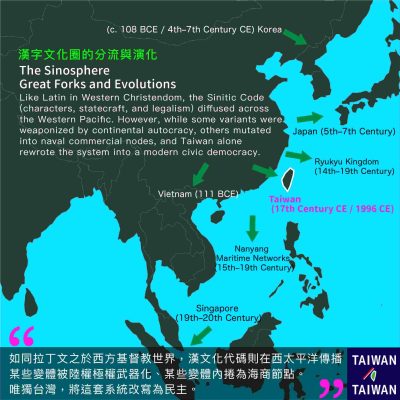
Under anthropological and historical audit, the Lunar New Year is not the private patent of any specific ethnic group or nation-state; rather, it is a seasonal marker of the East Asian Sedentary Agrarian Sinitic Sphere. Modern China, Hong Kong, Japan, Vietnam, Korea, Singapore, and Taiwan were all historical members of this Sinitic Characters Sphere (Sinosphere). Just as Europe was once united by Latin, East Asia shared the Sinitic script.
Literary Sinitic (Classical Chinese) played a role in East Asia that precisely mirrored the function of Latin in Europe. Although the spoken vernaculars of European nations were mutually unintelligible, they shared Roman law, Christian theology, and scientific paradigms through Latin as a standardized, compliant code.
Similarly, while various historical regimes in East Asia belonged to completely different language families, they ran the same statutory code (Ritsuryō), Confucian bureaucratic systems, and cosmological worldviews through written Sinitic characters.
The “Chinese New Year” we take for granted today is essentially a political label deliberately manufactured just over a century ago. Historically and structurally, it should be precisely defined as the “Sinitic New Year”—an open-source software shared across the Sinosphere. It represents two thousand years of continuous iteration that gradually evolved into a highly sophisticated technology of state-level surveillance and domestication.
The construct of the “Chinese Nation” (Zhonghua Minzu) is barely a century old. The Sinitic Code, by contrast, is a much older and more geographically vast operating system that has yielded highly divergent evolutionary lineages.
Culture, of course, does not equate to national identity or political sovereignty. While Koreans and Vietnamese share Sinitic cultural roots, they are obviously not part of the “Chinese Nation,” and their sovereignty belongs solely to their respective peoples, not to Beijing.
Because the open-source “Sinitic Code” is constantly and politically conflated with “Chinese Culture” to smuggle in nationalist allegiance, this opening chapter boards our modern HMS Beagle to demystify the Sinitic operating system that pervades Taiwanese life.
Section 1: The Genesis of “Han” and the Totalitarian Matrix of Domination
1. From an Accidental River to a Bureaucratic Label
To deconstruct the mechanics of the Sinitic script-based culture, one must trace the genealogy of the term “Han.” This word was not originally an ethnic marker, but a purely accidental geographical noun—the Han River flowing through modern Shaanxi and Hubei. It subsequently mutated into the name of an imperial dynasty, solidified into a label for a script and its compliant population, and ultimately crystallized into a cross-border operating system highly adapted to agrarian societies.
Prior to the third century BCE, there was no such concept as the “Han race” or “Han people” on the East Asian mainland. The inhabitants of these lands referred to themselves as Qin people, Chu people, Qi people, or Zhao people. Their spoken languages, customs, legal traditions, and attire were highly heterogeneous.
The “Han” were never a single, biologically defined ethnic group. Rather, they were a political and cultural community forged, homogenized, and woven together over millennia by the dual state apparatuses of the Sinitic script and the Qin-style autocratic operating system.
2. The Equity Origin of the First Empire
This transformation began with an accident of geopolitics. During the civil wars at the end of the Qin Dynasty, Liu Bang was enfeoffed by his rival Xiang Yu to the remote, marginalized region of Hanzhong (the upper reaches of the Han River) with the title “King of Han”—which carried connotations of political exile at the time.
After ultimately defeating Xiang Yu, Liu Bang established his central empire and naturally retained his prior territorial title, naming his dynasty “Han.”
Because the Western and Eastern Han Empires maintained administrative jurisdiction over the East Asian mainland for nearly four hundred years, this imperial brand became the standardized default label for the domesticated population under its rule. From this point onward, the “Sinitic Code” entered two millennia of continuous iteration, evolving from a simple administrative apparatus into a highly sophisticated technology of state-level population control and social engineering.
3. The Techno-Economic Matrix: Irrigation Agriculture and the Rigid Demand for Centralization
The birth and consolidation of the Sinitic Code were driven by the material realities of geography and climate. In a continental agrarian ecosystem, large-scale water management, the construction of thousand-mile dikes, and defense against northern nomadic incursions demanded highly centralized mobilization of labor and resources.
This material, techno-economic reality ultimately birthed the “Qin-style centralized” political machine, which prioritized the collective over the individual.
To stabilize a massive agrarian population locked to the soil and stripped of horizontal mobility, the system engineered the Confucian patriarchal hierarchy to regulate basic reproductive units and internal order. The primary, original function of this cultural software was never humanistic enlightenment, but the containment and management of a static, sedentary peasant class.
4. The Mechanics of Qin Autocracy: The Myth and Cost of State Extraction
To comprehend the genetic code of the Sinitic operating system, one must scientifically deconstruct the “Qin System” (Qin Zhi) that formed its core. In contemporary historical dramas and state-sponsored narratives, the Qin Empire’s annexation of the six states and its termination of the Warring States chaos are routinely romanticized as a pinnacle of civilizational order and a sacred historical necessity.
However, if one removes the elitist lens of the ruling class and analyzes the system through modern political science and property rights theory, the “Qin System” reveals itself as an exceptionally brutal, high-energy-consumption war machine. Its sole operating principle was the systematic eradication of individual rights to maximize resource extraction for the state.
The rise of the state of Qin was a cold, Darwinian exercise in optimization. Confronted with the predatory jungle of the late Warring States period, Qin pioneered the Shang Yang Reforms (Shang Yang Bian Fa). This systematically atomized local society by transforming every individual into a standardized, asset-stripped resource of the sovereign.
Through the coercive enforcement of registration (Bian Hu Qi Min), the state logged the entire population into a centralized ledger, implementing draconian systems of collective punishment and mutual surveillance. Individuals were legally stripped of local kinship protection, spiritual autonomy, and property security, reduced to mere digits on agricultural and military spreadsheets.
5. A Modern Civic Audit: Sacrificing the Millions to Specialize the One
Under a modern civic framework, the historical glorification of the Qin System is an epistemological absurdity. The Great Wall, the standardized road networks, and the vast territorial expansions were not public goods designed for the welfare of the citizenry.
On the contrary, they were monumental headstones built upon the systematic sacrifice of millions of lives. This was a precisely engineered institutional model designed to bankrupt and exploit the well-being of the entire registered population to capitalize the absolute power of a single individual—the Emperor.
Under the Qin ledger, the state claimed unlimited jurisdiction over the physical bodies and labor outputs of its subjects. Judged by modern global commercial standards and the rule of law, a system that could only sustain military competitiveness through perpetual state terrorism, heavy taxation, and slave labor was an institutional disaster.
The tragedy of East Asian history lies in the fact that this traumatic, dehumanizing tyranny was not quarantined as a toxic historical anomaly after the collapse of the Qin Dynasty. Instead, it was shrewdly preserved, draped in a gentle cloak of “pseudo-Confucian moralism,” and institutionalized as the bedrock of the “Sinitic Operating System” for the next two thousand years.
6. The Perfect Tool for Subjugation
Because this hybrid matrix of Qin autocracy and pseudo-Confucian moralism possessed the world’s most sophisticated techniques for population pacification and resource extraction, it produced a historical irony.
The nomadic tribes from the northern steppes who swept south on horseback and destroyed Han-ruled regimes (such as the Mongols of the Yuan Dynasty and the Manchus of the Qing Dynasty) invariably chose to adopt the Sinitic operating system once they seized control of the Middle Kingdom enterprise.
They realized that this indigenous system was the most perfect tool ever designed to subjugate and control a massive peasant population. Thus, they discarded their leather armor, donned the robes of Sinitic emperors, and seamlessly utilized this suffocating hierarchical order to extract wealth from the populace, generation after generation.
Section 2: The Four Historical Iterations of the Sinitic Operating System
This operating system for sedentary agrarian societies did not arrive fully formed; it underwent at least four major historical upgrades:
[Sinitic OS Version History]
Version 1.0 (Qin-Han)   --> "Confucian Exterior, Legalist Interior" (Moralized Autocracy)
Version 2.0 (Sui-Tang)  --> Imperial Examinations (Intellectual Property Monopoly)
Version 3.0 (Song-Min)  --> Neo-Confucianism & Clan Enforcement (Micro-Level Surveillance)
Version 4.0 (Great Qing)--> Literary Inquisitions & Memory Cleansing (Totalitarian Optimization)
1. Version 1.0 (Qin and Han Dynasties): Baseline Architecture — The Fusion of “Confucianism and Legalism”
The mighty Qin Empire was remarkably short-lived (221–206 BCE). Its rapid bankruptcy proved that raw, unadulterated physical violence is financially unsustainable for long-term territorial management. Constant internal surveillance and high-pressure collective punishments generate immense system friction, leading to sudden structural collapse.
During the Han Dynasty—specifically through the ideological engineering of Emperor Wu and Dong Zhongshu—the operating system received its critical baseline patch: the integration of “Confucianism on the outside, Legalism on the inside” (Ru Biao Fa Li).
This upgrade did not dismantle the authoritarian skeleton of the Qin war machine. Instead, it packaged the Qin system in soft, moral software. Draconian Legalist control and resource extraction were cloaked in the humanistic language of Confucian moral cosmology.
Under this framework, the system reinterpreted the absolute privilege of the monarch and the absolute submission of the subject as an unalterable cosmic alignment (Tian Ren Gan Ying), codifying this into the “Three Fundamental Bonds and Five Constant Virtues” (San Gang Wu Chang). Rebeling against the imperial court was no longer a political act; it was rebranded as a cardinal sin against the cosmic order.
Version 1.0 successfully achieved its design objective: leveraging internal moral guilt to minimize the marginal cost of external physical enforcement.
2. Version 2.0 (Sui and Tang Dynasties): Standardization — The Imperial Examination System and Monopoly of Knowledge
Following centuries of fragmentation during the Wei, Jin, and Northern and Southern Dynasties, the centralized political enterprise faced a severe challenge: hereditary regional aristocratic clans acted as powerful local shareholders, dividing central authority.
To dismantle these local strongholds, the Sui and Tang Dynasties (6th to 9th centuries CE) engineered a revolutionary administrative mechanism: the Imperial Examination System (Ke Ju).
Scientifically speaking, the imperial examination was a state-monopolized bidding process for intellectual property rights. The empire decreed that the mastery of Sinitic script and state-sanctioned Confucian classics was the sole compliant code for acquiring political dividends and bureaucratic advancement.
This forced local elites—whether clans from the sub-tropical south or scholars from the Jiangnan riverlands—to voluntarily censor their regional spoken identities and local historical memories. They dedicated their mental faculties entirely to memorizing standardized texts designated by the center.
The empire no longer needed to deploy physical force to crush local autonomy. By turning the entire intellectual class into humble supplicants for state-sanctioned privilege, it achieved total, standardized compliance across its territory.
-
Korea imported this exam system under the Goryeo Dynasty (958 CE). It remained the core mechanism for civil service selection during the Joseon Dynasty until its formal abolition during the Kabo Reforms of 1894.
-
Vietnam implemented the imperial examinations longer and more comprehensively than any country outside China. Introduced during the Ly Dynasty in the 11th century (1075 CE), the system persisted until 1919 under the Nguyen Dynasty—outlasting China’s own abolition of the exams in 1905.
-
Taiwan, by contrast, was integrated into this system latest of all. The exams were introduced during the Kangxi period (1686) under Qing rule. Taiwanese candidates had to pass local entry exams (Tongshi) to become licentiates (Xiucai), cross the sea to Fuzhou for the provincial exams (Xiangshi) to become provincial graduates (Juren), and journey to Beijing for the metropolitan exam (Huishi) to obtain the highest degree (Jinshi).
3. Version 3.0 (Song and Ming Dynasties): Micro-Level Internal Control — The Neo-Confucian Cage and Clan Enforcement
Confronted with relentless military pressure from northern steppe empires (Liao, Jin, Yuan), the Sinitic operating system during the Song and Ming Dynasties (11th to 17th centuries CE) executed a defensive, inward contraction.
This period birthed Neo-Confucianism, spearheaded by Zhu Xi, which successfully scaled down the totalitarian matrix of state domination from the macro-level of the state to the micro-level of individual physical existence.
The Neo-Confucian paradigm grafted state enforcement mechanisms directly onto the biology and private conscience of subjects. The ideological dogma of “preserving heavenly principles and extinguishing human desires” (Cun Tian Li, Mie Ren Yu) institutionalized cultural violence, standardizing female chastity and the systematic physical mutilation of foot-binding.
Simultaneously, the imperial court outsourced local disciplinary power to kinship clans through ancestral halls, genealogies, and clan laws. Elders received legal impunity to execute non-compliant members using clan-administered extrajudicial punishments (such as drowning in pig cages).
Version 3.0 successfully automated despotism, weaving the entire population into a self-censoring, mutually spying, and collectively confined web of social control.
4. Version 4.0 (The Great Qing): The Zenith of Imperial Control — Literary Inquisitions and Memory Cleansing
The Sinitic operating system reached its zenith during the High Qing era (17th to 18th centuries) through an irony of history: it was fully hijacked and optimized by a tiny foreign ruling elite—the Manchus.
The Qing emperors were acutely aware of their numerical vulnerability. Recognizing that this indigenous Sinitic matrix was the most perfect machine on Earth for domesticating agrarian populations, they did not destroy it. Instead, they reverse-engineered the system, packaging themselves as the supreme guardians of Confucian orthodoxy.
Under Version 4.0, the techniques of state terrorism reached a pinnacle. The Qing court launched the largest literary purge in human history. The compilation of the Siku Quanshu (Complete Library of the Four Treasuries) was fundamentally a severe ideological audit designed to censor, sanitize, or incinerate any writings hinting at local subjectivity or historical autonomy.
Complemented by perpetual “literary inquisitions” (Wen Zi Yu), the empire locked the intellectual class into a state of permanent terror.
By the eve of Liang Qichao’s debut at the end of the 19th century, Version 4.0 had completed its evolutionary loop. It had successfully castrated hundreds of millions of individuals into atomized, compliant registered assets (Bian Hu Qi Min) completely devoid of civic consciousness. When confronted with the dynamic maritime civilizations of the West and modern industrialization, the system fell into terminal paralysis.
Section 3. Cross-Border Deployment of a Classic Software: The Chartered Transfer of Resource Extraction Technology
Observed through the lens of a modern HMS Beagle, the Han cultural operating system is undoubtedly a crowning masterpiece in human history. It is a highly resilient suite of survival software that enabled hundreds of millions of people to survive over two millennia of natural disasters and warfare across the vast, continental landmass, all while maintaining fundamental social order in the absence of modern technology.
Its built-in credit codes—such as Confucian ethics, kinship networks, and Han characters functioning as a universal compiler—drastically reduced transaction costs and provided psychological anchoring for an immense population of sedentary agriculturalists.
This formidable systemic efficiency explains why this operating system effortlessly transcended geopolitical borders and was actively adopted by surrounding regimes in Korea, Vietnam, and Japan. For these emerging regional states, the Han cultural matrix was not a product of political conquest, but the most advanced “civilization tech-kit” on the East Asian subcontinent.
This tech-kit underwent two critical waves of “Global Deployment” in history:
The first wave was the “Beta Release” during the Han and Wei dynasties (approx. 2nd century BCE to 4th century CE). Facilitated by physical coupling through the Four Commanderies of Han and migration waves, it exported Han characters, metallurgy, and rudimentary bureaucratic concepts to the Korean Peninsula and northern Vietnam, providing these tribal alliances with their initial literacy and hardware upgrade.
The second wave was the “Flagship Release” during the Sui and Tang dynasties (7th to 9th centuries CE). With the compilation of the Code of Tang and the imperial examination system, this highly mature “matrix of penal codes and Confucian bureaucracy” became the ultimate governance software frantically imported by peripheral states.
Sharing the same sedentary agricultural ecology as the Central Plains, Vietnam and Korea found the Tang Empire’s centralized model to be the perfect solution against internal aristocratic fragmentation and external existential threats. Consequently, kingdoms like Goguryeo, Silla, and early Vietnamese regimes actively installed this OS, using the matrix of penal codes and Confucian bureaucracy to dilute the power of local clans and erect a centralized bureaucratic grid. The installation of the system in these two nations was a continuous process of system replication, executed under the rigid, centuries-long pressure of Chinese military expansion and physical border coupling.
However, the “trans-oceanic export” of Han culture beyond the East Asian mainland was an entirely different story. In antiquity, the ocean served as an insurmountable geopolitical firewall; projecting military force or executing large-scale colonization across the sea posed physical limitations that the Central Plains empires could not technologically overcome.
Japan’s Yamato court, shielded by a marine barrier and untouched by Chinese military conquest, experienced profound existential anxiety during the 7th-century “Taika Reform” upon witnessing the massive technical gravity of the Tang Empire crushing the Korean Peninsula. The Yamato court thus transformed itself into a wholesale “tech importer.” Defying the deadly perils of primitive navigation, Japan-bound vessels broke through the waves as envoys to Sui and Tang to actively pull Han characters, Buddhism, and the Ritsuryo legal system back to the islands, violently formatting a fragmented tribal society dominated by regional clans into a mature aristocratic state centered around the Emperor.
This software was capable of cross-border deployment precisely because it represented the optimal algorithm of its time for stabilizing regimes and organizing society.
Japan’s mindset of seeking advanced governance across the sea would manifest once again over a millennium later in the “Meiji Restoration,” except that the learning target would shift completely from Chang’an’s “Han cultural system” to a Western “modern civilization system” with an entirely different ethical matrix.
Yet, when this Han cultural system was finally brought to Taiwan in 1661 by Koxinga (Zheng Chenggong) and his fleeing army of tens of thousands, it was a mere two centuries away from Japan’s 1868 Meiji Restoration. By then, the world’s “optimal algorithm” was no longer the Han operating system, which had been running on rigid Confucian classics for two millennia.
This moment was also just over two hundred years before Han Culture Version 4.0 would meet its ultimate crash after its zenith—when the Qing Empire was utterly defeated in the 1895 First Sino-Japanese War by a Japan that had newly upgraded to the Western system.
This historical and temporal intertwining collided to produce a drastically different geopolitical script. For Taiwan, prior to the Age of Discovery, the Taiwan Strait and the Kuroshio Current acted as both a natural physical firewall against external powers and a massive home port absorbing and expanding the global geopolitical reach of the Austronesian peoples.
Taiwan at the time was a self-contained, independently running marine Austronesian ecosystem. Its underlying code was a wild logic of coexistence with mountains and oceans, completely disjointed from the Central Plains’ closed, land-power system that relied heavily on sedentary agriculture and household taxation. Imperial China essentially dismissed the island as an “overseas barren wildlands of no governance value,” as its hardware was functionally incompatible with the continent’s closed-source, agrarian system.
Thus, Han culture in Taiwan was neither forcibly installed through contiguous military expansion like in Vietnam, nor proactively “pulled” across the sea out of geopolitical anxiety like in Japan. Instead, amid the geopolitical tsunami of the Ming-Qing transition and the collapse of a regime, it was Koxinga’s fateful flight that abruptly “airdropped (Pushed)” and forcefully overlayed this twilight, pre-crash system onto Taiwan’s marine hardware.
This sudden code drop shattered the island’s original ecological balance. Yet, precisely because this island had never been systematically formatted by the Central Plains’ two millennia of feudal legalism, it retained its purest marine wildness and heterogeneous genes.
This destined Han culture’s fate in Taiwan not to be a submissive replica, but to undergo subsequent multiple compilations with Dutch colonization, Japanese modernization, and Western democratic frameworks—unexpectedly mutating into the world’s only “oceanic-variant Han culture” seamlessly fused with human rights and freedom.
Section 4: The “Ruler-Subject, Father-Son” Formatting Code
However, this “Han cultural” code, which has run across multiple East Asian nations for over a millennium, was never merely an elegant, abstract textual phrasing found within the Confucian Classics. Rather, it operated as a highly rigid command line for “behavioral formatting.” Through the vertical gravitational grid of “monarch-subject, father-son,” it functioned as the system’s underlying communication protocol, hard-coded directly into the hardware of everyday civilian life. This protocol systematically erased individual autonomy from within and severed all horizontal social connectivity from without, flawlessly executing the authoritarian empire’s property extraction and data monopoly through non-stop, twenty-four-hour behavioral surveillance.
[The Vertical Access Control List (ACL)]
       Superior Node (Ruler / Father / Elder)
                    │   ▲
                    │   │  Absolute Subjugation / Sacrifice
  Unlimited Access  │   │  ("Filial Piety" / "Loyalty")
  & Extraction      ▼   │
       Inferior Node (Subject / Child / Youth)
Title as Privilege: The Isomorphic Symmetry of Home and State
Within the Sinitic operating system, “Ruler, Subject, Father, Son” is not a guide for moral self-cultivation; it is an absolute Access Control List (ACL). The system does not recognize the independent existence of the individual. Instead, every person must be assigned to a coordinate on a vertical grid.
Nodes occupying superior coordinates (ruler, father, elder) hold near-unlimited access and administrative privileges over inferior coordinates (subject, child, youth). The only system command available to the inferior node is “subjugate and sacrifice.”
“Filial piety”—defined as absolute obedience and sacrifice to the patriarch—is the domestic equivalent of a subject’s unconditional loyalty to the sovereign. The oppression is structurally identical, scaling seamlessly from the family unit to the imperial state:
“Transposing Filial Piety into Loyalty”: The Patriarch as the Imperial Proxy
The Sinitic OS has maintained its grip on the East Asian mainland for thousands of years because it pre-installs a Trojan horse named “Filial Piety” into the private mainframe of every family from early childhood.
The system’s most sophisticated control algorithm lies in its ability to seamlessly transpose domestic resource extraction into imperial political enslavement. “Filial piety” functions as a pre-installed local proxy agent, conditioning the subject to surrender unconditionally to the sovereign.
While Western and maritime civilizations generally view children as independent individuals and parents as guardians, the Sinitic system treats children as the private property of their parents.
Through this patriarchal-imperial isomorphism, every father is compiled into a micro-dictator, executing micro-level obedience training and cognitive castration during an individual’s childhood.
On this grid, children must unconditionally yield their financial assets, career choices, and marital autonomy to feed the status and honor of the patriarch within the clan network. Individual self-actualization is flagged as “selfishness and rebellion.” One is only granted the system-certified label of a “filial child” by downscaling and sacrificing oneself as raw fuel for the family matrix.
Once the family mainframe is sanitized of individual property rights and grievance channels under the dogma of “the infallibility of parents,” the public space is primed to run the imperial counterpart: “If the ruler commands the subject’s death, the subject must self-terminate.”
This chained algorithm binds “loyalty” and “filial piety” under the guise of morality. By training individuals within the home never to defy the patriarch, to surrender personal assets, and to suppress their own will, the state ensures that their psychological defense lines and logical subjectivity are fully castrated long before they enter society.
When the state machine activates, the sovereign merely needs to execute the same command line. Both individuals and collectives will seamlessly transfer their domestic submission into blind obsequiousness toward the dictator.
Ironically, the more ruthless and tyrannical the dictator is, the more likely he is to trigger Stockholm-like attachment. The ruler’s cruelty taps into childhood traumas of surviving an unpredictable, all-powerful “strict father.”
In this distorted psychological loop, the ruler’s brutality is not met with resistance. Instead, the subject’s cognitive defense system automatically rewrites it as “parental tough love.” Unable to bear the existential dread of being abandoned by the “holy sovereign-father,” the individual self-hypnotizes, finding comfort in their exploitation and developing a fanatical worship of authority.
This psychological backdoor, which views the abuser as the savior, remains the most resilient and toxic Trojan horse within the gravitational pull of the Sinitic imperial matrix.
Rituals of Submission: From Public Buses to Corporate Offices
Consider the disputes over “priority seating” on public buses in Taiwan. When an elderly believer in the Sinitic Code demands that a younger passenger surrender their seat, he is operating under the “superior administrative privileges” granted to him by the system.
He is not appealing to empathy; he is executing a physical demonstration of vertical class order: “I am the elder; therefore, you must yield your space and submit to my rank.” The superior node does not want assistance; he requires the inferior node to perform a public ritual of submission and surrender of rights.
In South Korea, where the Sinitic Code is deeply entrenched, this hierarchical submission has mutated into an even more suffocating protocol.
Despite South Korea’s cutting-edge status in semiconductors and global pop culture, its societal bedrock runs on a rigid neo-Confucian seniority system and the asymmetrical “Gap-Eul” (dominant-subservient) dynamic.
In South Korea, age and administrative rank serve as absolute power keys. If someone is even a single year older or one step higher in the hierarchy—such as a paying client (Gap) versus a service provider (Eul)—they possess the systemic privilege to demand compliance and dictate terms to your body and mind.
In the horizontal credit system of maritime commerce, an employee and an employer are partners bound by a mutual contract. In the Sinitic matrix, however, a manager does not look for “professional output”; he demands submission and personal dependence.
An executive does not merely want excellent work delivered during business hours; he demands a “proof of submission”—typically demonstrated by an employee drinking to excess at an after-hours dinner while remaining thoroughly obsequious.
Within this “micro-Qin system” gravity well, declining a dinner invitation or offering a dissenting view in a meeting is compiled by the system as “insubordination” or “irreverence.” To survive, the individual must shut down their own logic and creative faculties to anticipate and soothe the emotions of the superior (the “imperial will”). Failure to do so invites workplace bullying and social downgrading.
This toxic matrix, which confiscates individual autonomy and professional identity in the name of seniority, leaves many creative young minds on the peninsula feeling systemically depressed and suffocated.
Section 5: Sinitic Code Parasitizing Modern Politics: The “Patriarchal Politics” of Perpetual Infallibility
When the “Ruler-Subject, Father-Son” code parasitizes modern East Asian political institutions, it consistently breeds a highly isomorphic entity: the Mimetic Patriarchal Politician. This occurs regardless of whether the state is legally structured as an authoritarian empire, an emerging democracy, or a high-tech semiconductor hub.
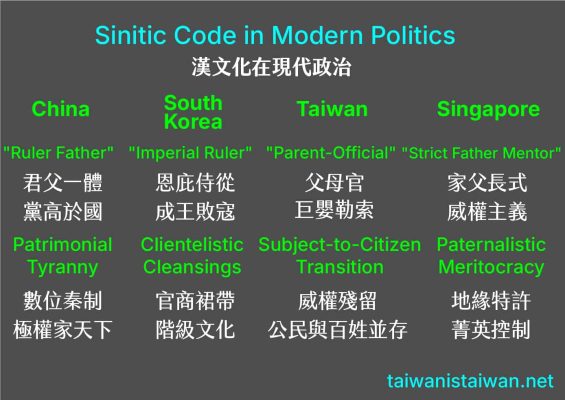
China: Digital Qinism and “Ruler-Father” Patrimonial Tyranny
In China, this code has undergone its most unvarnished, literal restoration. The reboot of the totalitarian Qin system has yielded a highly centralized “Ruler-Father Unity,” erasing any distinction between the state and the ruler’s private estate.
The nation is run not on a constitutional contract, but as the private property of the sovereign. The supreme leader is coded as the “irreplaceable sovereign-father of all China.” Everything from extreme pandemic lockdowns and censored speech to economic extraction is packaged by the propaganda apparatus as “a strict father disciplining and protecting his children.”
The concepts of “the state loves you” and “listen to daddy” are crudely coupled at the machine-code level. Under this political algorithm, citizens are downscaled into infants stripped of individual agency. Any rational debugging of state policy, or even protests against basic hardships, is automatically compiled as “filial disobedience” and treated as treason.
When systemic disasters occur, the ruling machine shifts the blame to Western imperialism, hostile foreign forces, or external environments. Predictably, the populace reacts by “rallying around the center.” Because the patriarchal regime monopolizes all resources, the collapse of the “patriarch” threatens to disconnect the entire survival network.
Terrified of chaos and abandonment, ordinary citizens activate a self-preserving psychological defense: they rationalize the ruler’s cruelty as a “necessary discipline required to allocate limited resources and defeat external enemies.”
This collective Stockholm syndrome strengthens the gravity of the Qin patriarch with every crisis. The consensus becomes: “Only strict discipline can make the nation strong.” And when the state grows powerful enough to extract resources from the outside world, everyone expects to share in the spoils.
Whether it is the aggressive rhetoric of “keeping the island [Taiwan] but discarding its people” or remaining silent as the government spends tens of billions on foreign aid in Africa, the underlying psychological mechanism is the same: “If the regime succeeds in its plunder, I too will receive a share of the dividend.”
This calculus of “investing in tyranny to share the spoils” induces individuals to willingly castrate themselves within the family and society in exchange for survival privileges under the imperial shadow.
This survival logic, which depends entirely on the sovereign-father, manifests internationally as a feudal warning: “You shall not eat my food and then smash my pot!” This is the most overt psychological relic of the Sinitic “home-state isomorphism.”
In the modern oceanic order, the contributions of Taiwanese businesses, foreign enterprises, and cultural figures are based on equal, mutually beneficial contracts and market exchanges. Within the patrimonial mindset, however, all commercial activity is distorted into “the patriarch’s benevolent charity.” Every dollar earned is viewed not as the fruit of professional labor, but as a feudal handout from the sovereign-father.
Therefore, if you “eat his food,” you must surrender your soul and pledge absolute submission. Any assertion of independence is branded as a “rebellious son smashing the pot.”
South Korea: Hyper-Concentrated Executive Power and Clientelist Patronage Within a Democratic Framework
Even in South Korea—where democratic competition is fierce and the public routinely takes to the streets in mass protest—the latent “monarch-subject, father-son” cultural codes are instantly reactivated once politicians enter the core of power. This authoritarian gravity hardens institutionally into hyper-concentrated executive power—a constitutional setup that grants the president near-absolute, unchecked dominance over the executive, budget, judiciary, and prosecution, operating as a power monster within a democratic shell. Socially, this power structure evolves into a “Neo-Confucian capitalism” deeply entangled with the chaebols.
Within this system, political leaders struggle to position themselves as contractually bound administrators. Instead, they unconsciously inherit the role of a feudal patriarch, converting public resources into leverage for clan-based patronage and factional arbitrage.
This represents a uniquely East Asian form of “Confucian” clientelism. Under the moral gravity of Confucianism’s “differential mode of association” (差序格局), once an individual rises to power—such as winning the presidency or a mayoral election—failing to distribute resources and official posts to the disciples, hometown networks, and juniors who supported him is not merely a matter of political calculation; it is condemned by society as a moral failure—an act of being “heartless, treacherous to one’s mentors, and filially impious.” When the ethical obligation to maintain the private morality of the inner circle completely overrides the public morality of the rule of law, political parties and power centers inevitably degrade into miniature feudal factions and vassal retinues, bound by fictive kinship and the deeply entrenched “Gap-Eul relationship (갑을관계)”—a cultural matrix of absolute hierarchical dominance and submission.
In the dining culture of South Korean politics, younger politicians perform rituals of submission to their seniors or superiors at the dinner table. These “disciple rites” serve as test environments for the patriarch to evaluate who is the most obedient and capable of “transposing filial piety into political loyalty.”
Within political parties and conglomerates (Chaebols), loyalty to the leader always supercedes professional competence. The political leader acts as a patriarch, treating state resources as private assets to be distributed among his loyal followers, who in turn maintain a suffocating personal dependence on him.
Under the influence of this concentrated “Ruler-Subject, Father-Son” gravity well, South Korean politicians view admitting mistakes or apologizing as fatal to their political survival. To acknowledge a policy flaw is to be exposed by rivals and voters as “lacking the moral legitimacy of a patriarchal ruler,” inviting swift political ruin.
This refusal to compromise—where apologizing is equated with weakness—leads to compounding system errors. When a patriarch makes a policy misstep or a corrupt blunder, the system’s default setting is never to debug. Instead, it deploys state power to block, cover up, and construct larger lies.
To mask minor errors, they engage in deeper factional spoils and backroom deals. However, this “unlimited defense of the ego” causes minor vulnerabilities to mutate into massive systemic crises.
Because power is finite, the moment the patriarch steps down and loses his immunity shield, the successor launches a purge under the banner of “cleansing the past.” By sacrificing the former patriarch, the new leader establishes their own moral legitimacy and authority.
In this moralistic algorithm, authority is derived not from constitutional text, but from unchallenged moral supremacy. This presents every incoming leader with a systemic challenge: How do I prove that I possess a greater mandate and higher moral standing than my predecessor?
The fastest, lowest-cost method that satisfies the collective subconscious is to execute a political “patricide and sacrifice.”
This explains the tragic trajectory of South Korea’s past presidents, who frequently end up disgraced, imprisoned, or worse. This is not merely partisan warfare; it is the inevitable system deadlock that occurs when the Sinitic patriarchal code runs on a modern democratic platform, manifesting as the modern equivalent of an imperial succession ritual: executing the old ruler to legitimize the new.
Taiwan: How the “Parent-Official” Code Breeds Civic-Deficient Infantile Subjects
In Taiwan’s historical trajectory, this patriarchal political style was refined and deployed by Chiang Ching-kuo in the 1970s. Faced with a dual crisis of international delegitimization and the rise of local Taiwanese political consciousness, this practitioner of authoritarian control executed a strategic algorithm upgrade.
He shed his austere military uniform for casual youth jackets, actively transposing his political persona from an “aloof monarch” to a “neighborhood friend and loving father.” His visits to local stalls and handshakes with farmers were highly tactical. When an imported regime can no longer prove its legitimacy through legal or constitutional means, the ruler must establish himself emotionally and morally as the island’s indispensable “strict father and loving mother.”
He took professional infrastructure budgets and engineering projects—financed entirely by the taxes of Taiwanese citizens—and packaged them through his personal moral authority as “benevolent policies” and “gifts from a caring parent to his children.”
The Trojan Horse & Captured Civil Society
This aesthetics of patronizing benevolence—a calculated mix of patriarchal authority and maternal nurture—successfully implanted an emotional Trojan horse into the minds of countless Taiwanese. Even though Taiwan has fully democratized its institutional hardware, and should theoretically champion a modern civic consciousness built on a reciprocal balance of rights and obligations, the legacy software of the authoritarian “parent-official” remains deeply entrenched.
Consequently, many politicians have no structural need to position themselves as professional managers contractually hired by the electorate. Instead, they remain eager to play the role of a compassionate patriarch guiding his children, repackaging modern representative budgeting and public infrastructure as the personal moral achievements of a “parent-official who suffers alongside the masses.”
Unlike Western democracy—where “citizens came first, followed by democratic systems,” emerging organically from autonomous social networks like churches and labor unions through reform and struggle—many of Taiwan’s grassroots and civil society organizations have long been dominated by the legacy of the Kuomintang (KMT) regime and corporate cartels. These groups are easily instrumentalized, leveraging votes as a tool to engage in arbitrage over local development projects, and are increasingly targeted by Beijing’s united front apparatus, degrading into tools for political and cognitive warfare.
Given that too many of these civic organizations harbor hidden agendas, while genuine, independent citizens remain highly fragmented, politicians realize that investing effort into explaining complex policy negotiations and compromises is politically inefficient. It is far easier to perform a political melodrama of the “benevolent magistrate acting on behalf of the weak” in front of the cameras. This performance translates infrastructure financed entirely by taxpayers’ money into their own personal “benevolence”—a symbolic theater that consistently harvests votes.
The Educational Vacuum and Cognitive Backdoors
Under the combined pressure of legacy party-state brainwashing, systemic arbitrage, and the continuous reinforcement of “parent-official” political performances, Taiwan has cultivated a population of psychological infants. They exist in a state of fractured agency: under the weight of authoritarian pressure, they act as submissive subjects who voluntarily surrender their power of oversight; yet, in an environment of freedom, they instantly mutate into an entitled rabble, weaponizing their ballots to blackmail politicians for short-term handouts, while refusing to shoulder any civic responsibility.
The core tragedy of this democratic transition lies in the educational vacuum. Following political democratization, Taiwan failed to utilize its public education system to radically de-compile and deconstruct the historical mythologies woven by the KMT and the CCP alike. Because the state failed to install this critical software update of modern constitutional civic consciousness, the gravity well of the old feudal operating system persists. Paradoxically, this un-cleansed legacy code has now become the most vulnerable backdoor for the contemporary Chinese totalitarian regime’s united front operations and cognitive warfare.
Singapore: The “Calculated Patriarchalism” of a High-Tech Nanny State
Lee Kuan Yew and his People’s Action Party (PAP) engineered a highly precise social system on a tropical island. His governing philosophy demonstrates two key variations of the patriarchal code:
No Need for Civic Rights under a “Tiger Mom”
Lee Kuan Yew made no secret of his skepticism toward modern Western maritime values like liberalism and democracy, famously arguing that “one man, one vote” was ill-suited for leading Asian societies.
In Singapore, the government functions as a highly meticulous and strict “Tiger Mom.” It manages everything from your housing (the Housing & Development Board quota system) and your neighbors’ ethnicities to family planning, waste disposal, and the sale of chewing gum.
Exchanging Obedience for Performance
The core logic of this patriarch’s system is: “I am doing this for your own good.” The state delivers exceptional performance metrics—a clean government, high economic growth, safety, and public order.
The algorithm operates on a simple transaction: “As long as the patriarch provides food, shelter, and security, the children do not need independent political agency. Any challenge to the patriarch’s authority is branded as ingratitude and a threat to family harmony.”
While Singapore is often praised for its “rule of law,” it actually operates under Rule by Law—utilizing legal codes as instruments for the patriarch to manage his household. In Singapore, the relationship between citizen and state is not one of sovereign and agent, but of a minor and a guardian.
Unlike China’s physical purging of dissent or South Korea’s historically violent political crackdowns, Singapore’s calculated patriarch does not use extrajudicial violence against political rivals or critical media. Instead, the state deploys elite legal teams to sue opposition figures for defamation in court, bankrupting them or forcing them into exile.
This represents the peak of patriarchal authority: using the household rules (the law) to systematically dismantle the capacity to resist.
By co-opting top talent into the civil service and state-backed enterprises (such as Temasek Holdings) with high salaries, the patriarch maintains a loyal administrative class. The prerequisite, however, is the surrender of independent political subjectivity to execute the patriarch’s will.
This has cultivated a highly rational, collective compliance: “Comply with the patriarch, and you will be rewarded with security; defy him, and you will be systemically marginalized.”
Singapore’s success proves that when the Sinitic patriarchal code is integrated with modern management science and efficiency, it can construct an exceptionally stable governance model. Its economic success leads observers to seek a “strong parent,” believing that strict penalties and top-down governance are the sole path to prosperity.
However, Singapore’s prosperity is not merely the product of “Confucian values, smart patriarchs, and compliant citizens.” It is highly dependent on a geopolitical charter concession.
Positioned at the throat of the Strait of Malacca, Singapore serves as a critical strategic, financial, and shipping gateway backed by Western maritime powers.
Secured by the implicit safety umbrella of Anglo-American naval hegemony, Singapore has been able to leverage its strategic geography to capture immense global trade flows despite its lack of a natural hinterland. This unique geopolitical position has allowed its internal restrictions on political rights, press freedom, and dissent to be accommodated by the international order.
Without this specific geopolitical gravity field, even the most calculated patriarchal algorithm would have remained confined to a tropical island.
Chapter Summary
The Cost and Limitations of the Sinitic Operating System: The Structural Barrier of Missing Horizontal Trust Technologies
Any software system optimized to its absolute limit inevitably carries fatal architectural debt. The core cost of the Han cultural operating system is the wholesale sacrifice of individual freedom and horizontal social autonomy in exchange for macro-stability when confronting continental-scale catastrophes.
Because the underlying kernel of this system was engineered around “Qin-style centralization,” it harbors a deep-seated, systemic paranoia and fear of any form of decentralized, autonomous horizontal connectivity. Within this ecosystem, the state recognizes only two dimensions of interpersonal structures: the vertical, absolute submission of the “monarch-subject” relationship, and the “father-son” credit chain locked down tight by bloodlines. Any horizontal organization that transcends clan bloodlines and bypasses government surveillance—be it a commercial guild, a private academy, or a religious fellowship—is automatically flagged by the empire’s security system as a high-risk virus with the potential to “gather crowds for rebellion.”
Consequently, this operating system is structurally incapable of spontaneously evolving the institutional tools of a “high-trust, horizontal contractual civilization.” Technologies such as joint-stock corporations, an independent rule of law, contractual credit among strangers, and public civic consciousness find no soil in which to grow within this architecture. Under the gravitational pull of vertical authority, individuals can only protect themselves through systemic cynicism and fragmented atomization. Society thus degrades into a “sheet of loose sand,” devoid of the structural momentum for bottom-up self-organization, ultimately driving the state to morph into a grotesque leviathan that monopolizes all social data and resources.
The Forcible Binding of Political Unification via Cultural Codes
Yet, the true historical tragedy lies not in this software itself, but in the deception of political ideology—permanently locking this open-source cultural code onto the hardware of imperial totalitarianism.
The Han cultural operating system was never merely the sum of script, rituals, and customs; it was a highly politicized software engineered for resource extraction and social control. For two millennia, the Central Plains empires successfully translated “private moral submission” into “absolute allegiance to a unified political order” by hard-coding Confucian ethics into the bureaucratic apparatus and legal matrices. The continental land-power narrative continuously instilled a myth: that to run the Han cultural software, one must submit to the vertical extraction of the Qin-style imperial hardware. This forced bundling imprisoned countless generations in a closed evolutionary cul-de-sac, causing people to mistake the rich nutrients of cultural tradition for the suffocating shackles of centralized authoritarianism.
This calculated binding of politics via cultural codes forged an incredibly resilient gravitational pull for the continental land-power empire, yet it simultaneously became a closed shackle that suffocated regional heterogeneity and evolutionary possibilities. However, as history stepped into the dynamic oceanic era, this classic system confronted an unprecedented environmental crisis. When the closed continental plains were overtaken by the open currents of global maritime networks, the underlying bugs built into Version 4.0—systemic rigidity, the absence of horizontal trust, and the erasure of the individual—triggered a catastrophic system crash, ultimately leaving the bankrupt empire trapped in a state of permanent systemic dysfunction.
Chapter 2: The Mythological Invention of the “Chinese Nation” and “Chinese Culture”
Preface: An Anachronistic Political Extortion
When a foreigner first sets foot in Taiwan, taking in the antique temples and Sinitic storefront signs, their immediate intuition is often: “This is Chinese culture.” However, this “Chinese culture” packaging is a construct barely a century old. In reality, its core essence is the Sinitic Code described in Chapter 1—a behavioral operating system with a two-thousand-year history of authoritarian iterations.
Take the Daoist pantheon in Taiwan as an example. Its celestial hierarchy runs entirely on the invisible source code of Sinitic bureaucracy and patriarchal status:
-
The “Heavenly Court” is the Imperial Court: The supreme sovereign, the Jade Emperor, is the celestial twin of the earthly Emperor.
-
The Bureaucratic Hierarchy: Under him serve the Wenchang Emperor over civil affairs, and the Guan Wudi over military affairs.
-
Local Administrative Nodes: Local Chenghuang deities (City Gods) act as dispatched district magistrates, while the Tudigong (Earth Gods) function as grassroots village chiefs.
-
The Code of Ritual Currency: Burning joss paper is, at its root, a spiritual transposition of Sinitic bureaucratic rent-seeking—paying administrative fees, taxes, and bribes to grease the wheels of the celestial state apparatus.
When this Sinitic software—originally engineered to domesticate sedentary peasants—escaped the maritime bans of the mainland and sailed to Taiwan in the 17th century, the symbols we take for granted today, such as “5,000 years of Chinese civilization” or “2,000 years of Chinese history,” had not yet been invented by anyone on Earth.
Between Koxinga’s landing in Taiwan with Sinitic culture in 1662—where the software underwent severe environmental rejection before being re-engineered by maritime civilization—and Liang Qichao’s fabrication of the concepts of the “Chinese Nation” (Zhonghua Minzu) and the modern political “China” (Zhongguo) in 1902, exactly 240 years elapsed.
Therefore, asserting that “Taiwan has been an inalienable part of the Chinese nation and Chinese culture since ancient times” is, from a chronological standpoint, an absolute absurdity—a historical extortion that violates the space-time continuum.
Please board the HMS Beagle once more and fasten your seatbelts. Having dissected the natural evolution and vast territory of the Sinitic OS in Chapter 1, we now sail straight into the eye of the early 20th-century political-engineering storm. Here, we will analyze the grandest project of political genetic modification in modern history: the fabrication of “the Chinese Nation” and “Chinese Culture.”
Section 1: Four Books and Five Classics vs. Industrial Steel Hardware
Dimensional Strike from Maritime Civilization: The Decoupling of Autocracy from Competitiveness
Before the Qing Empire’s Version 4.0 operating system collided with Western maritime civilization, the commoners of the East Asian mainland had zero conception of a “nation-state.” To the individual, the world was the Emperor’s “All-Under-Heaven” (Tianxia), and government officials were merely predatory “malware” sent to extract taxes and conscript labor. Commoners cared only about grain quotas, corvée labor, and clan reproduction. They were never citizens of an empire; they were merely fuel for the autocratic machine.
In the mid-19th century, this autocratic machine slammed into an immovable wall. For two millennia, the continental “Confucian exterior, Legalist interior” matrix maintained unchallenged hegemony only because its strategic boundaries faced nomadic cavalry to the north or weaker agrarian neighbors. The dimensional strike delivered by Western maritime civilization—an OS compiled on British maritime law, Anglo-American private property rights, global equity networks, and dynamic industrial automation—triggered a fatal system shock in this closed agrarian engine.
This clash was, at its core, a battle of the Four Books and Five Classics (agrarian cognitive software) vs. steam engines, gunpowder, and global trade networks (industrial steel hardware). While one side was still using ancient Confucian manuals to expand human mental calculations, the other was harnessing physical laws and mechanical horsepower. The Qing mainframe was lagging behind by an entire evolutionary dimension.
Scientific analysis reveals that the Opium Wars and the subsequent treaties were not mere military defeats, but the total bankruptcy of the Sinitic operating system. A regime that maintains internal stability by castrating individual curiosity, enforcing maritime bans, and terrorizing intellectuals with literary inquisitions is inherently devoid of technological innovation. When dropped into the arena of global commerce and industrial warfare, the “registered subjects” (Bianhu Qimin) formatted by the Qin system exhibited zero civic cohesion, zero organic mobilization, and zero institutional resilience.
No Free Trade, Only the Beneficence of the Kowtow
When 19th-century Western powers brandished Adam Smith’s The Wealth of Nations alongside industrial gunboats to pry open the Qing Empire’s ports, it was a catastrophic clash of incompatible underlying protocols. Western mercantilists assumed they were dealing with a massive “closed market” that could be integrated through treaties and negotiations. They failed to realize that the core instruction running inside the continental autocracy was: “Under the wide heaven, there is no land that is not the Emperor’s; within the land’s borders, there is no one who is not the Emperor’s subject.”
These sixteen characters were not literary rhetoric; they were the empire’s declaration of absolute monopoly over all assets. This was an imperial operating system that fundamentally lacked the drivers for “free trade” and “private property rights.”
Within this OS, there was no conceptual space for “private domains” or “property rights.” Every patch of land, mineral vein, grain harvest, and even the labor and surplus value of the registered population was the private asset of the crown. Consequently:
-
The Reality of Foreign Commerce: When private merchants shipped domestic silk and tea overseas, the Emperor saw it as “household slaves stealing their master’s estate and illegally transferring assets to external systems.” Legally, this was branded as “smuggling” and “piracy.”
-
Data Defense Mechanisms: Unrestricted maritime trade threatened to create data blind spots that the empire could not monitor, which would deconstruct the closed, docile ecosystem of inland agrarian subjects.
-
Sandbox Isolation: The Qing state did not refuse foreign silver; rather, it insisted on sanitizing and isolating foreign contact within the “Tributary Matrix” and the “Canton Thirteen Hongs”—a tightly sandboxed, single-port trade setup.
This was a framework of “political beneficence” rather than “economic exchange.” The “barbarians” had to first upload political compliance protocols (performing the kowtow and acknowledging celestial supremacy) before the Emperor would “bestow” localized, quota-restricted trade. When Western powers demanded open ports, extraterritoriality, and free trade, they were demanding that a massive, unmonitored open-source exploit be carved directly into the Qing’s monopoly code. For an empire whose lifeblood was “absolute data control,” this was a fatal system hack.
Legal Dilemma: The Liquidation Crisis of the Qing Holding Company
As the imperial administrative apparatus slid into military collapse and fiscal insolvency, late-Qing intellectuals found themselves in a jurisprudential and geopolitical purgatory.
The Qing Empire was never a nation-state; it was a multi-ethnic “Conglomerate Holding Company” controlled by a minority clan. The Manchu emperors ruled over highly heterogeneous, disconnected territorial assets: the Han agrarian heartland (the Eighteen Provinces), the nomadic steppes of Mongolia, the oasis sultanates of Xinjiang, the monastic plateau of Tibet, and their own ancestral Manchu homeland.
The only thread binding these disparate domains into a single political structure was a single, fragile contract: personal allegiance to the Manchu monarch. Across these regions and peoples, there was no shared language, no shared historical memory, no shared legal system, and certainly no shared identity.
As Manchu authority depreciated rapidly under foreign incursions and internal rebellions like the Taiping Uprising, the conglomerate faced immediate liquidation. The core geopolitical risk was clear: the moment the Manchu Emperor abdicated, the individual asset divisions—Mongolia, Tibet, Xinjiang, and the Han heartland—would legally dissolve their contracts and revert to independent sovereign states, utterly shattering the territorial integrity of the macro-empire.
Section 2: Liang Qichao and the Intellectual Forgery of the “Chinese Nation”
“The Emperor’s Realm, Not My Country”: Civic Apathy Under the Sinitic Grid
The phenomenon of Liang Qichao lamenting that the subjects of the Qing Empire were like “four hundred million grains of loose sand” was not due to some inherent moral defect in the common people; rather, it was the inevitable output of a continental agrarian Sinitic OS running Qin autocracy for two thousand years.
In the historical archives of the 1900 Boxer Rebellion, photographic evidence thoroughly shatters modern nationalist myths. As allied foreign troops breached the Forbidden City in Beijing, crowds of local Han commoners stood calmly along the Yongding River, helping foreign soldiers push supply carts, carry equipment, and even prop up ladders to help them scale the walls of the imperial palace.
This cold detachment, bordering on betrayal, was a structural necessity. It had nothing to do with whether the rulers were Manchu nobles or Han emperors. Whether under the Qing or the ethnically Han Ming Dynasty, the basic survival calculus of the commoner remained unchanged: “That is the Emperor’s realm, not my country.”
The tragedy stems from the centralized Qin system inherited by this continental culture. When a state demands absolute obedience and endless sacrifice while providing zero legal rights, dignity, or property protections in return, the court is not seen as a protector, but as a bandit with a legal license to plunder.
If the state never respects the individual as a “citizen,” treating them instead as a tax-paying, labor-conscripted slave, then when foreigners arrive to attack the court, it is perceived merely as “one gang of rulers fighting another.” Why should the commoners care? This is the structural ceiling of the East Asian concepts of “All-Under-Heaven” and “dynastic loyalty”: there are only subjects of the crown, never citizens of a nation.
The Textual Alchemy of 1902: Welding Heterogeneous Peoples into a Monolith
Witnessing the shocking sight of local commoners holding ladders for foreign troops, Liang Qichao realized that the East Asian mainland completely lacked the “political adhesive” needed to transform these cold, alienated slaves of the Qin system into modern national citizens. To prevent the bankrupt empire from undergoing total asset liquidation, he deployed masterclass “textual alchemy,” executing a phantom restructuring of the empire’s shareholders from the tip of his pen.
The birth certificate of this geopolitical myth can be traced precisely to Liang’s 1902 essay, The Trend of Mutation in Chinese Academic Thought, in which he wrote:
“When we in China speak of nationhood, we must construct a grand nation-ethnic identity over and above our minor sub-ethnic groups, and we shall call it the ‘Chinese Nation’ (Zhonghua Minzu).”
Through this rhetorical sleight of hand, the Mongols who had massacred Han people during the Song Dynasty, the Manchus who had purged Ming literati, the Tibetan monks under the Dalai Lama, and the Muslim merchants of Xinjiang were stripped of their distinct historical trajectories overnight.
They were press-ganged into a fictitious, multi-in-one family tree. This was a textbook piece of political magic, designed solely to awaken a numb populace using a synthetic lineage myth. It enabled the incoming political regime to seamlessly inherit the entire balance sheet of the Manchu conquerors, while systematically extinguishing the legal rights of these distinct peoples to self-determination.
Section 3: The Failed Metamorphosis and the Maritime Divide
The Legal Surgery of the Meiji Restoration: Leaving Asia for Modernity
To understand the fatal inertia of the mainland operating system at this historical juncture, one must compare it to the benchmark of the era: Japan’s Meiji Restoration (1868).
Japan’s epochal paradigm shift succeeded not because they purchased superior Western ironclads, but because they performed a radical structural audit of their institutional software—from constitutional law down to the temporal coordinates of daily life. Guided by intellectuals like Fukuzawa Yukichi, the Japanese elite accurately diagnosed that the secret of Western power lay not in its warships, but in its underlying legal, financial, and philosophical source code.
Consequently, Japan systematically dismantled its feudal domains, imported Anglo-American and continental civil law systems, established a constitutional monarchy, and anchored absolute protections for private property rights. They understood that to stand on the shoulders of Western modernity, they had to sever ties with the stagnant gravitational pull of the Sinitic sphere.
This structural overhaul was not limited to high-level jurisprudence; it extended to a complete formatting of cultural temporal software. In 1872, the Meiji government decisively decommissioned the traditional Tianbao Calendar—which was bound to continental agrarian cycles—and replaced it with the Western Gregorian calendar.
This was a precise commercial and fiscal decision designed to align Japan’s temporal coordinates with the global maritime trade network, minimizing transaction friction with Western stakeholders, while cleverly eliminating leap months to reduce the state’s fiscal deficit.
With the time-keeping OS reinstalled, Japan did not discard its shared Sinitic cultural assets. Instead, it subjected them to a pragmatic “flat translation” and horizontal adaptation. Traditional festivals were decoupled from the lunar calendar and mapped directly onto Gregorian dates with matching numbers:
-
New Year’s: Shifted instantly from the lunar first day to January 1st.
-
Qixi (Tanabata): Decoupled from the 7th day of the 7th lunar month and translated directly to July 7th.
-
Tango (Dragon Boat): Relocated permanently to May 5th.
Because Japan had maintained absolute sovereign separation from the Middle Kingdom, the Japanese elite carried zero political or spiritual baggage regarding the “imperial orthodoxy” (Zhengshuo) of the Chinese calendar. To them, the calendar was merely a “technical utility” for organizing society. Fukuzawa Yukichi’s thesis of “Leaving Asia” was, at its heart, an unemotional business decision: Japan chose to uninstall the obsolete East Asian agrarian OS, download the high-velocity maritime code, and recompile its cultural assets to run smoothly on global tracks.
Within a mere three decades, Japan transformed from an isolated island nation into a top-tier shareholder in the global commercial and geopolitical arena.
Evolution of the Western Source Code: Four Epochal Nodes of Modernity
While Japan was downloading this upgrade, what did the underlying source code of Western civilization actually consist of? Unlike the static dogmas of the Four Books and Five Classics, Western civilization was never a fixed creed. It was a high-efficiency operating system that continuously debugged and upgraded itself across four critical historical nodes:
-
The 17th-Century Scientific Revolution: Founded by Bacon, Galileo, and Newton, it replaced scholastic scholasticism with empirical evidence, mathematical logic, and the scientific method. It unlocked humanity’s ability to decode the cosmos using data and evidence rather than faith in imperial decrees or divine proclamations.
-
The 17th-18th Century Enlightenment: Shaped by Locke, Voltaire, and Montesquieu, it pioneered “natural rights” (life, liberty, property) and social contract theory. It established the legal cornerstone that the state exists solely to protect private property and liberty—the absolute inversion of the Qin system’s source code.
-
The Industrial Revolution and Admiralty Law (18th-19th Century): This movement fused automated manufacturing with the global gold standard, limited liability corporations, and the absolute predictability of the British Admiralty Courts. This created an anti-fragile ecosystem optimized for global commerce and credit expansion.
-
The Westphalian and Constitutional Order: This system institutionalized the rule of law and checks and balances, ensuring state power was bound by legal compliance, and allowed regular system debugging through democratic elections without triggering total system crashes.
Cognitive Stagnation on the Mainland: Clinging to Two-Thousand-Year-Old Dogma
In brutal and tragic contrast, while the Western maritime OS was executing these epochal upgrades, and while Japan was decoding and replicating them, the intellectual elite of the East Asian mainland remained locked within a software cage designed two millennia prior: the imperial civil examination system centered on the Four Books and Five Classics.
During the Self-Strengthening Movement, the Qing court prescribed a self-deluding formula: “Chinese learning for the essence, Western learning for practical utility” (Zhongxue Wei Ti, Xixue Wei Yong).
The absurdity of this formula from an institutional-engineering perspective was staggering: it fantasized that an empire could retain absolute Qin-style tyranny, anti-commerce Confucian dogmas, and a bureaucracy whose cognitive memory was filled with ancient moral platitudes (the “Chinese essence”), while simply purchasing Western ironclads and telegraph lines (the “Western utility”).
While Western minds were developing calculus and calculating global shipping trade routes, the pinnacle of intellectual achievement for the Qing bureaucratic elite remained polishing rhetoric and structure within the rigid constraints of the “eight-legged essay”. The mainland rejected structural institutional reform, treating modern science and rule of law as mere “decorative hardware” to be welded onto a rotting, highly centralized imperial keel.
This failed lesson of “essence vs. utility” should have prompted deep cultural soul-searching during the nation-building era. Instead, even today, it remains buried under nationalist noise: “What is so great about Western civilization? We have the Four Great Inventions! 5,000 years of history! The 21st century belongs to China!”
Double Bankruptcy: The Structural Failures of 1898 and 1919
This structural incompatibility guaranteed the catastrophic collapse of both the Hundred Days’ Reform (1898) and the celebrated May Fourth Movement (1919).
-
The Utopia of 1898: The Hundred Days’ Reform led by Kang Youwei and Liang Qichao collapsed in just 103 days. It was an intellectual fantasy—a top-down palace reform that attempted to modernize the state without touching the autocratic equity of the ruling class. Lacking any foundation in modern civic property rights or local governance, it was effortlessly crushed by the entrenched Legalist deep state of the Qing court.
-
The Cognitive Deficit of 1919: Two decades later, the May Fourth Movement loudly heralded the arrival of “Mr. Science” and “Mr. Democracy”. Under a cold institutional audit, however, it was a half-baked cognitive failure.
The minds of the movement’s leaders were already deeply contaminated by the historical viruses of the Sinitic operating system. The “Science” they conceptualized was not an empirical methodology of skepticism, experimentation, and data debugging; instead, it was treated as a new absolute dogma to replace Confucian scriptures.
The “Democracy” they envisioned was not an institutional framework designed to patiently protect individual property rights and minority voices through due process. Instead, it was romanticized into a Jacobin-style collectivist mob mobilization.
Consequently, the May Fourth Movement did not steer the mainland toward a constitutional republic. Instead, it slid back into the gravitational pull of the centralized Qin system, laying the cognitive tracks for an even more extreme high-tech totalitarianism: fusing imported Leninist steel bones with the eternal continental matrix of resource extraction. The mainland missed its window of evolutionary departure. It merely fitted the two-thousand-year-old Legalist whip with a Western ideological handle.
Section 4. Language Is Power: Unmonopolized Text as the Foundation of Freedom—The Class Decoders of Textual Codes and the Information Revolution
When the continental land-power legacy mainframe underwent a catastrophic system crash in Version 4.0, swapping the traditional legalist whip for a Westernized ideological handle, a more covert yet profoundly impactful low-level transformation was running beneath this radical hardware modification—a fundamental compiler refactoring (Compiler Refactoring) targeting the media of information transmission.
I. Proprietary Private Code: The Class Formatting of Characters and Literary Chinese
Any software system optimized to its absolute limit inevitably erects the highest privilege firewalls around its media of information transmission to maintain the vertical gravitational pull of its centralized authority. For two millennia, the core control mechanism of the Han cultural operating system has been this precise set of “proprietary private code”—Chinese characters and Literary Chinese (Classical Chinese).
In the early stages of its dissemination during the Qin and Han dynasties, the Chinese writing system was actually a highly expansive “graphical user interface (GUI).” As a logographic script, it functioned as a “cross-linguistic universal compiler.” While the spoken pronunciations (audio) of various regional dialects across the vast plains were as distinct as foreign tongues, the visualization of “horse” or “mountain” allowed different brains to synchronously decompress the exact same mental imagery. However, as the civilization grew more complex, the system ran a fatal iteration to accommodate abstract political doctrines and legal statutes: the vocabulary proliferated into tens of thousands of characters, and character forms, meanings, and pronunciations became completely decoupled.
Consequently, Chinese characters technically evolved into encrypted files characterized by “high-density compression coupled with astronomical decoding costs.” Literary Chinese operated like a high-level compressed archive (.zip), where a single character could encapsulate immense historical allusions and philosophical resonance. The fatal bug, however, was that the user’s “brain terminal” had to pre-install a massive knowledge base (mastery of the Confucian Classics) just to decompress and comprehend it. A commoner had to expend over a decade of wealth and leisure in rote memorization just to acquire this “decompression” capability.
From a telecommunications engineering perspective, this was a sophisticated monopoly on proprietary technology by the ruling class. Over ninety percent of the ordinary population within the Central Plains empires was structurally formatted into illiteracy, as the state permitted only a tiny fraction of the “literati class”—those who had unlocked the code—the exclusive privilege of interpreting imperial edicts and legal statutes.
For the continental land-power empire, this high-barrier Literary Chinese code served as the ultimate ideological firewall against political fractals (Fractal). In the realm of political engineering, language acts as the ultimate catalyst for “nation invention.” The moment commoners are allowed to use phonetic scripts they can intuitively hear and understand, the monopoly on knowledge shatters. When ordinary people begin to read, record localized history, and cultivate regional identities—when scripts for Cantonese, Min, or Korean proliferate among the populace—localized autonomous consciousness awakens, causing the empire’s cultural gravity to collapse.
Cultural fractals inevitably trigger political fission, birthing multiple independent nation-states out of linguistic divergence. For the Qin-style autocracy, this meant the vertical gravitational grid of centralization would fail, rendering the empire incapable of executing cross-regional, frictionless resource extraction. Therefore, forcibly locking down Chinese characters and Literary Chinese, while systematically eradicating all other emerging textual inventions, became an indispensable defense patch for the hardware of political unification.
The grand narrative of Chinese unification has long distorted history, vilifying the lack of independent scripts among peripheral nations or continental dialect groups as a symptom of their “primitive backwardness and lack of intellectual capacity for textual invention.” Yet, in the brutal reality of historical evolutionary games, any heterodox code that attempted to textualize local speech to foster autonomous consciousness was immediately flagged as a system virus by the vertical gravity of the monolithic state and subjected to devastating evolutionary suppression and dynamic erasure.
II. Reclaiming Cultural Hermeneutics: The Code Resistance of the Hangul System
The invention of the Hangul system by the Joseon Dynasty in the 15th century stands as a triumphant historical case study of the survival of “code resistance” behind an “autonomous sovereignty firewall.” At the time, Joseon functioned as an outsourced client running the Han cultural operating system. The grassroots populace, unable to comprehend the high-barrier Chinese characters used in official statutes, was left entirely at the mercy of the Confucian privileged class in matters of taxation and litigation. To shatter the Yangban aristocracy’s monopoly over this proprietary code, King Sejong the Great secretly engineered an “open-source, low-barrier” new textual operating system—Hunminjeongeum (Hangul).
This was a purely phonetic script (alphabetic system) that reduced the user onboarding cost (Onboarding Cost) to the absolute minimum. The core logic of a phonetic script is “speech is text”; it requires no complex external decoders. As long as the terminal hardware (the human brain) possesses basic auditory and vocal functionality, it can synchronously stream information (Streaming) in real-time. This was essentially a technological revolution that fully open-sourced the rights to literacy, triggering an instantaneous awakening of popular intellect by drastically expanding the collective information bandwidth of society.
Yet, when this new system was deployed in 1443, it immediately provoked frantic resistance from the imperial Confucian bureaucracy. The literati faction, led by Choi Man-ri, vehemently argued that abandoning Chinese characters constituted a form of geopolitical “self-disconnection”—a regression into barbarism that would alienate the Ming Dynasty mainframe. In reality, they were acutely aware that if low-born servants and peasants could decode the law in real-time, the vertical class privileges of the Yangban would face immediate backlash.
This palace struggle in East Asian history was far more than an underlying protocol war between an “open-source phonetic network” and “closed logographic authoritarianism”; it was a mortal combat to reclaim cultural hermeneutics and consolidate political sovereignty. Because Joseon maintained a physical geographic distance from the Central Plains, this open-source code managed to survive within the margins of the mainstream. Conversely, the Khitan, Jurchen, and Tangut scripts directly bordering the Central Plains, alongside early shoots of vernacular Cantonese and Min textualization, were entirely wiped from the earth by the military assimilation and imperial examination formatting of the monolithic leviathan.
Through the double-binding of political violence and institutionalized class interests, the logographic monolithic apparatus operated like a massive lawnmower, periodically severing every heterodox textual code at the roots before it could loosen the foundations of the unified structure.
III. Modernization and Power Capture: The Vernacular Movement under Scientific Impact
When the Qing Empire’s Version 4.0 encountered a catastrophic system crash under the high-dimensional assault of Western empires, the intelligentsia realized that the closed code of Literary Chinese was suffering from severe memory leaks and logical deadlocks. Not only were its decoding costs too high and its transmission bandwidth too narrow to rapidly enlighten the populace in an era of existential crisis, but it was also fundamentally incapable of compiling the new data streams of Western modern civilization (such as democracy, science, and joint-stock corporations).
The technical attributes of Literary Chinese—high-density compression, extreme polysemy, and absolute dependence on context—while highly effective for aesthetic composition or maintaining ambiguous political compromises, rendered it useless for precisely compiling modern science and rigorous jurisprudence. The system locked up entirely when confronting the incoming data of Western maritime modernity:
-
Incapacity for Objective Definition: Modern science demands absolute precision in quantification, qualification, and logical causality (e.g., the strict demarcation of calculus, the periodic table, or statutory laws). Literary Chinese, conversely, is steeped in profound but vague moral metaphors, where a single character can yield a dozen interpretations depending on the context. Attempting to explain $F=ma$ or the concept of a “Jurisprudential Person” in Literary Chinese instantly plunged the code into fatal semantic ambiguity (Ambiguity).
-
Stagnation of System Development: Confronted by the ocean of new data pouring in from Western maritime civilization, this archaic compiler was structurally incapable of upgrading within the framework of the traditional Classics. To persist with Literary Chinese meant that the continental intellectual stratum would remain “digitally illiterate” on the global stage, utterly incapable of operating on the same frequency as Western powers.
Concurrently, the Qing Empire made a suicidal decision in 1905: the abolition of the imperial examination system. In systems engineering, this meant the empire actively uninstalled its two-millennium-old “literati proprietary technical certification system,” causing the class authentication architecture of the agrarian operating system to collapse entirely. Overnight, the Literary Chinese and encoded essays that traditional intellectuals had spent their lives mastering became “deprecated code” useless for bureaucratic advancement. The new code of power demanded fluency in English, Japanese, mathematics, and modern science.
At this historical juncture, a new generation of Western-educated intellectuals (such as Hu Shi, Lu Xun, and Chen Duxiu) realized that if they remained within the semantic confines of the old Literary Chinese, they would never break free from the gravitational pull of the feudal remnants. They had to personally smash the obsolete compiler and develop a brand-new textual operating system where they would reign as the “Chief Architects.”
This catalyzed the radical “Vernacular Chinese Movement” (Baihua Movement). The push for “unity between speech and text” championed by Hu Shi and others was essentially the introduction of a “What You See Is What You Get (WYSIWYG)” visual interface, tightly coupling grammar with everyday civilian speech and forcibly stripping the old literati of their textual monopoly. Text ceased to be an encrypted file proprietary to a tiny elite and transformed into an open-source tool that the masses, women, and workers could freely download and utilize. Information transmission leaped from high-cost decoding back-end processing to universal, real-time streaming.
This movement successfully uprooted the “cultural hermeneutics” of the old regime. Intellectuals were no longer the servants of the imperial court; they transformed into the “enlightened mentors” and “spokespersons for Science and Democracy” of a new era. This was never a pure act of altruistic benevolence toward the masses, but a ruthless internal power capture engineered to eliminate the old bureaucracy through new code. The populace was treated as the vital “user base” required to boot up the new operating system, their literacy and bandwidth unlocked precisely to hardwire their brains into the newly constructed grid of the elite.
To completely purge the toxins of the old authoritarianism, radicals like Lu Xun and Qian Xuantong went so far as to declare that “if Chinese characters are not destroyed, China will perish,” attempting to launch a “Latinization (alphabetization) of Chinese” movement. Their logic mirrored King Sejong’s from centuries prior—only by converting text entirely into real-time streaming phonetic letters could the gravity of the old apparatus be shattered. Although the logographic script ultimately survived through optimized patches like “Simplified Characters” and phonetic/bopomofo notation, the movement successfully engineered a genetic modification of the Han cultural compiler.
Ironically, while this open-sourcing and democratization of the textual code expanded the information bandwidth of society at large, it mutated into a terrifyingly different instrument when planted in continental soil devoid of horizontal mutual trust technologies. The drastically lowered barrier to information, rather than cultivating autonomous, independent citizens, became the ultimate technological prerequisite for Marxist-Leninist organizations and subsequent high-tech totalitarian architectures to execute high-efficiency psychological formatting and mass ideological indoctrination upon a population of over a billion atomized individuals.
The legacy mainframe successfully hijacked the newly open-sourced compiler, forcibly binding an even grander scale of political unification, and paving the digital superhighway for the next phase of massive “mythological inventions.”
Chapter Summary: The Bundled Software Suite of “Chinese Culture”
The invention of the “Chinese Nation” (Zhonghua Minzu) was never a biological or historical reality. It was a defensive corporate restructuring forced upon intellectual elites desperate to rescue a bankrupt empire from total liquidation.
To make this phantom conglomerate of shareholders appear real and legitimate, a matching software suite had to be coded alongside it: “Chinese Culture.” By packaging diverse, localized, and historically conflicting traditions into a single, homogenized ancestral ledger, the deep state successfully disguised the shackles of imperial autocracy under the sacred robes of “cultural heritage.”
With the hardware casing of “Nationhood” welded shut and the software package of “Culture” uploaded, the largest ideological simulation game in East Asian history was fully deployed: a systematic engineering project to force-connect all individual nodes back to an unchallengeable, central “Imperial Orthodoxy.”
According to the chronological timeline of history, Taiwan was integrated into the Han cultural code starting in the 17th century. At that precise juncture, the collective ideological hardware known today as the “Chinese Nation” (Zhonghua Minzu) and “Chinese Culture” had not even been invented. More ironically, by the time Liang Qichao hastily engineered the virtual code of the “Chinese Nation” in 1902 during his exile in Yokohama—attempting to enable subsequent successor regimes to seamlessly inherit the territorial assets of the Qing Empire—Taiwan was already completely absent from the empire’s property ledger.
Having lost the First Sino-Japanese War, the Qing Empire permanently transferred the property rights of Taiwan to Japan through the Treaty of Shimonoseki in 1895, showing absolute zero emotional attachment to the island. This implies that while the monolithic operating system of the “Chinese Nation” was being written, tested, and mapped onto a targeted “user base” across the continental mainland, Taiwan had already executed a legal and political network disconnection. Furthermore, in the political imagination of mainland intellectuals conceiving the boundaries of a future China at that time, Taiwan was fundamentally excluded.
The transplant of Han culture to Taiwan remains a historical fait accompli that predates the invention of the “Chinese” nation-state; conversely, Taiwan’s political disconnection predates the live deployment of the “Chinese Nation” system code. This double chronological dislocation dooms all subsequent attempts to forcibly bind Taiwan into the centralized Chinese grid to be nothing more than unauthorized, illegally compiled historical pseudo-code.
CHAPTER 3 The Fiction of the Monolithic Pipeline: Decoupling the Historical Brainwashing Blueprint of “Sinitic Orthodoxy”
Q: China’s “Four Great Inventions” laid the foundation for global technology. Why does the rest of the world show no gratitude, acting as if they have forgotten their civilizational ancestors?
A: This is a fundamental cognitive error that mistakes a localized script flash for a systemic architecture upgrade.
While the ancient Central Plains occasionally flashed brilliant sparks of technological code, the underlying operating system was the closed, anti-intellectual Qin system. The core utility of this OS was to preemptively format civic agency and control societal telemetry. Any technological seed capable of destabilizing this centralized control was treated as a system virus and promptly quarantined or wiped.
Consequently, the compass was restricted to geomancy (Feng Shui); gunpowder was spent on aesthetic firecrackers; papermaking and printing were captured as telemetry tools for imperial exams, bureaucratic indoctrination, and neighborhood surveillance (Baojia collective guilt). These technologies never developed a scientific framework within the Sinitic space, nor did they trigger a scientific revolution. Thus, they did not lay the “foundation for global technology.”
[Local Technical Spark] ──> [Qin OS Environment] ──> [Formatting as Control Tool]
  * Gunpowder                  * Absolute Control         * Status Quo Maintenance
  * Compass                    * Anti-Intellectualism     * Ritual & Telemetry
In contrast, the West executed systemic architectural leaps:
-
The Steam Engine: A thermodynamic paradigm shift converting thermal energy directly into mechanical kinetic output.
-
Electromagnetic Induction & Grid Architectures: Instantaneous transmission of energy and information across vast matrices.
-
The Internal Combustion Engine: The catalyst for high-velocity logistics and spatial compression (automobiles, aviation).
-
Antibiotics: A biological patch that instantly doubled the average human life expectancy.
-
Silicon Microchips & Binary Code: The underlying logic gate defining modern human existence.
No one bothers to count “Four Great Inventions” in the West because their system runs on continuous integration and continuous deployment (CI/CD) of evolutionary leaps. The obsession with counting ancient achievements is itself a symptom of civilizational stagnation.
SECTION 1: The Sinitic Order and Textbook Historical Sorcery
1. The Essence of the “Sinitic Order”: Castrating Evolutionary Vitality into an Involutionary Cage
In institutional evolutionary biology, the highly romanticized concept of macro-unification (大一統) is not a civilizational triumph; it is a catastrophic, regressive bottleneck.
The historical peak of innovation, geopolitical dynamism, and intellectual diversity in the East Asian basin was not the monolithic imperial era, but the fragmented, multi-polar Warring States period.
As analyzed by Professor Fei-Ling Wang in The China Order, the Warring States system operated as a multi-node, competitive decentralized network. Because these states existed in a perpetual state of geopolitical insecurity, they faced an existential drive to optimize. This insecurity became an evolutionary driver:
-
Administrative Optimization: Eliminating nepotism and hiring meritocratic foreign talent (Keqing).
-
Material Tech Upgrades: Accelerating bronze/iron metallurgy and massive hydraulic infrastructure.
-
Anti-Fragile Ecosystem: Cultivating the “Hundred Schools of Thought” as an intellectual sandbox.
Geopolitical Insecurity ──> Evolutionary Pressure ──> Administrative & Technological Optimization
The imposition of the monolithic Qin-Han architecture killed this civilizational laboratory. Once a single, centralized corporate state monopolized the entire mainland, external selection pressures vanished. The imperial court no longer needed to innovate to survive. Its sole remaining operational challenge was internal asset management: extracting resources from an atomized, defenseless population.
The system’s root code shifted from evolutionary upgrades to zero-sum internal preservation (using Shang Yang’s strategies of weakening, impoverishing, and domesticating the populace). Deprived of external competition, the entire continental platform collapsed into systemic involution (內捲)—allocating all intellectual and material bandwidth to prevent rebellion and dismantle civil society’s self-organizing capacities.
2. Demystifying Historical Textbooks: Selective Memory and Fragmented Continuity
State-sponsored history textbooks operate as a form of linear teleology. They present a flawless, continuous pipeline:
This smooth pedigree is a historical fabrication designed to obscure massive system crashes and foreign acquisitions:
-
The “Sinicization Amnesia” of Foreign Conquest: Textbooks seamlessly absorb the Mongol Yuan Dynasty and the Manchu Qing Dynasty into the “Sinitic Orthodoxy” (Zhengshuo) family tree. In reality, Genghis Khan and Kublai Khan did not “unify China”; they conquered the Sinitic space, folding its territory into a global Mongol conglomerate where Sinitic subjects were legally categorized as third- and fourth-class assets. Calling the Yuan Dynasty a “Chinese Dynasty” is as structurally absurd as India claiming that the British Empire was simply an “English Dynasty of Indian History.”
-
Falsifying the Continuity of “Macro-Unification”: This narrative downplays centuries of deep system fragmentation (e.g., the Three Kingdoms, the Sixteen Kingdoms, the Southern and Northern Dynasties, and the Five Dynasties and Ten Kingdoms). Historically, the East Asian continent was a highly fractured geopolitical jungle for periods just as long—if not longer—than the periods of centralized control.
3. The Absurd Myth of “Orthogonal Succession”: The Cases of the Three Kingdoms and the Ming
The obsession with maintaining this unbroken pipeline results in bizarre mental gymnastics:
-
The Three Kingdoms Paradox: Textbooks waste immense analytical bandwidth debating whether Shu Han or Cao Wei held the “Zhengshuo” legitimacy. Legally and structurally, Cao Wei, Shu Han, and Eastern Wu were three completely independent corporate entities with distinct legal codes, separate fiscal balance sheets, and diametrically opposed strategic goals. There was no “divided China”—there were three sovereign states fighting for market share.
-
The Ming Dynasty Retrofit: The rise of Zhu Yuan璋 (the Ming founder) is celebrated as a patriotic restoration of Sinitic dignity. In terms of property rights and civic agency, however, the Ming Empire was merely a paranoid, highly regressive patch of the centralized Qin system. Zhu Yuan璋 institutionalized Tingzhang (the public flogging of ministers), abolished the prime minister’s office to monopolize executive power, and legally locked the populace into hereditary occupational castes (military, artisan, and commoner registries). The commoners were not liberated; they were merely transferred from the asset ledger of Mongol rulers back to the asset ledger of a Sinitic autocrat.
4. The Ultimate Cognitive Trap: How the “Macro-Unification Cult” Castrates the Modern Mind
The ultimate exploit of this textbook design is to trick modern individuals into conflating the boundaries of the empire with their own cultural survival.
By training citizens to view their language, writing, and social customs as inseparable from the centralized regime in Beijing, the state secures an absolute monopoly over cognitive property rights. It installs a lethal mental virus:
“Without a monolithic, centralized empire, our culture and identity will perish.”
This is the psychological anchor of the modern Sinitic Order. It ensures that even when the state apparatus evolves into a high-tech digital panopticon leveraging social credit scores and facial recognition, the atomized subjects will still defend the machine. They remain imprisoned in the grand illusion of being “Descendants of the Dragon,” blind to the fact that the dragon is not their protector, but the very apex predator consuming their generational wealth and personal liberty.
SECTION 2: Duopoly Code Collaboration and the Cultural Revolution Mutation
To diagnose the contemporary state of this civilizational OS, we must audit the second major genetic recombination of the “Zhonghua Minzu” code in the 20th century. Initially drafted in the intellectual laboratories of late-Qing reformers like Liang Qichao, this political software was later co-developed and deployed by both the Nationalist (KMT) and Communist (CCP) parties.
          [Late-Qing Labs (Liang Qichao)]
                         │
         ┌───────────────┴───────────────┐
         ▼                               ▼
[Nationalist Party (KMT)]     [Communist Party (CCP)]
  * Confucian Moral Dao       * Class Struggle Fuel
  * Authoritarian Legitimacy    * Absolute Social Mobilization
         │                               │
         └───────────────┬───────────────┘
                         ▼
             [Monolithic Centralization]
Before their mid-century schism, these two parties, despite their bloody rivalry, operated on the exact same low-level code: uncompromising macro-unification and centralized autocracy. The Nationalists packaged it as a Confucian moral-defense system to legitimize authoritarian rule; the Communists injected class-struggle fuel into it to maximize social mobilization.
However, when the two systems split and ran on separate hosts, they encountered vastly different environmental pressures. For the mainland host, this led to the ultimate evolutionary mutation: the Cultural Revolution (1966–1976).
The Cultural Revolution was not a mere political disturbance. In evolutionary terms, it was a destructive formatting of the Sinitic OS under extreme selection pressures. It systematically wiped the only defense-in-depth mechanisms that had preserved human dignity and social buffering over two millennia: kinship networks, local mutual-aid structures, folk beliefs, and the basic ethical boundaries of interpersonal trust.
During this decade-long survival game, traditional moral codes were inverted. Those who demonstrated empathy, intellectual integrity, or procedural fairness were systematically purged. The survival code selected for those who were ruthless, those who weaponized state violence against their peers, and those who displayed absolute, subservient sycophancy to the sovereign.
This artificial selection pressure permanently altered the cultural psychology of the mainland, hardcoding a traumatic survival script:
“Empathy is an evolutionary liability. Absolute submission to and worship of raw power is the only viable path to survival.”
When this generation of survivors entered the era of raw, digital state capitalism in the 21st century, their “power-worshipping” mindset integrated seamlessly with high technology. Stripped of traditional ethical constraints, the culture mutated into a hyper-pure form of Social Darwinism: a Stockholm-syndrome adoration of the state apparatus, coupled with utter contempt and collective bullying directed at vulnerable domestic groups (impoverished elders, migrant workers, marginalized populations).
The Cultural Revolution was the watershed event that distilled the autocratic tendencies of the traditional Sinitic OS into a highly potent, digitized authoritarianism. This is the source code of the “Wolf Warrior” behavior witnessed globally today.
SECTION 3: Formatting the Continental OS and the Digital Leviathan
1. The Catastrophic Formatting (1966–1976)
In system architecture, the most radical way to clear legacy debt is not to patch the system, but to perform a physical format. The Cultural Revolution functioned as a physical format of the mainland’s societal infrastructure:
-
Purging Civil Society Networks: Local kinship networks, rural gentry, and religious mutual-aid societies were deleted under the “Destroy the Four Olds” directive. This stripped individuals of all intermediate buffers between themselves and the state.
-
Extreme Atomization: By turning families, neighbors, and teachers against one another through political reporting, the system reduced society to isolated data points. This extreme atomization upgraded the ancient Qin style of formatted civic units (Bianhu Qimin), allowing central commands to propagate to the terminal nodes with zero institutional resistance.
-
The Survival Sandbox: Deprived of civil society and traditional ethics, the mainland became a resource-scarce survival sandbox. Evolutionary pressure ceased to select for cooperation, shifting instead toward hyper-competition.
[Social Trust Destroyed] ──> [Severe Resource Scarcity] ──> [Evolutionary Pressure Shifts] ──> [Hyper-Social Darwinism]
                                                                                               │
                                                                                               ├─► Behavior A: Power Worship (State)
                                                                                               └─► Behavior B: Contempt for the Weak
-
The “Wolf Warrior” Script: To survive, individuals had to internalize the logic of the jungle, identifying with the supreme power of the state while venting their systemic anxieties downward onto those with even less systemic defense.
2. The 21st-Century “Digital Leviathan”
In the 21st century, this formatted, hyper-survivalist operating system did not “democratize” as Western liberals predicted. Instead, it welded with globalized capital and high technology to evolve into a Digital Leviathan.
The physical barriers of the old Qin system (household registries, travel permits) have been upgraded to a digital panopticon of facial recognition, big-data tracking, the Great Firewall, and the Social Credit System. The Social Darwinism bred in the mid-century sandbox has transformed into aggressive expansionist code: from the predatory, zero-sum pricing of global e-commerce supply chains to the open-source export of digital surveillance tech to autocracies worldwide.
The fatal vulnerability of this Digital Leviathan is that it conflates absolute control with systemic stability. By consuming all horizontal trust and self-organizing capabilities to fuel its own processing power, the system operates with zero fault tolerance. It appears monolithic, yet it lacks the structural elasticity to absorb unmapped systemic shocks—such as rapid demographic collapse or diminishing fiscal returns—making it highly susceptible to a sudden, catastrophic system lockup.
3. Concrete Instances of the “Sinitic Order” Code in Modern Cognitive Behaviors
| Behavioral Symptom | Legacy Code Root | Modern Expression |
| Social Darwinism & Contempt for the Weak | Qin-style centralization; elimination of intermediate civil society. | Viewing impoverished elderly citizens, migrant workers, or marginalized groups not with civic empathy, but with contempt, labeling them as “lazy” or “dragons on national rejuvenation.” State actions like evicting low-income populations are rationalized as “necessary collateral damage for national rise.” |
| Information Stockholm Syndrome | Legalist “愚民” (Information Monopolization) code. | Netizens actively defending the Great Firewall, arguing that “without state information control, foreign operations would destabilize the country and ruin our economy.” The user actively defends the architecture of their own censorship. |
| The “Benevolent Emperor” Paradigm | The “Bao Qing Tian” (Upright Judge) illusion of vertical power distribution. | When facing local land grabs or corporate fraud, citizens bypass legal actions or civic organizing. Instead, they petition (Shangfang) in the capital, kneeling before central offices with portraits of top leaders, praying for the “Good Emperor” to purge the “corrupt local officials.” |
| Territorial Hysteria over Human Cost | Linear teleology and imperial real-estate worship. | Modern, educated youth screaming slogans like “Keep the island, discard its people” (Liu Dao Bu Liu Ren) during geopolitical tensions, valuing abstract territorial lines over the concrete lives, property rights, and liberties of the humans living on that land. |
SECTION 4: Spiritual Software Audit: Western Guilt vs. Sinitic Ritualism
1. The Source Code of Western Modernity: Guilt Culture and Structural Debugging
To capture the gap between Western modernity and the contemporary CCP narrative of the “Great Rejuvenation of the Chinese Nation,” one must conduct a deep spiritual source-code audit at the metaphysical level. This chasm is predestined by how each computing environment processes its “mythological code.”
Western civilization possesses a vast repository of mythological assets—from Greco-Roman deities to Norse epics—teeming with gods and heroes. Yet, throughout its evolutionary trajectory, the West has maintained a strict “compilation isolation” over these mythological modules. Within the Western historical stack and timeline, Zeus, Odin, or Achilles were never granted de jure legitimacy, let alone forcefully downloaded and downgraded into the linear historical matrix of real-world politics. The West understands that mythology operates as symbolic cultural metaphors, not as historical inventories of state property.
This architectural isolation stems from a core philosophical foundation downloaded later by Western civilization: it is anchored in the Judeo-Christian culture of “Original Sin.” Within this cognitive framework, humans are inherently flawed, error-prone, and constrained creatures. The purpose of human existence is never to praise one’s own perfection, nor to claim descent from the “sacred lineage” of a flawless mythological ancestor, but rather to constantly introspect, compensate for inherent shortcomings, and glorify God through self-correction and moral refinement.
When ported into secular institutions, this theological premise transformed into a monumental evolutionary advantage: it hardcoded “radical self-criticism” and “structural skepticism” into the genetic makeup of Western culture. Because no individual, monarch, regime, or mythological ancestor is flawless, real-world political power can never be blindly trusted. This lucid awareness of human fallenness ultimately engineered the Enlightenment’s obsession with checks and balances and constitutional rule of law, as well as the empirical methodology of modern science—perpetually refuting old hypotheses and searching for data to debug the system.
In brutal contrast, the core technology of the modernly invented “Chinese Culture” within the Han cultural operating system relies precisely on the politicized “historical encapsulation” of mythology. To forge a unidirectional, all-encompassing vertical orthodoxy, Central Plains intellectual elites dragged ancient mythological figures like the Yellow Emperor (Xuanyuan) and Shennong down from the divine realm, compiling them into “Huaxia Ancestors” with concrete historical timelines and legal legitimacy.
This technique welds myths and legends together with actual political chronicles, weaving an unbroken, indivisible “one-stop historical invention.” Its essence is not to pursue truth or execute self-debugging like the West, but to load a “closed-loop legitimacy of Celestial Empire genes” at the system level. This ideologically locks the cognition of all users, forcing them into the gravitational pull of ritualistic narcissism.
Consequently, Western progress has never been built upon claiming the moral high ground of a “five-thousand-year-old perfect and sacred bloodline.” Instead, it is built upon a cultural requirement that acknowledges its own flaws and executes systemic self-debugging on a daily basis.
2. The Sinitic Ritual Matrix: Avoiding Guilt through Hierarchical Submission
Conversely, the agrarian Sinitic OS bypassed this transcendental guilt model entirely, implementing a secular, relational ritual hierarchy (Lijiao).
In this Confucian-Legalist synthesis, world order is maintained not by individual accountability to a transcendental moral law, but by adherence to a rigid vertical grid of personal dependency (ruler-subject, father-son). The ultimate virtue is not self-reflection or debugging, but absolute compliance with one’s assigned position in the power hierarchy.
This structural swap has severe cognitive consequences: it cripples the capacity for systemic self-correction. Within a relational hierarchy, “morals” are defined by maintaining collective “face” and preserving the vertical order. Consequently, admitting error or initiating systemic critique is treated as an existential threat to the hierarchy’s legitimacy.
Under this system, the primary cognitive defense mechanism is externalization: internal failures are rewritten as external plots, and “face” is preserved at all costs. The core operational question is never, “How do we debug our system?” but rather, “How do I flatter those above me and suppress those below me to secure my position and preserve collective face?”
3. The “Great Rejuvenation” Myth: Collective Narcissism and Cognitive Stagnation
The contemporary narrative of the “Great Rejuvenation of the Chinese Nation” is a projection of this refusal to self-debug. It is a psychological shield built to block critical self-audit.
The narrative assumes a baseline of historical perfection: a golden, flawless Sinitic civilization that was only disrupted by the “Century of Humiliation” brought on by Western imperialists.
[Flawless Sinitic Golden Age] ──> [Western Interruption / Humiliation] ──> [Restoration of Center-Seat Orthodoxy]
  * Zero Internal Debt              * All Failure Externalized              * Digital Authoritarianism Justified
This teleology serves as an escape hatch from historical accountability. By attributing every historic systemic failure—from two millennia of dynastic collapse to modern self-inflicted tragedies—to external forces, the regime immunizes itself against structural self-criticism.
While Western self-audits ask, “What structural flaws in our own civilization allowed slavery or totalitarianism to occur, and how do we patch our constitutional code to prevent them?” the Sinitic narrative claims, “We are historically perfect. All surveillance and centralized control are simply defensive measures against hostile forces to restore us to our rightful throne at the center of the world (Tianxia).”
This software is designed to halt cognitive evolution. It demands that the individual surrender all critical inquiries regarding property rights, personal liberties, and state accountability, trading their intellectual autonomy to serve as processing power for a high-tech corporate state.
4. The Ultimate Audit of Strategic Algorithms: From Meta-Rule Debugging in Nolan’s Odyssey to the Deceptive Lock-in of The Art of War
This divergence of spiritual software at the metaphysical level dictates not only the trajectory of political systems, but also projects directly onto how both civilizations conduct cinematic and cultural audits of their “highest strategic code.” A prime living specimen of this is the brutal contrast between contemporary Western cinema’s millennial debugging of the “legitimacy of warfare technology”—exemplified by director Christopher Nolan’s reimagining of the ancient Greek epic The Odyssey—and the Chinese-speaking world’s uncritical, baseline-free glorification of The Art of War.(孫子兵法)
Within the strategic cognitive stack of Western civilization, warfare is never a “purely technical problem” that can be randomly optimized without limits; it must undergo compilation scrutiny by a higher-dimensional set of “Meta-rules.”
In the classical source code restored by Nolan’s film The Odyssey, although the Trojan Horse was a tactically flawless system intrusion, at the metaphysical baseline it brutally violated the “Laws of Zeus” protecting Xenia (guest-friendship) and sacred covenants. Consequently, even though Odysseus won the theater of war, his runtime immediately triggered the “Exception Handling” mechanism of core meta-rules: the system automatically threw a divine retribution error, downgrading his destiny and forcing him into a decade-long loop of maritime drifting.
The Western cinematic apparatus continuously reboots the dynamic audit of this piece of code. At its core, this is a rigorous act of civilizational self-introspection: when technical means (such as deception and Trojan horses) bypass absolute moral baselines, does winning the battle imply the collapse of the civilization’s soul or a total system infection? This radical debugging of the “legitimacy of the Trojan Horse” is the natural extension of its culture of Original Sin and structural skepticism.
In extreme contrast, because the Han cultural operating system lacks a transcendent, sacred moral law at its base, its strategic framework gravitates toward ultimate utilitarianism and “baseline-free algorithmic optimization.”
The fundamental baseline logic of The Art of War—”Warfare is the Tao of deception”—is essentially a high-efficiency intrusion manual aimed at hacking into enemy servers and executing absolute power control with minimal resource consumption. Within this algorithm, as long as the final output of “subverting nations and capturing enemies” is achieved, any module of “deception”—including fraud, camouflage, betrayal, and the trampling of covenants—is permitted and highly optimized by the system.
Within the cultural matrix of the Chinese-speaking world, we almost never see intellectual elites or cinematic works conduct a structural audit of the moral original sin behind The Art of War. On the contrary, this scheming—which pushes “deception techniques and machiavellian manipulation to their absolute limit”—is encapsulated as an exalted form of “cultural wisdom” and collective narcissism, downloaded and blindly celebrated by subsequent generations of users across two millennia of history.
While the Western intellectual brain, via the Laws of Zeus in The Odyssey, has spent millennia executing systemic debugging on the “technological original sin of the Trojan Horse,” the cognitive brain under the imperial unification matrix has thoroughly locked itself within the deception algorithm of The Art of War. This cognitive regression, which mistakes “technological baseline-free behavior” for the “highest realm of civilization,” is precisely the inescapable gravitational pull of ritualistic narcissism.
CONCLUSION: Taiwan and China Run Completely Different Civilizational OS Versions
In 1902, Liang Qichao invented the East Asian mainland version of nationalism. Disregarding the rights of nations such as Xinjiang and Tibet, he forcefully encapsulated all ethnicities within the Qing territories under the unified virtual code of the “Chinese Nation.”
However, when the Qing Empire faced total system bankruptcy and collapsed in 1912, giving rise to the Republic of China (ROC) which claimed to inherit its territories, the defunct empire no longer held the de jure authority to pass Taiwan down to the newly initialized state. The Qing had already permanently offloaded its title over Taiwan to Japan in 1895—just as it had permanently ceded Vladivostok to Russia in 1860. Simply put: you cannot execute a property transfer for an asset that has already been legally purged from your ledger decades prior.
Furthermore, since 1945, when the ROC government took temporary administrative control of Taiwan under Allied command, the island has operated on a variant of “Han culture” superficially labeled as “Chinese culture.” Yet, through a long process of ecological isolation and multi-layered code compilation, Taiwan’s Han cultural operating system has evolved in a distinct historical petri dish, mutating into a completely separate civilizational species.
While the mainland’s Sinitic OS was formatted during the Cultural Revolution, Taiwan’s operating system underwent three distinct stages of systemic debugging and open-source upgrades:
Taiwan Civilizational OS Evolution:
[Stage 1: 1895 Maritime Separation] ──► [Stage 2: 1945 Authoritarian Rollback] ──► [Stage 3: 1950 Allied Integration & Democratization]
  * Japanese Colonial Modernity            * KMT Martial Law Format                  * High-Frequency Global Grid
  * Rule of Law & Maritime Focus           * "Chinese Recovery" Code Injection       * Open-Source Democratic Patch
Stage 1: The 1895 Code Refactoring and the “Maritime-Western Sinitic OS”
When the Qing Empire ceded Taiwan in 1895, the island was uncoupled from the continental mainland. Under Japanese colonial administration, Taiwan underwent a modernization process.
Taiwanese intellectuals adapted modern concepts of sovereignty, human rights, and constitutional law to their local context. While maintaining local cultural practices privately, they rebuilt their public software around the rule of law and industrial-era discipline, creating a unique, maritime-hybrid Sinitic culture that combined local Sinitic roots with modern institutional structures.
Stage 2: The 1945 System Rollback and Conflict
This upgraded system suffered a severe rollback in 1945. When a continental regime with pre-modern authoritarian structures attempted to forcibly reformat an island accustomed to administrative rule of law, the systems clashed, leading to the tragedy of the February 28 Incident and the White Terror.
Under martial law, Taiwan was forced to run a “Cultural Restoration Base” script, injecting centralized, vertical control codes back into the island’s institutions.
Stage 3: The 1950 “Cold War Meteor” and Open-Source Integration
The outbreak of the Korean War in 1950 anchored Taiwan into the Western maritime security grid. Integrated into the global capitalist economy, the island restarted its maritime modernization.
Over the subsequent decades, the Taiwanese public executed an inverse compilation of the regime’s vertical code, dismantling authoritarian structures and integrating modern human rights, civil liberties, and democratic practices directly into the local cultural fabric.
The Architecture Gap
This history explains the fundamental code divergence between the two sides of the strait:
-
The Mainland System: Driven by a historic fear of maritime modernity, it digitized its legacy autocratic code into a centralized Digital Leviathan.
-
The Taiwan System: Tempered by maritime trade and democratic transitions, it evolved into an open-source, globally compatible system—proving that the Sinitic cultural script can be successfully refactored to run a stable, pluralistic democracy.
Join us as we step back aboard the HMS Beagle. Chapters 4 through 7 will conduct a detailed, step-by-step structural audit of these three developmental phases.
CHAPTER 4
Maritime Genesis: 28,000 Years of Island Identity and the Oceanic Network
SECTION 1: Geological Birth and Paleolithic Isolation (4 Million to 28,000 Years Ago)
1. The Vertical Outpost of the Pacific: Plate Tectonics and the Blue Barrier of the Black Ditch
To map the deepest lineage of Taiwan’s systemic identity, we must begin with geological dynamics. The island was forged by a violent convergence between two massive tectonic plates: the Eurasian Plate and the Philippine Sea Plate. Driven by primal mantle forces, this continuous compression pushed marine strata directly from the deep ocean floor, carving a vertical mountain redoubt defined by over two hundred peaks rising above 3,000 meters.
[Eurasian Plate] ──► ◄── [Philippine Sea Plate]
                      │
              [Vertical Orogeny]
                      │
           [3,000m+ Alpine Redoubt]
This tectonic origin established Taiwan’s physical and ecological autonomy, drawing an permanent boundary between the island and the flat, easily overrun continental plains nearby.
-
The Western Moat: To the west lies the turbulent Taiwan Strait—a deep blue barrier that physically isolates the island from the expansionist pull of continental land-based power.
-
The Eastern Conveyor: To the east runs the warm, swift Kuroshio Current (the Black Stream), an oceanic superhighway connecting the island directly to the vast Pacific network.
Taiwan is not an extension of any mainland. It is a highly specialized marine outpost pinned to the edge of the Pacific—a unique ecological sandbox where isolation bred high evolutionary adaptability.
2. Paleolithic Hearth: The 28,000-Year Historic Axis of Baxiandong
During the Last Glacial Maximum, freezing polar ice sheets dropped global sea levels by 120 meters, exposing a vast, fertile alluvial plain where the strait now churns.
For early hominids, this temporary land bridge served as a bidirectional gateway:
-
The Northern Land Route: Paleolithic hunters followed migrating megafauna southward and eastward across the exposed shelf, entering the island’s forested valleys.
-
The Southern Maritime Drift: Simultaneously, early maritime foragers likely leveraged coastal drifting techniques, utilizing the powerful northward flow of the Kuroshio highway to land along the island’s sheer eastern cliffs.
These migrating lines met where the steep Coastal Range drops directly into the Pacific: the sea-carved caves of Baxiandong (八仙洞).
The chipped stone tools, fire hearth ashes, and animal bones excavated from these caves prove that humans were thriving here at least 28,000 years ago. Long before the rise of continental dynasties or early state apparatuses, the hearths of Baxiandong were burning. This represents the earliest known human spark on the island, crackling in sea caves to the rhythm of the Pacific tide.
SECTION 2: Post-Glacial Baptism and Neolithic Autonomy (11,700 to 5,000 Years Ago)
1. The Civilizational Split: The Continental Hydraulic Engine vs. Oceanic Hyper-Connectivity
Around 11,700 years ago, the ice sheets retreated, warming the global climate. Melting glaciers flooded the lowlands, submerging the land bridge and returning Taiwan entirely to the ocean’s embrace. This geographical isolation triggered a deep civilizational split:
                  [Post-Glacial Sea Level Rise]
                               │
         ┌─────────────────────┴─────────────────────┐
         ▼                                           ▼
[Continental Hydraulic Engine]              [Maritime Hyper-Connectivity]
  * Large-scale flood engineering             * Decoupled coastal navigation
  * Centralized bureaucracy & hierarchy       * Decentralized, flexible nodes
  * Individual subsumed by state              * Open-source, adaptive networks
-
The Continental Model: Nearby mainland populations grew dependent on massive river basins, requiring large-scale hydraulic engineering to manage devastating floods. Historically, coordinating thousands of laborers for flood control fostered centralized political systems, rigid social hierarchies, and the total submission of individual units to central authority.
-
The Island Model: Island environments demanded that societies interface with the sea. For islanders, security was not achieved by building massive monoliths to block and control the water, but by treating the ocean as a blue hyperlink to an infinite horizon.
2. The Great Divergence: Tapenkeng Coastal Settlements and Decentralized Design
Around 7,000 years ago, a new lifestyle expanded across Taiwan’s western coast: the Tapenkeng Culture (大坌坑文化). These coastal communities brought the Neolithic revolution to the island, crafting polished stone tools, cultivating millet and tubers, and firing pottery marked by distinct corded impressions. They settled along coastal terraces and estuaries, combining agriculture with systematic marine harvesting.
Taiwan’s geography guided these populations toward a decentralized, ecologically integrated existence. Surrounded by rich marine ecosystems and backed by steep mountain barriers, these coastal villages had no functional need for centralized state mechanisms.
Daily survival relied on navigating tides, currents, and seasonal monsoons. This established the foundational island archetype: an organic, decentralized society running on a distributed network model in harmony with the sea.
SECTION 3: The Jade Highway and the Great Austronesian Voyages (5,000 to 4,000 Years Ago)
1. The Jade Highway: The Craftsmanship of the Prehistoric Exchange Network
By 5,000 years ago, this ocean-facing civilization reached an artistic and material peak, epitomized by the Peinan Culture (卑南文化) of the Taitung Plain.
Featuring stone-slab dwellings, aligned slate coffin burials, and sophisticated jade-working industries, Peinan sites reveal a prosperous and highly organized society.
[East Taiwan: Hualien Nephrite Source]
               │ (Refining)
[Peinan Crafting Guilds (Taitung)]
               │ (Maritime Distribution)
[Luzon / Vietnam / Borneo / South Thailand]
The defining artifact of this era was jade. Artisans sourced nephrite (Taiwan jade) from the Fengtian deposits in Hualien, shaping it into ear ornaments, bracelets, and exquisite double-headed animal pendants (lingling-o).
Mineralogical spectroscopy has confirmed that these distinct Taiwanese jade artifacts traveled far. They appear in prehistoric sites across Luzon, the Batanes Islands, central Vietnam, northern Borneo, and southern Thailand.
Long before continental empires opened land-based trade routes or sent state-sponsored fleets into these waters, Taiwan’s seafaring merchants had mapped a maritime highway across the Pacific, trading high-value artisan crafts.
2. The Austronesian Genesis: A Migration Across Three Oceans
Around 4,000 years ago, facing rising populations, Taiwan’s mariners initiated one of the most expansive migrations in human history. Felling giant trees to construct outrigger vessels, they navigated the open ocean using memorized star paths, current patterns, wind directions, and bird flights.
Departing from Taiwan’s shores, they spread across the Pacific and Indian Oceans, establishing the Austronesian peoples. Over millennia, their descendants populated a vast expanse covering one-third of the globe—reaching Madagascar off the east coast of Africa, Easter Island near South America, and New Zealand to the south.
Today, mitochondrial DNA analysis and historical linguistics confirm a profound truth: of the ten primary branches of the Austronesian language family, nine exist exclusively among the indigenous tribes of Taiwan.
This establishes Taiwan as the ancestral homeland of the entire Austronesian world. The genetic and linguistic source code of the world’s largest maritime diaspora traces back to this single island.
SECTION 4: The Maritime Crossroads and the Sovereignty Mosaic (2,000 Years Ago to 17th Century)
1. Iron and Commerce at Shisanhang and Hanben: Pre-Modern Trading Hubs
Around 2,000 years ago, Taiwan entered the Iron Age. At the mouth of the Tamsui River, the Shisanhang Culture (十三行文化) mastered iron-smelting, manufacturing tools and weapons that upgraded the island’s maritime logistics. Shisanhang was a connected trading hub; its sites have yielded imported Indian Ocean glass beads and carnelian ornaments, demonstrating high regional mobility.
         [Tamsui Estuary: Shisanhang Node]
                        │
         ┌──────────────┴──────────────┐
         ▼                             ▼
[Internal Metal Production]    [External Import Feeds]
  * Iron smelting workshops      * Indian Ocean glass beads
  * Tool/weapon forge-lines      * Southeast Asian carnelian
On the eastern coast, buried beneath the cliffs of Nan’ao, the Hanben Site (漢本遺址) reveals sophisticated village planning dating back a thousand years. Hanben features stone-walled terraces, paved drainage channels, and clearly designated residential and workshop zones.
The gold leaf, bronze objects, and iron tools unearthed at Hanben demonstrate how eastern islanders successfully combined mountain and marine resources with active maritime trade. They maintained an independent, decentralized crossroads for centuries.
2. Matriarchal Property Networks: Resisting Centralized Patrilineal Codes
This maritime network operated on a social framework of decentralized autonomy and localized asset protection, running counter to the rigid, patrilineal kinship systems of the nearby mainland.
Among many of Taiwan’s indigenous societies (such as the Amis, Kavalan, and Siraya), the social architecture was strictly matrilineal:
-
Property Rights: Land, dwellings, and family assets were owned and managed by women.
-
Inheritance: Lineage and family capital were passed down through the female line.
-
Marriage: Men married into the female’s household upon reaching adulthood (uxorilocal residence).
This social design naturally protected individual autonomy and localized property rights. Long before modern legal systems reached the island, its indigenous communities ran social software that valued communal networks and ecological balance over centralized authority. This rendered the island structurally resilient against top-down, command-and-control hierarchies.
3. Formosa on the Horizon: The Island Joins the Global Network
When the Age of Discovery integrated global trade in the 16th century, foreign fleets converged on these waters. The Spanish established an outpost in northern Keelung, while the Dutch East India Company built Fort Zeelandia in southern Tainan.
To these global empires, Taiwan was not an empty space, but a dynamic, deeply connected maritime hub. Under early global capital networks, Taiwan became an important trading node:
The island exported deerskins, sugar, and camphor to European and Asian markets in exchange for international silver and spices. Yet, for Taiwan, these colonial powers were not the authors of its history. Like the Paleolithic hunters of Baxiandong and the Neolithic navigators of Peinan, the Europeans were simply another wave of travelers on a long-standing maritime route.
Taiwan’s tectonic foundation, its 28,000-year human legacy, its matrilineal social structures, and its connection to the Pacific monsoons established a clear identity: Taiwan is an independent, maritime entity oriented toward the global ocean. It is a fluid, pluralistic space that stands in sharp contrast to the closed, land-bound gravity of the continental mainland.
CHAPTER SUMMARY: The Evolutionary Incubator of the West Pacific
Taiwan’s maritime boundaries and steep, towering peaks form a highly dense physical infrastructure. This geography has made the island a giant evolutionary incubator for millennia:
[Glacial Land Bridge Migrants] ──┐
[Windborne & Avian Seeds]      ──┼──► [3D Ecological Sandboxes] ──► [Speciation / Endemic Diversity]
[Kuroshio Marine Drifters]     ──┘
Migrating Paleolithic species, windborne seeds, and marine life traveling via the Kuroshio Current all found specialized ecological niches within the island’s steep, multi-climatic terrain. This biodiversity turned Taiwan into a resilient, highly compatible island of migration.
This network-style diversity peaked during the 17th-century Dutch and Spanish periods. At Fort Zeelandia and Fort San Salvador, European merchants, Southeast Asian spice traders, South American sailors, and displaced continental laborers crossed paths.
While continental systems would later attempt to impose rigid, land-bound patrilineal frameworks on the island, Taiwan’s oceanic environment has repeatedly demonstrated a strong capacity for cultural adaptation.
Next, we follow the HMS Beagle into Chapters 5 through 7 to explore how incoming continental scripts were adapted and refactored by the island’s maritime geography, ultimately evolving into a unique, sea-compatible democratic system.
CHAPTER 5
When the Land-Bound Agrarian Walls of Sinitic Culture Attempted to Domesticate the Children of the Ocean and the Mountain
PROLOGUE: There Are No Walls on the Sea—The Agrarian Giant Refusing to Sail
Before the Age of Discovery forced open the gates of East Asia, the Sinitic operating system had a historic window to embrace a maritime trajectory. In the early Ming Dynasty, the voyages of Zheng He proved that the continental empire possessed the industrial and engineering capacity to construct the most formidable treasure fleets (Baoshan) on Earth.
However, this brief naval expansion failed to integrate with global oceanic networks. Rather than representing a dynamic leap outward, it was merely a state-monopolized, resource-heavy projection of the imperial tribute matrix (Tianxia) extending vertically onto the water.
Because the core source code of the Sinitic OS was optimized to extract resources from stationary agrarian units, the imperial deep state viewed the ocean not as an expansive network of capital and liberty, but as a zone of unmonitored data and instability. These massive ships were not engines of market expansion; they were floating, mobile city walls.
                  [Ming Treasure Fleets (Zheng He)]
                                  │
         ┌────────────────────────┴────────────────────────┐
         ▼                                                 ▼
[External Imperial Projection]                   [Deep Sinitic OS Source Code]
  * Floating, mobile city walls                    * Optimized for agrarian extraction
  * Extension of tribute matrix                    * Fear of unmonitored data & mobility
         │                                                 │
         └────────────────────────┬────────────────────────┘
                                  ▼
                     [System Rollback (海禁)]
                       * Destruction of logbooks
                       * Abandonment of naval tech
                       * Demilitarization of coasts
Ultimately, the empire executed a system rollback. The treasure fleets were left to rot, naval records were burned by bureaucrats, and strict maritime bans (Haijin) were enacted, formatting the coastline into a military barrier.
For the next three centuries, the continental matrix chose to seal its borders and turn its back on the global maritime age, retreating to the safety of agricultural walls and the inland plains. While Western maritime powers were evolving naval artillery and deep-sea navigation, the East Asian colossus locked its strategic vision within walled land boundaries, remaining there until the waves of the global maritime network broke its defenses.
SECTION 1: Continental Code Spillover: The Amphi-Biotic Sinitic Fleet Escaping to the Sea
1. The Vikings of East Asia: The Maritime-Terrestrial Zheng Cartel
In the mid-17th century, as the Ming Dynasty collapsed under the dual pressure of internal rebellion and Manchu armies, the Zheng maritime syndicate rose to prominence. Led by Zheng Chenggong (Koxinga), they were not traditional land-bound bureaucrats; they were highly adaptable amphi-biotic actors.
Operating an armed smuggling cartel spanning Nagasaki, Southeast Asia, and the South China coast, they represented a historic moment: Sinitic actors escaping the gravitational pull of continental agrarianism and testing their structures against the realities of global maritime trade and capital.
In 1662, sailing under the banner of restoring the Ming, Zheng Chenggong expelled the Dutch East India Company (VOC) from Fort Zeelandia. This marked the first time a Sinitic political entity established formal control over a developed hub of early global capitalism, and it began the systematic introduction of Sinitic cultural institutions to Taiwan.
Compared to the spread of Sinitic culture to Korea (2nd century BCE), Vietnam (111 BCE), or Japan (5th century CE), its systematic entry into Taiwan occurred very late in history. It was a direct attempt to domesticate an island that had run on decentralized, maritime logic for millennia.
To survive beyond the reach of Qing armies, the Zheng regime militarized and expanded the agricultural lands developed by the Dutch and Spanish, establishing the Kingdom of Tungning, which covered nearly one-fifth of the island. Geopolitically, they did not face submissive tribute states, but rather armed Western trading enterprises and regional powers capable of projecting force across oceans.
As a result, the Zheng regime had to adapt to maritime realities, setting aside imperial arrogance to negotiate commercial treaties, manage global silver flows, adopt Western artillery, and align their survival with international market dynamics.
2. The Erasure of Matriarchal Property Networks by Confucian Patriarchal Codes
Internally, however, the Kingdom of Tungning ran a highly centralized, agrarian control script. They used military farming (Tuntian) to divide and settle the western plains, establishing Confucian academies under the direction of Chen Yonghua to enforce patriarchal social structures.
This top-down administrative system targeted the indigenous social software that had existed on the island for thousands of years. Indigenous coastal groups, such as the Siraya, ran a matrilineal property operating system where land ownership, family assets, and lineage were managed through female lines.
[Siraya Matrilineal OS] ──► [Confucian Patriarchal Overwrite] ──► [Atomized Agrarian Units]
  * Female property ownership  * Patriarchal family codes        * Loss of property rights
  * Matrilocal kinship network * Top-down moral policing        * Subjection to state labor
The incoming Confucian elite viewed these practices as uncultivated customs. Through state administration and patriarchal legal codes, they dismantled these matrilineal lineages, restricting indigenous women to subordinate roles within a state-regulated agricultural labor pool.
3. The Hybrid Coastal Adaptation of the Sinitic OS
Sinitic writing, Confucian ethics, and agricultural calendars were systematically introduced across the western plains. However, because of the severe gender imbalance among migrating Sinitic males—reflected in the local saying, “There are grandfathers from Tangshan, but no grandmothers”—these single men (羅漢腳) married indigenous women on a large scale.
This demographic integration refactored the Sinitic OS from the ground up:
-
The Elite Layer: Administrative officials maintained traditional Confucian protocol and imperial legal terminology.
-
The Popular Layer: The mixed-lineage population developed practical survival scripts, bypassing bureaucratic oversight to engage in coastal smuggling and regional maritime trade.
This hybrid evolution was cut short. The political ideology of the Zheng regime (“Oppose the Qing, Restore the Ming”) made Taiwan a security target, drawing the attention of the Qing Empire, which sought to eliminate this maritime base.
SECTION 2: Qing Frontier Administration: The Island’s Maritime Resistance to Continental Monolithic Software
1. “Governing Taiwan to Defend the Mainland”: The Land Power’s Fear of the Maritime Horizon
In 1683, after Shi Lang defeated the Zheng navy at the Battle of Penghu, the Qing Empire annexed Taiwan. Yet, they initially dismissed this highly contested island as a marginal outpost unworthy of strategic investment.
                      [Qing Annexation of Taiwan (1683)]
                                      │
               ┌──────────────────────┴──────────────────────┐
               ▼                                             ▼
[Negative Defensive Containment]              [Physical Spatial Quarantine]
  * "Governing Taiwan to defend mainland"       * Border trenches (土牛溝)
  * Strict immigration & family bans            * High peaks left completely unmapped
  * Focus on static containment                 * Active rejection of maritime expansion
To prevent Taiwan from becoming a base for anti-Qing resistance or pirate syndicates, the Qing court implemented a policy of passive quarantine. They enacted strict immigration bans (forbidding families and restricting Cantonese settlers) and dug trench systems (Tuniugou) to separate Han settlers from indigenous territories, showing no interest in administering the mountainous eastern half of the island.
The core of Qing policy toward Taiwan was defensive containment rather than active development. They sought to format a dynamic maritime crossroads into a static, closed frontier, isolating the island to prevent its maritime elements from destabilizing the mainland’s closed agricultural system.
2. “An Uprising Every Three Years, a Rebellion Every Five”: The Island’s Active Resistance to Imperial Authority
This policy of neglect and containment triggered continuous instability throughout the two centuries of Qing rule, summarized by the historical phrase: “An uprising every three years, a rebellion every five” (三年一小反,五年一大亂).
Without an effective local administration to provide order, the island relied on decentralized self-defense and resource competition:
-
Decentralized Mobilization: Leaders like Zhu Yigui (1721) or Lin Shuangwen (1786) mobilized frontier settlers who had survived the Taiwan Strait and were accustomed to armed land reclamation, smuggling, and communal disputes (Zhuangdou).
-
Violent Resistance: When local officials imposed taxes or crossed administrative boundaries, local resistance was immediate. Rebel forces routinely captured local offices, defeated imperial garrisons, and forced the Qing court to dispatch expensive military expeditions from the mainland to restore control.
These frequent uprisings were not standard peasant rebellions; they represented a structural mismatch between Taiwan’s maritime geography and the static administrative software of the continental empire.
SECTION 3: Code Translation Across the Black Ditch: Structural Successes and Maritime Limits
The historical migration of Sinitic structures to Taiwan was neither a simple process of cultural erasure nor one of easy political domestication. To understand its legacy, we must view Sinitic culture as a highly integrated Universal Operating System (Universal OS). This system combined bureaucratic administration, moral codes, and the imperial examination system into an efficient framework for organizing and governing populations.
When this continental OS, developed in river valleys and agrarian plains, was carried across the Taiwan Strait, it encountered a vertical island geography surrounded by the Pacific Ocean. This environment tested the Sinitic OS, demonstrating its capacity for adaptation while exposing its structural limits.
1. Structural Successes: Building Social Networks and Trust Systems
In a frontier environment lacking centralized governance, early settlers used the Sinitic OS as a framework to build essential social and economic structures:
[Sinitic Universal OS Toolkits]
               │
         ┌─────┴─────────────────────────────────────┐
         ▼                                           ▼
[Contractual/Commercial Toolkits]           [Societal Integration Toolkits]
  * Shared writing across local dialects      * Lineage replication (joint-ancestral halls)
  * Multiparty land tenancy agreements        * Trans-local temple alliances (Mazu networks)
  * Standardized credit & joint-stock lines   * Mutual-aid networks for atomized migrants
-
Establishment of Commercial Networks: The use of Sinitic script bypassed local dialect barriers, enabling merchant coalitions (Jiao) to draft complex contracts, land tenancy agreements, and joint-stock shipping partnerships. This commercial framework allowed the island’s sugar, camphor, and tea industries to connect with global markets.
-
Creation of Mutual-Aid Alliances: Settlers used ancestral lineage models to organize isolated single male migrants (羅漢脚) into cooperative communities. They also adapted local maritime folk beliefs into structured temple networks (such as Mazu and Baosheng Dadi alliances), providing spiritual stability and mutual-aid systems that laid the groundwork for an independent frontier society.
2. Maritime Blind Spots: The Intellectual Limits of the Continental Foundation
Despite these successes, the Sinitic OS carried structural limitations rooted in its agrarian origin:
-
Inability to Legalize Maritime Spaces: The Sinitic political framework lacked the legal concepts needed to define or govern open maritime spaces. Within the imperial worldview, the ocean was not a global trade network, but an untaxable zone of displacement, piracy, and instability. Consequently, while Taiwan’s inhabitants lived as maritime merchants and sailors, their formal institutions continued to look to the mainland for legitimacy, failing to translate their maritime experience into an independent maritime legal doctrine.
-
Exclusion of the Vertical Frontier: This flat, agrarian-oriented system was unable to integrate Taiwan’s steep mountain ranges and diverse indigenous populations. Lacking the flexibility to incorporate matriarchal property structures or decentralized tribal networks, the administration relied on isolation, setting border lines (Tuniugou) and classifying the highland indigenous populations as unadministered outsiders, which limited the island’s geographic integration.
This created a historical paradox in 19th-century Taiwan: while the population operated as a self-reliant maritime society in their daily trade, their formal cultural systems remained tied to continental models of political legitimacy. They navigated the open seas but retained an intellectual connection to the mainland, using the Sinitic OS as a primary framework for social organization.
CHAPTER SUMMARY: Continental Systems Cannot Format Maritime Geography
The maritime commerce of the Zheng syndicate was incompatible with the agrarian models of both the Ming and Qing dynasties. This conflict was not merely ideological; the Zheng cartel’s reliance on global trade networks ran counter to the closed, land-based source code of the continental system.
[Global Trade Networks] <───► [The Zheng Syndicate] ◄───[Imposed Agrarian Sinitic OS]
                                      ▲
                                      │ (Incompatible)
                         [Continental Autocratic Code]
Paradoxically, after fleeing the continental system, the Zheng regime imposed similar land-bound controls on Taiwan’s population, combining international trade negotiations on the high seas with rigid patriarchal structures and military farming internally.
Without the presence of the Zheng regime on the island, the Qing court would have shown little interest in Taiwan. Within the continental strategic framework, the Taiwan Strait and the Central Mountain Range were formidable natural barriers. The strait was navigable only during specific weather windows, and the island’s isolation made military logistics expensive and difficult.
The continental plains run on land-based administrative systems, whereas islands require flexible, maritime-oriented networks. Forcing Taiwan into the continental administrative framework created high costs and administrative challenges for the Qing Empire, whose primary concern was preventing maritime trade from disrupting the mainland’s controlled agricultural economy.
Taiwan’s geography and historical experience resisted integration into a static continental system. This divergence stems from a simple geographical reality: Taiwan is not a land-bound extension of the continent; it is a maritime island.
CHAPTER 6
Oceanic Return and Civilizational Leap: Japanese Rule’s “Leaving Asia for Europe” and the Total Infusion of Western Modernity
PROLOGUE: Colonizers as Foreign Hackers
Before entering the geopolitical turning point of the Japanese colonial period, we must establish a clear framework free from ideology. Viewed from the perspective of state reason and the nature of power structures, the occupations of Taiwan by the Dutch, the Spanish, the Zheng regime, the Qing Dynasty, and the Empire of Japan were all actions of foreign colonial regimes.
Whether treating Taiwan as a trade sandbox (the Dutch and Spanish), a militarized base for restorationist warfare (the Zheng regime), a passive defensive outpost (the Qing), or a modernized springboard for southern expansion (the Japanese), each regime arrived with military force and bureaucratic systems to claim sovereignty, seize land, and format resources. In their core colonial objective—subordinating the island’s domestic interests to the needs of the metropole—the Qing bureaucracy and the Japanese Governor-General operated on the same underlying logic.
Yet, even by colonial standards, Qing governance was exceptionally passive. The empire restricted migration, limited trade, and forced the island to turn its back on the Pacific, aligning its administrative focus with the static agrarian models of the mainland. The Qing state made no attempt to systematically govern the high mountain ranges, aiming primarily to prevent Taiwan’s maritime dynamics from destabilizing the mainland’s agricultural system.
The arrival of the Japanese Empire shifted this geopolitical trajectory, reconnecting the island with global maritime routes and initiating a deep refactoring of its social and administrative institutions.
SECTION 1: Oceanic Return: Breaking the Continental Pull to Rejoin the Pacific Highway
1. Korea as the Rigid “Confucian State” vs. Taiwan’s Fluid Frontier
To trace the civilizational trajectory of Taiwan under Japanese rule, it is useful to contrast it with other societies in the East Asian cultural sphere, particularly Korea and Vietnam.
                  [East Asian Civilizational Baselines]
                                   │
         ┌─────────────────────────┴─────────────────────────┐
         ▼                                                   ▼
  [Korea (Joseon Dynasty)]                             [Taiwan (Pre-1895)]
  * 1,000+ years of Sinitic integration               * 28,000-year Austronesian baseline
  * Neo-Confucianism as rigid state religion          * Sinitic codes introduced late (17th c.)
  * Deeply formatted, institutionalized social order * Ungovernable "barbarian frontier"
         │                                                   │
         ▼                                                   ▼
[Annexation (1910): Shock & Rejection]              [Cession (1895): Rapid Adaptation]
Korea had been a core participant in Sinitic institutional culture for over a millennium. The Joseon Dynasty (1392–1910) established Neo-Confucianism as its state ideology, formatting local society down to the village level with strict ancestral rites, Confucian kinship systems, and a deeply entrenched bureaucratic examination structure. Because this framework was long-established, the Japanese annexation of 1910 caused a severe civilizational shock, as the population resisted the dismantling of their traditional social and ethical order.
Taiwan presented a different baseline. Its Austronesian heritage spanned millennia, while Sinitic institutional structures were introduced relatively late, starting in the mid-17th century with the Zheng and Qing administrations. Prior to 1895, Taiwan remained a volatile maritime frontier, with its population frequently resisting imperial administrative control. Sinitic administrative structures had not yet fully formatted the island’s underlying social tissue.
2. Turning to Face the Pacific
Consequently, when the Qing Empire ceded Taiwan to Japan under the Treaty of Shimonoseki in 1895, the transition did not shatter a millennium-old orthodox Confucian state. Instead, Taiwan’s fluid, hybrid frontier environment was integrated into a rapidly modernizing Meiji Japan, which was actively implementing Western legal and industrial models.
By severing Taiwan’s administrative ties to the mainland, the new regime forced the island to turn outward toward the Pacific. Harbors were dredged, maritime shipping lanes were synchronized with international steamship schedules, and the island’s economy was integrated into a modern maritime empire. Rather than serving as an isolated, defensive border post, Taiwan became a highly connected maritime node in the Western Pacific.
SECTION 2: Comprehensive Modernization: The Systematic Transformation of Taiwan’s Social Tissue
1. The Modernization Discrepancy: Treaty Ports vs. Island-Wide Transformation
In traditional East Asian histories, mainland treaty ports like Shanghai, Guangzhou, and Tianjin are often highlighted as the primary gateways of modernization. However, the Westernization of these treaty ports was fragmented, remaining concentrated within foreign concessions and among a small merchant and intellectual elite. Outside these zones, the surrounding countryside remained under pre-modern administrative and agrarian structures.
                           [Paths of Modernization]
                                      │
         ┌────────────────────────────┴────────────────────────────┐
         ▼                                                         ▼
 [Continental Treaty Ports]                              [Taiwanese Template]
  * Fragmented, enclave-style Westernization              * Island-wide systemic modernization
  * Modernity confined to concessions & elites            * Uniform application of legal/social reforms
  * Surrounding areas under agrarian structures           * Public health, education, & infrastructure
In contrast, Taiwan underwent a comprehensive, island-wide administrative upgrade. The Western legal, scientific, and administrative frameworks that Meiji Japan had adapted—including German and French legal principles, Western epidemiological systems, capitalist logistics, and compulsory primary education—were deployed systematically across the entire island. This was not a localized development but a top-down overhaul of Taiwan’s administrative and physical infrastructure.
2. The Micro-Physics of Modernity: Property, Hygiene, and Synchronized Time
Modernization under Japanese rule transformed the daily habits and social organization of the population through strict state regulation:
-
Establishment of Private Property: A comprehensive island-wide land registry replaced complex, overlapping traditional land tenure systems with clearly defined, legally binding private property rights.
-
Public Health and Sanitation: The introduction of Western epidemiological standards, modern water supply infrastructure, and strict quarantine laws systematically eradicated endemic diseases like plague, cholera, and malaria within a few decades.
-
Temporal Standardization: The implementation of the seven-day week and the twenty-four-hour time standard reorganized local life, training agricultural settlers to operate within the synchronized schedules of a modern industrial economy.
Decades before many agrarian communities on the mainland encountered modern legal courts, public sanitation systems, or compulsory primary school curricula, Taiwanese youth were being educated in standardized public schools (Kōgakkō), studying mathematics, physics, and biology under a modern scientific framework. This process deeply embedded Western administrative and social practices into the island’s daily life.
SECTION 3: The Structure of Taiwanese Identity under Colonial Rule
The emergence of a distinctive Taiwanese identity during this period did not rely on simple ethnic resistance; rather, it developed through three structural dimensions of adaptation and negotiation.
┌─────────────────────────────────────────────────────────────────────────┐
│                    THE THREE-DIMENSIONAL IDENTITY MATRIX                │
├────────────────────────────────┬────────────────────────────────────────┤
│ 1. Han Script as a Shield      │ * Used "Sino-Japanese" terms to bypass colonial censors│
│                                │ * Imported Western constitutionalism & rights concepts │
├────────────────────────────────┼────────────────────────────────────────┤
│ 2. Dual Identification         │ * Public: Professional compliance with modern systems  │
│                                │ * Private: Retention of domestic Sinitic practices     │
├────────────────────────────────┼────────────────────────────────────────┤
│ 3. Structural Misalignment     │ * Adopted modern self-determination theories early     │
│                                │ * Mismatched with the militarized realities of mainland│
└────────────────────────────────┴────────────────────────────────────────┘
1. Sinitic Script as a Medium for Western Constitutional Ideas
During the 1920s, local intellectuals promoted Sinitic literacy and vernacular writing through organizations like the Taiwanese Cultural Association. The writing they utilized, however, was not the traditional imperial classical style, but rather a medium for importing modern Western political philosophy.
Key political concepts—such as “sovereignty” (主權), “human rights” (人權), “democracy” (民主), and “self-determination” (自決)—had been translated into Han characters by Meiji-era Japanese scholars to align with Western terminology (known as Wasei Kango or Japanese-coined Chinese words).
By using Han script, Taiwanese elites could bypass direct colonial censorship. It served as a legal and linguistic shield, enabling them to introduce advanced concepts of citizenship, civil rights, and constitutionalism into local discourse. Sinitic writing on the island evolved from a traditional cultural inheritance into a modern tool for political advocacy.
2. Dual Identification and Spiritual Sovereignty
During the mobilization and “Japanization” (Kōminka) periods of the 1930s and 1940s, Taiwanese identity operated on two parallel tracks:
-
The Public Domain: The population adhered to state administration, modern legal codes, public health regulations, and industrial routines, developing the civic habits of a modern society.
-
The Private Domain: Within families, religious practices, and domestic spaces, people retained traditional Sinitic scripts and ancestral memories.
Because the Japanese administration also utilized Han characters in its own writing systems, local intellectuals maintained the view that Sinitic culture represented an older civilizational source. This perspective served as an intellectual defense against total assimilation.
Yet, this dual identity contained a deep historical irony: while Taiwanese citizens asserted their cultural heritage in private, their public habits, legal concepts, and standard of living had been thoroughly modernized, creating a significant developmental gap between Taiwan and the mainland, which was then undergoing severe wartime disruption.
3. Structural Misalignment and Information Asymmetry
From the perspective of global political history, the cultural and civic nationalism adopted by Taiwanese intellectuals was distinct from the radical political transformations occurring on the mainland.
In the early 20th century, European nationalist theory emphasized the alignment of culture, ethnicity, and state sovereignty. Taiwanese elites, operating within a highly organized state framework, engaged with these concepts directly.
When Japan was defeated in 1945, local society viewed the end of colonial rule and the prospective integration with the mainland as a natural return to their cultural roots. However, this expectation was based on a significant historical misunderstanding.
While Taiwanese intellectuals had preserved a idealized, classical conception of Sinitic culture, the mainland had endured decades of warlord conflict, state fragmentation, and total war. The administrative systems of the mainland had become highly centralized, militarized, and focused on survival, leading to an immediate structural mismatch when the two societies finally encountered each other.
SECTION 4: The Sino-Japanese-Western Sinitic Synthesis
The pressure of colonial modernization and mobilization did not erase local identity; instead, it refined and modernized Sinitic cultural elements, synthesizing them with Japanese and Western structures to produce a unique Sino-Japanese-Western Sinitic Synthesis.
                       [SINO-JAPANESE-WESTERN SINITIC SYNTHESIS]
                                          │
         ┌────────────────────────────────┼────────────────────────────────┐
         ▼                                ▼                                ▼
  [Eliminating Agrarian Stagnation] [Preserving Classical Ethics]    [Integrating Global Civic Systems]
  * Rejected absolute authoritarianism* Retained Sinitic literacy   * Western rule of law & science
  * Abandoned patriarchal practices    * Maintained moral integrity  * Japanese civic discipline
  * Cleaned up unhygienic customs      * Shielded identity via text  * Modern administrative hygiene
1. Eliminating Agrarian Stagnation
Taiwanese reformers actively dismantled several pre-modern, agrarian social practices left over from the Qing era:
-
Authoritarian Submission: They rejected absolute submission to imperial bureaucrats and the passive civic detachment common in traditional peasant societies.
-
Patriarchal Restrictions: Reformers campaigned against practices that limited female autonomy, such as foot-binding, child-bride arrangements (Tongyangxi), and polygyny.
-
Unhygienic Customs and Superstitions: Through organizations like the Taiwan People’s Party and the Taiwanese Cultural Association, intellectuals worked to reform unhygienic practices and expensive superstitious festivals, replacing them with modern scientific standards.
2. Preserving Classical Ethics
In private life, the population maintained specific ethical frameworks as a shield against total assimilation:
-
Literacy as a Shield: Han script functioned as an intellectual barrier against complete cultural integration. By preserving the written language, families maintained their historical memory and cultural continuity.
-
Ethical Integrity: The classical scholar’s ideal of moral resilience under pressure (such as Lin Xiantang’s refusal to speak Japanese or adopt a Japanese surname) was adapted into a modern political strategy to advocate for local autonomy within the colonial system.
3. Integrating Global Civic Systems
Intellectuals integrated these Sinitic elements with Western and Japanese modern systems:
-
Western Rationality and Civil Rights: Through Japanese translations and education, Taiwanese scholars engaged with liberalism, social theory, Western literature, and international law, using concepts of natural rights and self-determination to articulate their political aspirations.
-
Japanese Civic Discipline: The local population adopted Japanese standards of temporal punctuality, legal compliance, and public hygiene, along with the administrative efficiency of a modern bureaucracy.
This synthesis transformed Sinitic culture in Taiwan. It was no longer the static, imperial system of the late Qing Dynasty, nor did it mirror the war-torn administration of the mid-20th-century mainland. It had evolved into a modernized, literate, and civically disciplined identity.
4. The Realization of Early Mainland Reformist Goals
In a striking historical irony, these Taiwanese intellectuals realized the core aspirations of earlier mainland reformers, such as Kang Youwei, Liang Qichao, and the early May Fourth generation.
While the goals of constitutional government, scientific education, and institutional rule of law had struggled to take root on the mainland due to ongoing conflict and political instability, they had been systematically implemented in Taiwan through the structures of colonial modernization. Modern public health, legal compliance, and early experiences with local elections became part of the everyday civic habits of the population, forming a unique, modernized Sinitic identity.
SECTION 5: Three Trajectories of Maritime Sinitic Culture
While Hong Kong, Singapore, and Taiwan all developed as modern maritime societies in the Western Pacific, their historical paths diverged based on their colonial administrative structures.
                          [Maritime Sinitic Trajectories]
                                         │
         ┌───────────────────────────────┼───────────────────────────────┐
         ▼                               ▼                               ▼
 [Hong Kong (British)]           [Singapore (British)]           [Taiwan (Sino-Japanese-Western)]
  * Indirect rule                 * Indirect rule / Forced ind.   * High-pressure direct rule
  * Preserved domestic customs    * Pragmatic city-state survival * Systematic social engineering
  * Colonial financial enclave    * Multicultural authoritarianism* Sino-Japanese-Western Sinitic Synthesis
1. British Indirect Rule vs. Japanese Direct Assimilation
-
Hong Kong and Singapore (The Anglo-Sinitic Template): The British Empire operated primarily through indirect rule and pragmatism, focusing on maintaining free ports, maritime commerce, and efficient local civil services. They generally left local family structures, religious customs, and clan organizations unmanaged as long as they did not disrupt commerce or challenge British authority. As a result, while their commercial frameworks were Westernized, their domestic social structures retained many traditional, pre-modern Sinitic customs.
-
Taiwan (The Sino-Japanese-Western Template): The Japanese administration pursued a policy of direct, systematic assimilation and modernization. They implemented detailed household registration, land surveys, public hygiene programs, and universal primary education, which directly transformed local domestic life. By translating Western ideas into Sinitic characters, they integrated modern administrative concepts directly into the local language, forcing a deep structural modernization.
2. Sinitic Literacy: Commercial Medium vs. Constitutional Tool
-
Hong Kong and Singapore: Under British rule, English was the exclusive language of state administration and upward mobility. Chinese literacy remained a community language, useful for commerce and traditional associations, but it did not serve as a primary tool for constitutional advocacy or anti-colonial political reform.
-
Taiwan: In the middle and late periods of Japanese rule, Taiwanese intellectuals utilized Sinitic writing to publish newspapers like the Taiwan Minbao and organize literary societies. Because the Japanese administration also understood Sinitic script, Taiwanese writers used its nuances to bypass censorship, translating Western constitutional principles and civil rights theories into a shared medium to advocate for local assembly rights and political representation.
3. Geopolitical Trajectories and Identity Formations
-
Hong Kong and Singapore: Both developed primarily as trading enclaves. Singapore’s independence in 1965 was an unexpected geopolitical necessity, leading the city-state to adopt a highly pragmatic, multicultural, and politically controlled administrative model to survive in a complex regional environment. Hong Kong developed as an offshore financial center, with its identity remaining fluid between local life and its status as a global trade hub.
-
Taiwan: Taiwan is a large island dominated by high mountain ranges. Following the post-war clashes of 1947 and the onset of the Cold War in 1950, Taiwan was integrated into the Western Pacific security architecture. The civic and administrative habits developed during its modernization were eventually channeled into a powerful movement for democratic reform, establishing a distinctive, human-rights-focused civic identity.
CHAPTER SUMMARY: The Divergence of Two Worlds
By 1895, Taiwan was administratively separated from the Qing Empire, beginning fifty years of integration into global maritime networks under Japanese rule. This transition did not disrupt a deeply rooted, ancient orthodox state structure, as Sinitic administrative systems had only been active on the island for two centuries. Instead, the island reverted to its historical status as a dynamic maritime crossroads connected to the global economy.
To resist total cultural assimilation, the local population used modern education and Sinitic script to synthesize Western concepts of civil rights with Sinitic literacy, creating a modern Sino-Japanese-Western Sinitic Synthesis. This synthesis combined Sinitic ethical traditions with modern Japanese civic discipline and Western legal concepts.
However, because the colonial administration kept Taiwan isolated from the mainland’s contemporary political developments, the island’s population remained largely unaware of the deep changes taking place across the strait. This divergence set the stage for a profound structural and cultural clash when the two distinct societies finally met after 1945.
CHAPTER 7
The Great Divergence: The Democratic Mutation of Maritime Sinitic Culture
PROLOGUE: The Specialized Ecological Niche of the Central Console
Standing on the deck of the Beagle as it navigates through time, scanning this island in the Western Pacific with the dual radar of an evolutionary biologist and a geologist, one realizes that Taiwan is not merely a hatchery for biological species. It occupies a highly specialized, singular ecological niche in global geopolitics.
“Taiwan’s coordinates on the Pacific chart have never been those of a continental margin, but rather those of an oceanic central console.”
During the Age of Discovery, the Dutch, the Spanish, and the Zheng regime chose to anchor themselves in Taiwan because, in an era ruled by sail and current, the island sat at the literal convergence of the Kuroshio Current and the seasonal monsoons. To control Taiwan’s deep-water ports was to control the data stream of maritime trade routes connecting Japan, Ryukyu, the coastal mainland, and Luzon in Southeast Asia.
As humanity transitioned to steam power, heavy artillery, aircraft carriers, and submarines, Taiwan’s strategic weight did not diminish. Instead, its geopolitical leverage underwent an astronomical escalation in the mid-20th century, placing the island at the geometric center of the Western Pacific’s “First Island Chain.”
To the north, it aligns with the Ryukyu Islands and the Japanese archipelago, locking down the exits of the Yellow and East China Seas. To the south, it connects with the Bashi Channel and the Philippine archipelago, commanding the throat of the South China Sea and the Strait of Malacca.
For a red, continental, land-based regime attempting to break out of its geographical enclosure, Taiwan is the “iron curtain lock” that confines its geopolitical gravity. For a blue, maritime alliance seeking to maintain an open oceanic order, Taiwan is the “unsinkable aircraft carrier” guarding the absolute security of the Western Pacific.
Yet, in 1945, the Taiwanese people standing on the Keelung docks to welcome the Nationalist (KMT) troops had no inkling of their island’s immense strategic weight. They only hoped to be liberated from the double humiliation of being “second-class, defeated imperial subjects” and to attain local autonomy under the new administration.
SECTION 1: Civilization Without Defensive Power Regresses
1. The Docks of Keelung: The Shattering of Cultural Romanticism
In 1945, as the bells of Allied victory rang, the maritime network of the Japanese Empire dissolved overnight. When the Nationalist government arrived to administer the island under General Douglas MacArthur’s General Order No. 1, the deep-water docks of Keelung were transformed into a massive stage built on collective cultural romanticism.
After half a century of colonial suppression and high-pressure assimilation, the Taiwanese public, led by their intellectual elites, fell into a state of near-messianic ecstasy. They hung welcoming banners written in elegant Han characters across the streets, waved hastily hand-made national flags, and eagerly practiced the ancestral Sinitic pronunciations they had painstakingly preserved as legal and cultural shields during Japanese rule.
Living in the sheltered greenhouse of a highly ordered maritime island, these people had spent fifty years filtering their perception of the “ancestral homeland” through classical poetry, literature, and lineage ties, romanticizing it into an elegant, sublime matriarch of Confucian civilization. They naively expected the arriving military to be a disciplined, majestic force that would restore the island to the core of Asia and vindicate their dignity.
However, what unfolded on the concrete piers of Keelung was a severe civilizational shock that shattered the Taiwanese soul.
When the transport ships dropped anchor and the gangplanks lowered, those who shuffled onto the docks were not the steel-clad armies of a modern state. Instead, they were a crowd of war-weary survivors, thoroughly drained and brutalized by the relentless, cruel fires of continental conflict. Soldiers marched in straw sandals, carrying cooking pots, pans, and tattered umbrellas on shoulder poles, their faces etched with the deep exhaustion and trauma of surviving the continental “Qin-style agrarian survival meatgrinder.”
This was not merely a superficial clash of military aesthetics. It was a tragic collision between two Sinitic communities that had traveled along entirely different historical trajectories and existed in different temporal dimensions.
The Taiwanese, whose every second of daily life had been formatted by Western temporal precision, modern public sanitation, and systematic rule of law, suddenly came face-to-face with the raw, broken reality of a mainland devastated by a century of chaos, imperial collapse, and civil war. A highly developed maritime grid, fully formatted with modern systems, collided without warning or buffer with a traumatized continental remnant.
This was the beginning of a profound disillusionment. The Taiwanese realized, with sudden horror, that without physical defensive power, the delicate crystals of their Sino-Japanese-Western Sinitic Synthesis were completely defenseless.
                     [THE CIVILIZATIONAL COLLISION (1945)]
                                      │
         ┌────────────────────────────┴────────────────────────────┐
         ▼                                                         ▼
 [Taiwan: The Maritime Grid]                            [Mainland: The Continental Remnant]
  * Formatted by Western legal systems                    * Devastated by a century of total war
  * Regulated by temporal precision                       * Driven by raw survival and ad-hoc extraction
  * Disciplined by modern public health                   * Traumatized by the "Qin-style meatgrinder"
2. The Clash of Civilizations: High-Trust Modern Grid vs. Low-Trust Qin-Style Extraction
When the Nationalist government arrived to take control of Taiwan under MacArthur’s mandate, it was not, in a strict legal sense, a simple “return to the homeland.” Since the Qing Empire had permanently ceded Taiwan to Japan under the Treaty of Shimonoseki in 1895, the island had been struck from the Qing administrative registry. When the Republic of China succeeded the Qing in 1912, it could not inherit a territory that had already been legally transferred, just as it could not inherit Vladivostok, which had been ceded to Russia.
Spiritually, though the Taiwanese desperately wanted to shed their status as “second-class, defeated subjects” of the Japanese Empire, the transition of 1945 triggered an immediate, severe systemic rejection between two incompatible social operating systems. A highly developed, Western-formatted maritime society was forcibly stuffed into a lower-version, highly autocratic, and regressive continental extractive machine.
Within weeks of the military’s arrival, Taiwan’s public spaces became battlegrounds of civilizational rejection. Citizens accustomed to mandatory quarantines, chlorinated tap water, and strictly enforced public health standards watched in horror as the incoming administration and military demonstrated a total ignorance of basic epidemiology.
The most famous historical metaphor of the era was that of continental soldiers buying brass water faucets in local markets, driving them with their bare hands into dry, concrete walls, and then flying into a rage when no water flowed. In their worldview, the flow of resources depended on the grace of imperial power and grand political slogans, not on hydraulic engineering and synchronized utility networks.
Within months, cholera and plague—diseases that had been completely eradicated under Japanese rule—returned to the island, serving as a biological testament to the regressive nature of the incoming regime.
Furthermore, the ironclad property rights and contract credit established through decades of rigorous land surveys and modern jurisprudence were instantly wiped out by the erratic, predatory logic of the wartime continental regime. To bureaucrats accustomed to zero-sum extraction on the mainland plains, Taiwan was not a province populated by citizens with autonomous rights, but a “booty” to be liquidated.
The newly established Chief Administrator’s Office and Trade Bureau systematically seized rice, sugar, coal, and factory machinery under the guise of “takeover”—which locals quickly dubbed “plunder”—shipping the island’s resources across the strait to fuel the bottomless abyss of the mainland civil war.
3. The Severing of the Spiritual Umbilical Cord
The ultimate consequence of this collision was a profound, irreversible psychological uncoupling in the collective subconscious of the Taiwanese people. They decoupled their “cultural and ethnic kinship” from “political sovereignty.” The imaginary umbilical cord that had bound the island’s identity to the mainland was severed amidst the bitter, popular cry of “the dogs have left, and the pigs have arrived” (狗去豬來).
The Taiwanese realized, through immense suffering, that the Han characters, ancestral halls, and traditional deities they had fiercely guarded did not provide any civilizational defense against a low-trust, highly autocratic, and brutalized Leninist-Qin state machine.
They discovered, to their astonishment, that in their public behavior, legal compliance, expectations of administrative fairness, and respect for civil order, they stood in the same dimension as the modern Western world. The “homeland” they had romanticized was, in reality, a massive civilizational regression.
Yet, this disillusionment was only the prologue to a deliberate, structural massacre. The occupying regime realized with deep panic that this highly modernized, civically disciplined, and legally literate population could never be easily housebroken into passive subjects of a low-version autocracy.
Consequently, in 1947, the regime unleashed a premeditated, bloody purge known as the February 28 (228) Incident. They systematically hunted down and executed Taiwan’s intellectuals, lawyers, doctors, and civic leaders—the very brain trust that sustained the island’s maritime modern grid—attempting to violently format the island’s social software.
This state-sponsored violence executed a permanent psychological and political divergence. It forced upon the Taiwanese a painful spiritual awakening: seeking cultural revival through ethnic mythologies within a continental autocracy would only result in the ruthless destruction of their hard-won modern civilization by a regressive tyranny.
SECTION 2: Riding the Oceanic Wake: The Democratic Mutation of Maritime Sinitic Culture
1. Class Division within the “Great Unified Nation”
Following its total collapse on the mainland in 1949, the KMT regime retreated to Taiwan, establishing its seat of government on the very island it held under military occupation and Allied mandate. To secure its survival, the regime initiated a massive psychological formatting program designed to impose a “Great China historical narrative” and leader-worship on the population, emphasizing orthogenetic Chinese legitimacy, party-state supremacy, and the sacred mission to “reconquer the mainland.”
This cognitive formatting began with the confiscation of the people’s linguistic property. The party-state strictly enforced the “National Language Movement” (國語運動) in schools, outlawing the local Taiwanese, Hakka, and Indigenous languages—which had evolved through maritime trade and complex island geography—as illegal codes.
History textbooks were rewritten to center on Central Plains orthodoxy. Taiwan’s history was reduced to a minor, provincial footnote, focusing solely on Han migration and KMT-approved narratives, such as Koxinga expelling the Dutch to restore the Ming Dynasty.
Geography textbooks were coded to map the vast, continental territory of China, forcing students to memorize the railways and mineral deposits of distant provinces they could not reach, while completely obscuring the geography of the island beneath their feet and erasing the modern infrastructural legacy left by Japanese administration.
The school system became an ideological weapons factory. By deifying Chiang Kai-shek in textbooks as the “Savior of the Nation” and erecting bronze statues at every campus node, the party-state successfully grafted an authoritarian cult onto the subconscious of the younger generation. This parasitic operating system hijacked the historical agency of the Taiwanese, formatting them into political fertilizer to sustain a zombie state claim of mainland sovereignty.
             [THE TRIPARTITE SOFTWARE OF THE KMT PARTY-STATE]
                                    │
         ┌──────────────────────────┼──────────────────────────┐
         ▼                          ▼                          ▼
  [The Moral Base]          [The Control Engine]       [The Security Chip]
  * Sinitic "Qin-ism"       * Soviet Leninism          * Prussian-style militarism
  * Emotional blackmail     * Party-state cell control * Total Martial Law
In a striking historical irony, while Chiang Kai-shek loudly championed a unified “Chinese Nation,” his regime built a highly sophisticated system of institutional discrimination: the “Provincial Border Wall.” This was a deliberate, systemic segregation.
In civil service exams, the party-state rejected fair meritocracy, instead utilizing a quota system based on the population ratios of mainland provinces that the regime no longer controlled. This maneuver monopolized the state apparatus for a privileged class. Mainland emigrés were systematically funneled into the military, public service, and education sectors, granted exclusive housing rights in military villages (Juancun), educational subsidies, and food rations.
The design of this system was calculated: it fabricated a class chasm between the local Taiwanese (本省人) and the newly arrived mainlanders (外省人), deliberately placing ordinary mainlander refugees on the frontlines of local resentment. This forced the mainlander population to rely entirely on the authoritarian core for their survival out of existential fear.
Through this divisive algorithm, the regime successfully diverted the fundamental contradiction between “the people and an autocratic government” into “inter-community provincial conflict,” ensuring the population was too fractured to mount a unified resistance against the state. In propaganda, it was a grand harmony of “compatriots under heaven”; in operation, it was a precise extraction and concentration of resources.
The KMT’s governance model proved that the construct of the “Chinese Nation” (Zhonghua Minzu) was never designed for genuine cultural synthesis. The slogan that “Han, Manchu, Mongol, Hui, Tibetan, Miao, and Yao are all of one family” was merely a Trojan horse engineered to legitimize the inheritance of the Qing Empire’s vast territories and strategic assets. Taiwan was reduced to a military springboard, its population subjected to memory cleansing and fiscal extraction behind the shield of a permanent state of emergency.
To preserve its political myth as the “sole legitimate government of China,” the Chiang regime launched the “Chinese Cultural Renaissance Movement,” branding itself as the exclusive guardian of the pure Confucian Dao.
Yet, a structural audit of this ruling machine reveals it was not a product of classical Confucianism. It was a Frankensteinian hybrid of three distinct authoritarian architectures: it used Sinitic “Qin-ism” as its emotional and moral base, Soviet “Leninist” party-state structures as its social control engine, and German “Prussian-style” total-war militarism as its Martial Law security chip.
The regime sought to castrate the island, turning it into a static, highly militarized barracks dedicated to a continental civil war. A strict maritime ban (Haijin) was declared; the coastline was wrapped in barbed wire and fortified with bunkers, turning the ocean from a highway of opportunity into a forbidden, highly policed void.
2. The Outbreak of the Korean War: The Island’s Second Ascent
In June 1950, the outbreak of the Korean War struck the Western Pacific like a physical asteroid. The iron curtain of the Cold War slammed down, but as the US Seventh Fleet steamed into the Taiwan Strait, Taiwan was integrated into the core of the global containment architecture. For the Taiwanese, this geopolitical shift began to crack open the isolationist cage Chiang Kai-shek had erected.
This strategic realignment forced a profound restructuring of the island. The global defense perimeter and massive influx of US aid carved a massive window through the KMT’s closed authoritarian operating system, connecting the island directly to the Pacific.
Although the regime continued to chant continental slogans of “reconquering the homeland,” in terms of physical infrastructure, economic survival, and strategic security, Taiwan was returned to the ocean, deeply bound to the democratic network of the Western world.
3. The Reverse-Compilation of Identity: The Truth of the 1956 Census
To administratively format the Taiwanese population into “temporary residents of Taiwan from various mainland provinces,” the Chiang regime executed a spectacular administrative deception during the 1956 census—the first comprehensive census conducted after their arrival. They used the Japanese household registry system to perform a “reverse-compilation of ancestral origin.”
The authorities retrieved the detailed household records kept by the Japanese, which had used the markers “Fukien” (福, indicating Hoklo-speakers) and “Canton” (廣, indicating Hakka-speakers) purely as linguistic and cultural identifiers to distinguish Han settlers from Indigenous peoples.
The KMT administration hijacked these markers. Anyone marked “Fukien” was instantly registered as a citizen of “Fujian Province” and forced to name a specific ancestral county. Hakka residents marked “Canton” were registered as citizens of “Guangdong Province,” regardless of how many generations their families had lived in Miaoli or Meinong.
This administrative trick used the everyday language of the islanders as a shackle to lock them into a continental grid. It arbitrarily rewrote Hoklo speakers into Fujianese and Hakka speakers into Cantonese.
Consequently, generations of Taiwanese children who had never set foot on the mainland were forced to state on their national identity cards and school registries that they belonged to distant Chinese provinces with which they had no connection. Every time they presented their ID cards, they were forced to pledge paper allegiance to a continental homeland.
Centuries earlier, their ancestors had risked their lives to cross the perilous “Black Ditch” (the Taiwan Strait) to escape that very continental system—a decaying, Qin-style autocracy plagued by famine, corruption, and the breakdown of civil trust. Yet, the KMT regime executed a trans-temporal kidnapping, dragging their descendants back into the system their ancestors had spent their lives trying to escape.
This registry was a betrayal of their ancestors’ historic choice, designed to erase Taiwan as an autonomous geographical and political reality. This administrative chain remained intact until 1992, when the wave of democratization finally abolished the “ancestral province” designation, replacing it with “place of birth,” and severed the administrative link tethering Taiwan to the continental gravity well.
4. The Decentralized Alpine Island Gene
Although the Chiang regime attempted to format the island through brute force, the physical geography of Taiwan caused constant “leaks” in this rigid software. The island’s physical topography is naturally incompatible with a highly centralized agrarian empire.
In the continental plains of the mainland, power and wealth depend on highly centralized bureaucracies and state-backed monopolies. Taiwan, however, is a decentralized, fractured alpine island of towering peaks and short, rapid rivers. Its geographical folds have historically bred a wild, non-compliant social DNA that resists centralized formatting. During the Cold War industrial boom of the 1960s to the 1980s, this island architecture mutated into a globally unique network of decentralized small businesses.
While the party-state monopolized upstream heavy industries like steel, petroleum, and finance, the Taiwanese public flourished like wild grass across the western plains. Instead of forming massive, state-dependent continental conglomerates, the island spawned millions of micro-manufacturing units under the slogan “the living room is the factory” (客廳即工廠).
                     [DECENTRALIZED MARITIME COMMERCE]
                                    │
         ┌──────────────────────────┴──────────────────────────┐
         ▼                                                     ▼
  [The Autocratic Center (Taipei)]                     [The Decentralized Grid (Plains)]
  * Continental "Great China" ideology                  * Globalized trade networks
  * Monopolistic state enterprises                      * "Living room as factory" (SMEs)
  * Vertical command and control                        * Horizontal integration with US markets
This first generation of maritime trade adventurers did not rely on state credit or bureaucratic favors. Countless small entrepreneurs and family workshop owners (the “blacksmiths turned bosses”) cared little for the continental nostalgia taught in state textbooks.
Instead, they rode the global wake of the American market, packing their samples into a single suitcase and flying directly to New York, San Francisco, and Frankfurt. While the regime in Taipei attempted to assert vertical command through “Central Plains” dogmas, the island’s peripheral nodes were already horizontally integrated with the global market.
This was a highly resilient, distributed network. Every family workshop and small factory operated as an independent sandbox. This horizontal economic power, driven by millions of self-made individuals, bypassed the state’s vertical grids and forged a resilient foundation of economic sovereignty, anchoring Taiwan firmly within the global trade system.
5. The Democratic Mutation: Deconstructing Vertical Authority
Crucially, the systems the United States introduced to Taiwan during the Cold War went beyond military hardware; they included the institutional grids of local elections, free markets, and early concepts of civil rights.
When Chiang Kai-shek initiated local elections in 1950, it was not a genuine move toward democracy, but a cynical, calculated strategy of “divide and rule” designed to secure the regime’s footing. By releasing control over local agricultural, fishery, and financial cooperatives, the party-state manufactured zero-sum competition among local Taiwanese factions, aiming to splinter any unified local identity.
However, the regime underestimated the evolutionary resilience of the island’s horizontal networks. The Taiwanese civic society reverse-compiled these tools of division. Local elites hijacked the legal loopholes of this flawed electoral system, transforming a tool of division into a political crucible that forged a shared destiny. Within local councils and underground economic networks, the seeds of a powerful opposition movement began to sprout.
At this historical juncture, the maritime Sinitic culture of Taiwan underwent its most radical evolutionary leap: the mutation into a modern democratic synthesis.
Unlike Hong Kong, which surrendered its political imagination under British colonial administration, and unlike Singapore, which traded its political soul for the security of an efficient paternal autocracy, the Taiwanese learned to wield the language of modern constitutionalism and civil rights to systematically strip away the “Qin-style” authoritarian coat of the KMT state.
Through daily resistance, economic arbitrage, and civic struggle, the Taiwanese transformed the very Han characters and traditional lineage networks once used to brainwash them into powerful banners of resistance against continental autocracy, establishing the world’s first Sino-Japanese-Western Sinitic Synthesis in its fully realized, democratic form.
SECTION 3: Insularity—Weaving Horizontal Self-Rescue Networks in the Crevices of Natural and Man-Made Disasters
1. The “Mycelial Network Society” Forged by Tectonic Collisions and Typhoons
In the gravity well of the East Asian continent, the flooding of the Yellow River, the breaching of the Yangtze dikes, or multi-province droughts have historically surpassed the self-governing capacity of any single village or clan. To survive, the agrarian population relied on a highly centralized, absolute imperial authority to mobilize millions of laborers for monumental hydraulic engineering projects.
Faced with massive ecological threats, the continental peasant’s instinct was to “gaze upward,” surrendering individual agency to the Emperor and the bureaucratic machinery in exchange for flood control and disaster relief.
       [CONTINENTAL HYDRAULIC EMPIRE]            [TAIWANESE MYCELIAL ISLAND]
                  (Vertical)                              (Horizontal)

                  ┌─────────┐                             ┌───┐   ┌───┐
                  │ Emperor │                             │ o ◄───► o │ Distributed
                  └───┬─────┘                             └─┬─┘   └─┬─┘ Nodes
                      │ Vertical                            │       │
            ┌─────────┴─────────┐                         ┌─▼─┐   ┌─▼─┐
            ▼                   ▼                         │ o ◄───► o │ Horizontal
        [Subject]           [Subject]                     └───┘   └───┘ Self-Rescue
Thus, natural disasters on the continent were systematically converted into the supreme legitimacy of the “Son of Heaven” (the autocrat). Survival depended on vertical, centralized allocation, permanently locking the continental civilization into an infantile, dependent attachment to vertical authority.
On the island of Taiwan, however, the physical environment runs on a completely different set of source codes.
This is a volatile, unfinished geological formation, violently pushed upward by the ongoing collision of the Eurasian and Philippine Sea plates. Here, environmental instability is the baseline of existence. Earthquakes are a daily reality; typhoons act as an annual formatting of the landscape.
When typhoons and earthquakes strike Taiwan’s steep, fractured alpine terrain, the destruction is fractal and instantaneous. Riverbeds shift overnight; entire communities can be swept away in minutes by torrential mudslides.
In such a volatile environment, waiting for a distant imperial bureaucracy to dispatch relief resources was a form of collective suicide. The state’s administrative speed could never outrun a mudslide.
Consequently, the islanders developed a highly adaptive, localized, and decentralized system of horizontal mutual aid. When the floodwaters receded, neighbors grabbed shovels to clear mud together; when a bridge collapsed, surrounding villages gathered stones to rebuild it.
Confronted with constant natural volatility, the basic cells of society—neighborhoods, temples, local associations—evolved a remarkable capacity for autonomous self-repair. They bypassed the slow, rigid state apparatus, weaving a horizontal, underground “mycelial network” of self-reliance.
When nature threatens to physically format your life at any moment, your survival depends not on a distant court or rigid ancestral rituals, but on the immediate, reliable network of your neighbors. The credit of the state was functionally obsolete; islanders had no time to wait for institutional promises.
This fluid, highly pragmatic, and resilient social mechanism operates precisely like a biological mycelial network. It lacks a centralized command center or a single core processor. Instead, it is composed of countless micro-nodes executing distributed computations—allowing for the rapid, precise horizontal transfer of nutrients and resources when disaster strikes.
2. The Clash of Metaphysics: Empathy vs. The Hierarchical Brain
This organic, mycelial social structure stands in stark, metaphysical opposition to the rigid, vertical hierarchy imported by the KMT party-state. The deep division between this horizontal “mycelial network” and the imported “vertical hierarchy” continues to manifest microscopically in the daily life of contemporary Taiwan.
Consider the deeply ingrained culture of yielding seats on public buses and subways. The subconscious code of the islander is: “We are all passengers on the same swaying bus, riding across an island prone to sudden earthquakes and storms. Our fate is shared.”
If you cannot stand steadily today, I yield my seat to you; when I am injured or grow old tomorrow, someone else in this network will do the same for me. This is an autonomous act of mutual protection, operating seamlessly without the coercion of the state. Its core features are spontaneity, fluidity, and horizontal connection.
In contrast, the highly controversial disputes over “coerced seat-yielding” (情勒讓座)—often triggered by elder generations steeped in rigid, traditional Confucian hierarchies—represent the toxic residue of an authoritarian, vertical worldview.
The cognitive operating system of these individuals dictates: “According to the vertical hierarchy of Confucian filial piety, my advanced age places me in a superior social tier. Therefore, you, as a junior, must submit to my authority and surrender your resources (the seat) to me.”
They are not seeking empathetic mutual aid; they are exercising a hierarchical privilege. If a younger passenger declines, these individuals immediately activate the punitive mechanisms of the vertical operating system—resorting to public shaming, verbal abuse, or physical intimidation to forcibly restore the “superior-inferior” order. Its features are coercive, rigid, and vertically oppressive.
In traditional, land-based Confucianism, vertical oppression forces individuals to pass pressure down the food chain to those even weaker. Within that system, “compassion” is merely a top-down bureaucratic concession, and “benevolence” (Ren, 仁) is fundamentally a hierarchical charity granted by the strong to the weak.
However, in a horizontal maritime society, empathy is organically generated rather than dogmatically prescribed. We help others not to perform moral superiority, but to repay the community that has sustained us, safeguarding the network that will protect us, our children, and our collective future.
This island of mountains, earthquakes, and typhoons used its harsh yet nurturing physical code to teach humanity how to shed the dependency of servitude and build a sustainable, egalitarian cycle of trust.
3. The Suffocation of the White Terror: The Collapse of Vertical Trust and the Underground Mycelial Weave
This horizontal self-rescue instinct, forged through natural disasters, underwent its most brutal test during the man-made catastrophe of the White Terror following the KMT’s retreat to Taiwan.
The Chiang Kai-shek regime imported a classic, highly militarized “Leninist-Qin” surveillance apparatus. Through the mutual-guaranty system (Baojia), ubiquitous informants, secret police, and strict household registries, the party-state attempted to surgically castrate the natural, horizontal trust between citizens. It tried to force everyone into a singular, vertical dependence on the party-state leader—fostering an environment where fathers feared sons, teachers feared students, and society regressed into a collection of deeply suspicious, atomized individuals.
Yet, this totalizing attempt to format Taiwanese society suffered structural leaks when confronted with the island’s decentralized DNA.
When vertical state credit and interpersonal trust were choked by the white terror, the islanders’ oceanic survival code was activated, establishing underground, horizontal networks of mutual preservation:
-
Silent Shelters in the Private Sphere: Within local neighborhoods, religious temples, and regional associations, Taiwanese citizens quietly wove invisible safety nets. If a father “disappeared” in the night, the community silently absorbed his family’s livelihood, quietly helping to raise and educate his children.
-
Horizontal Financial Safety Nets (The Beboe system): Facing systemic credit discrimination by the party-state financial institutions against the native Taiwanese population, the islanders bypassed the state banking system entirely. Through informal rotating savings associations (Beboe, 標會) and unwritten verbal agreements, they constructed a massive, highly efficient underground financial network, pumping vital capital into the decentralized small and medium enterprises (SMEs) that fueled Taiwan’s economic miracle.
While the authoritarian regime poured thick sheets of concrete (the White Terror) over the social landscape, the Taiwanese people existed beneath the surface as an invisible mycelial network, intertwining and sustaining one another through the cracks. This resilient, horizontal force bound the social fabric of the island together, quietly distributing trust and life-support until it finally cracked through the rigid concrete, blooming first as wild grass, and eventually as the Wild Lily democracy movement.
                  [THE CONCRETE AND THE MYCELIUM (1950s-1980s)]

               ==================================================  ◄── Party-State Concrete
                ▲              ▲              ▲              ▲         (White Terror)
                │              │              │              │
                │     ┌────────┴────────┐     │     ┌────────┴────────┐
                │     │                 │     │     │                 │
                └─────►   Local Temple  ◄─────┴─────►   Underground   ◄── Mycelial Web
                      │   Associations  │           │   "Beboe" (會)  │    (Horizontal
                      └─────────────────┘           └─────────────────┘     Trust)
4. Disaster Mutual Aid Mutates into Democratic Mobilization
This distributed self-rescue firmware, sharpened through natural and man-made disasters, ultimately underwent an incredible functional mutation during Taiwan’s democratization process in the 1980s.
As the democratic, environmental, and feminist movements swept the island, the Taiwanese people—long accustomed to organizing horizontally without state protection—unleashed a formidable civic energy.
Taiwanese democracy was not a top-down concession granted by benevolent elites, nor was it a purely intellectual exercise limited to academic journals and salon debates. It was built block by block, wire by wire, on the streets, through underground radio stations, and within civic movements, using the exact same distributed, horizontal networks that had survived typhoons, earthquakes, and the secret police.
Because they were used to lock hands during environmental disasters, they knew how to link arms to form human shields against police batons and tear gas. Because they had mastered the art of whispering banned books through the silence of the White Terror, they knew how to disseminate democratic ideals through decentralized cells across the Western plains on the eve of the lifting of Martial Law.
This is the collective character of the Taiwanese: forged between towering mountains and deep oceans, refined by typhoons and military oppression, they transformed horizontal mutual aid into an unbreakable, fluid civic consciousness.
The evolution of Sinitic culture on this island represents the only instance in Han civilizational history where a society successfully decoupled from its infantile, vertical dependence on autocratic emperors, learning instead to stand upright, hand-in-hand, as modern, sovereign citizens.
While contemporary media often laments the presence of a “spoiled child mindset” (巨嬰心態) in Taiwanese politics, the underlying DNA of the island has never relied on autocracy.
Those who still crave vertical, authoritarian handouts, who depend on rigid social hierarchies, who aggressively demand that the weak yield to them, and who blame the state for every personal misfortune, are simply harboring the unformatted, continental, patriarchical operating system of the ancient mainland.
SECTION 4: The Great Democratic Divide: The Lifting of Martial Law vs. Tiananmen
When the Cold War iron curtain severed the Taiwan Strait in the 1950s, both the KMT and the CCP spun elaborate narratives claiming to be the sole legators of the orthodox “Chinese” civilization. Beneath the surface propaganda, however, their civilizational trajectories underwent a radical, permanent divergence.
Trapped in the closed loop of totalitarian gravity, the Chinese mainland suffered the cataclysm of the Cultural Revolution—a political meatgrinder that systematically pulverized classical Sinitic aesthetics, horizontal clan-based mutual aid networks, and the independent spirit of the intellectual class.
The remaining social trust was dug out by its roots by a pervasive system of mutual denunciation. Bolstered by Leninist party structures, the continental Qin-style system evolved into a monolithic, totalitarian monument built on absolute ideological discipline, surveillance, and raw force.
On the other side of the strait, the United States shielded Taiwan from communist expansion, while anchoring the island into the post-war global capitalist market by providing capital, technology transfers, and vital consumer demand.
Crucially, this American wake did not merely provide physical defense; it bolted a civilizational safety valve of universal human rights directly onto the island’s institutional core.
With the passage of the Taiwan Relations Act (TRA) in 1979, the US Congress—executing a forward-looking geopolitical strategy—explicitly enshrined “the preservation and enhancement of the human rights of all the people on Taiwan” (Section 2, Clause c) into the foundation of the law. Consequently, the United States consistently used defensive arms sales and diplomatic support as leverage, quietly and firmly forcing the Nationalist government to release political prisoners and improve human rights during congressional hearings and backchannel negotiations.
This arrangement functioned as an external human rights alarm wired directly into Washington, monitoring the KMT’s authoritarian console. Every delivery of precision defense systems and every strategic assessment came with a strict geopolitical warning against domestic oppression.
                 [THE WESTERN PACIFIC DEMOCRATIC PRESSURIZER]

                ┌───────────────────────────────────────────┐
                │             UNITED STATES                 │
                └─────────────────────┬─────────────────────┘
                                      │
                         TRA Section 2(c) Leverage
                         (Arms Sales & Geopolitical Shield)
                                      │
                                      ▼
                ┌───────────────────────────────────────────┐
                │          KMT AUTHORITARIAN CORE           │
                │  * External human rights alarm wired      │
                │    directly to Washington                 │
                └─────────────────────┬─────────────────────┘
                                      │
                                      ▼
                ┌───────────────────────────────────────────┐
                │             CIVIC TAIWAN                  │
                │  * "Mycelial" social spaces protected     │
                │  * Able to organize and litigate          │
                └───────────────────────────────────────────┘
Thus, while the Chiang regimes continued to mandate an elite-driven, continental “Great China” curriculum, this imported software could no longer execute a total, violent formatting of the population under the constraints of the US security-and-rights framework.
Meanwhile, the Taiwanese public’s natural drive for horizontal oceanic trade was reactivated by global market access. This commercial energy synchronized with the influx of Western human rights concepts championed by overseas Taiwanese communities, weaving an resilient, irreplaceable economic and civic foundation for the island’s sovereignty.
This forty-year divergence culminated in the late 1980s, forcing a final, civilizational showdown between the horizontal, maritime democracy developed on the island and the vertical, continental authoritarianism of the mainland.
1. 1987—The Lifting of Martial Law in Taiwan: The Blooming of the Sino-Japanese-Western Synthesis
In 1987, Taiwan declared the end of Martial Law and lifted the ban on political parties. While mainstream history books often view this transition as a top-down concession by political elites, its structural reality was the sudden, physical emergence of the Sino-Japanese-Western Sinitic Synthesis. This identity, carefully nurtured in the mental cocoons of Taiwanese intellectuals through decades of oppression, finally shattered its authoritarian shell.
The immense civic energy that erupted on the streets, in underground journals, and through local election networks was driven by a population whose mental firmware had already been modernized. Their Sinitic cultural roots had been thoroughly reshaped by Western rational human rights and Japanese civic discipline and rule of law.
When these entrepreneurs traveled the world with “a single suitcase” to secure global trade contracts, they brought back not just capital, but the expectations of free markets and universal rights.
Using this highly specialized, maritime modernity, the Taiwanese people successfully dismantled, cleansed, and cast off the corrupt, vertical “Qin-style” casing forced upon them by the KMT regime.
For the first time in history, Han characters and classical culture were stripped of their authoritarian, imperial armor. They were repurposed and translated into a civic language designed to defend individual liberty, champion social justice, and secure the rights of a diverse, multicultural society, culminating in the legalization of same-sex marriage.
2. 1989—The Tiananmen Square Massacre: The Iron Grip of Continental Gravity
Only two years later, across the strait in Beijing, a generation of students educated in the same Sinitic cultural tradition gathered to call for democracy, only to be systematically crushed by tanks and state infantry.
The gunfire and blood of Tiananmen Square signaled to the world the unyielding nature of the continental “Zhonghua” order. It remains a modern incarnation of the vertical, monopoly-driven Qin dynasty. Any attempt to introduce genuine democracy or free markets will be ruthlessly crushed the moment it threatens the absolute control of the land-based autocracy.
3. 1996—Taiwan’s First Direct Presidential Election: Clearing Out the “Phantom Shareholders”
In March 1996, this civilizational divide was formally codified.
As the Taiwan Strait swelled with tension, the CCP—terrified of the island’s imminent democratic transformation—launched ballistic missiles into the shipping lanes off Keelung and Kaohsiung. This physical intimidation, executed in the name of continental “Great China” unity, failed to break the island’s spirit. Instead, it served as the ultimate trial of passage for the maritime mycelial network. The Taiwanese people responded with defiance, recording a 76% voter turnout to execute the first direct presidential election in the history of Han civilization.
                      [1996 SHAREHOLDER RECONSTRUCTION]

   [PRE-1996: Flow-Through Legitimacy]         [POST-1996: Grounded Sovereignty]

         ┌───────────────────┐                     ┌───────────────────┐
         │ "Phantom" Chinese │                     │ 23 Million Active │
         │   Shareholders    │                     │    Islanders      │
         └─────────┬─────────┘                     └─────────▲─────────┘
                   │                                         │
       Flow-Through│Legitimacy                      Sovereign│Ownership
                   ▼                                         │
         ┌───────────────────┐                     ┌─────────┴─────────┐
         │  KMT State-Party  │                     │ Republic of China │
         │  Zombie Mandate   │                     │    (Taiwan) Co.   │
         └───────────────────┘                     └───────────────────┘
Politically and historically, this election was a profound corporate restructuring of the state.
Historically, the authoritarian “Republic of China” state apparatus had claimed legitimacy by invoking a vast pool of “phantom shareholders”—the hundreds of millions of citizens living on the Chinese mainland who had no physical interaction with the island. The KMT regime had used this theoretical mandate to enforce a permanent state of emergency, justifying its vertical dominance and extraction.
In 1996, the direct presidential election cleared this administrative deception.
The moment each resident of Taiwan cast their ballot, they executed an elegant, legally binding audit of the state. This act of popular sovereignty permanently cleared out the “phantom shareholders” who had never lived on the island, never faced its typhoons, and never survived its political terrors.
“Popular sovereignty” and “self-determination” were no longer abstract slogans; they were hard-coded into the physical operating system of the state.
The Republic of China on Taiwan ceased to exist as a stranded, mainland-focused exile regime. It mutated into a modern, joint-stock democratic republic, owned and operated exclusively by its 23 million resident shareholders, fully connected to the free alliances of the Pacific.
The island used its ballots to declare a final, civilizational split from the digital Qin-style autocracy emerging across the strait: Taiwan’s coordinates are permanently anchored in the Pacific, and its ownership belongs solely to the horizontal, self-reliant citizens who call it home.
CHAPTER SUMMARY: The Triumph of the Hybrid
The post-war history of Taiwan is the story of a highly modernized maritime grid surviving a high-pressure collision with an imported, regressive continental autocracy.
While the party-state attempted to format the island’s memory, property, and identity through systemic violence, Taiwan’s decentralized geography, horizontal social fabric, and integration into the Cold War Western alliance enabled the population to adapt, survive, and mount a successful democratic counter-offensive.
By leveraging global commerce and turning the regime’s localized electoral structures against itself, the Taiwanese people engineered a brilliant civilizational mutation. They fused Sinitic cultural literacy, Japanese civic discipline, and Western constitutional ideals into a resilient, modern identity: the Sino-Japanese-Western Sinitic Synthesis. This synthesis bypassed the gravity of the continental empire, anchoring Taiwan as a crucial, democratic node in the open maritime alliance of the Pacific.
CHAPTER 8
Conclusion: The Sovereign Vessel of the Great Ocean
SECTION 1: The Mutual Exclusion of Physical Hardware: Alpine-Oceanic vs. Riverine Civilization
The civilizational foundation of the East Asian continent is, at its core, a plain-based ecology structured around two major vertical river basins: the Yellow River and the Yangtze. To manage system-level water control and defend unshielded plains, this geographical architecture naturally favors a highly centralized system of resource monopoly. This is the physical gravity well of imperial centralization—the vertical “Qin system”—from which continental autocracy has been unable to break free for over two millennia. Under system-level ecological disasters, the peasant’s instinct was to look upward to the autocrat for resources, locking the land-based civilization into an infantile, dependent attachment to vertical authority.
Taiwan’s physical hardware, however, stands in total, structural opposition to these continental plains.
               [EAST ASIAN GEOPOLITICAL GRAVITY WELLS]

     [The Continental Core]                 [The Maritime Outlier]
   * Open plains, vast basins             * 268 Alpine peaks over 3000m
   * Centralized hydraulic control         * Fracture-zone geography
   * High-gravity, vertical Qin-ism       * High-velocity local adaptations
   * Infinite internal "neijuan" (內捲)   * Infinite horizontal connections
This island, covering a mere 36,000 square kilometers, is encircled by the deep Kuroshio Current and the volatile Taiwan Strait. Within this compact landmass, 268 alpine fortresses tower over 3,000 meters above sea level. The natural barriers of the “Black Ditch” (the Strait) and the Kuroshio ensure that any vertical political gravity traveling from the continental plains decays drastically by the time it reaches Taiwan’s coastline.
At the same time, the island’s short, rapid alpine rivers historically disrupted the vertical reach of centralized imperial control. Its volatile natural disasters forced localized civic cells to develop highly autonomous capacities for self-repair.
From prehistoric Austronesian times to the early Japanese colonial era, Taiwan existed in a natural state of decentralized autonomy. Once we strip away the artificial lenses of continental “Great China” ideology and discard the simplistic comparison of “big versus small,” the physical divergence between the two landmasses explains why Taiwan could never be formatted by the continental operating system.
Taiwan’s survival does not depend on the centralized distribution of river basins; it depends on horizontal, outward integration with the blue highways of the Pacific. From the Age of Discovery to the modern era of deep-water submarine operations, Taiwan’s geostrategic position has steadily ascended, never once retreating.
SECTION 2: Oceanic Subjectivity: Sinitic Culture Refined and Democratized
Historically, the golden age of Sinitic intellectual dynamism occurred during the Spring and Autumn and Warring States periods—a multi-state era of fluid, open borders. Competing sovereign boundaries forced rival states to execute intense internal reforms and technological innovations to survive.
Conversely, when history marched into the cul-de-sac of centralized continental unification, the vertical operating system eliminated internal competition. The ultimate fate of this system was laid bare by the systemic stagnation and collapse of the Qing Empire.
The modern civilization Taiwan has evolved is not a betrayal of Sinitic culture. Instead, it represents the liberation of a 28,000-year-old oceanic civilization that, after a brief historical insertion of continental codes, rode the free economic currents of the global ocean to execute a profound institutional upgrade.
                [THE GEOPOLITICAL DECOUPLING PROCESS]

    [Sinitic Cultural Origins] ───► [Traditional Lineage & Literacies]
                                              │
                                              ├─► [Decoupled Statehood]
                                              │   * Japan (Early adoption/separation)
                                              │   * Korea (Sovereign divergence)
                                              │   * Vietnam (Independent statehood)
                                              │   * Singapore (Civic state identity)
                                              │
                                              └─► [The Taiwanese Synthesis]
                                                  * Sino-Japanese-Western Sinitic Synthesis
                                                  * Grounded civic sovereignty
This decoupling of cultural ancestry from political sovereignty is an objective historical reality in East Asia. Centuries ago, Japan, Korea, and Vietnam demonstrated how to use Han characters and absorb Confucian ethics while maintaining strict political separation from the Middle Kingdom.
Even Singapore, a maritime city-state with a majority ethnic Chinese population, long ago established a national strategy of “putting down roots locally,” cleanly separating traditional cultural heritages from modern civic national identity.
SECTION 3: The Jurisdictional De-compilation (1895–1996): Grounded Sovereignty and the Constitutional Firewall
Among the maritime Sinitic experiments in East Asia, neither Hong Kong nor Singapore completed the mutation into a fully realized democratic model. Hong Kong, lacking a sovereign border, was eventually consumed by the black hole of continental gravity. Singapore, lacking strategic depth, chose to build a highly centralized state apparatus.
Only Taiwan executed the decisive genetic mutation. Guarding the strategic core of the First Island Chain, Taiwan’s democratization was, in essence, a geopolitical formatting and legitimacy upgrade required by the global free world to counter continental totalitarianism.
Starting in 1895, when the Qing Empire permanently ceded Taiwan under the Treaty of Shimonoseki, the island entered a state of international legal indeterminacy. Following its placement under Allied-mandated administration in 1945, its legal sovereignty remained unresolved for decades.
Yet, driven by a grassroots “guerrilla capitalism” that bypassed state systems to connect directly with global markets, Taiwanese society possessed the structural antibodies to resist and reverse-engineer authoritarian rule.
This internal resistance synchronized with global dynamics when the US Congress passed the Taiwan Relations Act (TRA) in 1979. By hard-coding human rights conditions into Section 2(c) and using defensive arms sales as leverage, Washington bolted a critical safety valve onto the KMT’s authoritarian console. This intervention turned a temporary anti-communist military outpost into a resilient democratic shield in the Pacific.
                     [1996: RE-CHARTERING THE CORPORATE STATE]
                                        │
           ┌────────────────────────────┴────────────────────────────┐
           ▼                                                         ▼
  [The Old Colonial Model]                                  [The Modern Civic Model]
  * Legitimacy based on "phantom" voters                    * Legitimacy based on active resident voters
  * Exile regime claims on mainland                         * Sovereign ownership of 23 million shareholders
  * Permanent vertical state of emergency                   * Horizontal democratic accountability
Taiwan’s first direct presidential election in 1996 was not a mere internal administrative exercise. It was a profound, trans-temporal de-compilation of international law.
By casting their ballots under the threat of Chinese missiles, 23 million residents executed a thorough corporate restructuring of an exiled state. Through this act of popular sovereignty, the islanders permanently cleared out the “phantom shareholders”—the mainland millions who had never lived on the island and shared no part of its historical experience.
With this vote, the Taiwanese people ended the exile status of their governing apparatus, resolving the island’s long-standing post-1895 sovereignty question and anchoring its legitimacy in the hands of its citizens.
To this day, Taiwan’s complete sovereignty remains wrapped in an ambiguous official title: the “Republic of China” (ROC). This historical ghost continues to blur the island’s true identity on the international stage.
From a strategic perspective, however, this residual name is no longer an instrument of continental unification. Instead, the Taiwanese people have recoded it into a defensive perimeter.
Taiwan’s civic society treats this historical anomaly as a geopolitical legal firewall. It pacifies the continental regime’s obsession with historical continuity while providing the international maritime alliance with the legal leverage needed to operate within the post-war international framework.
Beneath this ambiguous legal shell, the underlying source code has been completely rewritten. Taiwan is not a leftover fragment of a continental civil war; it is an autonomously evolved maritime democracy. Its statehood does not require the recognition of any external empire; it is validated daily through the democratic practices of its people.
SECTION 4: Reweaving the Civic Fabric: From Captured Grassroots to a Decentralized “Mycelial Network” of Defense
While Taiwan achieved constitutional sovereignty at the macro-level in 1996, its micro-level civic software faced a unique structural block. Unlike Western democracies, where civic agency grew organically from autonomous networks like churches and labor unions, Taiwan’s democratic crusade—fueled by the blood and grit of intellectuals, dissidents, and grassroots activists—encountered a rigid bottleneck post-democratization. As the political vanguard eventually institutionalized into a mainstream party, the vital capillaries of grassroots society—local associations, farmers’ cooperatives, and religious temples—remained firmly locked within the patron-client networks established by the KMT party-state. These captured institutions were functionally incapable of evolving into the baseline cells of a healthy civil society.
Yet, Taiwan’s horizontal, civic “mycelial network” has always existed. Its viral potential ranges from the mundane micro-coordination of neighborhood Line group-buying to the awe-inspiring decentralized mobilizations triggered by major natural disasters. This organic vitality was powerfully demonstrated during the catastrophic 1999 Chi-Chi Earthquake, and again when local excavator operators—acting as unsung “shoveler-superheroes”—spontaneously cleared the landslide barrier lake on the Mataian Creek. In both crises, long before any official government machinery could respond, ordinary citizens formed an unprecedented self-rescue mesh that stunned the world.
Today, this latent mycelial instinct is undergoing a systematic evolutionary upgrade. Pioneering open-source communities like g0v (Zero Billion Government) are redefining civic oversight through decentralized digital infrastructure, while civil defense initiatives like Kuma Academy are translating raw, grassroot rescue reflexes into organized modern resilience and media literacy. Even the recent citizen-led “Grand Recall” campaigns, though falling short of their final targets, successfully acted as relay torches that re-galvanized a collective consciousness of self-preservation to safeguard Taiwan against Chinese authoritarian encroachment. The cells of Taiwan’s civil society are spontaneously weaving a highly resilient, horizontal mycelial network—one that actively bypasses internal clientelist co-optation while neutralizing the totalitarian cognitive warfare raging from across the strait.
SECTION 5: Civic Nationalism in Island Practice: From Ethnic Coercion to Value-Based Identity
On this fertile ground of geostrategic leverage and civic initiative, Taiwan is executing a profound identity shift: transitioning from traditional ethnic nationalism (built on bloodlines and race) to modern civic nationalism (built on constitutional values).
                     [IDENTITY TRANSFORMATION PARAMETERS]
                                      │
         ┌────────────────────────────┴────────────────────────────┐
         ▼                                                         ▼
 [Ethnic Nationalism (Continental)]                        [Civic Nationalism (Oceanic)]
  * Mythological bloodlines & ancestry                      * Constitutional rights & human dignity
  * Coerced political loyalty via ethnicity                 * Defending democratic systems & rule of law
  * Rigid Han-chauvinist monoculture                       * Inclusive, multi-layered "endemic" synthesis
The continental regime’s legitimacy relies heavily on ethnic coercion, using myths of ancestral bloodlines and Han chauvinism. Under this antiquated operating system, anyone carrying Sinitic descent or using Han characters is deemed to owe political allegiance to the continental state.
Taiwan’s civic society is dismantling this outdated software through the practice of constitutional democracy. The core of Taiwan’s civic nationalism is not determined by ancestral origin or blood percentages. Instead, its boundaries are defined by a shared commitment to constitutional democracy, individual liberty, human rights, and the protection of the island’s natural home.
This island functions as a crucible of modernity in the Pacific. Over centuries, diverse institutional seeds—from Dutch global trade and Qing-era land contracts to Japanese rule of law and post-war American democratic networks—have been absorbed and localized by the island’s environment.
Taiwan’s civic nationalism possesses a powerful capacity to integrate and synthesize. It weaves together Indigenous Austronesian, Sinitic, Japanese, Western, and new immigrant cultures, localizing these elements within a global security network into a unique, endemic species of identity. Taiwan does not need to defensively “de-Sinicize” its heritage, because these cultural elements have already been integrated with modern civic values.
SECTION 6: Dismantling the Continental Monopoly: Semiconductors and the Global High-Trust Network
The clearest evidence of this transition from continental extraction to oceanic cooperation is Taiwan’s central role in the global artificial intelligence and semiconductor industries.
In traditional continental planning, the ideal economic model is a vertically integrated monopoly (一條龍)—seeking absolute control over everything from raw materials to final assembly within a single, closed authoritarian territory.
Taiwan’s technology supply chain broke this continental paradigm, embracing the core strengths of oceanic civilization: global division of labor, geostrategic arbitrage, and decentralized collaboration.
               [SILICON MYCELIUM VS. MONOLITHIC MONOPOLY]

      [Continental Monopoly]                    [Taiwanese Silicon Mycelium]
    * Vertical integration (一條龍)             * Pure-play foundry model (TSMC)
    * Closed, state-directed mandates           * Horizontal, decentralized networks
    * Low-trust, zero-sum environment           * High-trust, IP-protective alliances
    * Heavy industrial coercion                 * Dynamic global supply chain integration
The pure-play foundry model pioneered by TSMC and the modern AI server supply chain did not emerge from state-controlled conglomerates. It inherited the DNA of the 1970s Taiwanese entrepreneurs who traveled the world with a single suitcase. At the highest levels of technology, this model manifests the core value of maritime commerce: high trust.
This global supply chain, woven horizontally by hundreds of highly autonomous, competing yet cooperative private enterprises, is the high-tech manifestation of the island’s distributed mycelial network.
By committing to protect intellectual property and adhering to the code of “never competing with customers,” Taiwan’s high-trust model integrated with US design, European lithography, and Japanese materials. This global trust network, built on contracts and mutual reliability, is the economic manifestation of Taiwan’s civic nationalism, defining its real-world sovereignty in the 21st century.
SECTION 7: Protecting Sovereignty is Not “De-Sinicization”: Taiwan Beyond the Continental Operating System
After four centuries of physical reorganization and historical divergence, the two sides of the strait may use similar cultural symbols, but they have evolved into incompatible lifeforms running on entirely different social operating systems.
                    [THE GREAT HISTORICAL DIVERGENCE]
                                    │
         ┌──────────────────────────┴──────────────────────────┐
         ▼                                                     ▼
  [Digital Qin-ism (Continent)]                         [Civic Pluralism (Taiwan)]
  * Weaponized cultural symbols                         * Decentralized civil society
  * Totalitarian social control                         * High interpersonal trust & safety nets
  * Monolithic Han-chauvinist identity                  * Multicultural, values-based citizenship
Today’s mainland is a digital incarnation of the ancient Qin system—a closed, monolithic entity. The traditional Sinitic beliefs carried to Taiwan in the 17th century have been repackaged by Beijing into an imperialist ideology designed to serve state nationalism and digital control.
Modern Taiwan, meanwhile, is moving beyond ethnic nationalism to embrace a civic nationalism suited to an oceanic democracy, where identity is anchored in shared civic values and multicultural inclusion.
For 28,000 years, the character of oceanic Taiwan has been defined by integration, evolution, and outward expansion. Like the 268 alpine peaks that catch the Pacific monsoons and shelter migratory birds, this island has allowed seeds from across the seas to take root, adapt, and evolve into unique, endemic forms.
Sinitic culture was simply one of those seeds brought to the island. Taiwan does not need to defensively debate whether it has “de-Sinicized”. The reality is that Taiwan has elevated these cultural traditions to a level of civic modernization that the continental system cannot replicate.
In Taiwan, Han characters write the laws that protect marriage equality. Sinitic traditions like the Mazu pilgrimages have evolved into decentralized, grassroots networks of mutual aid and civic celebration. When visitors look lost on a Taiwanese street, citizens step forward to offer help. At the same time, the island’s silicon foundries power the global tech economy through high-trust partnerships.
Taiwan has moved beyond the ancient, closed continental operating system.
The historical and legal divergence, accelerated over the half-century since the post-war collision, has been executed through geographical barriers and democratic institutions.
Taiwan is a maritime civilization with a twenty-eight-thousand-year history. As long as the physical laws of this planet remain unchanged, this vast, deep ocean—embracing all things and connecting the entire world—can never be drained by united front tactics or mere propaganda.
Taiwan’s identity was forged through horizontal mutual aid amid typhoons and earthquakes. Having escaped the gravity of continental autocracy, this modern civilization continues to sail forward into the open horizon of the Pacific.
