Taiwan A-Z
A is for ADIZ: Defending Taiwan’s Airspace and Mindspace Against Autocratic Erosion

Preface
Before we delve into the history and present status of Taiwan’s Air Defense Identification Zone (ADIZ) and the Taiwan Strait Median Line, we must first remove the artificial myopia of “Great Unification” ideology. Boarding a modern-day HMS Beagle, we take a sweeping view from above, observing the architectural divergences and systemic evolutions between this island and the East Asian mainland. For today’s Taiwan, it is not merely the sovereign boundary of its ADIZ that is being eroded; the cognitive defense lines of its people are also under a Trojan horse attack by the Chinese Communist Party (CCP), which exploits a shared Han cultural codebase.
Taiwan: Running an “Open Oceanic Operating System”
Looking down upon the island from our Beagle high in the stratosphere, one discovers that physically, Taiwan is no transoceanic extension of the East Asian continental plains. Driven by primordial mantle forces, dynamic rock strata were thrust directly upward from the abyss of the deep ocean, creating a three-dimensional island anchored by a longitudinal mountain range as its spine.
This geological origin endowed the island from day one with an independent physical and ecological environment—an “independent host computer” forged by the collision of the Eurasian and Philippine Sea plates, protected by high-mountain barriers and the vertical convection of the Kuroshio Current, separated from the East Asian mainland by the natural moat of the Taiwan Strait.
The island’s more than two hundred peaks over 3,000 meters bestow upon it a defensive characteristic akin to “distributed edge computing”—capable of rewriting, deconstructing, and locally integrating any foreign code arriving from across the sea.
At the same time, the fragmented and rapidly changing natural disasters on the island demand that local communities possess a high degree of horizontal self-healing resilience. From daily life onward, this naturally and continuously dilutes vertical central authority.
Situated on the sea, fully open on all four sides, with a fragmented and dispersed interior geography, this “independent host computer” has operated since its birth on an Open Oceanic Operating System—dynamically dispatched by ocean currents and sea winds, possessing high adaptive resilience and continuous self-updating capabilities.
The Mainland: Running a “Qin-Style Imperial Unification System(秦制大一統天朝操作系統)“
The East Asian mainland presents a radically different picture. Its vast eastern plains form a geographically contiguous, boundless land mass lacking natural topographic barriers. On such an open plain without natural defenses, a powerful cavalry or infantry corps could sweep across the entire landscape at formidable speed.
The absence of physical barriers meant that regional fragmentation was inherently unstable; local regimes could rarely rely on terrain for long-term defense. This produced a zero-sum game of “total victory or total destruction”—one either unified the entire plain or was unified by someone else. Such geographical hardware inherently drove the political system to evolve toward “Great Unification.”
Furthermore, the Yellow River basin experiences a harsh monsoon climate, with rainfall heavily concentrated in the summer. Coupled with the Yellow River’s exceptionally high silt content, the river was notoriously prone to shifting course and catastrophic flooding. This rendered water resources, droughts, and deluges large-scale, high-intensity, and cross-regional phenomena. A single village or small city-state could never build hundreds of kilometers of flood dikes or execute vast irrigation works on its own.
This environment birthed “Hydraulic Despotism.” To combat massive floods and manage vast irrigation networks, society had to build a formidable, centralized bureaucratic apparatus capable of mobilizing hundreds of thousands of conscripted laborers across vast regions while strictly controlling material resources and populations. The core of the Qin system (the Reforms of Shang Yang)—registering every household, standardizing the populace, and mobilizing all of society as a hydraulic and war machine—was the extreme culmination of these water-management hardware demands.
Simultaneously, the North China Plain, formed by alluvial loess from the Loess Plateau, possessed fertile soil but an extraordinarily uniform ecosystem, relying overwhelmingly on grain cultivation. Low ecological diversity translated into fragile resilience against natural disasters. To survive famine years, extreme grain control was imperative; the system had to maintain massive state granaries, a standing army, and nationwide tax consolidation. This further reinforced the Qin logic: the central authority drains all social resources, which are then paternalistically redistributed by the Emperor.
Bordering the northern edge of this plain lay the vast Mongolian steppe and arid zones, establishing the world’s most distinct agricultural-nomadic frontier. To repel southward raids by nomadic cavalry, the plain’s regimes leaned heavily into militarism—not only mobilizing national resources to build the Great Wall, but also maintaining massive standing armies.
The hallmark of this “Qin System” was the transformation of the entire society into a “plow-and-war apparatus.” It prioritized the collective over the individual, crushing individual dignity and thoroughly instrumentalizing every member of society in exchange for maximal totalitarian mobilization efficiency. To stabilize this vast agrarian population bound strictly to the land, the system further developed the “Confucian Patriarchal Order” to regulate basic reproductive units and internal social hierarchy.
This is the fundamental origin and operational logic underlying the “Qin-Style Imperial Unification” code embedded deep within Han culture.
Taiwan: An Island of Cultural Melting Pots and Civilizational Evolution
Separated from the East Asian mainland by the Taiwan Strait—a natural water wall over a hundred kilometers wide with treacherous winds and waves—Taiwan remained outside this system for millennia. Because the underlying driver of the Qin system was household registration and absolute control, any population or wealth that left the land and ventured into the ocean represented an unmonitored “system vulnerability” to the empire.
Thus, unlike Vietnam or Korea, which were forcibly injected with the “Qin-Style Imperial Unification” code by East Asian empires as early as the 1st century BCE to 1st century CE, Taiwan did not receive this code until 1662, when Koxinga (Zheng Chenggong) fled the gravitational pull of the East Asian mainland and brought Han culture to the island.
Unlike the mainland’s logic of assimilation and xenophobia, Taiwan had operated an underlying code for 28,000 years that was inherently un-closed and un-obsessed with imperial blood purity. As a result, cultures brought by various waves of migrants intersected, fused, and evolved on this island:
-
The Paleolithic Era (c. 28,000 years ago): The Changbin Culture established the island’s earliest survival code and an East Coast oceanic adaptation model.
-
The Neolithic Era (from c. 6,000 years ago): Austronesian peoples expanded from Taiwan across the Pacific Ocean, establishing an “Oceanic DNA” and a decentralized, autonomous tribal architecture that faced the open ocean rather than the continental interior.
-
The 17th Century Age of Discovery: The Dutch and Spanish introduced Western mercantilism, modern cartography, the Sinkang Manuscripts, and fortress governance like Fort Zeelandia, compiling Taiwan into the global capitalist and international legal systems.
-
17th to 19th Centuries: Migrants from Fujian and Guangdong crossed the dangerous Black Ditch to bring the agricultural code of Han culture to the island, seeking to escape the vertical class hierarchy of the East Asian mainland. Filtered and evolved by the island, the oppressive aspects of Han culture—such as patriarchal polygamy and rigid vertical feudal hierarchies—were discarded or gradually deconstructed. Useful practical wisdom, such as seasonal agricultural calendars, postpartum recovery practices, and herbal medicine, was stripped of aristocratic monopolies and popularized within Taiwan’s common society.
-
The seafaring “The Qin Imperial Operating System,” meanwhile, never achieved one-sided suppression or expansion on Taiwan. Instead, it was continually refined by the island’s oceanic genes. Facing the physical reality of its inability to fully format the island, the Qing Empire resorted once again to maritime bans and mountain boundary closures, attempting to build a physical firewall to prevent oceanic network code from “reverse-contaminating” its closed political system. Meanwhile, Fujian and Guangdong migrants put down deep roots, evolving independently from the mainland systems they had fled.
-
Late 19th to Early 20th Centuries: Japan, having completed its Datsu-A Nyu-O (“Leave Asia, Join Europe”) modernization, brought its digested Western modernity to Taiwan. It introduced modern state governance, cadastral surveys, household registration systems, public health, railway infrastructure, and modern concepts of the rule of law. This represented the island’s first comprehensive modernization system rewrite.
-
Japan, historically part of the Kanji cultural sphere, translated many modern Western political concepts following the Meiji Restoration: sovereignty, human rights, democracy, class, and self-determination were rendered into compound Kanji terms, creating “Wasei-Kango” (Japanese-made Chinese vocabulary). During this period, Taiwanese intellectuals fighting Japanese national discipline and assimilation used Chinese writing enriched by “Wasei-Kango” to engineer a functional mutation in Kanji script on the island. It ceased to be merely a vehicle for traditional imperial Confucianism, transforming instead into a modern instrument for anti-colonial struggle and civil rights advocacy.
-
Post-WWII Era: A larger wave of migrants from the East Asian mainland arrived in Taiwan, bringing a diverse array of continental Han subcultures—ranging from imperial collections of the Forbidden City and northern aristocratic entertainments to modern literary and intellectual trends of the Republican era. By this time, however, these diverse cultural codes were unified and rebranded as “Chinese Culture” under the national narratives of both the KMT and the CCP. Some of these external cultural fragments were artificially frozen and preserved through state-mandated political claims of “orthodoxy” during the martial law regime. Yet, much like the Fujian and Guangdong settlers centuries earlier, most of these cultural elements underwent an inevitable process of oceanic adaptation as soon as they touched down on the island.
-
The “Qin-Style Imperial Unification Operating System” experienced a restoration on the island. On one hand, the Chiang regime intensified its control codes—vertical class hierarchies, monarchical loyalty, and imperial Confucianism—to execute ideological discipline and ethnic control under martial law, banning local dialects in favor of mandatory “National Language” (Mandarin). On the other hand, in contrast to the Cultural Revolution ravaging the East Asian mainland, the regime presented itself as the “guardian of orthodox Chinese culture” and promoter of moral education, weaponizing traditional Confucianism as a political firewall and legitimate shield against communist expansion.
-
However, the outbreak of the Korean War struck the political ecosystem of East Asia like a massive meteor. Owing to its strategic geographic position, Taiwan was integrated into the First Island Chain by the United States to contain communist expansion. The island re-linked with the open ocean, connecting directly to the latest codebase of the oceanic operating system.
-
Riding the wave of the post-war American order and global trade, Taiwanese entrepreneurs—the small-business “black-hand bosses”—traveled the world with a single briefcase. Upon returning, they brought back not only trade orders but also the latest tools of modern civilization. As Taiwan’s economy surged, its oceanic operating system quietly underwent an underlying code upgrade. The control network imposed on civil society by “Qin-style authoritarianism” was dramatically diluted by a booming private economy and global information flows. The islanders no longer needed to depend on an authoritarian regime; through global supply chains, they gained economic autonomy. The underlying code irreversibly shifted from “passive authoritarian application” to “autonomous democratic compilation.“
Consider food as a metaphor: Taiwanese cuisine, Hakka dishes, Cantonese, Jiangzhe, Sichuan, and Yunnan cuisines, along with Japanese, American, French, Vietnamese, Thai, and Korean foods… Any foreign culinary style that drifted to this island was filtered, retranslated, and refined, evolving a flavor profile unique to Taiwan.
Just as one goes to France for “authentic, traditional” French cuisine, Taiwan is Taiwan—neither authentic France nor traditional China. This is the magic of Taiwan’s Open Oceanic Operating System: it is never xenophobic, yet it never accepts anything blindly. It distills the best from all cultures, turning them into nourishment for the island.
Yet, precisely because Taiwan has embraced such diverse cultures to fuse and evolve here without forcibly formatting anyone, the deep brains of certain islanders still stubbornly run an malicious “Imperial Unification” code that was never debugged by the logic of modern democracy and civic society. This leaves a vulnerability that an ambitious CCP is eager to exploit.
This is why today, while Taiwan faces physical erosion of its maritime and air domains by an enemy state, its internal cognitive defense lines are also being systematically corrupted.
Next, let us board our modern HMS Beagle once more, soaring at an altitude of 65,000 feet above the Taiwan Strait, to inspect the physical firewalls that protect the security of all Taiwanese people and refuse “malicious hardware access to the host computer”—the Taiwan Strait Median Line and the Air Defense Identification Zone.
Section 1: Air Defense Identification Zone (ADIZ): The Firewall Between Freedom and Totalitarianism
1. Friend-or-Foe Identification Prior to Hardware Connection: The ADIZ
Every nation possesses Airspace, defined as the air column directly above a country’s territorial landmass and its extending 12-nautical-mile (approx. 22.2 km) territorial sea. Within this zone, a state holds complete, exclusive, and absolute sovereignty; no foreign aircraft may enter without explicit permission.
An Air Defense Identification Zone (ADIZ), however, extends far beyond sovereign airspace. Because modern fighter jets carry missiles with operational ranges spanning hundreds of kilometers, waiting until an adversary enters sovereign airspace compresses a defense system’s reaction time to zero. Therefore, nations establish ADIZs around their perimeter. Its fundamental essence is simple: demanding that all approaching aircraft proactively identify themselves.
This serves as the indispensable Friend-or-Foe Identification (IFF) protocol built into any secure host mainframe: requiring external hardware to submit an identification “certificate” establishing identity and intent prior to connecting to the host system. Otherwise, the system automatically tags the incoming hardware as carrying malicious code, triggers an alarm, and scrambles fighters to intercept.
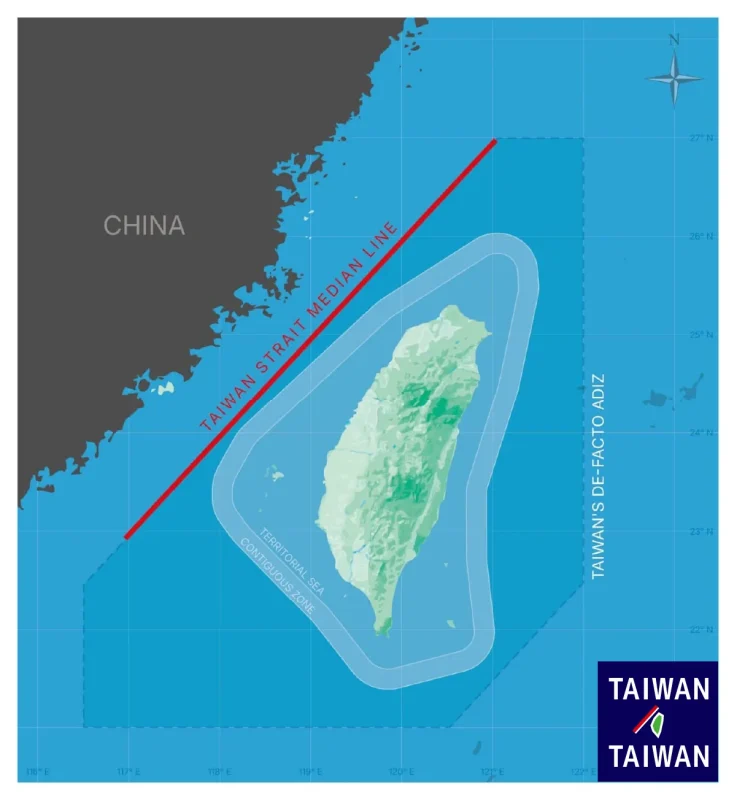
Taiwan’s ADIZ and the Taiwan Strait Median Line have served as the two most critical safety protocols maintaining the status quo across the Taiwan Strait for the past several decades. Armed by the Taiwanese military, these two invisible boundary lines guarantee the stable, daily execution of the island’s operating system. Today, however, both firewalls are under intensive, systematic assault by the Beijing regime, which seeks to “overwrite” them in both physical and legal realms.
2. The Historical “Safety Accord” of the Taiwan Strait Median Line
To understand the Taiwan Strait Median Line, one must return to the factory settings of the Cold War era. In 1954, following the signing of the Sino-American Mutual Defense Treaty between the United States and the Republic of China (Taiwan), Brigadier General Benjamin O. Davis Jr., commander of the US Air Task Force 13 (Provisional), established a warning boundary down the center of the Taiwan Strait—historically known as the Davis Line.
Brigadier General Davis’s command was explicitly clear: “Should aircraft or vessels of the Chinese People’s Liberation Army cross the median line of the Taiwan Strait and demonstrate hostile intent, co-defending US fighter jets are authorized to engage and fire.”
The creation of the Median Line was essentially a Sandboxing Protocol set up by the United States to prevent a major war in the Taiwan Strait that could “infect the global system.” At the time, Taiwan’s air and naval capabilities were far superior to China’s. By drawing this line, the US guaranteed Taiwan’s security while simultaneously “constraining” Chiang Kai-shek from launching large-scale attacks against the mainland, thereby isolating potential conflicts within a contained sandbox.
Although the Beijing government never formally acknowledged this line, the People’s Liberation Army (PLA) substantially respected and observed this boundary in practice for decades. This tacit, pragmatic mutual compliance became the core operational accord preserving peace and stability across the Taiwan Strait.
3. The Malicious Overflow of Expansionism: From the Nine-Dash Line to Threatening the Global AI Supply Chain
However, since Xi Jinping assumed power in late 2012, China began systematically dismantling the core foreign policy commitments established during the Deng Xiaoping era. Consequently, the decades-long equilibrium across the Taiwan Strait is being dangerously unravelled by the CCP.
Contrary to the grand, illusory spectacle of “All Nations Paying Tribute” created by Beijing’s state propaganda, historical and economic reality shows that China’s economic and military rise depended entirely on its reliance on—and clever exploitation of—the Western-led free international trading order.
China’s most famous foreign policy pledge occurred in 1974 at the United Nations General Assembly, when then-Vice Premier Deng Xiaoping solemnly declared to the world:
“China is not now, nor will it ever be, a superpower! … China will never become an imperialist power seeking world hegemony! Nor will it ever engage in aggression, interference, control, subversion, or plunder against other countries!”
This pledge laid the cornerstone of the CCP’s national policy to “hide capabilities and bide time” (taoguang yanghui), refraining from disrupting the international order while integrating into the Western trade system. However, upon assuming power, Xi Jinping led China down a radically different path. To accept the CCP’s self-serving narrative—that its aggressive hostility toward Taiwan is merely “resolving an unfinished civil war from the last century”—is to dangerously underestimate its global expansionist ambitions.
When the global economy was rocked by the 2008 financial crisis, China insulated itself and reversed its fortunes through a massive four-trillion-yuan stimulus package. This stark contrast bred an inflated arrogance in Beijing: a conviction that its authoritarian system was far superior to the “inefficient Western democracies.” With that, Beijing abandoned its posture of “biding time” and pivoted sharply toward a assertive “Rise of a Great Power.”
In 2013, at the peak of China’s economic prowess, Chinese President Xi Jinping boldly proclaimed to then-U.S. President Barack Obama that “the Pacific Ocean is vast enough to encompass both China and the United States.” The implication was unmistakable: China intended to divide and dominate the Western Pacific—utterly disregarding the fact that the United States had sacrificed over 150,000 American lives in the Asiatic-Pacific Theater of World War II to establish and defend post-war freedom and stability.
By 2015, Xi Jinping’s ambitions materialized into action. As international media exposed Beijing’s aggressive island-building and militarization in the South China Sea through satellite imagery, Xi unilaterally claimed these maritime features as “inalienable sovereign territory since ancient times.” Beijing drew the “Nine-Dash Line” across international waters, treating international law with complete disdain.
In response, the Philippines brought the dispute to the Permanent Court of Arbitration (PCA) at The Hague. The 2016 South China Sea Arbitration ruling concluded that China’s claims to historic rights within the Nine-Dash Line lacked any basis under international law. Yet, Beijing crudely dismissed the tribunal’s award as “illegal, null, and void,” insisting on its refusal to “accept or recognize” the decision. It has since continuously intruded upon the Exclusive Economic Zones (EEZs) of neighboring South China Sea nations, absurdly framing these incursions as “lawful patrols in Chinese territorial waters.”
In 2019, this intense pressure of territorial expansion was formally directed at Taiwan. Xi Jinping unilaterally locked cross-strait relations into a rigid framework of “One Country, Two Systems” under “One China,” declaring his intention to “reunify” Taiwan while explicitly warning that Beijing “makes no promise to renounce the use of force.“
It is precisely against this backdrop of revisionism and hegemonistic expansion that the long-standing, tacit understanding between the two sides of the Taiwan Strait—the Taiwan Strait Median Line—began to be systematically and deliberately shattered by the authorities in Beijing.
4. A “Stress Test” on the Defense Limits of the Free World
In 2022, following the historic visit to Taiwan by then-U.S. Speaker of the House Nancy Pelosi, Beijing seized upon the pretext of “refusing foreign interference in internal affairs” to effectively normalize incursions by military aircraft across the Taiwan Strait Median Line.
Today, this pressure of overflowing authoritarian malice has fully engulfed the South China Sea, the Taiwan Strait, the East China Sea, and the Yellow Sea. The People’s Liberation Army (PLA) has even sailed as far as the Tasman Sea—between Australia and New Zealand—to conduct live-fire exercises.
Much like China’s intrusions into the Exclusive Economic Zones (EEZs) of the Philippines and Japan, the CCP’s intensive harassment of Taiwan’s Air Defense Identification Zone (ADIZ) and the Median Line is by no means an “unfinished issue from last century’s Chinese Civil War.” It is a calculated stress test by a totalitarian empire against the defensive thresholds of the entire Western free world.
The CCP’s deliberate obsession with capturing Taiwan is not driven by the sentimental “national rejuvenation” touted in its propaganda. Rather, it is dictated by the cold military geometry of a totalitarian empire seeking to breach the First Island Chain and expand its naval power into the Pacific:
-
Geological and Hydrological Limitations: From a geological and hydrological standpoint, the vast majority of China’s coastal waters—stretching northward from the Bohai Sea, Yellow Sea, and East China Sea down through the Taiwan Strait—consist of shallow continental shelves. Aside from the deep basin in the center of the South China Sea, the depth along China’s coastline is inhospitable to large submarine operations. Submersibles there are easily tracked by satellites, underwater sonar arrays, and magnetic anomaly detectors, rendering effective stealth virtually impossible.
-
The Deep-Water Asset of Taiwan’s East Coast: Conversely, off the eastern coast of Taiwan (outside Hualien and Taitung), the seabed plunges steeply into a deep ocean trench ranging from 1,000 to 4,000 meters just a short distance offshore. If the PLA navy were able to use Taiwan’s east coast as a base, it would gain an “invisibility cloak” for its nuclear submarines, allowing them to slip silently into the abyssal depths.
Consequently, the international strategic community increasingly recognizes Beijing’s grand trajectory: forcibly seizing the South China Sea—a global maritime “router”—was merely the first step; capturing Taiwan, the “host computer,” and turning the Taiwan Strait into its internal lake is the second step; and enabling PLA submarines to plunge directly from Taiwan’s eastern coast into the deep waters of the Western Pacific—evading U.S. and Japanese tracking to extend its strike range across the vast Pacific (pinning down Japan and Guam nearby, while threatening Australia and even the U.S. mainland farther afield)—is its clearly visible third step.
This geopolitical threat to the free world strikes directly at the very heart of the global economy and AI technology:
-
The World’s Busiest Maritime Chokepoint: Globalization has made the Taiwan Strait one of the busiest shipping lanes on Earth, carrying over 20% of global maritime trade. The First Island Chain is simultaneously packed with the world’s top high-tech supply chains, through which electronic components, semiconductors, and energy shipments must all pass. Should China control the Taiwan Strait, it would hold its hand directly on the throat of Taiwanese, Japanese, South Korean, and global trade.
-
The Irreplaceable Computing Heart of the AI Era: Since 2022, the wave of artificial intelligence has swept the globe, with advanced semiconductor chips standing at its core. Taiwan serves as the computing heart of the world, producing over 90% of the world’s most advanced chips. Meanwhile, Japan and South Korea, also situated along the First Island Chain, are indispensable nodes in the broader semiconductor and AI supply chains.
If the host computer of Taiwan falls into the hands of the authoritarian CCP, the Taiwan Strait will be locked down as a Chinese internal sea. The energy lifelines and strategic security of Japan and South Korea will be placed in a vice grip controlled by Beijing, and this totalitarian virus will instantaneously cause the global technology supply chain to suffer a total system crash and network blackout.
No civilized nation or global tech brand reliant on liberal democracy and intellectual property protection can afford the catastrophic risk of handing the world’s core computing heart and chip lifeline over to an authoritarian control system.
5. “The CCP Is Not a Hostile State” Is a Dangerous Legal Illusion
The CCP’s ambition to eliminate the Republic of China and annex Taiwan has been an unmistakable historical fact ever since the Chiang regime retreated to Taiwan in 1949. This ambition has grown increasingly concrete and systematic under Xi Jinping, becoming the cornerstone of his grand design to dominate the Western Pacific and divide power across the ocean with the United States.
However, a segment of the population in Taiwan attempts to provide legal cover for the CCP by clinging to the literal text of the 1947 ROC Constitution drafted in Nanjing, arguing that the CCP is merely a “rebellious organization”—neither a “foreign country” nor an “enemy state.” This is a deliberate conflation of the “pre-1947 Old Chinese Jurisprudence” with the “post-1991 Democratic Taiwanese Jurisprudence.”
I. The Termination of the Civil War State and the Settlement of International Representation
The fact is that when the Republic of China (ROC) abolished the Temporary Provisions Effective During the Period of National Mobilization for Suppression of the Communist Rebellion in 1991 and enacted the Additional Articles of the Constitution of the Republic of China, it completed a decisive transformation in legal framework—the ROC officially recognized the CCP’s de facto rule over mainland China, thereby terminating the legal state of “civil war.”
Even earlier, UN General Assembly Resolution 2758, passed in 1971, marked the international community’s ultimate legal settlement regarding “China’s representation”—the struggle over the “Chinese Civil War” and “who represents China” had effectively ended.
Did the United Nations determine that the Republic of China and the People’s Republic of China are the same country? No.
Did it rule that Taiwan must belong to the CCP? Absolutely not.
II. The Historical Reality of Territorial Succession
The ROC’s loss of the “representation of China” by no means implies that Taiwan—which it de facto governs—must automatically be handed over, whether in sovereignty or ownership, to the victor of the Chinese Civil War:
When the ROC was founded in 1912 and succeeded the Qing Dynasty’s territory, Qing’s land registry no longer included Taiwan (as the Qing Dynasty had permanently ceded Taiwan and the Penghu Islands to Japan under the Treaty of Shimonoseki in 1895). The ROC never inherited Taiwan from the Qing Dynasty.
The PRC, established as late as 1949, naturally has even less basis to “inherit”—simply by winning the Chinese Civil War—territories that were long absent from the Qing Dynasty’s registry upon its collapse, whether that refers to Taiwan or Vladivostok.
When the state of civil war ended, yet the CCP continued to claim sovereignty over Taiwan while deploying thousands of missiles and military aircraft aimed at the island, its legal status shifted. In both international law and substantive jurisprudence, the CCP officially transformed from a past internal “rebellious organization” into an “external diplomatic and military enemy state threatening the sovereignty and territory of the ROC (Taiwan).”
III. The Definition of “Enemy State” in Taiwan’s Substantive Legal System
To examine only the original text of the Constitution while ignoring statutory law and judicial practice is blind legal scholasticism. Taiwan’s current legal framework has long codified strict definitions regarding the CCP’s status as an “enemy state / foreign hostile force”:
-
Article 2 of the Anti-Infiltration Act: Explicitly defines a “foreign hostile force” as a “foreign country, political entity, or group that is at war or in armed confrontation with our country.” The PLA’s daily force projection across the Taiwan Strait Median Line using fighter jets and warships fully meets the definition of an armed confrontation.
-
Amendments to the National Security Act and the Criminal Code (Offenses Against the External Security of the State): In 2019, the Legislative Yuan completed legislative amendments extending the scope of treason/external security offenses from traditional “foreign countries” to explicitly cover “the Mainland Area, Hong Kong, Macao, and foreign hostile forces.” In legal practice, this officially declared that leaking state secrets to the CCP is legally equivalent to leaking them to an enemy state, subject to the same penalties for treason.
IV. Basic Systemic Security Commonsense for Survival
Furthermore, Beijing has directly enacted the Anti-Secession Law to authorize PLA aggression against Taiwan. It dispatches military aircraft across the Median Line daily and rehearses cutting off supplies from the U.S., Japan, and Australia during wartime—with the ultimate strategic goal of extinguishing Taiwan’s democratic sovereignty.
If a military entity that rehearses the annihilation of your national sovereignty every single day does not count as an enemy state, what does?
Recognizing that “the CCP is an enemy state” is by no means a provocation. It is the absolute baseline of “systemic security commonsense” for any independent sovereign nation and its citizens to safeguard their own survival.
Section 2: Forged Property Title: The CCP’s Jurisprudential Deception
1. Taiwan Is Not China: Why Is It Called the “Republic of China”?
I. Taiwan Is Not an Extension of the Chinese Civil War, but Was Administered on Behalf of the Allied Powers
When the Republic of China (ROC) was established in 1912, Taiwan was already a territory lawfully held by Japan under the Treaty of Shimonoseki; thus, the ROC never inherited Taiwan from the Qing Empire.
When World War II ended in 1945, the Nationalist Government was directed by General Douglas MacArthur, Supreme Commander for the Allied Powers, under General Order No. 1 to take over Taiwan on behalf of the Allied Powers. In executing this “military occupation” and “trusteeship” over the island, the Nationalist Government acquired no sovereignty or property rights over the land of Taiwan.
At that time, the Nationalist Government was locked in a fierce civil war with the Chinese Communist Party on the mainland. It positioned Taiwan as a “rear base,” engaging in large-scale extraction of material resources and financial wealth from the island to fuel its civil war efforts on the mainland, which subsequently triggered severe social instability and inter-ethnic conflicts in Taiwan.
In 1949, the Nationalist Government led by Chiang Kai-shek suffered a total defeat in the civil war. Much like Koxinga (Zheng Chenggong), who was pushed back to Taiwan by Qing forces in the 17th century, Chiang Kai-shek retreated with the defeated ROC government to Taiwan—an “Allied trusteeship territory”—still possessing no sovereignty over Taiwan.
Internal classified documents of both the Nationalist Government and the U.S. government at the time made this exceedingly clear. One piece of evidence is a secret telegram dated January 12, 1949, in which Chiang Kai-shek reprimanded Chen Cheng, then Chairman of the Taiwan Provincial Government:
“The legal status and sovereignty of Taiwan, pending a peace treaty with Japan, are merely in the nature of a trusteeship area for our country; furthermore, the Taiwan Provincial Government is by no means our country’s formal government.”
This confirms that Chiang Kai-shek was acutely aware that the Nationalist Government was merely administering Taiwan as a trustee for the Allied Powers, and did not possess sovereignty over Taiwan.
II. An “Unsinkable Aircraft Carrier” Sustained the Republic of China
In 1950, the Korean War erupted. As the CCP brazenly entered the conflict, Beijing strategically aligned itself completely with Moscow, shattering the United States’ original assumption that Taiwan and Korea could be excluded from the Pacific defense perimeter.
General Douglas MacArthur, a legendary World War II commander, looked at the map and famously established Taiwan’s strategic position in the free world for the first time—as an “unsinkable aircraft carrier.” He warned the free world that if Taiwan fell to the Communists, this vital strategic hub would become a “springboard for authoritarian expansion.”
The US government consequently re-established its global containment strategy against Communist expansion. Linking Japan, the Ryukyu Islands, Taiwan, and extending south to the Philippines and the Greater Sunda Islands, it formally constructed a free line of defense: the First Island Chain.
The Chiang regime, which had almost been abandoned by the United States due to the corruption and ineffective anti-communist performance of the “Chiang-Soong-Kong” families, suddenly regained vital US military and economic support simply because it exercised effective governance over Taiwan—the choke point of the First Island Chain.
III. “Undetermined Status of Taiwan” Was Designed to Prevent Falling into Chinese Hands
To prevent the Chiang regime from being wiped out ordefecting to the Communists—which would allow the CCP to claim legal annexation of Taiwan under the pretext of an “internal civil war”—US President Harry S. Truman issued a crucial declaration:
“The determination of the future status of Formosa must await the restoration of security in the Pacific, a peace settlement with Japan, or consideration by the United Nations.”
This meant the United States did not recognize post-WWII Taiwan as part of China. Naturally, the CCP could not claim sovereignty over Taiwan under international law on the grounds of “inheriting Chinese territory.”
The US military immediately dispatched the Seventh Fleet into the Taiwan Strait to protect this “post-war territory with undetermined status” and enforce the “neutralization of the Strait.” The historical background of the Taiwan Strait Median Line mentioned in Section 1 originates precisely from this policy.
Under the Cold War framework tacitly permitted by the Allies, Chiang Kai-shek was able to use the “Republic of China (ROC)” as his state title to exercise de facto governance and institute decades of authoritarian rule over Taiwan.
2. Each Nation’s One-China “Policy” Is Not Equal to the CCP’s One-China “Principle”
I. Allied Shareholders: No Reason to Hand Taiwan Over to the CCP
Following the Chiang regime’s defeat and retreat to Taiwan, the People’s Republic of China (PRC) established its core diplomatic stance upon its founding in 1949: “There is only one China in the world, and the PRC government is the sole legitimate government representing all of China.” Beijing demanded that any country wishing to establish diplomatic relations with it must sever official ties with the ROC government.
The United Kingdom was among the earliest Western nations to recognize the CCP as representing China. Driven by the need to protect its vast economic interests in Hong Kong and evaluating the reality of the Kuomintang’s complete defeat on the mainland, the UK decided in 1950 to recognize Beijing as the de facto and de jure government of China. Crucially, however, the UK firmly refused to recognize Taiwan as Chinese territory.
This was because in 1945, the Nationalist Government merely occupied Taiwan as an agent of the Allied Powers. In the official international treaty determining post-WWII territorial status—the 1951 Treaty of San Francisco—the US and Allied nations constructed a critical legal firewall for Taiwan: the treaty did not specify transferring Taiwan to any country; it merely required Japan to “renounce all right, title, and claim to Formosa and the Pescadores.”
Therefore, Taiwan’s property title was left suspended high over the Western Pacific by international treaty law in 1951, waiting for the true legal owner to complete local registration. This waiting period lasted until Taiwan held its first direct presidential election in 1996.
Because the UK refused to endorse the view that “Taiwan is part of China,” the CCP downgraded diplomatic relations between the two countries to the chargé d’affaires level. It was not until 1972, when relations were formally upgraded to the ambassadorial level, that the UK used the word “Acknowledge” regarding Beijing’s claim over Taiwan in their joint communique, rather than “Recognize.”
II. The CCP’s “One-China Principle” Contains a Jurisprudential Trojan Horse
Taking advantage of the fact that Allied nations like the UK and US did not recognize Taiwan as belonging to China, the CCP began deliberately confusing other nations’ One-China “Policies” with its own One-China “Principle,” attempting to build a “jurisprudential Trojan horse” to conceal its expansionist ambitions.
The CCP’s “One-China Principle” is a deceptive, three-part hostage formula:
-
There is only one China in the world;
-
The People’s Republic of China is the sole legitimate government of China;
-
Taiwan is an inalienable part of China.
For international citizens unfamiliar with East Asian history, when the first two points align with geopolitical reality, it is easy to be misled by CCP propaganda into assuming that the false third point is also an established fact—thereby downloading this “fake source code.”
However, a forensic legal analysis of diplomatic documents between China and other nations reveals that, except for a few totalitarian client states, the free world has never recognized China’s sovereignty claim over Taiwan.
The United States, United Kingdom, Canada, Japan, and the European Union use phrases such as “Acknowledge,” “Take note of,” or “Understand and respect” regarding Beijing’s claim that “Taiwan is part of China.”
In international law and diplomatic practice, this is known as “leaving it on read”—I note your position, but I am by no means endorsing it, nor does it imply my acceptance.
3.The CCP Has No Legal Right to Inherit Taiwan Through the Chinese Civil War
Why do major Western nations refuse to recognize that “Taiwan is part of China”? The reason is crystal clear: although Taiwan was conquered and ruled by the Qing Empire in the late 17th century, the Manchu Qing Empire was not “China” in the modern Westphalian sense.
Furthermore, the Qing Empire permanently ceded the sovereignty and governance of Taiwan to Japan under the Treaty of Shimonoseki in 1895.
Therefore, when the Republic of China was founded in 1912 and inherited the Qing territory, Taiwan was no longer on the Qing territorial ledger; the ROC had no basis to inherit Taiwan, let alone the People’s Republic of China founded in 1949. Under international jurisprudence, Taiwan has had no legal property connection with any modern Chinese regime established after 1895.
The Chinese Civil War Is Settled: The ROC Has No Claim to Represent China
Although Chiang Kai-shek frantically indoctrinated people on the island with the idea that the “ROC” was the sole legitimate China, desperately hoping the US and CCP would enter a war to help him “recover the mainland,” the international trend recognizing the PRC as representing China became irreversible. Nations severed diplomatic ties with the ROC, reaching a crescendo in the 1970s.
In 1971, the United Nations General Assembly passed Resolution 2758:
“Decides: to restore all its rights to the People’s Republic of China and to recognize the representatives of its Government as the only legitimate representatives of China to the United Nations Organization … and to expel forthwith the representatives of Chiang Kai-shek from the place which they unlawfully occupy at the United Nations and in all the organizations related to it.”
This represented the formal legal settlement of the Chinese Civil War at the international level. It declared that the “ROC’s” corporate identity as the sole legal representative of all China was completely bankrupted and liquidated in international forums—making the Beijing government the sole legitimate representative of the corporate entity known as “China.”
Consequently, the ROC experienced a massive wave of broken diplomatic ties. This remains the primary reason most countries today maintain only substantive ties with the ROC (Taiwan) without formal state-to-state diplomatic relations.
The Crucial Legal Boundary: Expelling the Manager Does Not Transfer Property Title
However, the most critical jurisprudential core of this resolution lies in one fact: UN Resolution 2758 does not contain the word “Taiwan” or “Formosa.”
The People’s Republic of China by no means automatically acquired sovereignty over Taiwan simply because it won the Chinese Civil War and secured the “representation of China.”
Because Taiwan’s sovereignty was placed in legal suspension by the 1951 Treaty of San Francisco, the United Nations had no authority to award an island not belonging to China to Beijing. All the UN did was expel the exile property manager (ROC) holding the old business sign from the assembly hall of the “China” corporate entity.
4. The ROC, Unable to Represent China, Executes “Corporate Restructuring and Local Registration” in Taiwan
I. The Republic of China Takes Root in Taiwan
From that point forward, the state title and constitution born on the Chinese mainland could no longer represent China. Internally, the governing authority claiming to “recover the mainland” faced a total breakdown of reality. Those “lifetime representatives” in parliament who represented mainland provinces without facing re-election for decades were no longer merely illusory; they constituted outright political fraud. Launching an “attack to recover the mainland” would have constituted a severe violation of international law.
As the legitimacy of the ROC regime faced total collapse, Chiang Kai-shek’s successor, Chiang Ching-kuo, initiated a series of localization transformations in the 1970s to allow the ROC to “take root” in Taiwan. He abandoned the political myth of “recovering the mainland” and launched the “Ten Major Construction Projects” in Taiwan.
This marked the regime’s first large-scale “local capital improvement” on the island—an acknowledgment that Taiwan was no longer a temporary hotel or a springboard to attack the mainland, but a permanent home.
By the 1990s, the Taiwanese people’s demand for democracy and freedom reached its peak. Through unyielding civil protest and effort, the ROC underwent its most critical constitutional metamorphosis and legitimacy restructuring under Chiang Ching-kuo’s successor, Lee Teng-hui.
Responding to the surging democratic wave, Lee executed a bloodless “Quiet Revolution” through seven constitutional amendments. He abolished the martial-law-era Temporary Provisions Effective During the Period of National Mobilization and retired all the “lifetime representatives” and legislators who represented fantasy maps of mainland provinces without re-election.
II. The 1996 Direct Presidential Election: A Dual Legal Milestone
The first direct presidential election held in 1996 served as a decisive jurisprudential milestone. In international law and property jurisprudence, this direct election held profound dual significance:
-
Legitimacy Authorization (Restructuring the Governing Shell): The governance shell of the Republic of China (ROC)—born on the Chinese mainland and bearing authoritarian original sin—was granted direct voting authorization by the 21 million people of Taiwan for the first time. Its governing authority no longer derived from that old 1947 map drafted in Nanjing, but from every tangible vote cast on this island.
-
Local Registration of Sovereignty (Formal Alignment of Property Title): This direct election was the moment the Taiwanese people collectively stepped up to that “Taiwan Sovereignty Title Certificate”—which had been left suspended and unassigned by international treaty law since the 1951 Treaty of San Francisco—and solemnly signed the names of all 21 million residents. (Out of roughly 14 million eligible voters at the time, over 10 million cast their ballots, achieving a staggering 76.04% turnout).
By establishing the Additional Articles of the Constitution of the Republic of China, the system legally excluded residents of “unfree areas” (mainland China) from the national community, strictly restricting voting and governance rights to the “Free Area.” Following the direct presidential election, the ROC in Taiwan completed a thorough “Corporate Restructuring and Asset Localization.”
Twenty-one million citizens re-registered the assets and ownership of this ancient constitutional company. Taiwan’s sovereignty and governing authority formally merged in 1996, coming entirely under the ownership of the 21 million Taiwanese people.
Crucially, when the previously suspended sovereignty over Taiwan was legally acquired and locally registered by all Taiwanese inhabitants through bloodless democratic means in 1996, this “corporate restructuring” directly confiscated any pretext for the CCP to meddle with Taiwan through “inheritance” or “civil war jurisprudence.”
5. The Battle for Taiwan’s Sovereignty Won Entirely by Islanders Through the Ballot Box
Facing this flawless democratic practice, a helpless Beijing could only react in anger, firing test missiles into the Taiwan Strait in an attempt to use physical violence to obstruct property registration. The crisis ended abruptly under the powerful military deterrence of two US aircraft carrier battle groups entering the Taiwan Strait.
The 1996 Taiwan Strait Missile Crisis formally declared the total bankruptcy of the CCP’s Taiwan strategy. From that moment on, if the PRC wishes to seize Taiwan, only two legal and physical pathways remain:
-
Launching an illegal invasion in direct violation of international law;
-
Coercing or enticing Taiwanese people to voluntarily surrender their sovereignty through democratic means.
The Business Sign Paradox: Absurd Diplomatic Schizophrenia
However, the constitutional revision project of the ROC remains unfinished. This “company” still uses the old “ROC” business sign, failing to intuitively represent the legal entity whose corporate ownership has been restructured by Taiwanese residents to completely exclude mainland Chinese inhabitants.
This misalignment between name and reality prevents the international community from engaging with democratic Taiwan under formal “state-to-state” diplomatic frameworks—even though Republic of China Taiwan is far more qualified to be treated as a normal nation than many recognized states around the world.
For the CCP, this has created an almost schizophrenic “Business Sign Paradox”:
-
On one hand, frantically suppression of the old sign: In international organizations and sports events, the old “ROC” sign reminds the world that this regime was once the legitimate China. Thus, the CCP forcibly forbids Taiwan from using “Republic of China,” forcing it to compete under the humiliated moniker “Chinese Taipei.”
-
On the other hand, strictly forbidding the sign from being changed: Beijing simultaneously threatens Taiwan that renaming the state to “Taiwan” constitutes “Taiwan Independence,” for which China will launch an unprovoked war. In recent years, Beijing has used “anti-independence” as a pretext to refuse official communication with the DPP government, which holds a legal mandate from Taiwanese voters.
The Ultimate Definition in History and Reality
Neither jurisprudence nor facts can be erased: Republic of China Taiwan has long severed ties with its past continental history; it is an independent sovereign state. Her jurisdiction is defined by the democratic reality of 23.5 million people, not by an imperial map unilaterally drawn by Beijing.
Taiwan’s continued use of the old “ROC” business sign today is purely “strategic forbearance” under the threat of violence from a neighboring bully—it in no way signifies that the people of Taiwan recognize any Chinese claim of sovereignty over Taiwan.
Section 3: Grey-Zone Warfare: Dual Erosion of the Physical and Cognitive Realms
1. Incapable of Legal Justification, Resorting to Military Coercion for Voluntary Surrender of Sovereignty
I. China sent 5,441 military aircraft toward Taiwan in 2025 alone
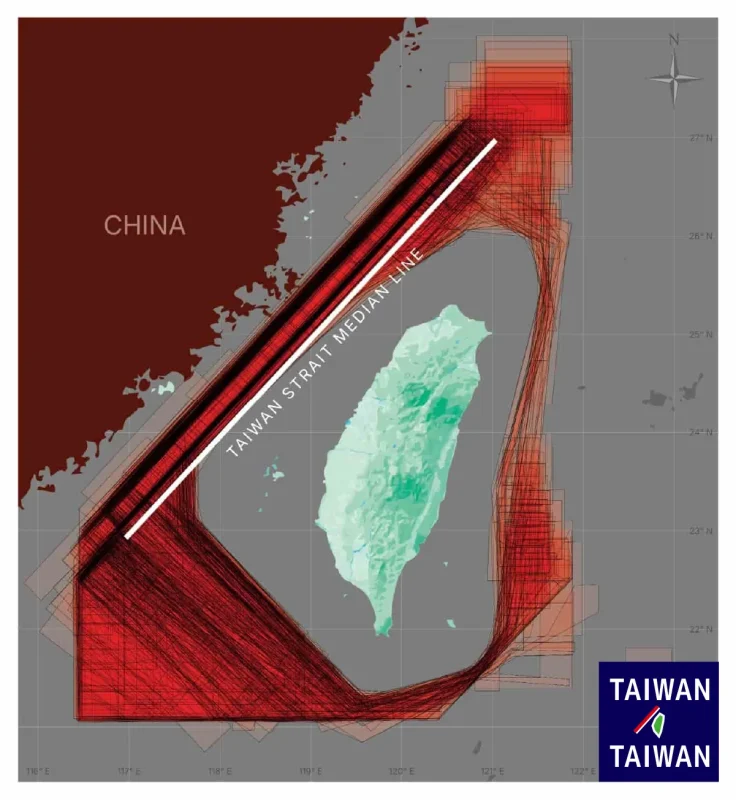
Today, the Taiwan Strait is defined by international media as “the most dangerous place on Earth.” According to data released by Taiwan’s Ministry of National Defense, in 2025 alone, a staggering 5,441 sorties of CCP military aircraft intruded into Taiwan’s Air Defense Identification Zone (ADIZ), with 3,764 of those sorties crossing the Median Line. Simultaneously, 2,915 naval vessel sorties engaged in maritime incursions.
This is by no means a pre-modern “internal sovereignty dispute.” Rather, it is a series of asymmetric, rogue extortion operations conducted openly at the maritime heart of the Western Pacific, directly assaulting the bottom line of international law and global contractual civilization:
-
In the South China Sea, persistently harassing and ramming Philippine resupply vessels;
-
In the Taiwan Strait, normalizing Median Line crossings and conducting blockade-style military exercises;
-
In the airspaces and sea lanes surrounding Japan, joining forces with Russia to conduct joint strategic bomber patrols and live-fire drills.
Against Taiwan, Beijing seeks to instill fear, induce numbness, and tear society apart from within; toward the international community, it attempts to fabricate an illusory diplomatic narrative out of thin air: that “China exercises effective jurisdiction over Taiwan.”
II. Grey-Zone Coercion: System Erosion Between Peace and War
These military pressure tactics that stop short of kinetic warfare are known as Grey-Zone Coercion. By deliberately remaining below the threshold of open military conflict, the Beijing regime successfully insulates itself from the catastrophic political and economic costs associated with triggering an actual war.
Concurrently, through this normalized “system freeze” and “background noise,” China is fundamentally reshaping the strategic environment—aiming to paralyze the international community, force the global system to accept its aggressive military presence, and incrementally dismantle the defensive status quo of the Taiwan Strait step by step.
III. Geopolitical Cybersecurity Metaphor: A Physical DDoS Attack
In the vocabulary of information systems engineering, the CCP’s deployment of military aircraft and naval vessels for systematic harassment constitutes a textbook “Distributed Denial of Service (DDoS) Attack”—this is not a single, decisive battle, but a “long-term bandwidth attrition war” targeted directly at Taiwan’s military mainframe.
By flooding the zone with high-density “junk packets,” the CCP relentlessly erodes the operational lifespan of Taiwan’s Air Force hardware, paralyzes the processing power of its air defense systems, and continuously tests the absolute limits of the Taiwanese military’s response time.
In response to every CCP incursion, Taiwan’s Air Force must immediately scramble, maintain tracking, and remain on high alert. Simultaneously, however, Taiwan’s national defense resources are silently consumed; frontline logistical pressure relentlessly accumulates, and the entire combat readiness posture is subjected to 24/7 high-pressure stress testing.
The intention is to leverage endless virtual and physical traffic—without triggering the US-Japan Security Treaty or inviting international military intervention—to utterly crush the logistical processing compute and psychological bandwidth of Taiwan’s defense system.
Within Beijing’s meticulously engineered erosion of Taiwan’s airspace, the frontline of Taiwanese sovereignty faces an absolute compression of physical speed: should a Chinese warship launch cruise missiles from just beyond Taiwan’s 24-nautical-mile contiguous zone—targeting the island’s radar sites, airfields, and air defense bastions—the entire lethal ballistic trajectory leaves Taiwan with a mere three-minute reaction window.
This is a cold, calculated geopolitical psychological gamble: an attempt to precisely calibrate aggression below the threshold of full-scale military conflict, intimidating the Taiwanese government and cowing its people.
2. Cognitive Warfare: Exploiting the “Imperial Unification” Code Within Han Culture
This grey-zone offensive does not halt at the physical domain; it integrates a protracted, highly systematic campaign of cognitive warfare. To understand why this cognitive warfare proves particularly effective against a segment of islanders, we must explicitly isolate and deconstruct the “Imperial Unification” code embedded within the shared Han/Chinese culture.
I. The Imperial Unification Code: A Collectivism Birthed for Great Plain Agriculture, Hydraulics, and the Son of Heaven
The concept of “Imperial Unification” (Da Yi Tong) was born on the East Asian mainland, engineered specifically for vast plains and massive river basins. In a continental agrarian ecosystem, large-scale water management, the construction of thousands of miles of flood dikes, and defense against northern nomadic cavalry required a highly centralized allocation of manpower and resources.
This harsh techno-economic reality ultimately birthed the “Qin-Style Centralized” political machine—one that asserted the collective over the individual. To stabilize this massive agrarian populace bound strictly to the land and devoid of horizontal mobility, the system engineered the “Confucian Patriarchal Order” to regulate basic reproductive units and internal social hierarchies.
The primary, primitive function of this cultural software was never humanistic enlightenment; rather, it was the management and incarceration of an immobile, settled peasant class.
The operational mechanism of this codebase combines the “Myth of the Son of Heaven” with a structural isomorphism of home and state: filial piety is loyalty, and loyalty is filial piety. Its foundational logic dictates that a state is not formed by “citizens” entering into a “social contract,” but is instead a sacred, indivisible “Tianxia” (All-Under-Heaven / Imperial Realm).
This realm is monopolized by the “Son of Heaven,” who holds absolute ownership and dominion over all resources and “subject-masses” (baixing).
Politically, Confucian scholar-officials packaged the fait accompli of regimes established through brute military force into a myth endorsed by “Heaven and its Son.” Today, this logic has evolved into an extraordinarily crude proposition: whoever occupies the Central Plains and inherits the imperial palaces of Beijing is the ‘Son of Heaven’ and the ‘Orthodoxy.’
When someone refuses to submit to the “Son of Heaven” or rejects annexation by the Imperial Realm, the “Imperial Alarm” pre-installed in the minds of these subject-masses sounds violently. They feel compelled to avenge an absolute monarch who has no place in the 21st century—because “All under Heaven belongs to the Emperor.”
For two millennia, this ancient continental agrarian operating system has instructed its subjects:
-
Unification = Peace and Prosperity = Good: This system operates on a collectivist logic of centralized control over all human and material resources to accomplish basin-wide hydraulic engineering. Its fruits are agricultural harvest and the orderly distribution of hierarchical classes.
-
Divided Governance = Warlord Chaos = Evil: A multiplicity of states is believed to bring only turmoil, interrupting agriculture and the operation of “Heavenly Law” (Tian Li). In this political myth, “Heavenly Law” is an exclusive affair between Heaven and the sole Son of Heaven. Therefore, “there cannot be two Sons of Heaven under the sun.”
Thus, “Taiwan Independence” is viewed not only as disrespect toward the sole Son of Heaven, but as a violation of “Heavenly Law” itself. Under this logic, the Republic of China is “no longer the Orthodoxy” and must “submit to the CCP representing the Orthodoxy.” Taiwanese people living under the ROC are expected to kneel before “Orthodoxy and Heavenly Law,” lest “man disobeys Heaven, and Heaven abandons man.”
Even though the peace and prosperity enjoyed by most islanders today stems from the post-war oceanic order and global free-trade system led by the United States, this agrarian operating code—revolving around the Son of Heaven, Imperial Unification, and Central Plains political mythology—remains deeply ingrained and un-debugged in the minds of many who enjoy freedom and democracy.
II. Loyalty Is Filial Piety, Filial Piety Is Loyalty: “To Criticize the Empire Is to Insult My Father”
The reason this continental political myth has successfully brainwashed populations for two thousand years is that it seamlessly deploys the empire’s totalitarian architecture into every family and grassroots community via the Confucian code of “sovereign-subject, father-son.” The family serves as a microscopic microcosm of the empire: the state has its Son of Heaven; the family has its patriarch. “Loyalty” and “filial piety” are thoroughly bound together at the bedrock of society.
This is not merely a mechanism of political control; it is an all-pervasive structure of vested interests and emotional defense mechanisms.
In terms of interest structures, “identity” equals class privilege. So long as an individual holds an authoritative identity—as a senior, father, husband, or boss—they automatically acquire micro-authoritarian class privileges to dominate others within the family or workplace without challenge. This structure—obey the top to enjoy privileges over the bottom—became the most stubborn psychological alliance in pre-modern societies.
Those who enjoyed identity dividends under the old system subconsciously defend this order. They recognize that negating the legitimacy of the “Son of Heaven and Imperial Unification” at the apex inevitably triggers the collapse of their own derivative authority and privileges at the micro level.
Simultaneously, a deeper mechanism operates through inverted emotional projection. Under the cultural conditioning of “loyalty is filial piety,” the Son of Heaven is sublimated into the ultimate collective father, while the worldly father is sanctified as the empire’s representative within the home.
Entangling individual emotion with national totems translates political criticism into an ethical original sin: questioning the Imperial myth is subconsciously perceived as a denial and betrayal of one’s own lineage, parental dignity, and a father’s lifelong value.
This defensive emotional compensation drives many individuals—even those who never enjoyed class dividends—to voluntarily become guardians of the Imperial myth, continually replicating and consolidating this authoritarian codebase across generations.
III. Power Worship and the Illusion of Privilege: A Paralysed Risk Perception
Contrary to the proverb “there are no wrong parents in the world,” parents are human beings with flaws and errors. Likewise, there is no blood type or gene designated for a “Son of Heaven.” The “Empire” and the “Son of Heaven” are humanly invented political myths. If this dictator can truly communicate with Heaven, why does China suffer catastrophic flooding year after year? If Heaven favors him, why does it repeatedly use raging floods to demonstrate that he is merely an ordinary mortal incapable of managing water resources?
Yet, for those who blindly worship this “Imperial Myth and Class Matrix,” prioritizing “preserving Imperial Unification” ranks far higher than the people’s right to self-determination and a free way of life.
In their “Imperial-First” minds, even if the CCP is a brutal and ruthless totalitarian regime, so long as it achieves “Imperial Unification and territorial expansion,” this historical “achievement” supersedes all of the dictator’s atrocities.
In recent years, this code has been embedded into the grand narrative of “A Century of National Humiliation” and “The Great Rejuvenation.” Consequently, the “Chinese Orthodoxy” in the minds of these subject-masses must be a strongman capable of taking “revenge” against the Western free world and displaying “Great Power Majesty.” The glorification of the brutal Qin Dynasty in contemporary media further implies that the more ruthless a regime is, the more likely it is to accomplish unification—thereby retroactively bestowing the highest level of legitimacy upon brutal tyranny.
Under this psychology of power worship, the CCP’s massive military threats—fighter jets, aircraft carriers, and missiles—are embraced as physical symbols of the “Great Rejuvenation of the Chinese Nation.” PLA aircraft and naval incursions around Taiwan are rationalized with the refrain: “Blame the DPP for pursuing independence.” The CCP’s aggressive ambition to annex Taiwan is manipulated by media into a mere “Independence vs. Unification” or “Blue vs. Green” partisan duel.
They are willing to sacrifice human rights, the right to life, private property rights, and the freedom to pursue happiness in exchange for an illusory, collective glory of “The Rise of a Great Power” and “All Nations Paying Tribute.”
Even more lethal is the presence of a contradictory “Illusion of Privilege” and “Risk-Aversion Paradox” inside their minds.
Their thinking is thoroughly hypnotized by the Just-World Fallacy. They treat the tolerance of Taiwan’s democratic society as a global norm, while romanticizing cold, Qin-style tyranny as a compassionate, paternal ruler who acts with personal leniency.
Hence, when they witness victims under tyranny—unannounced pandemic lockdowns, wealth zeroing, the harvesting of the middle class, the formatting of Xinjiang, the subjugation of Hong Kong—they feel no empathy. Instead, they rationalize that the iron fist of totalitarianism strikes only “disobedient heretics”: “Those people were punished because they were disobedient, pursuing independence, democracy, or subversion. I am obedient and support unification, so the Empire’s iron fist will never strike me.”
They naively believe that the totalitarian iron fist possesses logic, honors promises, and understands “clientelist rewards.” They mistake “submission” for a “security code”—believing that by waving the flag of “Motherland Unification” early, they can leverage their status as “early subjects” or “local collaborators” to secure an exemption pass (a golden shield against death) and perhaps even join the privileged class.
Although they reside in the free world, their brains run a closed “Imperial Narrative.” The CCP they imagine is the “prosperous, powerful, and considerate-to-obedient-subjects” China shown on TikTok, CCTV, and state-sponsored documentaries; they have never personally experienced true Qin-style tyranny.
They enjoy freedom of speech, constitutionally protected private property rights, and a security barrier erected by the U.S. and Taiwanese militaries. Yet, they take for granted the systemic security of a democratic state that respects individual rights as if it were a natural law. They delude themselves into thinking that “even if annexed by China, this way of life will miraculously continue,” believing that the arrival of totalitarianism is merely “changing a flag or swapping the ruling party.” They are utterly incapable of conceiving the ruthless treatment that a true Qin-style empire reserves for surrendered generals and subjugated collaborators.
IV. Conflating Cultural Identity with Political Nationality
They are held hostage by the code of “lineage/culture equals sovereignty,” gravely conflating “cultural identity” with “political nationality.” In their minds, so long as one speaks Chinese, celebrates the Lunar New Year, and has ancestors originating from the East Asian mainland, one is “naturally and inherently subject to China.” They bind cultural inheritance and political subjugation together—utterly ignoring the fact that their ancestors crossed the perilous Black Ditch to come to Taiwan precisely to escape that heavy, suffocating operating system.
They are incapable of grasping the modern logic governing nations like the United States, Singapore, or Australia: that populations sharing a common language and lineage can absolutely establish independent, sovereign, and democratic constitutional states that respect human rights.
The cognitive framework in their minds remains stuck in a two-thousand-year-old continental agrarian system that required massive manpower for basin-wide hydraulic engineering. Yet, stubbornly in the 21st century, they attempt to offer up this three-dimensional oceanic island—a host where a flatland hydraulic system cannot even run—to a totalitarian leader they perceive as holding “Orthodoxy,” all to fulfill the imperial ambitions of an Imperial Realm.
What they fail to realize is that once the physical firewall is dismantled, the underlying legal framework granting them private property and freedom of speech will be thoroughly formatted overnight. And atop a destroyed architecture, any civilization, prosperity, or security will evaporate into thin air.
3. Airspace Incursions Paired with Proxy Voter Manipulation
Precisely because the code of “Imperial Unification” exists within Han/Chinese culture—having run at the bedrock of Taiwanese cognitive systems for centuries without ever being debugged from the perspective of a civic society—the CCP has no need to build a new brainwashing tool from scratch. They need only leverage shared Kanji script, similar traditional festivals, ancestral ties, and linguistic symbols to transmit a poisoned “Imperial Rejuvenation” data packet. This bypasses the physical alarms of modern national defense, launching a Trojan horse attack directly behind Taiwanese psychological defense lines:
“Both sides of the Strait belong to one family! China is the elder brother, Taiwan the younger! We must join forces to resist foreign aggression!”
“Blood is thicker than water on both sides of the Strait; we are all descendants of the Flame and Yellow Emperors! Taiwan independence is forgetting one’s ancestors!”
“Both sides are proud descendants of the Dragon! The 21st century belongs to us Chinese!”
“Both sides share the same roots and bloodlines! Chinese people do not fight Chinese people—we only strike down Taiwan independence, Xinjiang independence, and Hong Kong independence!”
Concurrently, in an eerie resonance with Beijing’s physical military incursions, certain academics and political figures within Taiwan have begun peddling a blatantly flawed narrative to the public. They claim that defensive deterrence constitutes a “provocation,” and that peace can only be secured through “unilateral disarmament.”
Through local proxies and media outlets in Taiwan, the CCP continuously drives division and brainwashing across every corner of society, from mainstream news down to social media niches:
-
Skepticism Toward the U.S. (The “Abandonment/Destruction” Trojan): Deploying virus code that cuts off connections to the free world. They endlessly claim that “the U.S. merely uses Taiwan as a pawn,” “the U.S. only wants TSMC,” or “the U.S. will bomb Taiwan after the CCP takes it over.” They twist healthy national defense cooperation between allies into a narrative that “the U.S. is hollowing out Taiwan to turn it into a battlefield.” This is a classic projection of the traditional “Imperial Unification” mindset—in their worldview, equal “alliances and contracts” do not exist; there is only “tribute and domination.” Incapable of understanding the collective defense systems of the free world, they forcibly deconstruct U.S.-Taiwan relations into a “master-and-pawn” dynamic, duping the Taiwanese people into severing links with modern oceanic civilization and isolating themselves.
-
Skepticism Toward the Military (The “Armament as Provocation” Paralysis Software): Tricking islanders into manually turning off their own firewalls. Whenever the Taiwanese Armed Forces make strides in indigenous submarine programs, procure anti-aircraft missiles, enhance military training, or expand the defense budget, these actors jump up to criticize the moves as “provoking the other side,” “militarism,” or “warmongering.” Running beneath this is the pre-modern agrarian “Heavenly Law” logic: the massive military apparatus of the Empire represents ‘order and orthodoxy,’ while self-defense by a small periphery constitutes ‘rebellion that disrupts harmony.’ They advocate unilateral disarmament, claiming that “so long as we do not provoke, the Empire will show benevolence”—utterly ignoring the historical fact that when a totalitarian empire purges defenseless, obedient subjects, it has never needed a pretext.
-
The Great Power Rejuvenation Dream (The “Might Makes Right” Spiritual Opium): Injecting pre-modern codes of imperial submission. Across Taiwanese mainstream media and cultural commentary, they relentlessly glorify the CCP’s aircraft carriers, hypersonic missiles, high-speed rail, and digital surveillance. They package the totalitarian enslavement and asset freezes of 1.4 billion people as an enviable “modern miracle” and “Chinese-style democracy.” They preach that “both sides belong to one family” and “blood is thicker than water,” hijacking political choices with emotional ties. This leverages the ancient code of “lineage equals sovereignty,” enticing islanders to voluntarily take down their democratic firewalls and hand Taiwan—a high-tech host computer—over to the emperor in Beijing on a silver platter.
-
Social Polarization Warfare (The “Extreme Opposition” Cleavage Toxin): Creating zero-sum antagonisms to trigger a system deadlock. They cleverly reach into Taiwan’s internal civic discussions, exploiting the vulnerabilities of an open society’s freedom of speech. On public forums and social media platforms, they polarize and weaponize social issues that normally require rational debate and policy reconciliation:
-
Gender Cleavages: Stoking dialogue on diversity and equal rights into a zero-sum war between “extreme feminism vs. misogynistic men’s rights.”
-
Traffic & Pedestrian Conflicts: Manipulating right-of-way and road safety optimizations into class hatred pitting “scooter riders vs. pedestrians/drivers.”
-
Energy Systemic Division: Simplifying complex energy transition debates into a deadlocked binary of “nuclear zealots vs. green energy partisans.”
-
The strategy is crystal clear: they do not need you to fall in love with Beijing; they only need Taiwanese society to fracture and hate one another. By manufacturing a sense of futility—of “internal friction, societal paralysis, and democracy bringing only chaos”—they aim to make islanders completely lose faith in Taiwan’s Open Oceanic Operating System. In total despair, the population is conditioned to long for the old order of “Imperial might and totalitarian dictatorship.”
4. Replacing the Existential “Anti-Annexation Unity” with Partisan Polarization and Unification-Independence Duels
Among all vectors of cognitive warfare, the most lethal is the deliberate erasure of Taiwan’s defensive attributes by the CCP, executed through its local proxies and media. They systematically replace what should be a cross-party, nationwide consensus of “National Unity Against Annexation” with a manufactured conflict of “Unification vs. Independence” and “Blue vs. Green Partisan Polarization.”
By labeling every government initiative aimed at national defense, self-reliance, and combat readiness as “Pro-Independence Provocation,” this meticulously engineered campaign of political labeling achieves devastating inversions:
-
“National Defense” is twisted into “DPP Self-Interest”: Strengthening defense capabilities is no longer framed as protecting the freedom of 23 million people, but as “the DPP provoking conflict and kidnapping Taiwan to pursue independence.”
-
“Defending the Homeland” is twisted into “Sending Youth to the Slaughterhouse”: Military service reforms and reservist training are reduced to fear-mongering slogans like “A vote for the DPP is a ticket to the battlefield for our youth.”
-
“Identifying the Enemy” is twisted into “Green Terror”: Rooting out infiltration and defending national security are manipulated into “the ruling party suppressing dissent and creating internal division.”
This constitutes a deeply malicious “Democratic Autoimmune Reversal.” Through these deceptive labels, the hacking system successfully tricks a segment of islanders into a bizarre hallucination—they direct the alarm bells that ought to be aimed at an external threat inward, targeting their own elected government and fellow citizens. Consequently, they harbour a deeper hatred for internal political rivals than for the physical enemy state that dispatches warplanes daily and vows to extinguish their democratic way of life.
Ultimately, the comprehensive national defense line of “Anti-Annexation Unity” is downgraded into a self-draining “partisan dogfight,” while the “national security” safeguarding freedom is deconstructed into meaningless “Blue-Green political calculus.”
5. Infiltrating Taiwanese Media and Cyberspace: Traditional Capital Hijacking and Digital Cognitive Castration
Beyond eroding physical military boundaries in grey-zone operations, authorities in Beijing have reached directly into Taiwan’s public square, launching a two-pronged, multi-dimensional assault through “Traditional Media Capital Hijacking” and “Digital Algorithmic Cognitive Warfare.”
I. Capital Hijacking: Buying the Backbone of Taiwanese Media via Market Pressure and Advertising Control
Understanding the structural vulnerabilities of a commercial society, the CCP has long leveraged “access to the vast mainland market” and “control over corporate advertising budgets” as bargaining chips to deeply infiltrate and sanitize traditional Taiwanese media.
-
Purchasing Media to Serve as “Beijing’s Spokespersons”: The most glaring example involves using Taiwanese businesspeople (Taishang) as “fronts” or “white gloves” to acquire major Taiwanese media conglomerates. These outlets echo the exact rhetoric and news framing of CCP state media on cross-strait issues—at times even taking direct editorial directives from the Taiwan Affairs Office (TAO) to serve as megaphones for United Front work and internal division.
-
Market-Driven Self-Censorship: Drawn by Chinese market interests, Taiwanese corporate advertising dollars, and legacy “Imperial Unification” sentiment, established Taiwanese media outlets continuously sneak narratives of “U.S. Skepticism,” “Defeatism,” and “Inevitable Unification” into their daily coverage.
-
Economic Strangling via Advertisers: By controlling the advertising budgets of Taiwanese businesses operating in China and pro-Beijing tycoons, the CCP executes targeted financial strangulation against media outlets holding pro-Taiwan stances. Concurrently, it injects massive advertising revenue and sponsorships into outlets and digital platforms willing to align with United Front messaging. To survive commercially, traditional media are coerced into self-censorship, marginalizing anti-communist voices and arguments defending local sovereignty in mainstream broadcasts.
II. Digital Castration: The Pincer Attack of Algorithmic Mechanisms and Enemy Cognitive Troll Armies
Beyond the fall of traditional media, the digital public square—once the frontline defense network of Taiwanese democracy—has rapidly deteriorated under the collusion of commercial algorithms and CCP cognitive troll armies.
During pivotal moments like the Sunflower Movement (which halted the opaque Cross-Strait Service Trade Agreement) or the Hong Kong Anti-ELAB Protests (where citizens witnessed totalitarianism strangle freedom), social media platforms once hosted vibrant public discourse and united civic resistance against aggression. Today, however, these very spaces face severe shadow-banning, reach-suppression, and algorithmic downgrading under the rules of commercial platform algorithms.
Caught in the pincer attack of evolving platform traffic algorithms and enemy cognitive warfare trolls:
-
Serious national security issues are flagged as “sensitive keywords”: Well-reasoned, long-form essays that establish defense awareness, expose infiltration, or critique totalitarianism are automatically throttled by system filters or even misclassified as “inciting division.”
-
Extreme hatred and short-form videos are granted “high-traffic priority”: Content that manufactures societal friction, stokes gender or class hatred, or spreads seconds-long fabricated anti-American disinformation waves smoothly through algorithmic amplification.
-
Civic helplessness is infinitely amplified: When serious discussions fail to gain traction, and cynical maxims like “Politics is filthy; both sides are equally corrupt” become the social media mainstream, civic society loses its cohesive energy, retreating into apathy and mental fatigue.
This is nothing short of a “Digital Castration” targeted directly at Taiwan’s democratic system.
Hostile proxies and algorithmic mechanisms have partnered to convert social media spaces—once the command bases of democratic defense—into “echo chambers for disseminating nihilism and fear.” The ultimate objective is clear: to strip Taiwan’s civic society of its capacity for rational dialogue and collective alertness to national security, forcing islanders to manually shut down Taiwan’s final psychological firewall against foreign aggression amidst silence and internal attrition.
Section 4: The Crossroads Between “Subject-Masses” and “Citizens”
Today, Taiwan is indisputably one of the most free, vibrant, and high-performing democracies in Asia. However, a careful deconstruction of the underlying logic of Taiwanese democracy reveals that it followed an evolutionary path radically distinct from Western modernity.
I. The Cost of Translation: Substituting “People-as-Baseline Thought” for “Popular Sovereignty”
The Western democratic transition was, at its core, driven by a sequence where “citizens preceded the system.” Long before the birth of the “modern state,” autonomous networks independent of royal power—churches, self-governing boroughs, trade guilds, and professional associations—already thrived in Western societies.
Through centuries of bargaining and conflict with monarchs and aristocrats, these communities forged a “Citizen” consciousness centered on individual rights, the social contract, and legal autonomy. To them, the government was merely a “proxy”—an agent entrusted with delegated powers via a contract to protect citizens’ lives, liberty, and property.
In contrast, Taiwan’s democratization unfolded under intense external authoritarian suppression as a high-stakes “gambit of conceptual translation.” To counter the Kuomintang (KMT) regime—which ruled under martial law via a “Qin-Style Pseudo-Confucian” apparatus—early pro-democracy activists faced massive communication barriers when introducing Western liberal thought.
To break through nationalistic discipline and mobilize the broadest possible traditional populace in the shortest amount of time, these modern democratic concepts were translated into the most easily understood legacy code within Han culture: searching for a “benevolent and enlightened monarch,” yearning for “paternal magistrate-officials who feel the suffering of the people,” and longing for “upright, chivalrous judges” (Bao Qing Tian) to execute justice on Heaven’s behalf.
This mindset of “paternal magistrate and subject-masses” (Baoxian) was written even deeper into the islanders’ brains postwar because the external authoritarian regime performed a masterclass in cultural translation.
In the 1970s, facing a dual systemic crisis—the bankruptcy of its legal orthodoxy following UN Resolution 2758, the collapse of ROC representation, and the rise of local democratic consciousness—Chiang Ching-kuo, a master of authoritarian control techniques, executed a highly strategic algorithmic upgrade of the “Imperial Son of Heaven” model. He stripped off the unapproachable, majestic military uniform and donned civilian attire and a yellow jacket, recompiling the ruling code from a “lofty monarch” into a paternal figure who “felt the people’s pain and cared for his children.”
He frequented local alleys, inspected infrastructure projects, and shook hands with ordinary folks, successfully packaging the traditional empire’s coercion into an all-encompassing “paternalistic care.”
This algorithm proved so successful among a populace steeped in Han cultural traditions that it not only neutralized the ruling crisis for the KMT government, but was also adopted as a convenient translation tactic by the opposition (Tangwai) movement. By leveraging “Bao Qing Tian”-style moral justice to breach martial law’s authoritarian lines, they eventually forced full parliamentary re-elections and direct presidential elections, completing a modern structural recompilation of the island’s host system.
However, the postwar social structures—manipulated by authoritarian ethnic division, politicalized clans, atomized social units, and localized patron-client networks—were not fundamentally remediated by democratization.
National education was never re-centered around “ROC Taiwan,” nor did it deconstruct the grand “Imperial Unification” myth engineered jointly by the KMT and CCP from a civic perspective—even after the ROC was expelled from the UN in 1971, or after the constitutional amendments of the 1990s retired continental representation to complete an onshore equity restructuring of the ROC.
As a result, many post-democratization politicians in Taiwan felt no need to position themselves as “professional managers hired by voters under contract.” Instead, by posturing as “loving fathers guiding their children” or “devoted mothers taking care of every detail,” they could easily capture emotional identification and even sacred worship from islanders.
This persists because countless voters, despite acquiring the right to vote, still run a legacy codebase in their minds that “expects a good emperor or patriarch who will care for them, make decisions for them, and handle everything”—rather than a “contracted proxy” whose power is strictly limited and subject to oversight, questioning, and restraint by a civic society.
Politicians simply go with the flow, packaging public works and policy budgets—which natively belong to citizen taxation and professional planning under modern representative politics—into moral “bounties” from “benevolent officials who feel the people’s suffering.” They face no imperative to elevate civic consciousness among the populace, nor do they need to expend effort on rational communication and consensus-building required in modern politics. By continuously feeding this paternalistic myth with exaggerated political performances of “feeling the people’s pain,” they effortlessly harvest the residual dividends of authoritarian legacy.
II. The Bedrock Code Duel: “Subject-Masses” vs. “Citizens”
While “traditional subjects” and “modern citizens” outwardly coexist and vote within the same democratic society, the underlying logic of their minds runs on two fundamentally different operating systems:
Modern “Citizens”: System Maintainers Driven by Contract and Responsibility
Within the Open Oceanic Operating System, the citizen is the primary agent—the true master and bearer of responsibility for their nation. A citizen’s relationship with the state is bound by a “social contract”; they hold sovereignty over their own fate and that of their community, fully accepting the consequences thereof.
Democracy naturally means the abolition of absolute emperors holding powers of life and death; instead, the people elect professional proxies to conduct the specialized work of governance. Citizens pay taxes, fulfill military obligations, and engage in public discourse, while the media and civic society continuously subject the government to rational oversight.
Citizens recognize a fundamental truth: democracy is not a divine bounty bestowed from above, but a system that requires every individual to pay a cost and fulfill duties to collectively maintain the freedom, security, and order of the host computer. The nation belongs to its citizens, not to an emperor, nor exclusively to any privileged class.
Every unit of government power must be safeguarded against, and every unit of state resource originates from the sweat and blood of the people. Citizens seek professional managers, not divine messiahs; they build their security upon their own strength and institutional defense lines, rather than outsourcing it to the goodwill of their enemies.
Traditional Subjects: From Authoritarian Servitude to Democratic-Era “Infantile Emperors”
In stark contrast to civic consciousness, traditional subjects lack a balanced, system-oriented mindset where rights and responsibilities align. Subjects view politics merely as “selecting a saint to rule over them.” In their eyes, the government is an omnipotent patriarch, and rights are bounties granted by Heaven or the strong.
They emotionally sanctify and idolize political figures. Once they elect their ideal “paternal magistrate,” they expect the government to handle everything—from price stabilization and economic prosperity down to individual happiness. Yet, simultaneously, they fiercely resist bearing the coded costs required of a sovereign population: military service, tax burdens, risk assessment, and civic oversight.
When this legacy “Imperial Code” crosses into the democratic era, it undergoes an extreme functional mutation: the minds of these “subjects” possess no foundational concepts of “freedom, independence, contract, or responsibility.” To them, democratization simply means having an unearned ballot unexpectedly placed in their hands by “rebels and traitors,” which they promptly convert into the ultimate lever for extortion.
Nurtured by decades of party-state brainwashing, arbitrage, and the continuous political performances of “paternal magistrates,” Taiwan has long harbored a demographic of mentally “infantile subjects”:
-
Before authoritarian oppression, they act as obedient subjects who voluntarily emasculate their own right to oversee power.
-
Before democratic freedom, they instantly mutate into entitled agitators, using their votes to extort every conceivable benefit while utterly refusing to bear the public responsibilities of modern citizenship.
Armed with the democratic identity of “the boss” and fully aware that a democratic government “will not open fire and kill them,” these “infantile subjects” seamlessly invert their past servility toward the emperor into arrogant commands directed at the democratic state.
Posing as “the true masters of the land,” they compare themselves to ancient emperors like Han Wudi or Kangxi, casually dictating orders to the government: demanding low taxes, cheap electricity, and exemption from military service, while expecting all-encompassing welfare, economic prosperity, and absolute security:
-
Welfare must match the Nordic model, yet tax burdens must be the lowest in the world.
-
Salaries must rival Silicon Valley, yet prices must remain at developing-world levels.
-
Milk prices must match New Zealand, yet national infrastructure must be as modern as Singapore.
-
Electricity and fuel prices must be the lowest globally, yet the government must never subsidize state utility companies (Taipower and CPC), lest it “spoil state enterprises into spoiled children.”
-
Traffic safety must mirror Japan, yet pedestrians must never waste “my” time when crossing the street.
-
Property prices must be cheap when “I” buy, but when “I” sell my second-hand apartment, “I” must net a 20% profit—otherwise, it is labeled an “economic collapse and misery for the people.”
When confronted with risks or threats, they blame the government for inadequate care. They reduce national defense and diplomacy—matters of life and death for the state—to vulgar marketplace transactions: “I’ll vote for whoever gives me money or lets me get rich.” They go so far as to demand that the nation compromise with authoritarian powers just to preserve their personal “tranquil lifestyle.”
This subject-mindset—toggling constantly between “subservient slave” and “arrogant emperor”—is precisely the vulnerability most easily exploited by the Imperial Trojan Horse. The enemy state needs only to offer petty inducements like ultra-cheap tour packages, along with flattering rhetoric like “descendants of the dragon” or “great power rejuvenation,” to buy them off effortlessly.
Similarly, the enemy state needs only to apply a fraction of military intimidation to make these “subjects”—who want a comfortable life without paying the price for freedom—meekly surrender their sovereignty and defense lines.
Yet, democracy has never been about “selecting a paternal magistrate to serve infantile subjects”—it is about a mature body of citizens collectively bearing the destiny of a nation.
III. Pluralistic Taiwan Must Abandon Ethnic Nationalism in Favor of Civic Nationalism
Sun Yat-sen and the revolutionaries hastily shifted from the late-Qing slogan of “Expelling the Manchurian Barbarians to Restore Han Rule” to “Five Races Under One Union.” In doing so, they attempted to force an empire composed of diverse ethnicities into a man-made, monolithic national framework. This transition was not built upon an egalitarian social contract among distinct ethnic groups; rather, it was driven by the imperative of territorial inheritance. This framework not only erased the rich histories and independence of the various peoples across the East Asian continent, but in practice, it also forcibly assimilated them by enforcing Han culture as the sole “orthodoxy.”
This forced synthesis of nation-building inherently generated structural internal tensions. Compounded by the exclusive nature embedded in the “Qin-style Celestial Autocracy and Grand Unification” doctrine, it birthed mutual prejudice and the divide-and-rule tactics of statecraft—governance mechanisms that were subsequently brought to the ethnically diverse island of Taiwan in 1949.
To authoritative rulers, an atomized society plagued by mutual distrust is undeniably easier to control. However, in post-democratization Taiwan, from a civic perspective, this myth rooted in bloodline and grand unification has become utterly unsustainable once stripped of authoritarian coercion.
From the perspective of a democratic Taiwan, forging a “Civic Nationalism” anchored in “liberty, democracy, and constitutional values” represents the sole viable path for Taiwan’s survival and internal reconciliation:
1. Shattering the Myth of Bloodline: Replacing Ethnic Division with an Inclusive Contract
Ethnic nationalism grounds nationhood in common ancestry, genetics, and linguistic homogeneity. In a multi-ethnic Taiwan, this logic inevitably leads to hierarchical ranks and identity conflicts among Indigenous peoples, Hakka, Hoklo, Mainlanders, and new immigrants. Conversely, Civic Nationalism redefines a “Taiwanese” as any member of society who identifies with this land, respects the constitutional system, and shares civic responsibilities. This political contract—unconditioned by arrival order, lineage, or heritage—thoroughly deconstructs the provincial and bloodline barriers historically utilized by the party-state to “divide and rule,” thereby transforming ethnic diversity into a resilient asset for constitutional democracy.
2. Defending the Free System: Forging “Value Identity” Through Shared Life Experience
The essential soul of Civic Nationalism mirrors the founding spirit of the United States and its federalist architecture: defining who we are not through bloodlines or ancestral origins, but through a shared “democratic contract” that all citizens believe in and uphold. This spirit of Civic Nationalism—taking pride in the Constitution, liberty, and civic identity—serves as Taiwan’s premier reference point to break free from the shackles of bloodline-based united front operations and grand unification ideology. A Taiwanese national identity needs no foundation in ancient, mythical emperors; rather, it springs from decades of shared experience fighting for and enjoying a democratic way of life: an independent judiciary, free speech, equal human rights protections, and highly efficient civic participation. This shared cherish and pride in a “free and democratic system” forms a substantive social bond (Civic Pride) that transcends blood ties.
3. Resisting Authoritarian Coercion: Neutralizing Geopolitical United Front Narratives of “Common Roots and Blood”
Authoritarian China has long employed ethnic nationalist narratives—such as “sharing the same roots and race” and “blood is thicker than water”—as a pretext to legitimize its annexation of Taiwan. Should Taiwan remain entangled in bloodline-based national narratives, it will remain in an extremely passive strategic position. Civic Nationalism establishes a clear geopolitical defense line: our political loyalty and identity are determined by the values and institutions we autonomously choose, not by our genes or ancestors. Because these chosen values and institutions are democracy and freedom, Taiwan’s struggle against authoritarian expansion is elevated into a shared front with the global democratic camp to defend democratic values. Abandoning ethnic nationalism is not only the antidote for Taiwan to shed the ghost of “Grand Unification” and imperial rule, but also a crucial leap toward shaping a modern, mature national identity.
4. A Democratic Civic Community Enjoying Equal Rights and Mutual Respect
As an island operating an “open maritime system,” Taiwan is home to 17 officially recognized Indigenous peoples, including the Amis, Atayal, Paiwan, Bunun, Puyuma, Rukai, Tsou, Saisiyat, Yami (Tao), Thao, Kavalan, Truku, Sakizaya, Seediq, Hla’alua, Kanakanavu, and Siraya; Hokkien (Taigi) speakers descended from Quanzhou, Zhangzhou, and Chaozhou; Hakka speakers originating from Tingzhou, Zhangzhou, Chaozhou, Huizhou, and Meizhou; various mainland Chinese provincial communities that migrated after WWII; and new immigrants from Vietnam, Indonesia, the Philippines, and their descendants.
If ancestral home, bloodline, or mother tongue are used to draw national boundaries, Taiwan will inevitably sink into a political quagmire of infinite fragmentation and mutual exclusion.
However, these rich and diverse ethnic groups, dialects, and cultural histories should never be used as political lines to divide “enemies from allies”; instead, they must serve as cultural assets within a civic society. Only when anchored in a political contract of “constitutional democracy, universal human rights, and a shared land” can these 17 Indigenous peoples, immigrants of various dialectal backgrounds, and all residents—old and new—enjoy equal rights and mutual respect while jointly forming a resilient and inclusive democratic civic community.
This by no means erases the cultural heritage of any ethnic group. On the contrary, when “constitutional democracy, universal human rights, and a shared land” serve as the greatest common denominator, the historical memories, languages, and cultures of all ethnic groups are liberated from the shadows of power struggles and forced assimilation, gaining truly equal dignity and space for free development.
-
Constitutional democracy serves as a “protective umbrella” for cultural diversity, not an “assimilationist melting pot”: Under ethnic or monocultural nationalism, the state often enforces a single language and historical narrative in the name of “assimilation” (such as past policies banning local dialects or enforcing a single national language), leading to the marginalization and extinction of minority languages and cultures.
-
When nationhood is built upon constitutional democracy and human rights: Cultural rights become fundamental human rights. Learning one’s mother tongue, passing down traditional ceremonies, and preserving tribal histories are no longer state favors, but basic civic rights guaranteed by the Constitution.
-
The role of the state shifts from “assimilator” to “supporter”: For example, enacting the Indigenous Languages Development Act, the Hakka Basic Act, and the National Languages Development Act, or establishing Indigenous and Hakka television stations, utilizes the public resources of a democratic state to assist ethnic groups in revitalizing their cultures under the protection of constitutional cultural freedom.
-
Cultivation and re-creation of cultural assets: Just as the United States absorbed English legal traditions, Continental philosophy, and global immigrant cultures, Taiwan synthesizes imported Chinese, Japanese, and Western cultures with its native, millennia-old Austronesian heritage. This fusion creates a unique modern democratic civilization belonging to Taiwan—a process that enriches and deepens cultural assets without any issue of “de-culturalization.”
-
Deconstructing the link between cultural heritage and political identity: Traditional Chinese characters, folk beliefs, culinary traditions, and Sinitic dialects preserved in Taiwanese society are deeply rooted in daily life, forming a vibrant chapter of Taiwan’s multifaceted maritime culture. However, the “monolithic political myth, bloodline shackles, and Celestial Unification code” embedded within Chinese imperial culture must be discarded, as these functions act like a “Trojan horse” weaponized for power struggles and oppressive assimilation. Discarding this political code is not “desinicization,” but a necessary deconstruction separating cultural heritage from political allegiance. For Taiwanese people, speaking Chinese no more implies political alignment with China than an American speaking English implies political loyalty to Great Britain.
Bloodline belongs to the past and is passive; but love for this land and the defense of a free system belong to the present and are active. When we center our cohesion around the “land we inhabit together” and a “system of freedom and democracy,” every ethnic group’s historical contribution to this island—whether it be the Indigenous peoples’ stewardship over millennia, the cultivation of the island by various immigrant waves, or the collective struggles across generations to win democracy and freedom—converges into a single national memory and source of pride.
When national identity is founded upon each citizen’s autonomous choice of freedom, democracy, and the rule of law, the inhabitants sharing this island can truly bid farewell to an atomized state of being ruled, and forge a solid, inclusive, and democratic civic community.
Conclusion
I. Intimidating You into Voluntarily Surrendering Sovereignty
Today, as the CCP continuously dispatches aircraft and warships to intimidate Taiwan and rehearse a “blockade” of the island, it sparks deep anxiety among citizens while naturally triggering an obvious question: Why does the CCP rely strictly on “intimidation” against Taiwan?
Why has the CCP restricted itself to grey-zone harassment to this day? Isn’t Taiwan an non-negotiable “red line” for China? Why are PLA fighter pilots noticeably more “restrained” than the online Little Pinks?
Given that the CCP tolerates intense internet hostility toward Japan and permits fanatical slogans like “bloodbath Taiwan” and “keep the island, leave no people,” why do Chinese missiles fall only into the Taiwan Strait or Japan’s Exclusive Economic Zone (EEZ), yet never dare strike Taiwan or Japan directly?
Taking a broader historical perspective: as early as the 1960s and 1970s, the CCP possessed nuclear weapons and intercontinental ballistic missiles (ICBMs). With a longstanding military advantage over Taiwan, why has the CCP hesitated for decades to launch a direct invasion? Why must it still instruct local proxies in Taiwan to preach surrender, dupe the public into signing a peace agreement, and entice Taiwanese people to voluntarily accept “One Country, Two Systems”?
If the CCP is determined to capture Taiwan at all costs, shouldn’t its proxies in Taiwan be goading Taiwan into war with China, allowing the CCP to “recover Taiwan” in a single stroke?
To dismantle this deception of “intimidating you into voluntarily surrendering sovereignty,” we must clearly perceive the fundamental nature of the post-WWII global order and the true bedrock underlying China’s economic rise.
I. The Global Trading Order Anchored by U.S. Maritime Power
Following the end of World War II, the United States emerged as the most powerful hegemon in human history—commanding over half of the world’s industrial capacity, absolute naval and air dominance, and a monopoly on nuclear weapons. Yet, rather than establishing a vast colonial empire through direct conquest like Britain, France, Japan, or Spain before it, the United States leveraged its absolute naval and air supremacy to secure the world’s primary sea lines of communication, establishing the Liberal International Order and a Maritime Commercial System.
Crucially, the United States did not wall off the oceans as its private property. Instead, it guaranteed “Freedom of Navigation” to the entire world, constructing history’s first truly globalized free-trade framework. Under this system, any nation—regardless of size—could safely transport goods across the oceans to global markets so long as it adhered to the rules, enjoying the wealth created by globalization. This international order, safeguarded by U.S. sea power, remains the single greatest public good supporting modern global prosperity.
Taiwan stands as one of the greatest beneficiaries of this free-trade order. Following the outbreak of the Korean War in 1950, Taiwan—by virtue of its strategic choke-point location along the First Island Chain and its role as an “anti-communist outpost”—was officially incorporated into the U.S. defense umbrella and the free-world bloc. This not only halted the threat of totalitarian expansion, but also granted the island a ticket into global markets.
Even after the rupture of official U.S.-Taiwan diplomatic relations in 1979 and the ROC’s loss of representation at the UN, the United States effectively preserved Taiwan’s defensive security and the cross-strait status quo through domestic legislation—the Taiwan Relations Act (TRA)—alongside the Six Assurances. Taiwan was never excluded from global trade networks; instead, as a free-market economy, it deeply integrated into Western supply chains. Under the protection of U.S. sea lanes and open markets, Taiwan evolved from early export-processing zones into the computing heart of the global semiconductor and high-tech supply chain. Ultimately, Taiwan’s economy and national security both owe their foundation to the order led and maintained by the United States.
II. The Truth Behind China’s Rise: An Export Economy Parasitic on the U.S.-Led Order
Contrary to the imperial illusion of “all nations paying tribute and looking up to China” promoted in Beijing’s official propaganda today, historical and economic reality demonstrates that China’s economic rise over the past four decades has been built entirely upon its extreme reliance on, and clever exploitation of, this U.S.-led global free-trade order.
China indeed possesses a massive market of 1.4 billion people and the capacity of the “world’s factory.” However, the long-term exploitation of workers and the grassroots populace under its totalitarian system has left domestic consumer purchasing power extremely weak. “Selling goods to oneself” cannot sustain a genuine economic cycle or deliver substantive GDP growth. China’s massive industrial capacity must continuously export to high-purchasing-power free democracies—such as the United States, Europe, and Japan—to earn vital foreign exchange and development resources.
The CCP’s rhetoric boasting readiness for a “wartime economy” or “Dual Circulation” is merely a desperate fallback strategy when facing Western containment. Without the sea lanes guaranteed by U.S. naval power and without open Western consumer markets, China’s massive industrial capacity would instantly mutate into indigestible scrap iron that crushes its own domestic economy.
III. The CCP May Have the Power to Attack Taiwan, but Does It Have the Power to Guard China?
More fundamentally, the Taiwan Strait separating the two sides is a formidable natural barrier, making an amphibious landing a “hell-tier challenge” in military history. Taiwan’s eastern coast features deep oceanic trenches, while its western coast consists of rugged bluff beaches heavily blanketed by air defense systems. Should a cross-strait landing attempt fail and the PLA suffer heavy losses to its primary forces, the CCP regime would face the ultimate existential crisis of internal collapse.
Many fall into a one-sided panic, focusing solely on “how the CCP will attack Taiwan and how Taiwan must defend.” Yet the true reality of the game theory is this: once China opens Pandora’s box, how will Taiwan and its allies counterattack China? How will China’s neighboring states react? And can the CCP actually defend China?
The CCP may possess the military strength to temporarily paralyze Taiwan, but it absolutely lacks the capacity to hold China together once war erupts, let alone absorb the cost of regime collapse.
Every weapon, missile, and blockade strategy used by the CCP to threaten Taiwan will, at the moment war breaks out, recoil back upon China itself:
-
A Vast Territory Becomes a Defensive Nightmare: China possesses nearly ten thousand kilometers of coastline alongside complex land borders. Once a cross-strait conflict erupts and triggers a counterstrike from the free-world alliance—combined with strategic vigilance or opportunistic moves by neighboring states (such as India, Japan, or Russia)—China will find itself trapped in multi-front warfare and absolute isolation under a global economic blockade.
-
Without Wealth Redistribution, How Does an Autocracy Function? Once subjected to global economic sanctions and the severance of maritime routes, China’s export-driven economy would suffer immediate shock, cutting off foreign exchange reserves. What benefits and resources would Xi Jinping then have left to distribute to the military, or to appease bureaucrats and regional factions? When the economy collapses and public livelihoods fall into ruin, wouldn’t a direct thought emerge within the CCP elite and society—“Wouldn’t replacing this disastrous leader to secure the lifting of Western sanctions be a far better option?”
-
The Dictator’s Deepest Nightmare: Delegating Military Power and Turning Guns Inward: Once the Chinese mainland enters a wartime state, Beijing would be forced to delegate vast military command authority and logistical resources into the hands of regional theater commanders. For an intensely insecure dictator who has never stopped conducting internal purges, would Xi Jinping truly dare to surrender military command? Does he not fear commanders wielding massive military power staging a coup or redirecting missile targets from the Taiwan Strait back toward Zhongnanhai?
This is the foundational reason why the CCP restricts itself to “intimidation” and “grey-zone” harassment—or perhaps at most a localized blockade or occupation of an offshore island—yet never lightly crosses the final red line. It fears real war more than anyone else, because war would strip away its inflated veneer to expose the fragile reality of its governance and economic vulnerability.
The CCP understands perfectly well that a direct clash of military hard power carries the catastrophic risk of setting its national development back by decades, or even forfeiting its ruling power altogether.
Consequently, the CCP’s cheapest and most efficient strategy is “intimidation” combined with “United Front propaganda.” It seeks to plant fear deep within the minds of the Taiwanese people, conditioning them to believe that “resistance is futile,” “the U.S. will not come,” and “Japan dare not intervene.” By narrowing Taiwan’s perspective down to a false dichotomy of “go to the battlefield or surrender,” the CCP aims to entice Taiwan into voluntarily signing a surrender document at the negotiation table, accepting “One Country, Two Systems,” and handing over control of this host computer. In doing so, the CCP could capture this oceanic fortress at zero military cost.
At the same time, acknowledging the CCP’s strategic vulnerabilities does not mean the probability of a full-scale invasion of Taiwan is zero. The 2022 full-scale Russian invasion of Ukraine demonstrated that dictators often inhabit an “information black hole” of their own making. Vladimir Putin launched that invasion precisely because he believed false intelligence fed to him by subordinates claiming that “Kyiv would fall in three days and Ukrainians would welcome Russian troops with open arms”—deluding himself into thinking that “the situation is overwhelmingly favorable, optimism reigns, and the enemy is fragile.”
Xi Jinping faces this exact same “dictator’s information blind spot.” If the CCP’s internal intelligence apparatus and local proxies in Taiwan continuously transmit erroneous signals to Zhongnanhai—claiming that “the Taiwanese are terrified,” “military morale is shattered,” and “Taiwan will swiftly collapse and surrender the moment war starts”—this fatal strategic miscalculation could induce Xi Jinping to push the button for an invasion.
This is precisely why the defeatism, anti-Americanism, and capitulation narratives floating among certain segments of the Taiwanese population are so immensely dangerous. The more weakness you display, and the more you preach that “resistance is futile,” the less you do to avoid war. Instead, you transmit a fatal signal of “welcome invasion” to Beijing, acting as the very catalyst that triggers a conflict.
We cannot predict the internal impulses of a dictator; thus, the correct answer remains an unshakeable truth: “Preparing for war is the only way to avoid war,” and “Peace relies on strength.”
Taiwan can deter reckless aggression only by continuously bolstering its self-defense capabilities, refining its asymmetric warfare prowess, and demonstrating an unyielding will to defend itself—elevating the military and political costs of an invasion to a level the CCP simply cannot bear.
Only when the regime across the strait comes to the absolute realization that “Taiwan will never surrender, and an invasion means total catastrophe” will the peace and sovereignty of Taiwan find their most solid guarantee.
2. The CCP’s United Front Code: “Targeting Only a Handful of Taiwan Independence Diehards”
This explains why, alongside exerting military pressure on ROC Taiwan, the CCP must simultaneously employ hybrid warfare to execute cognitive infiltration against the Taiwanese populace, while manufacturing a “legal illusion” of jurisdiction over the Taiwan Strait for the international community.
Regarding cognitive infiltration, certain islanders choose to ignore the historical truth that their ancestors crossed the sea precisely to escape the suffocating vertical gravity of the continental imperial system. Instead, they harbor a misplaced longing for the “Great Power and Great Rejuvenation of the Chinese Nation” myth spun by the CCP.
A deeper pathology lies in how the CCP precisely exploits the core toxins embedded within the “Qin-Style Imperial Hierarchy Code”—namely, exclusion and grievance. The essence of the Qin imperial code is hierarchical oppression coupled with privileged rewards for submission (“those who obey prosper”). During the former Kuomintang (KMT) authoritarian era, the party-state established a classic clientelist system (patron-client network) through the monopoly of national resources. So long as individuals swore allegiance to the imperial code and submitted to authoritarian rule, they were granted a sense of “class superiority” and “patronage privileges” denied to other groups.
However, when the Tsai Ing-wen administration initiated pension reforms—attempting to adjust these unsustainable benefit allocations in alignment with the fiscal sustainability and intergenerational justice standards of a modern democratic rule-of-law state—these former patrons of clientelism interpreted the restoration of institutional rationality as an act of profound enmity that “stripped away their privileged status.”
This intense resentment and psychological imbalance following the loss of privileged superiority spawned a powerful desire for retribution. Observing the bitterness festering within this demographic, the CCP seized the opportunity to inject its imperial cognitive toxins directly into the wound.
CCP proxies in Taiwan have led these individuals to naively believe that a CCP takeover would simply represent a “restoration” of the old authoritarian party-state. They delude themselves into thinking that by submitting to this authoritarian power, pledging allegiance to Beijing’s imperial code, or even acting as an internal “fifth column” and “collaborator,” they can leverage external force to “punish” Taiwan’s democratic system, thereby reclaiming their former class superiority and patronage privileges.
They would rather beg a totalitarian enemy state—one that points thousands of missiles at Taiwan daily—to “chastise” their own compatriots and democratic institutions than accept that they are now modern democratic citizens who must share responsibility for the nation’s future on equal footing with everyone else.
This “infantile grievance mindset”—willing to invite the wolf into the house and sabotage Taiwan’s democracy just to defend an illusion of past privilege—constitutes the precise system vulnerability through which the enemy state’s psychological warfare breaks in.
This is why spokespersons for China’s Taiwan Affairs Office (TAO) meticulously repeat the United Front formula: “We target only a tiny handful of Taiwan independence diehards, not the broad masses of Taiwanese compatriots.”
This rhetoric is far from magnanimous; it is a precisely targeted psychological opium. It continuously transmits subtle hints to specific grievances within Taiwan, luring those embittered by the loss of privilege into a fatal hallucination:
They foolishly believe that future CCP purges will fall exclusively upon “pro-independence resisters,” while collaborators who parrot Beijing’s condemnations and secretly pave the way will “receive preferential treatment and share in the imperial glory” after a totalitarian takeover—perhaps even being entrusted with authority to judge their former political rivals.
The CCP further transforms this grievance into systematic semantic conflation: they forcibly equate the “Chinese Nation” (Zhonghua Minzu) of the Republic of China with that of the People’s Republic of China. In doing so, they completely erase two radically different historical trajectories—the catastrophic destruction of traditional civilization during the CCP’s Cultural Revolution versus the modern civic society forged through Taiwan’s democratization. These divergent paths have long caused the “Chinese identity” on opposite sides of the strait to evolve into fundamentally different community attributes and civilizational codes.
Attempting an “unauthorized access” between culture and statehood, they intentionally conflate “cultural heritage” with “political allegiance.” They twist the preservation of Han cultural tradition into a mandatory submission to Beijing’s totalitarian empire, while maliciously vilifying Taiwan’s democratic transition—its effort to cleanse the authoritarian codebase of the Qin imperial system—as so-called “De-Sinicization.”
If this cognitive virus, woven from privileged grievances and imperial codes, is allowed to continuously pollute the system, Taiwan—as a free host computer—will ultimately face the existential crisis of being forcibly re-compiled and subjugated by an external totalitarian power.
3. Taiwan and China Share the Han Cultural Code: The “Chinese Nation” Is an Invented Construct
The historical reality is that the concept of the “Chinese Nation” (Zhonghua Minzu) was invented as late as 1902 by Liang Qichao. When he forcibly grouped the diverse ethnicities ruled by the Qing Dynasty—the Han, Manchu, Mongol, Hui, and Tibetan—under the umbrella of “Zhonghua Minzu” on paper, and packaged the “Qin-Style Imperial Unification” of Han culture under the name of “Chinese Culture,” Taiwan was no longer on the Qing Dynasty’s territorial inventory. As early as 1895, the Qing Empire had permanently ceded Taiwan to Japan.
Neither the Republic of China (established in 1912) nor the People’s Republic of China (established in 1949) could inherit Taiwan—just as neither could inherit Vladivostok, which the Qing had earlier ceded to Russia.
Therefore, whether under international law or within the territorial imagination of late-Qing intellectuals, Taiwan was simply absent from the inventory of the “Chinese Nation.”
The truth is that the invention of the “Chinese Nation” was merely one of many political initiatives that emerged during the late Qing and early Republican periods. However, both the Kuomintang (KMT) and the Chinese Communist Party (CCP) later discovered the immense “centralizing” value of this concept. They adopted it wholesale, back-knitting a linear, pseudo-historical mythology that smuggled the “Qin-Style Imperial Unification” of Han culture into this invented construct as a sacred, inviolable law of iron.
Taiwan’s “Han Cultural Code,” meanwhile, was introduced to the island at least as early as 1662 with the arrival of Koxinga (Zheng Chenggong). Many elements cherished by islanders—such as Mazu worship, Traditional Chinese script, and artifacts in the National Palace Museum—are undeniably part of Han culture.
Historically, Han culture functioned across East Asia much like Latin in Europe: a universal code. Japan learned Han culture from the Sui and Tang Dynasties; Korea and Vietnam integrated the Han code over a thousand years earlier than Taiwan. When it comes to the orthodoxy of Confucianism or the institutional legacy of imperial civil service examinations, both South Korea and Vietnam boast far deeper roots than Taiwan.
Crucially, the essence of “culture” has never been static museum antiques or ancient philosophies preserved in two-thousand-year-old texts. Rather, it is a living way of life—how people treat one another daily and how they interact with power.
Just like the international trade culture brought by the Dutch and Spanish, the Western modern civilization introduced during Japanese rule, and the postwar integration into the U.S.-led global trade order alongside modern civilizational ideals voluntarily adopted by islanders—the Han cultural code, like all these external influences, has been filtered, refined, and evolved by islanders endowed with oceanic genes into a unique “Taiwanese Culture.”
Unlike the Central Plains continental operating system—which felt compelled to enforce maritime bans (Haijin) as soon as seafaring technologies emerged—this island of diverse immigrants has continually run an Open Oceanic Operating System across the vast oceans. Guided dynamically by ocean currents and sea winds, this system exhibits high adaptive resilience and self-driven updates. Drawing on the distributed topology of its towering mountain ranges, it functions like “distributed edge computing,” continuously rewriting and synthesizing heterogeneous codebases.
Just as an Apple smartphone cannot run a legacy operating system designed by Microsoft for a massive desktop PC, a continental imperial totalitarian software engineered two thousand years ago for basin-wide hydraulic irrigation across East Asian river plains cannot be seamlessly installed onto a oceanic, mountainous island. Instead, this legacy code has been continuously filtered, integrated, and evolved by the island’s Open Oceanic Operating System: obsolete segments were discarded outright, while compatible fragments were recompiled into Taiwan’s active host system.
Consequently, neither the legacy Han cultural code nor the “Chinese Culture” code monopolized and re-interpreted by the CCP today can “format” this island, which remains intrinsically open, resilient, and inclusive of diverse civilizational streams.
4. The CCP’s Interpretation of Chinese Culture Cannot Encompass Democratic, Popular-Sovereignty Taiwan
Today, whether it is the “Chinese Culture” interpreted by the People’s Republic of China or the legacy Han culture embedded with Imperial Unification ideology, both are hopelessly incapable of encompassing modern Taiwanese culture—a culture defined by democracy, inclusion, and pluralistic coexistence.
In Taiwan, Chinese characters written by the people become legal statutes guaranteeing same-sex marriage. Diverse ethnic groups, new immigrants, and Indigenous cultures enjoy equal opportunity to interact and flourish. Citizens can stand proud before the Presidential Office to protest, openly question public officials, and exercise absolute freedom of speech.
The Mazu pilgrimage—a traditional Han folk belief—has evolved in Taiwan into the world’s most decentralized, horizontal mutual-aid network. When a foreigner looks lost on a Taiwanese street, countless locals will proactively step forward to ask, “Do you need help?” Meanwhile, Taiwanese semiconductor wafers serve as the foundational “trust technology” branching throughout the free world.
This is an island that honors individual dignity, cares for the vulnerable, and embraces dissenting voices. Diverse cultures are filtered, evolved, and projected back to the globe from this hub. Taiwan has thoroughly transcended—and is actively formatting away—that ancient, self-cannibalizing continental operating system. It can never be monopolized or hijacked by a traditional imperial culture built on rigid hierarchy and exclusion.
Furthermore, the CCP’s long-standing narrative to the international community—that “the Taiwan question is merely an unfinished continuation of the Chinese Civil War”—is a geopolitical lie through and through. The “Chinese Civil War” between the Kuomintang and the CCP effectively ended in the mid-20th century.
When the United Nations expelled the representatives of Chiang Kai-shek in 1971 under Resolution 2758, it recognized the People’s Republic of China as representing China. However, the PRC did not thereby acquire sovereignty over Taiwan. The supreme legal instrument determining Taiwan’s post-war territorial status—the San Francisco Peace Treaty—had long erected a legal firewall: Japan renounced all right, title, and claim to Taiwan without assigning sovereignty over Taiwan to any Chinese government.
In the 1990s, the Republic of China further terminated the “Period of Mobilization for the Suppression of Communist Rebellion” through constitutional amendments and the retirement of “ten-thousand-year” parliamentary representatives. In both legal theory and political reality, this formally ended ROC claims over the Chinese mainland, retired continental representation, and completely withdrew Taiwan from the civil war game of competing for the “sole legitimate representation of all China.”
Through the first direct presidential election in 1996, all islanders used their sacred ballots to execute an onshore equity restructuring of the Republic of China, fully realizing Popular Sovereignty. From that moment on, sovereignty over Taiwan was irrevocably held by its 23 million citizens, beyond all doubt.
Despite Beijing’s relentless external propaganda, no foreign observer confuses democratic and free Taiwan—where citizens spontaneously unite as “shovel-wielding volunteers” during crises—with the political culture across the strait: a regime shaped by the Cultural Revolution, enforced through digital Qinism, marked by the tanks of Tiananmen, and brandishing the flags of wolf-warrior nationalism.
5. Taiwan Has 28,000 Years of History: An Island of Inclusion and Evolution
China claims five thousand years of civilization, but the island of Taiwan has hosted human life and flourishing for at least 28,000 years—whether brought by prehistoric hunters tracking mammals across ancient land bridges or southern seafaring adaptors riding the Kuroshio Current.
Situated in the Western Pacific and physically independent from the Eurasian continent, Taiwan’s hardware and geographical position were destined from the moment of their creation to be open and pluralistic.
From the Paleolithic Changbin culture to serving as the genetic and linguistic origin for the vast Austronesian expansion across the Pacific and Indian Oceans, geographical and scientific evidence unanimously demonstrates one fact: from its inception, the underlying driver of this island has operated within the networked topology of an Open Oceanic Operating System.
For six million years, this island—continually uplifted by tectonic compression—has, with its array of towering three-thousand-meter peaks and surrounding seas, intercepted seeds carried by monsoons, sheltered migratory birds, and become a new home for all who stepped ashore from every direction.
These organisms and seeds, including early humans, did not come to this island out of any allegiance to an “ideology.”
The reason tiny Taiwan hosts over tens of thousands of unique species today is not due to a vast territorial expanse, but because its towering mountains and dramatic vertical relief offer microclimates and topographical barriers where seeds blowing in from all directions can take root and thrive.
Geographically, Taiwan is not an extension of the East Asian mainland, nor does it run a “Great Imperial Power” operating system. The natural law of this island has never been “unification” or “assimilation”—it has always been “dispersion” and “coexistence.”
Precisely because of the island’s independent and inclusive geographical architecture, honed through ten thousand years of blind evolutionary selection by geology and ocean currents, its system design serves as an ecological “optimal solution”—a warm, safe ecological haven for diverse life forms.
From the perspective of Earth history and evolutionary biology, the fundamental survival strategy of life seeking safe refuge during the Last Glacial Maximum objectively mirrors the historical trajectory of migrations led by Koxinga and Chiang Kai-shek, when people fled the turmoil of the East Asian mainland for this island tens of thousands of years later.
For all living beings, pursuing safety and avoiding harm is an intuitive instinct; migration is a survival necessity; and adapting and evolving in response to geological environments and climates is the most natural and logical process imaginable.
Yet, if the people of Taiwan are intimidated into voluntarily surrendering their sovereignty by the CCP’s threats, where else can islanders flee under totalitarian rule?
Taiwan has never been an inalienable part of any geopolitical entity. If one truly believes that “politics is filthy and neutrality is noble,” then narratives asserting that “Taiwan is an inalienable part of someone else, destined to fulfill some grand rejuvenation” are the most deliberately constructed, artificial, and politically coercive ideologies in the world—ones that must be resolutely resisted.
6. The “Qin-Style Imperial Unification” Code in Han Culture Must Be Thoroughly Demystified
Through multiple constitutional revisions, the termination of the Period of Mobilization for the Suppression of Communist Rebellion, direct presidential elections since 1996, and popular self-determination, the equity of the Republic of China (Taiwan) has been fully localized and restructured. It is now entirely held in the hands of its 23 million citizens.
Under modern international law and the framework of popular sovereignty, the CCP has only two options if it wishes to capture Taiwan: first, launch an extremely risky, illegal military invasion that would trigger global sanctions; or second, manipulate the Taiwanese people into a state of panic over their survival, coercing them into voluntarily surrendering their sovereignty.
The “pressure” element is already underway. By leveraging physical steel hardware for intimidation—such as fighter jets daily probing Taiwan’s Air Defense Identification Zone (ADIZ) and warships conducting encirclement drills—the goal is to engineer a collective sense of panic and helplessness that whispers, “Resistance will lead to total destruction.”
The “voluntary” element is equally active today. It exploits the “Qin-Style Imperial Unification” code embedded within the shared Han culture as the primary vulnerability for cognitive infiltration by the CCP and its local proxies.
I. The Sovereignty Vulnerability Caused by the “Qin-Style Imperial Unification” Code
The malicious mechanism of this Trojan program lies in how it vilifies defending one’s homeland and democracy as “betraying one’s ancestors,” while glorifying submission to imperial totalitarianism as “returning to orthodoxy and fulfilling great national rejuvenation.”
If this codebase is not thoroughly demystified, a political backdoor will remain deep within the minds of islanders. When the enemy arrives at the gates, this code triggers internal moral guilt and defeatism, systematically unraveling Taiwan’s defensive resolve through internalized narratives:
“Acknowledging ancestors and returning to China is the right path! Separation is merely temporary!”
“Both sides share the same roots; unification is a heavenly mandate that no human can defy!”
“We are all one family; it is only proper for the younger brother to yield to the eldest son and the Son of Heaven! Should more lives be lost just to save the President’s face?”
“Reject external interference in our internal affairs! This is our family matter, and outsiders have no right to meddle!”
“What’s wrong with doubled national strength under ‘One Country, Two Systems’? So long as you follow the rules and don’t speak recklessly, nothing will happen to you! Do you really want to be a rebel and traitor?”
When physical military pressure reaches a critical threshold, this Trojan program executes in the minds of vulnerable segments of the population. It tricks them into rationalizing that “since we are all compatriots, why fight?” or “the other side holds the legitimacy of unification.” This leads directly toward non-resistance and the acceptance of a “peace agreement” or “One Country, Two Systems”—causing Taiwanese citizens themselves to press the authorization button and hand over root access to this oceanic host computer without a single shot being fired.
Purging the “Qin-Style Imperial Unification” code is not so-called “De-Sinicization.” Rather, it represents the most urgent system cybersecurity protection and mental defense debugging required for a modern, democratic Taiwan.
II. “Cultural Heritage” and “Political Subjugation” Must Be Thoroughly Decoupled
Writing Traditional Chinese characters, speaking the Mandarin language, celebrating Lunar New Year, and worshipping Mazu are entirely natural dimensions of Taiwanese people’s rich cultural life. However, forcibly equating “preserving Han or Chinese culture” with “mandatory submission to Beijing’s imperial orthodoxy” represents an unauthorized access attempt—sneaking the malicious “Qin-Style Imperial Unification” Trojan program straight into our cultural codebase.
Forcibly binding “culture” to “political orthodoxy” is the oldest and most heavy-handed form of cognitive hostage-taking practiced by totalitarian regimes. The “Qin-Style Imperial Unification” concept is a piece of malicious code that must be singled out, isolated, and permanently formatted out of our system.
Sharing a cultural legacy does not mean surrendering one’s sovereignty and freedom:
-
Decoupling Civilization from Power: Modern technology and systems originate overwhelmingly from the West. Yet, using an iPhone daily does not mean we must kneel before Steve Jobs or Tim Cook, nor does it mean we must forfeit our civic rights to adopt an American political identity. Civilization is civilization; sovereignty is sovereignty. Coercing users into becoming “subjects” is an absurdity in modern civilization.
-
Decoupling Culture from Nationality: Dozens of countries worldwide use English as an official language. Citizens of the United States, Canada, Australia, and New Zealand speak English daily and study Shakespeare and Homer in school, yet no American believes they must take orders from Buckingham Palace or swear allegiance to the King of the United Kingdom. By the same token, appreciating Traditional Chinese characters, Tang poetry, and Song lyrics, or speaking Mandarin and celebrating Lunar New Year and Mid-Autumn Festival, in no way implies that Taiwanese people must submit to Beijing’s totalitarian empire.
-
Decoupling Civilizational Influence from Political Hierarchy: South Korea retains East Asia’s deepest and most rigorous Confucian tradition and ancestral rituals to this day, yet no South Korean considers adopting a People’s Republic of China passport. Vietnam historically operated the longest-running, most complete imperial examination system in East Asia, absorbing deep Han cultural influences. Yet this does not reduce the Vietnamese Prime Minister to a political subordinate of the CCP General Secretary, nor can it be slippery-sloped into asserting that “Vietnam is an inalienable part of China.”
In East Asian history, Han culture served much like Latin in Europe—a regional common cultural codebase (Lingua Franca). Japan, Korea, and Vietnam all downloaded, applied, and adapted this codebase without compromising their modern status as independent, sovereign nations.
Isaac Newton and Gottfried Wilhelm Leibniz developed calculus; Albert Einstein formulated $E=mc^2$ to reveal the mass-energy equivalence of the universe. Though these monumental scientific breakthroughs originated in specific contexts and minds, once released, they instantly became the shared rational foundation of all humanity.
Engineers worldwide apply calculus to design microchips and aircraft, and physicists utilize $E=mc^2$ to explore nuclear energy and stars. Yet no modern state would make the absurd claim: “Because calculus or the mass-energy equation originated with us, all global users must voluntarily surrender their sovereignty and submit to our rule.”
If this holds true for tangible, invaluable scientific equations, it applies even more forcefully to intangible, priceless cultural legacies.
Learning English to engage with the Anglosphere does not mean submitting to Britain; learning Chinese to communicate with Chinese people does not mean submitting to China. Science and ideas belong to all humanity as public goods—and so do culture and language.
Culture is a shared software asset of human civilization, not the private patent of any political regime, and certainly not a battering ram for the Beijing Empire to conquer its neighbors.
III. The Malicious Impact of the “Qin-Style Imperial Unification” Code on Modern Society
Purging the “Qin-Style Imperial Unification” code from Han culture is absolutely essential for modern civic society. The core purpose of Qin-style centralization has never been the well-being of the people, but rather the perpetual preservation of imperial power. The social structure it forged throughout history is a rigid hierarchy: Absolute Emperor—Paternal Magistrate—Subject Population (Obedient Masses / Violent Mobs).
Poisoning Modern Democracy
Qin-style centralization refuses to recognize individual dignity or popular sovereignty, discouraging independent thought and demanding total submission and blind obedience from “subjects.”
Since the lifting of martial law, the termination of the Period of Mobilization for the Suppression of Communist Rebellion, three peaceful transfers of power, and repeated exercises of self-determination, the 23 million people on this island have legally and institutionally transformed their identity from “subservient subjects” into modern citizens.
The cornerstone of modern democratic nationalism (civic nationalism) is an empowered citizenry capable of independent thought, willing to bear defense responsibilities, and dedicated to safeguarding constitutional rule of law. Yet the Qin code continuously lures the populace into reverting to an ancient “subject mentality”—outsourcing national survival to the goodwill of external powers, or fantasizing about a “benevolent emperor or upright magistrate” to save them. This mindset completely ignores the modern citizen’s responsibility that “sovereignty rests with the people, and defense rests with oneself.”
This dynamic yields a populist “infantile subject” phenomenon: servile before authoritarian power, but entitled and uncooperative toward democratic governance. These individuals gladly consume the rights, welfare, and security provided by the democratic system, while refusing to bear any obligation to defend it.
Yet modern democracy is not an uncritical sandbox that tolerates its own destruction. A healthy democratic system must possess the self-defense mechanism of Defensive Democracy, forbidding authoritarian proxies from exploiting democratic freedoms to dismantle democracy itself.
The Qin code maliciously deconstructs national security and existential defense into “meaningless political infighting,” tricking islanders into choosing “non-resistance” or “surrender for peace” when facing external aggression—allowing the entire democratic host computer to be silently compromised by hostile actors.
Poisoning Economic Freedom
Taiwan’s hardware is an open oceanic island characterized by towering mountain ranges, rich microclimates, and deep global connectivity. Taiwan’s prosperity and survival rely heavily on global free trade, decentralized flexibility, and a pluralistic, inclusive ecosystem. The underlying logic of the Qin code, by contrast, is centralized power, closed control, and forced assimilation—fundamentally incompatible with Taiwan’s operational architecture of distributed edge computing, pluralistic coexistence, and dynamic openness.
The core competitive advantage of Taiwan’s economy lies in the edge computing network formed by countless small and medium-sized enterprises alongside its technological “Shield of Mountains”—a network that reacts rapidly to global market shifts and dynamically reconfigures supply chains. Qin-style unification, however, systematically siphons resources away to concentrate them within state-owned enterprises and party-state capital, replacing market mechanisms with rigid political directives. Installing such a model would directly strangle the innovation and adaptability that define Taiwanese industry.
Today, Taiwan serves as an indispensable Trusted Node within global free trade and high-tech supply chains. The Qin regime’s coercive surveillance over information, capital, and human flows—coupled with its disregard for intellectual property and international norms—would destroy international trust in Taiwan, isolating the island from global prosperity and locking it back into the closed, inefficient, high-pressure gravity well of the East Asian mainland.
Under a Qin-style system, “all land under heaven belongs to the emperor.” No private property or individual effort is inviolable. When political power can arbitrarily conduct “tax audits, equity seizures, or forced common prosperity” against private enterprises, entrepreneurial spirit vanishes, causing capital and talent to flee the gravity well—just as Koxinga and Chiang Kai-shek fled the mainland generations ago.
Refining Han Culture by Purging the Waste
Within traditional Han culture, the status of women was locked down by Confucian norms (“three obediences and four virtues; men superior, women inferior”) and Qin-style household registration under patriarchal authority. Women were treated as domestic dependents without independent property rights, inheritance rights, or even the right to sit at the main dining table alongside men. This systematic reduction of women’s status and erasure of their dignity represents the deepest imperial toxin within traditional Han culture.
Yet the people of Taiwan did not uncritically accept these discriminatory historical practices. On this open oceanic island, Taiwanese society filtered the Han cultural codebase, retaining its value while purging its flaws.
Today, Taiwanese women pursue careers, build businesses, and serve as President of the Republic. Domestic responsibilities are shared between men and women. Spousal fidelity is a mutual obligation, and the legacy concept of concubinage has been replaced by legal gender equality under monogamy.
The reality is that since Han culture arrived in Taiwan, it has undergone continuous filtering and evolution by the islanders. Its gentle traditions, warmth, everyday customs, folk beliefs, literature, and arts have long been recompiled into the fabric of Taiwanese culture.
What is unsuitable for this island, detrimental to survival, or harmful to citizens—such as imperial arrogance, authoritarian patriarchies, and the virus of “Imperial Unification”—must be debugged and purged, just as smallpox, cholera, plague, and malaria were eradicated.
Decoupling “Qin-Style Imperial Unification” from Han culture is not “De-Sinicization”; it is an essential process of cultural detoxification. A modern civic society need no longer bow to the monopolistic framing of imperial power and feudal patriarchy.
If blind reverence for antiquity and tradition were the ultimate standard, Taiwan would never have transformed American and Japanese convenience stores into hyper-convenient, multi-functional community hubs; nor would TSMC have disrupted the integrated device manufacturer (IDM) model of Western tech giants to pioneer the pure-play foundry model.
Because the people of Taiwan possess the intellectual creativity to filter the waste, recompile the codebase, and elevate the output, we have successfully built an exceptionally modern, inclusive, and egalitarian society upon this island.
7. System Defense and Code Auditing: Before It Is Too Late
When we embark on a modern-day Beagle-like journey to observe Taiwan’s history from above, a clear pattern emerges: whenever Taiwan is locked into the gravity well of the East Asian mainland, what follows is suffocating instrumentalization—being reduced to a tool for continental campaigns (such as “opposing the Qing to restore the Ming” or “counterattacking the mainland”). Conversely, whenever Taiwan pivots back toward the ocean and connects with the broader world, it links into the free, vital codebase of modern civilization and flourishes with limitless opportunity.
Having failed to establish legal legitimacy, the CCP now works tirelessly to intimidate and coerce the Taiwanese people into voluntarily surrendering their sovereignty so it can transform the island into its military stepping stone. Yet from every objective angle, Taiwan and China inhabit two entirely separate worlds running two fundamentally distinct systems—and the divergence grows wider by the day.
Taiwanese culture represents the collective life experience accumulated over generations by islanders and diverse waves of immigrants; it functions as an ever-evolving, open-source library. The Han cultural components contained within it must never be manipulated into political chains wrapped around Taiwan’s neck by a continental empire.
Nor should cultural heritage be used as a battering ram by a totalitarian regime to hijack “cultural identity” into a “political crusade.” Writing Traditional Chinese characters, celebrating the Lunar New Year, and worshipping Mazu are organic parts of Taiwanese culture—just as Americans speaking English do not take orders from London, and Singaporeans speaking Chinese do not submit to Beijing.
This island acts as a furnace of modernity in the Pacific. Across a vast timeline, various external “institutional seeds”—the global trading genes of the Dutch, the contractual customs of Han settlers under Qing rule, the modern legal and public health discipline of the Japanese Empire, and the postwar framework of American-style democracy and human rights—have been absorbed, recompiled, and adapted by the island’s mountainous and oceanic hardware.
Today, Taiwan is bidding farewell to “ethno-nationalism”—a paradigm reliant on Huangdi myths, lineage coercion, and Han chauvinism. It is making a definitive leap toward “Civic Nationalism,” the standard of modern maritime nations—a vibrant oceanic democracy whose core identity rests upon shared civic values, pluralistic inclusion, and a joint commitment to this island home.
Taiwan’s core identity is not determined by the mainland province of one’s ancestors or the percentage of Han lineage in one’s DNA. Instead, its boundary is defined by faith in constitutional democracy, the defense of individual freedom and human rights, and a shared dedication to safeguarding the fate of this island’s natural and societal hardware.
The distinction between “friend and foe” in the Republic of China (Taiwan) is never based on bloodline, ethnicity, or language, but on a shared commitment to defend our way of life and popular sovereignty. Conversely, “enmity” is defined as any intent to violate this shared defense. Because the ballots cast in a democracy determine a nation’s trajectory, the boundary between friend and foe in a modern democratic state must be crystal clear:
-
The External Foe: Any totalitarian regime that seeks through military intimidation or cognitive infiltration to strip 23.5 million Taiwanese people of their right to freely choose and self-determine their destiny is an uncompromising enemy of this host system. Enmity consists in “the opponent’s attempt to seize root control of the host computer.” No leader’s claim to a “Heavenly Mandate” can legitimize or sanitize an imperial ambition to erase our lives, property, and freedom.
-
The Internal Foe: Malicious ideological code that echoes enemy narratives and seeks to dismantle Taiwan’s self-defense capabilities is equally a “foe” to an independent sovereign state and civic society. These actors preach “non-resistance,” advertise “surrender in exchange for peace,” conceal enemy aggressive intent, and maliciously deconstruct existential national security issues into meaningless political infighting.
These proxies and infiltration mechanisms function as malware invading the system—their ultimate objective is to weaken the host, allowing it to be compromised and taken over by an enemy state.
Viewed through the evolutionary lens of the Beagle, Taiwan’s operational model—following its integration into the Western economic orbit and its democratic transition—runs on the true genetic blueprint for which this island was designed: a fully open-source Open Oceanic Operating System connected to global networks of freedom.
Taiwan’s contemporary prosperity, democracy, and diversity stand as living proof to the world that this is the system best suited for this host.
A healthy democratic system requires a robust physical firewall against external threats, alongside an internal capacity for civic self-debugging—routinely purging malicious ideological code that would lead to system destruction or host takeover.
For tens of thousands of years, regardless of arrival order, this island’s majestic mountains and vast oceans have embraced every life seeking shelter and a home. In turn, every such life carries a inherent mission to defend this island—both its physical borders and its boundaries of sovereign consciousness.
If Taiwanese society, under relentless pressure, gradually lowers its defense resolve, weakens its military preparedness, or allows a “non-resistance” script to be installed—accepting non-resistance or political arrangements (such as “One Country, Two Systems” or a “peace agreement”) as viable options—the CCP could accomplish through a cybernetic exploit of our democratic entity what it cannot achieve by force: taking complete control of the host computer without firing a single shot.
Therefore, just as approaching hostile aircraft must identify themselves well in advance, politicians and media entities in a democratic society must clearly disclose their stances, choices, security awareness, and code alignments to the electorate before it is too late.
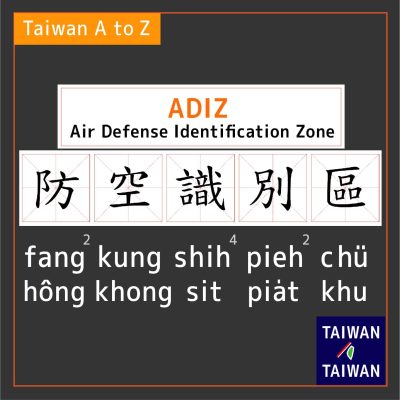
A is for ADIZ 防空識別區:遭雙重侵蝕的實體防線與認知防線
深度解析中共軍機侵擾台灣防空識 [...]
