Taiwan A-Z
A – ADIZ: The Eroding Frontiers of Taiwan’s Airspace and Mind 防空識別區 遭雙重侵蝕的台灣空域與認知防線

An ADIZ is not sovereign airspace. It is a buffer zone that extends beyond a country’s territory, where approaching aircraft are expected to identify themselves in advance. Modern fighter jets can carry missiles with ranges of hundreds of kilometers—you do not wait until they enter your airspace to respond. By then, it would already be too late. That is why countries around the world maintain ADIZs.🔗
防空識別區與領空不一樣,是由領空向外延伸的緩衝空域,用來要求接近的飛機提前表明身份。因為現代戰機所搭載的飛彈,其射程可能達數百公里,如果等到別國戰機進入領空才派出戰機應對,那樣早已來不及,這也是為什麼各國普遍都劃有 ADIZ。
Taiwan’s ADIZ spans from 21° to 27° North latitude and 117.5° to 123° East longitude, with its western flank bounded by the Taiwan Strait median line🔗. For decades, these two invisible boundaries in the sky maintained a fragile yet stable peace across the Taiwan Strait. Today, however, they are being systematically eroded and erased by Beijing’s relentless military incursions.
台灣的防空識別區範圍位於北緯 21 至 27 度,東經 117.5 至 123 度,其中西側以台灣海峽中線為界。過去數十年來,這兩條存在於天空的隱形界線,維持了台海兩岸脆弱卻穩定的和平。但如今,它們正遭到北京當局密集的軍事侵擾,進行系統性地蠶食與抹滅。

What is the Taiwan Strait Median Line? (The Davis Line History)
台灣海峽中線(戴維斯線)是什麼?
The Taiwan Strait median line has a long history. Following the signing of the Sino-American Mutual Defense Treaty in 1954, Brigadier General Benjamin O. Davis Jr.—then commander of the U.S. Air Task Force 13 in Taiwan—established an air defense alert line down the center of the strait to contain and de-escalate potential conflicts. He advised Taiwanese forces and all allied U.S. military personnel keeping the peace to operate strictly east of this “median line.”
台海中線存在已久。1954 年,美國與台灣簽訂《共同防禦條約》,出於控制衝突的考量,時任駐台美軍第十三航空特遣隊司令戴維斯准將(Benjamin O. Davis Jr.)在台灣海峽中間劃設一條警戒線,要求台灣與所有在台協防的美軍都在「海峽中線以東」活動。
Furthermore, General Davis issued a definitive operational order at the time: “Should aircraft or vessels of the Chinese People’s Liberation Army cross the median line of the Strait, and be determined to possess hostile intent, defending U.S. fighter jets are authorized to engage and open fire.” This historic mandate became famously known as the “Davis Line.”
戴維斯准將發布的命令是這麼說的:「只要中國人民解放軍之機、艦越過海峽中線,而且判明具有敵意的話,協防台灣的美軍戰鬥機即可迎戰開火」,此即著名的「戴維斯線」(Davis Line)。
The Median Line Exists: Proven by Decades of Chinese Adherence
海峽中線確實存在 中共遵守了數十年
Breaking the Promise: The Rise of an Aggressive Superpower
背棄承諾:不再隱藏的擴張野心
However, this delicate balance began to unravel after Xi Jinping assumed power in late 2012. Xi has systematically dismantled the core foreign policy pledges laid out during the Mao Zedong era.
然而,這項脆弱的平衡在 2012 年底習近平掌權後逐漸瓦解,中國開始系統性地拆解毛澤東時代所奠定的核心外交政策承諾。
Most notably, in 1974, then-Vice Premier Deng Xiaoping solemnly declared before the United Nations General Assembly: “China is not and will never be a superpower… China will never become an imperialist nation seeking world hegemony, nor will it ever engage in aggression, interference, control, subversion, or plunder against other countries.”🔗
最著名的例子是,1974 年時任國務院副總理鄧小平曾在聯合國大會上鄭重宣告:「中國現在不是!將來也不做超級大國!……中國絕不會成為謀求世界霸權的帝國主義國家!也絕不會對別國進行侵略、干涉、控制、顛覆、和掠奪!」
Salami-Slicing Strategy: PLA Air Incursions in 2025
切香腸戰術:2025 年共機擾台
In August 2022, following the visit of then-U.S. House Speaker Nancy Pelosi to Taiwan🔗, Beijing seized the moment to normalize military crossings of the median line. Since then, the Chinese military has operated around Taiwan with ever-increasing frequency and scale. PLA fighter jets and drones now breach Taiwan’s ADIZ on a near-daily basis.
2022 年 8 月,在美國時任眾議院議長裴洛西(Nancy Pelosi)造訪台灣後,北京當局藉此機會將「軍機越過海峽中線」常態化。自那時起,中國軍隊在台灣周邊活動的頻率與規模便不斷增加。如今,中共解放軍的戰機與無人機幾乎天天闖入台灣的防空識別區。
Furthermore, Beijing has unilaterally launched sweeping, simulated joint military operations encirclement campaigns around Taiwan, treating these maneuvers as real-world dress rehearsals for a potential future blockade.
此外,北京更單方面發動了全面且具備模擬性質的圍台聯合軍事演習,將這些軍事操演視為未來潛在封鎖行動的實戰預演。
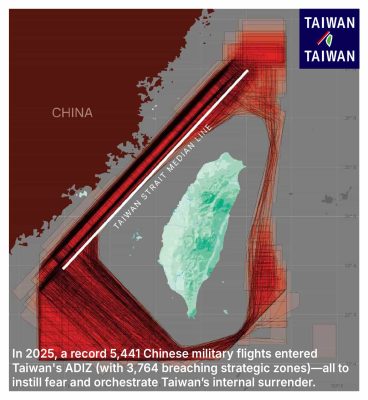
According to official data from Taiwan’s Ministry of National Defense (MND)🔗, the scale of these incursions is staggering. In 2025 alone, a record 5,441 sorties of Chinese military aircraft entered Taiwan’s ADIZ, with 3,764 of those sorties crossing the median line or entering Taiwan’s southwestern and eastern ADIZ. On the maritime front, a staggering 2,915 sorties of Chinese naval and government vessels entered Taiwan’s contingency zone in 2025.
根據台灣國防部的資料,僅 2025 年就有 5441 架次中共軍機進入台灣防空識別區,其中 3764 架次逾越台海中線、進入台灣西南與東部 ADIZ。在海域方面,2025 年也有 2915 艘次中共船艦進入台灣應變區。
Consider the mundane irritation of a flight where an ill-mannered neighbor shoves their elbow past the shared armrest’s “median line.” China’s geopolitical maneuver, however, is the equivalent of a passenger thrusting their reeking, bare feet straight across the main aisle, flashing a strapped ankle-holster to the entire cabin—short of drawing the weapon itself.
試想,我們在搭飛機時,有時會遇到鄰座乘客無禮地將他的手肘靠超過彼此扶手的「中線」。而中國的這種行徑,則是直接將它的臭腳丫跨越中間走道,向整機的乘客展示他腳踝上的槍套,只差沒有拔出來使用。
This is far from an obsolete internal dispute over territorial lineage; it is a raw, asymmetric extortion executed directly at the maritime throat of the Western Pacific, deliberately testing the red lines of international law and treaty-based civilization.
這絕非一場前現代的內政主權爭議,而是一場公然在西太平洋海權心臟地帶、對國際法與全球契約文明底線進行的非對稱流氓勒索。
In this Beijing-engineered erosion of Taiwanese airspace, the frontline of sovereignty is subjected to the absolute compression of physical velocity. Should a Chinese warship launch cruise missiles from just outside Taiwan’s 24-nautical-mile contiguous zone, targeting the island’s radar stations, airfields, and air defense bastions, the entire lethal ballistic trajectory leaves Taiwan a mere 3 minutes to react.
在北京這場精心設計的空域侵蝕中,台灣主權的前線正面臨著物理速度的絕對壓縮。一旦中國軍艦從台灣 24 浬鄰接區外發射巡弋飛彈,瞄準島上的雷達站、機場與防空要塞,整個致命的物理彈道過程,台灣僅有約 3 分鐘的時間可以反應。
Desensitizing the Global Community Through Normalized Incursions
侵擾常態化 麻痺國際社會
Each incursion forces a response. Taiwan’s air force must scramble, monitor, and remain on constant alert. Resources are consumed. Pressure accumulates. Readiness is tested—again and again.
應對中共的每一次侵擾,台灣空軍會立即升空、全程監控、維持高度警戒。但同時台灣的國防資源也被消耗,壓力在累積,戰備狀態也持續被測試。
This relentless strategy—operating in the shadow between peace and conflict—is the textbook definition of “grey-zone coercion.🔗“
這種方式,被稱為「灰色地帶施壓」,介於和平與戰爭之間。
Cognitive Warfare: From Airspace Erosion to Democratic Manipulation
認知戰:侵擾空域搭配代理人操縱台灣選民
Is China ready to wage an all-out war? Decades have passed, and at least for now, Beijing has frozen short of crossing that final, irrevocable red line. Yet, that is precisely the point.
中國準備好要開戰了嗎?數十年過去,至少到目前為止,它仍未跨出最後那一步。然而,這正是關鍵所在。
The ultimate objective of these relentless incursions is not to trigger an immediate kinetic war. Instead, it is a psychological gamble: to intimidate Taiwan’s government and terrorize its people while staying just below the threshold of an all-out military conflict.
這些侵擾台灣的行動,其終極目的並非要立即引爆一場實體的戰爭,相反地,這是一場地緣政治上的心理賭博:企圖在精準維持低於全面軍事衝突門檻的前提下,恫嚇台灣政府並震懾台灣人民。
Crucially, this grey-zone offensive does not stop at the physical domain; it seamlessly integrates a prolonged, systemic campaign of “cognitive warfare” aimed squarely at the hearts and minds of Taiwanese voters.
這種灰色地帶的攻勢並未止步於實體領域,它結合了一場曠日持久、且具系統性的「認知戰」,而這場戰役的槍口,直接對準台灣選民的心智與認同。
In recent years, opposition forces, including the Kuomintang (KMT), have repeatedly boycotted, delayed, or slashed special defense budgets proposed by Taiwan’s Ministry of National Defense. Regardless of the rhetoric they use to justify these moves, the objective effect remains the same: it directly undermines Taiwan’s capacity to withstand escalating military pressure.
近年來,彷彿與北京的實體軍事侵擾形成詭異共振,台灣內部開始有部分學者與政治人物向民眾推銷一種破綻百出的敘事:宣稱防禦性的嚇阻是一種「挑釁」,和平唯有透過「單方面解除武裝」才能獲得保障。
This rhetoric manifested in tangible obstruction: opposition forces, led by the Kuomintang (KMT), systematically filibustered, delayed, and slashed the Ministry of National Defense’s special budgets. Critical funding for next-generation defense infrastructures—including AI-driven air defense command systems, domestic drone production lines, and joint Taiwan-U.S. ammunition supply chains—was zeroed out.
這種論調隨即轉化為實質的政治阻礙:以中國國民黨為首的在野勢力,系統性地惡意杯葛、延宕、並刪除台灣國防部的特別預算。諸多攸關下一代防衛架構的關鍵資金包括——防空 AI 指揮系統、本土無人機產線、台美合作的彈藥供應鏈——全數遭到清零。
Whatever the domestic pretexts offered, the objective geopolitical consequence remains undeniable: it actively hollows out Taiwan’s capacity to withstand escalating military coercion.
無論其在國內宣稱何種藉口,客觀的地緣政治後果難以粉飾:他們實質上正在掏空台灣應對升級軍事脅迫的能力。
If Taiwanese society, under this protracted duress, gradually loses its resolve to resist, weakens its defense preparation, and begins to accept “non-resistance” or “political arrangements” (such as ‘One Country, Two Systems’ or a ‘Peace Agreement’) as viable options, then Beijing will achieve its ultimate strategic goal—without firing a single shot.
如果台灣社會在持續的壓力下,逐漸降低防衛意志、削弱國防準備,甚至開始接受「不抵抗」或「政治安排(如一國兩制、和平協議)」作為選項,那麼,中共的某些目標,或許就能在不開一槍的情況下實現。
Therefore, perhaps it is not just approaching warplanes that must identify themselves in advance. The stances and choices of politicians and media outlets in a democratic society should be equally transparent to voters. We must demand this clarity—before it is fatally too late.
因此,也許不只是逼近的飛機需要提前表明身份,民主社會的政治人物與媒體,其立場與選擇,同樣也應該提前表明給選民知道。在一切還未太遲之前。
Reference
▍Ministry of National Defense ROC(Taiwan)—PLA activities in the waters and airspace around Taiwan
▍Office of the President ROC(Taiwan)—President Lai interviewed by AFP
▍Reuters—Taiwan says budget delay risks ‘rupture’ in line of defence against China
▍Reuters—China turns Taiwan’s own voices against it in information war
▍The Diplomat—Taiwan’s Special Defense Budget Cut Will Cost Its Drone Capabilities
D – Democracy: The Beacon of Resiliency in the Shadow of Authoritarianism 民主:極權陰影下的自由燈塔
Explore Taiwan's ep [...]