Taiwan is a vibrant, young democracy, having elected its own president through a ‘one person, one vote’ universal suffrage system since 1996.
台灣是一個年輕且充滿活力的民主國家,自 1996 年起,一人一票選出自己的總統。
In global evaluations measuring democracy and liberty, Taiwan consistently ranks at the very top. Authoritative metrics—such as the Democracy Index published by the Economist Intelligence Unit (EIU)🔗, the Freedom in the World report by Freedom House 🔗, and the Press Freedom Index surveyed by Reporters Without Borders (RSF)🔗—all demonstrate that Taiwan stands as one of the most democratic and free nations in Asia.
Taiwan embraces freedom of speech and religion, champions gender equality, and in 2019, made history as the first nation in Asia to legalize same-sex marriage.
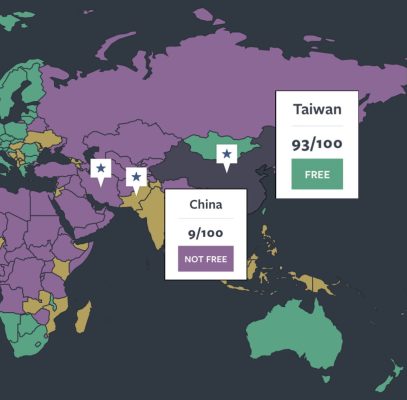
In Freedom House’s “Freedom in the World 2026” report, Taiwan was ranked as a “Free” country with 93 points, while China received only 9 points and was again classified as “Not Free”. 台灣在 Freedom House 2026 年全球自由報告以 93 分名列自由國家,中國則獲得 9 分。
Yet, Taiwan’s democracy and freedom were never easily won. Following its total defeat in the Chinese Civil War, the Nationalist Government officially established its presence in Taiwan in 1949. From that defining moment onward, this island was locked within the KMT’s authoritarian matrix, enduring half a century of suffocating torment under thirty-eight years of martial law and iron-fisted state terror.
The road to Taiwanese democracy remains a long epic forged and tempered in historical trauma, out of which an unyielding bravery and radiant hope were fiercely extracted. Enduring the synchronized strangulation of an internal alien autocracy executing bloody deprivation and an external totalitarian black hole exerting its annexation pull, successive waves of free souls moved forward in an unceasing, defiant-unto-death procession. Driven by an ironclad collective resolve within the narrow fractures of global geopolitics, they steered Taiwan away from destruction, step by step growing a powerful civilizational antibody out of the ruins of history to shatter the siege of autocratic tyranny.
Trusteeship under the Bayonet: Chiang Kai-shek’s Military Occupation and the Parachuted External Constitution
刺刀式代管:蔣介石的軍事佔領與強行空降的憲法
Following the conclusion of World War II in 1945, as Taiwan emerged from fifty years of Japanese rule, the Chinese Nationalist Government—authorized by General Order No. 1 🔗 issued by General Douglas MacArthur, Supreme Commander for the Allied Powers—entered Taiwan on behalf of the Allied Powers to accept the surrender of Japanese forces and institute a military occupation.
1945 年二戰結束後,台灣脫離日本長達 50 年的統治。中國國民政府依據同盟國盟軍最高統帥麥克阿瑟將軍發布的《一般命令第一號》(General Order No. 1)授權,代表同盟國前往台灣接受日軍投降並實施軍事佔領。
Under international law, this takeover placed Taiwan under a post-war military trusteeship of the Allied Powers, a legal reality that persisted until the 1951 Treaty of San Francisco when Japan formally renounced all rights, titles, and claims to Taiwan and the Pescadores. Within the framework of international law, the Nationalist Government functioned merely as a temporary administrator of governing authority; it possessed absolutely zero legal right to incorporate Taiwanese territory and its populace into a permanent registration of its own national constitutional sovereignty.
However, the Chiang Kai-shek regime subsequently unilaterally declared the “Retrocession” of Taiwan and forcibly altered the nationality of Taiwan’s inhabitants. The two core shareholders of the Allied Powers at the time—the governments of the United States and the United Kingdom—immediately lodged fierce protests through diplomatic notes, stating unequivocally that the National Government had no legal authority to unilaterally alter the sovereignty of Taiwan prior to the signing of a formal peace treaty.
The rationale behind the U.S. and U.K. refusal to recognize the claim was crystal clear: following the lawful cession of Taiwan to Japan under the 1895 Treaty of Shimonoseki, the Great Qing Empire’s asset ledger completely and permanently ceased to include Taiwan. Whether it was the Republic of China founded in 1912, or the Chinese Communist Party that subsequently usurped power, the historical Chain of Title at their respective moments of founding bore absolutely no relation to Taiwan. The National Government’s forced transfer of title in Taiwan was, under international law, purely an invalid and illicit occupation.
英美拒絕承認的理由很清楚,因為大清帝國的資產總清冊早在 1895 年《馬關條約》將台灣合法割讓給日本後,就徹底不包含台灣。 不論是 1912 年創立的中華民國,還是後來篡位的中共,其建國時的產權前手因果(Chain of Title)都與台灣毫無關係。國府強行將台灣過戶,在國際法上純屬無效的非法強佔。
The British Foreign Office immediately dispatched an official diplomatic note to the Chinese Embassy, stating: “Pending a peace treaty to settle the status of Taiwan, His Majesty’s Government cannot recognize the Chinese Government’s decree issued on January 12, 1946, which purports to effect the collective naturalization of Taiwan’s inhabitants as Chinese citizens.” The United States subsequently aligned its legal stance with this view. 🔗
Declassified U.S. official archives further reveal that following the outbreak of the February 28 Incident in Taiwan in 1947, a flurry of telegrams was exchanged among the U.S. Consulate in Taipei, the U.S. Embassy in Nanjing, and the Department of State. In an official instruction directed to the Embassy in China by Secretary of State George Marshall (recorded in Foreign Relations of the United States, 1947), the United States government reiterated its firm legal position: “The transfer of sovereignty of Formosa to China has not yet taken place.” 🔗 The U.S. and U.K. governments consistently maintained that, prior to the signing of a formal peace treaty, the Chinese government’s unilateral decrees could legally alter neither the sovereignty of Taiwan nor the nationality of its inhabitants.
Although Chiang Kai-shek promulgated the Constitution of the Republic of China on the mainland in 1947, grandiosely hoisting the banner of the “Three Principles of the People,” this constitution enacted in Nanjing functioned in reality as a mere paper utopia designated for an unrealizable future. At that historic flashpoint, nearly one-third of China’s territory and population had already fractured from the Nanjing government’s sovereign administrative control, falling under the de facto governance of the Chinese Communist Party, while the Nationalist and Communist armies locked in blood-soaked combat involving hundreds of thousands of troops across northern China. In other words, this constitution operated purely as a legalistic weapon engineered by Chiang Kai-shek to contest historical legitimacy against the Communist insurgency; it possessed absolutely zero genuine legal lineage or popular property title relationship with Taiwan.
Although there were eighteen so-called “Taiwanese delegates” orchestrated under the KMT’s alignment to travel to Nanjing to participate in the constitutional convention, these individuals were by no means sovereign trustees authorized through universal suffrage by Taiwanese civil society. Instead, they were mostly hand-picked elites and gentry generated through internal appointments or indirect elections by the KMT’s local party branches and provincial councils—parachuted into a remnant system already heavily infiltrated and controlled by the alien autocratic machinery. Legalistically operating as an “unauthorized agency,” they were curated strictly as theatrical props for a political stage play engineered to simulate the “retrocession of Taiwan,” rendering them utterly incapable of representing the collective will of the Taiwanese populace, who were then enduring hyperinflation, severe societal upheaval, and the imminent explosion of the February 28 Incident.
Out of 2,050 statutory seats in the Nanjing convention, the arbitrary presence of these so-called Taiwanese representatives accounted for less than one percent. Within the matrix of constitutional jurisprudence, this severe imbalance constitutes a “systemic and structural disenfranchisement,” rendering this continental legal framework a thoroughly “unconscionable adhesion contract” that inflicts an irremediable “original legitimacy deficit” upon this external text over Taiwanese sovereign agency. While some of the local gentry who became Taiwanese representatives attempted to fight for “provincial autonomy clauses” and economic autonomy for Taiwan at the Nanjing convention, they subsequently encountered the brutal suppression of the February 28 Incident upon their return to the island, followed closely by the iron-fisted horrors of the subsequent grand purges.
In the fateful year of 1949, this continental constitution—utterly detached from the collective will of the Taiwanese people—was forcefully parachuted and weaponized by the exiled government of Chiang Kai-shek to permanently lock down this island. Worse still, upon retreating to Taiwan, Chiang immediately frozen the democratic rights and fundamental human liberties guaranteed by this external text. By enforcing strict bans on political parties and independent press, the regime stripped away any pretense of constitutionalism—ensuring that everything on the island was dictated purely by the raw force of an armed, autocratic government.
The Roots of Oppression: The White Terror and KMT’s Authoritarian Rule
以反攻大陸為名:白色恐怖、經濟壟斷、文化清洗、思想箝制
Under this deeply entrenched “party-state system,” state capital and ruling party assets became seamlessly intertwined, monopolizing the island’s economic lifelines. An elite class of oligarchs and crony capitalists colluded with the regime, systematically elevating authoritarian survival far above democratic principles.
During this dark era, political dissent was violently suppressed, and freedom of speech was entirely stripped away. The imprisonment of citizens for purely political reasons became widespread. This harrowing chapter of history is known as the “White Terror.” Countless individuals fell victim to relentless state persecution—losing their freedom in labor camps, having their private properties confiscated, and, in too many tragic cases, facing execution by firing squad.
Crucially, those persecuted during the February 28 Incident and the ensuing “White Terror” were not exclusively advocates of Taiwanese independence or communism. Instead, the vast majority were highly educated, moderate elites who enjoyed immense social prestige: progressive gentlemen, lawyers, physicians, scholars, and elected representatives.
A whole generation of top-tier talents—who could have led Taiwan toward a modern democracy, the rule of law, and a cultural renaissance—was virtually decimated or forced into exile within just a few years. This included legal pioneer Wang Yu-lin, master painter Chen Cheng-po, visionary educator Lin Mao-sheng, medical elite Shi Jiang-nan, and revered local leader Chang Chi-lang, along with peasant movement leader Chien Chi.
Indigenous leaders with cross-ethnic appeal were also brutally targeted. Prominent Indigenous elites—such as Uyongu Yatauyungana (Kao I-sheng) and Yapasuyongu Yulunana (Tang Shou-jen) of the Tsou tribe, alongside Losin Watan of the Atayal tribe—were systematically executed by firing squad under fabricated charges of “rebellion” and “corruption.”
Mainlanders who retreated with the KMT were by no means exempt; in fact, Chiang Kai-shek purged them with even greater severity. To the dictator, because these individuals operated at the very epicenter of power, their threat to his regime was perceived as more immediate and lethal than that of the native Taiwanese. This ruthless political cleansing spared no one—stretching from the highest echelons of the party-state to high school principals and grassroots citizens—as tragically illustrated by the persecution and silencing of Chang Min-zhi, General Sun Li-jen, Wu Kuo-chen, Lei Chen, and Tsui Hsiao-ping.
In education, Chiang Kai-shek systematically constructed a rigid “Great China Historiography” and a pervasive party-state ideology rooted in leader-worship. This curriculum explicitly emphasized Chinese cultural orthodoxy, party-led governance, and the militaristic vow to “recover the mainland.” History textbooks were strictly curated around the myth of “Zhongyuan (Central Plains) Orthodoxy,” pushing Taiwan’s own rich past to the margins as a mere passive appendage of Chinese regional history—reducing the island’s narrative to nothing more than Han settlement and Koxinga’s expulsion of the Dutch.
To engineer a homogenized “Chinese nation” identity, Chiang Kai-shek strictly enforced the “Mandarin Movement” across all educational campuses, implementing an absolute, punitive ban on the use of Taiwanese, Hakka, and Indigenous languages. The geographical textbooks of that era mandated a pathological memorization detailing the railway networks, mineral deposits, and topographical features of distant Chinese provinces, while completely marginalizing the immediate reality of Taiwan, deliberately expunging the infrastructural modernization and institutional advancements instituted during the Japanese colonial period.
Schools were effectively weaponized as institutional hubs to implement this party-state orthodoxy. Campus management heavily demanded absolute discipline and unyielding ideological loyalty to the regime. Textbooks were flooded with hagiographic stories celebrating Chiang Kai-shek’s personal achievements, elevating him to the divine stature of the “Savior of the Nation” and a “Great Leader of the World.” Bronze statues of Chiang and portraits of Sun Yat-sen saturated every schoolyard, and students were legally compelled to bow and pay homage every single time they passed them.
By executing a legal and educational confiscation of the people’s maternal linguistic property rights, and forcibly overlaying Taiwan’s maritime geostrategic memory with a mythic continental matrix, the KMT regime formatted the collective consciousness of the islanders into mere political instruments designed to sustain its undead, exiled claims of continental legitimacy. This violent erasure of the island’s autonomous historical lineage and modern heritage subjected the Taiwanese people to one of the most sophisticated exercises in memory liquidation and institutional captivity in modern history.
To cement the loyalty of his two-million-strong entourage of displaced military and public servants while executing a preemptive strike on the political agency of native Taiwanese, Chiang Kai-shek institutionalized provincial discrimination. In this rigged system, meritocracy was discarded in national exams; positions were instead distributed through a rigid provincial quota blueprint tied to mainland China’s outdated demographics. The Mainlander population was predominantly absorbed into the military, civil service, and public education sectors, enjoying exclusive state privileges such as housing rights in military dependents’ villages (Juancun), subventions for children’s education, and rations of essential goods. This systemic coddling was deliberately engineered to widen the socioeconomic and lifestyle chasm between native Taiwanese and Mainlanders.
This institutional design created a vicious cycle of dependency: facing ostracization from native Taiwanese, the Mainlander community had no choice but to rely on and support Chiang’s authoritarian regime. Concurrently, the native population misdirected their grievances onto ordinary Mainlander civilians. By manufacturing this friction, Chiang masterfully deflected the core conflict—transforming the volatile tension between an oppressed public and a tyrannical government into a horizontal provincial divide among citizens themselves.
Most damningly, the subsidized pension scheme implemented for this state apparatus guaranteed an astronomical 18 percent annual interest rate, executing a slow-motion, multi-decadal fiscal drain on the island’s resources until it was permanently terminated under the unyielding pension reforms of the Tsai Ing-wen administration in 2021.
This systematic provincial segregation operated, in its realist essence, as an institutionalized plunder launched by an alien regime to enforce minority autocracy. By treating the state apparatus as the private property of a select diaspora, and forcefully replicating a feudal, clientelist hierarchy upon Taiwanese soil, the KMT establishment suffocated the island’s socioeconomic self-determination, formatting the generational labor of the Taiwanese majority into mere financial fuel to sustain its fictional Greater China matrix.
Beginning in the 1950s, although Chiang Kai-shek was compelled by international pressure to permit local elections (for county magistrates, mayors, and local representatives), he weaponized a sophisticated political design to fragment local forces. Within each county and city, the party-state deliberately nurtured and sustained two mutually antagonistic local factions. During elections, the KMT central leadership would alternate its nominations between these rivals, or strategically engineer a balance where one faction secured the magistracy while the other controlled the local council speaker ship.
To secure compliance, the regime weaponized local economic monopolies as lucrative rewards for obedient factions. These captured resources included the credit departments of farmers’ associations, regional bus companies, local banks, and credit cooperatives. This calculating institutional design forced Taiwanese local elites into protracted, bitter factional infighting for short-term economic and political spoils. Locked in a fierce competition to “curry favor” with the KMT central leadership for survival resources, they were systematically prevented from coalescing into a unified, potent Taiwanese indigenous political force.
Through this highly calculated, dual-track system—wielding the carrot of local privileges and patronage in one hand, and the stick of secret police terror and bloody purges in the other—the party-state systematically fractured Taiwanese society. It split the population into mutually antagonistic local factions, polarized provincial identities, and suspicious individuals isolated from one another, effectively anchoring the KMT’s authoritarian rule for decades.
Small on the Continent, Vital on the Sea: The Age of Sail and the Pivot of Maritime Power
台灣以陸權來看很小,但以海權的視角觀之:無比重要
Had Taiwan been situated within a landlocked enclave, entirely insulated from external threats, Chiang Kai-shek’s authoritarian playbook might well have been flawless. But Taiwan is not.
台灣如果是位處封閉的內陸,而且沒有外敵,蔣介石政權的這套統治術也許無懈可擊,但台灣不是。
Though Taiwan is a small island, its geographical positioning remains extraordinary; to fully comprehend this, we must trace our lineage back to an even earlier horizon of the island’s history. Admittedly, because of the natural barriers imposed by its mountainous terrain, the early Indigenous societies scattered across the island never coalesced into a unified state capable of resisting foreign colonization.
Yet, a deeper truth lay hidden beneath the soil. Through rigorous linguistic and genetic research, archaeologists have discovered that Taiwan harbors the most ancient and diverse branches of the Austronesian language family—conclusively establishing the island as the foundational cradle and epicenter of the entire Austronesian expansion. Roughly 4,000 to 5,000 years ago, Taiwan’s maritime voyagers initiated an epic southward migration. Their footprints eventually saturated the vast island regions spanning Southeast Asia, Oceania, and the Indian Ocean.
Viewed through the narrow lens of continental power, Taiwan appears deceptively small. But oceans cover 71% of our planet, and Taiwan sits directly at the ultimate strategic pivot between the East Asian continent and the vast Pacific. Taiwan is by no means the dead end of continental power; it is the glorious inception of an expansive maritime domain.
Beginning with the 17th-century Age of Sail, due to its exceptional positioning situated directly between the Ming Empire, the Japanese Ryukyu Archipelago, and the Philippine Archipelago, Taiwan has operated as an indispensable maritime throat connecting Northeast and Southeast Asian sealanes. This extraordinary geostrategic location was swiftly identified by rising global maritime powers. From that defining moment onward, Taiwan’s destiny became irrevocably tied to the shifting currents of global geopolitics, transforming the island into a fierce vortex of international competition.
Taiwan was first weaponized as a commercial transit hub disputed by European colonial powers; subsequently, it was seized by the Zheng regime to serve as a joint military and mercantile base.
台灣先是成為歐洲殖民帝國爭奪的貿易轉口站;接著被鄭氏政權奪取,當作軍事與貿易基地。
However, because the Zheng dynasty flew the banner of “resisting the Qing and restoring the Ming,” it inevitably drew the strategic focus of the Qing Empire—a monolithic continental power. Taiwan was ultimately captured by the Qing court, but for nearly two centuries, it was treated merely as an isolated island to be quarantined from the mainland, defensively managed to prevent it from ever being used as an insurrectionist springboard again.
Only when the Qing Empire sluggishly realized that continental supremacy cannot survive without maritime power, it was already too late—Japan had triumphed in the First Sino-Japanese War. Under Tokyo’s demands, Taiwan was ceded to the Japanese Empire.
Securing this vital strategic anchor provided the catalyst for Japan to aggressively project its power deep into the South Seas, seeding the imperialistic ambitions that would later drive its invasions of Korea, Manchuria, and eventually, the entirety of Southeast Asia.
During World War II, Taiwan was intensively heavily industrialized to function as a critical military logistics and heavy industrial processing fortress for the Japanese Empire. The aviation alcohol storage tanks scattered across Taiwan became the absolute lifeblood of the Japanese military aircraft. Consequently, the island was repositioned as a top-priority strategic bombardment target for the United States and Allied forces, unleashing a torrent of devastating air raids that caused countless Taiwanese civilian casualties in the roaring fires.
In August 1945, following the atomic bombings of Hiroshima and Nagasaki by the United States, Japan surrendered unconditionally.
1945 年 8 月,美國在日本本土投下兩顆原子彈,日本投降。
Did the suffering of the Taiwanese people finally come to an end? Far from it. Taiwan failed to catch the global wave of decolonization and independence sweeping across other former colonies, permanently missing its historic window to emerge as an autonomous maritime nation. Instead, the people gathered at the Port of Keelung to welcome the arriving Nationalist (KMT) government from China.
Once again, Taiwan was relegated to a resource colony, ruthlessly plundered this time to bankroll the KMT’s crumbling civil war on the Chinese mainland. This severe economic over-extraction rapidly triggered a catastrophic spiral of hyperinflation across the island.
台灣,再次地,又被當作榨取資源的基地。這次,是被用來支持國民政府在中國即將崩潰的內戰。
The resulting societal desperation culminated in the February 28 Incident of 1947, which the arriving regime strategically weaponized as the bloody inception to systematically purge and liquidate Taiwan’s intellectual and social elites.
國民政府的超額榨取導致台灣陷入惡性通膨,1947 年的二二八事件,成為國民政府清洗台灣菁英的開端。
In December 1949, suffering a decisive and total defeat in the Chinese Civil War, President Chiang Kai-shek retreated his entire government and military to Taiwan, unleashing a draconian state of military martial law that would freeze the island for nearly forty years. Under this total control, the lives, livelihoods, properties, and fundamental freedoms of the Taiwanese people were left entirely to the mercy and absolute whim of a tyrannical regime.
Uncannily mirroring the Zheng Koxinga era centuries prior, Taiwan was redefined yet again into a heavily fortified, martial-law military garrison—a mere tactical springboard to exploit for “recovering the mainland.” And once more, the island found itself squarely in the crosshairs, trapped under the perilous gaze of the dominant regime occupying the East Asian continent.
Geopolitical Pivot: The First Island Chain and U.S. Cold War Strategy
第一島鏈戰略樞紐:自由世界的不沉航母
Initially, thoroughly repulsed by the systemic corruption of the “Chiang-Soong-Kung” clans, the U.S. government was firmly unwilling to extend further aid to the Republic of China in its fight against the Chinese Communist Party. Concurrently, Washington harbored deep anxieties that any American intervention in the Chinese Civil War would inadvertently drive Beijing permanently into the strategic embrace of the Soviet Union.
Consequently, then-U.S. President Harry S. Truman issued a definitive public declaration: the United States had absolutely no intention of intervening in the Chinese Civil War, nor would it provide any military aid or strategic counsel to the collapsing Nationalist government.
時任美國總統杜魯門因此一度公開聲明,美國無意介入中國內戰,也不再為中華民國政府提供軍事援助與意見。
However, the sudden outbreak of the Korean War in 1950 and the subsequent entry of the Chinese Communist forces completely shattered this paradigm. As Beijing executed a total strategic tilt toward Moscow, it fundamentally disrupted Washington’s original defense blueprint, which had explicitly excluded both Taiwan and South Korea from its Pacific defense perimeter.
It was during this defining crisis that legendary U.S. General Douglas MacArthur, staring intently at the map, first crystallized Taiwan’s strategic value for the free world, famously dubbing it “the unsinkable aircraft carrier.” He forcefully warned that should this strategic pivot fall into Communist hands, it would instantly be weaponized as a “springboard for authoritarian expansion.”
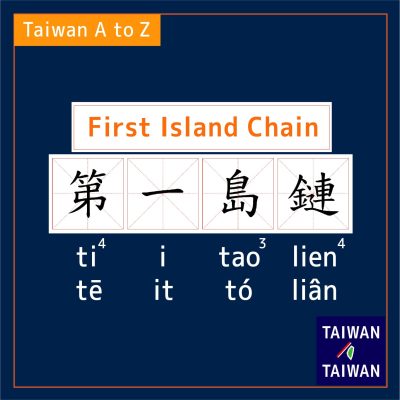
Driven by this historical imperative, the United States formalized its grand strategy to contain communist expansion, constructing the “First Island Chain”🔗—a strategic maritime perimeter anchoring from Japan, the Ryukyu Islands, Taiwan, and the Philippines, all the way down to the Greater Sunda Islands. This was far more than a localized conflict; it marked the formal crystallization of the global Cold War.
This marked a monumental, historic turning point for Taiwan. Due to its pivotal location at the absolute core of the First Island Chain, Taiwan was instantly transformed from an abandoned outlier into a heavily supported and protected frontline of the Western alliance, serving as the vanguard against authoritarian expansion.
Crucially, President Truman officially declared that the legal status of Taiwan remained unresolved, stating explicitly that “the determination of the future status of Formosa must await the restoration of security in the Pacific, a peace settlement with Japan, or consideration by the United Nations.”🔗
This historic pronouncement carried profound implications in international law: it signaled that the United States did not recognize post-WWII Taiwan as an integral part of China. Consequently, Beijing was stripped of any legal foundation to assert sovereignty over Taiwan under the pretext of “inheriting Chinese territory.”
To back this legal stance with military resolve, Washington immediately dispatched the U.S. Seventh Fleet into the Taiwan Strait. Their mission was to protect this post-war territory of undetermined status, enforcing what became strategically known as the “neutralization of the Taiwan Strait” to freeze any military cross-strait conflict.
Paradoxically, while President Truman’s “undetermined status” doctrine and the Seventh Fleet’s “neutralization of the strait” shielded Chiang Kai-shek’s regime from Communist annexation, it simultaneously castrated his core political myth—the obsolete claim of being the sole legal government of all China and the grand vow to “recover the mainland.” This legal snub provoked furious rage from Chiang, who fiercely counter-asserted: “Taiwan is an inseparable part of China’s territory! The Government of the Republic of China possesses absolute sovereignty over Taiwan! This position shall never change!”
This historic doctrine of “undetermined status,” decreed by President Truman of the United States—the preeminent victorious power of World War II—operated as a brutal forensic audit under international law: it systematically stripped Chiang Kai-shek’s regime of any a priori, legitimate sovereign claim over Taiwan. Legalistically, it demonstrated that the KMT’s military occupation and iron-fisted governance of the island was merely a temporary “post-war military trusteeship” authorized by the Allied Powers via Douglas MacArthur’s General Order No. 1, rather than a valid transfer of territorial title. The subsequent Allied-led Treaty of San Francisco, engineered predominantly by the United States, strictly mandated that Japan renounce all rights, titles, and claims to Taiwan and the Pescadores without assigning permanent ownership to any specific Chinese government. This calculated omission instantly exposed the foundational myth of the KMT’s authoritarian “ruling legitimacy” as a legal vacuum and a castle in the air.
Though Chiang possessed the physical machinery of the state and bayonets on the ground, his regime never acquired a clean, registered sovereign title over Taiwan on the grand chessboard of international realpolitik. This legal severance thoroughly dismantled the alien autocracy’s continental mythology, leaving a profound international legal void that the Taiwanese populace, half a century later through self-determination and deep integration with the global order, would resolutely occupy—permanently re-registering that “undetermined state” into an ironclad, locally sovereign asset.
Yet, despite his immense fury, Chiang confronted a chilling, inescapable reality. With the Chinese Communist forces heavily amassing along the southeastern coast, poised to launch a bloody invasion to liquidate Taiwan, the dictator knew with absolute clarity that without the U.S. Seventh Fleet and the massive infusion of American dollars, his regime would disintegrate and collapse within a matter of months. Trapped in this geopolitical stranglehold, Chiang pragmatically submitted to the U.S. strategic framework. He begrudgingly traded a degree of sovereign clarity for the absolute guarantee of his political survival underneath the American military and financial umbrella.
U.S. Security, Economic Aid, and the Catalyst for Democratic Dawn
美國提供的安全、經濟、與民主化契機
The half-decade spanning from 1945 to 1950—demarcated by Taiwan’s transition to Nationalist (KMT) control and the outbreak of the Korean War—stands uncontested as the darkest economic twilight for the island in the twentieth century. The Nationalist government’s ruthless over-extraction triggered catastrophic material shortages and untamable hyperinflation. In June 1949, as the reckless over-printing of the old currency spiraled completely out of control, the regime introduced the New Taiwan Dollar to replace the old. In a flash of financial devastation, Taiwanese citizens watched their life savings of forty thousand old Taiwan dollars in the banks instantly evaporate into a mere single New Taiwan Dollar. 🔗
Admittedly, when the KMT retreated to the island, they transported 2.97 million taels of gold from the Central Bank in Shanghai—valued at roughly NT$8.32 billion at the time—and placed it under the management of the Bank of Taiwan. Yet, rigorous economic reality shatters the myth of its sufficiency: had that entire reserve of gold been used solely to purchase rice, it could only cover 55% of Taiwan’s total domestic rice production for a single year. Gold was far from enough to secure the island.
Ultimately, the massive influx of U.S. aid became the absolute lifeline that prevented a total societal collapse, thoroughly breaking the back of the catastrophic hyperinflation. Bypassing the broke Nationalist authorities, Washington poured vital commodities directly into the dry supply chains of the Taiwanese market. Shipments of American wheat, raw cotton, soybeans, and chemical fertilizers arrived in a non-stop maritime pipeline, saturating the parched domestic market.
Through the sophisticated financial engineering of the “U.S. Aid Counterpart Fund”, the government successfully absorbed the rampant excess liquidity floating in the market. This structural mechanism instantly restored public confidence in the currency, firmly anchored the exchange value of the New Taiwan Dollar, and successfully forged a stable, unshakeable macroeconomic shield for the island’s subsequent industrial takeoff.
During the U.S. Aid era spanning from 1950 to 1965, Taiwan’s economy weaponized this geopolitical leverage. Supported by American technology, capital infusion, market access, and umbrella military protection, Taiwan’s economy aggressively skyrocketed into a period of hyper-growth during the 1960s. This era of relentless export expansion permanently redefined the island’s industrial landscape.
Crucially, this economic leap catalytic a profound social revolution for Taiwanese women. As labor-intensive light industries boomed, Taiwanese women transitioned rapidly from peripheral, unpaid roles in traditional subsistence agriculture into the industrial workforce. By earning their own independent wages through factory labor, women achieved unprecedented financial autonomy, resulting in a dramatic and permanent elevation of women’s social status across Taiwanese society.🔗
In 1971, the U.S. advised Chiang Kai-shek to remain in the UN as “Taiwan” or “ROC Taiwan,” but the offer was rejected due to ideological obstinacy. This led to UN Resolution 2758, which recognized the PRC and expelled the ROC, stating that the PRC is the only legitimate representative, and that the ROC’s representatives in the UN should be removed. Losing the “sole legal government” status severely weakened the KMT’s justification for martial law, as the “recover the mainland” myth was exposed as empty, deeply undermining its legitimacy in Taiwan.
Following its eviction from the United Nations in 1971, the Republic of China lost its status as the “sole legal government of China” on the global stage. This monumental shift rendered the KMT’s core justification for its martial law regime—the vow to “recover the mainland”—increasingly vacuous, severely shaking the very foundations of its political legitimacy and authority to rule Taiwan.
Chiang Kai-shek’s son, Chiang Ching-kuo, acutely realized that the KMT government could no longer survive on ideological myths. To forge a new foundation of domestic legitimacy, the regime had to empirically prove its capacity to govern by delivering tangible economic prosperity and improving the daily lives of the Taiwanese people.
Consequently, amidst the shock of the first global oil crisis in 1973, Chiang Ching-kuo launched the landmark “Ten Major Construction Projects,” heavily leveraged by loans and technical expertise provided by the United States. This massive infrastructure drive symbolized a profound, irreversible shift: the core identity of the ROC regime in Taiwan permanently transitioned from a “temporary military government obsessed with recovering the mainland” into a “modern administrative state dedicated to local, sustainable development.”
Paradoxically, the dead end of diplomacy paved the way for the survival of national autonomy. The loss of a hollow, phantom seat in the United Nations stripped away the imperial illusions, forcing the ruling regime to “fall to the ground and take root.” When the doctrine of “Developing Taiwan” permanently supplanted the hollow slogan of “Recovering the Mainland,” the KMT government was, through its actions, effectively conceding a reality: that Taiwan was no longer a mere military springboard to be exploited for a counter-offensive.
“Developing Taiwan and benefiting its people” thus became an unwritten, binding social contract between the regime, the land, and its citizens—a tacit admission that Taiwan itself was now the sole legitimate source of the state’s survival. Ultimately, this profound strategic shift cleared the ground and carved out a vital space for the initial germination of an indigenous Taiwanese consciousness.
The Statutory Shield: The Taiwan Relations Act as the Ultimate Guardian of Security and Human Rights
台灣人安全與人權的法理靠山《台灣關係法》
In the 1980s, driven by internal pressure and a shifting international landscape, Taiwan’s political system began to transform, with the United States playing a pivotal role.
1980 年代,在內部壓力與國際環境變化的影響下,台灣的政治體制開始轉變,美國在其中扮演關鍵角色。
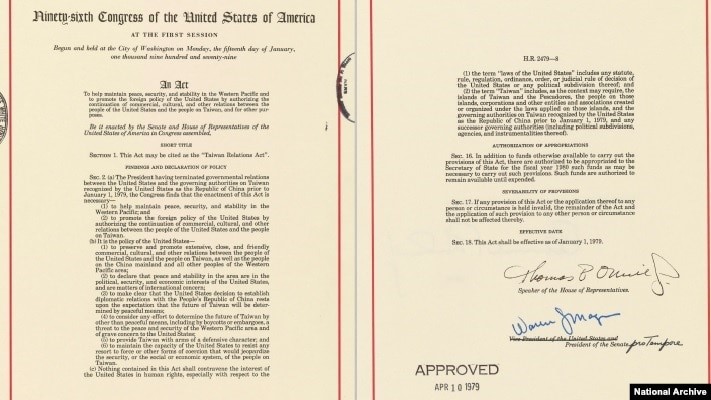
In 1979, the United States severed formal diplomatic ties with the Republic of China to establish relations with the People’s Republic of China. Yet, Washington did not abandon Taiwan. Instead, the U.S. Congress immediately enacted the landmark Taiwan Relations Act, explicitly authorizing the U.S. government to provide defense articles and services to Taiwan, equipping the island to resolutely resist Beijing’s ambitions of forced annexation.
By codifying human rights into law, the Taiwan Relations Act established it as a core concern of U.S. policy toward Taiwan. This historic legislation, by transforming national defense and security cooperation into a strategic leverage against authoritarian rule, played a vital role in sheltering Taiwanese political dissidents, catalyzing Taiwan’s democratization, and safeguarding the fundamental human rights of the Taiwanese people.
Taiwan Relations Act (Public Law 96-8, 22 U.S.C. 3301 et seq.)
For Chiang Kai-shek’s son and successor, President Chiang Ching-kuo, the 1979 diplomatic rupture with the United States was an apocalyptic catastrophe. Especially the termination of the Sino-American Mutual Defense Treaty stripped the Republic of China of its legal armor, leaving Taiwan legally and militarily naked and exposed to an imminent cross-strait assault by Beijing.
Yet, Chiang Ching-kuo was ultimately forced to bow to cold geopolitical realism. Although he bitterly loathed the U.S. Congress inserting “human rights oversight” and “arms sales linkage” into the Taiwan Relations Act, he acutely recognized that without the TRA’s legal mandate for “defense articles” and its unwritten safety guarantee, his regime would rapidly suffocate and collapse in international isolation. Trapped in this absolute strategic dependency, he begrudgingly accepted this conditional American shield in exchange for the fragile survival of his regime.
This legal leverage, which strategically tied arms sales to human rights within the Taiwan Relations Act, repeatedly materialized as a powerful mechanism to pivot history during Taiwan’s darkest political crises. In the painful aftermath of the Formosa Incident (Meilidao), the mysterious death of Professor Chen Wen-chen, and the brazen assassination of journalist Henry Liu (The Jiang Nan Incident)🔗, the U.S. Congress and international public opinion unleashed relentless pressure on the KMT regime. Washington explicitly delivered a stark ultimatum: if Taiwan’s systemic human rights abuses did not immediately improve, all crucial defense sales would be frozen.
For a regime that had lost formal diplomatic recognition but remained heavily dependent on U.S. security support, this pressure was consequential. It constrained the extent of repression. And gradually altered the political environment.
Coupled with earlier phases, the economic assistance and market access provided by the United States laid a solid foundation for Taiwan’s development. This critical aid successfully stabilized Taiwan’s volatile economy, curbed runaway inflation, and aggressively propelled the island’s early infrastructure development.
As Taiwan’s economic takeoff integrated the island deeply into the fabric of the global economy, making it an indispensable manufacturer for the world, this growing international interconnectedness backfired on the dictatorship. The more Taiwanese society connected with the free world, the more intolerable the rigid constraints of the party-state system became to its people.
The resulting economic growth brought far more than mere material wealth; it catalyzed the birth of a highly educated middle class possessing a robust consciousness of public participation. By the 1980s, this empowered demographic gradually matured into the critical, driving force behind Taiwan’s sweeping democratic reforms.
This surging middle-class energy immediately converged with long-suppressed grassroots grievances, igniting a tempestuous wave of social movements during the mid-1980s. Almost overnight, the island’s civil society launched a full-front retaliation across every stratum: working-class strikes, agrarian street protests, environmental actions blocking toxic industries, and Indigenous campaigns demanding land rights. These intersecting currents exerted an unyielding, bottom-up tectonic pressure on the monolith of the party-state.
This domestic explosion of civil liberty synchronized precisely with a global geopolitical vertigo. In 1986, the “People Power Revolution” in the Philippines shattered the dictatorship of Ferdinand Marcos; South Korea, a fellow anti-communist fortress and economic tiger, was surging toward the apex of its own pro-democracy uprisings; even the People’s Republic of China across the Strait was flirting with the initial phases of its Reform and Opening-up.
The absolute climax of this defiant momentum occurred on September 28, 1986, when dissident “Tangwai” forces gathered in direct defiance of martial law to declare the founding of the Democratic Progressive Party (DPP)—the first postwar opposition party forged by the native Taiwanese. Under the draconian legal codes of the party-state, this act was technically an illicit treasonous rebellion. Fully bracing for a brutal military crack-down, the dissidents organized a “Group of Seven” core leadership, psychologically prepared to face immediate mass arrests and execution.
Yet, the sheer velocity of citizen mobilization and the structural gravity of the grassroots tsunami forced the regime to blink. Just ten days later, inside the presidential office, an exhausted President Chiang Ching-kuo met with Katharine Graham, the publisher of The Washington Post, and capitulated to history, signaling that the state would move toward lifting martial law and legalizing opposition parties.🔗
Cornered by relentless domestic upheaval, a shifting international horizon, and fierce pressure from the United States Congress regarding human rights, the old order finally collapsed.
In 1987, the 38-year-old martial law was officially lifted, marking an irreversible civilizational pivot from totalitarian asphyxiation to a wide-open, free society.
The Quiet Revolution: Popular Sovereignty and the 1996 Direct Presidential Election 寧靜革命:台灣轉型為全民授權的民主政體
Following the lifting of martial law, Taiwan embarked on a progressive democratic transition. The press and publishing sectors were systematically liberalized, citizens secured the right to form opposition political parties, and elections finally evolved into genuinely competitive contests with real political accountability.
Following the sudden passing of Chiang Ching-kuo, Lee Teng-hui stepped into the presidency, orchestrating what historians now celebrate as Taiwan’s “Quiet Revolution.”
在蔣經國驟逝後,李登輝繼任總統,他一手主導了被歷史學家譽為「寧靜革命」的民主質變。
Operating within the hazardous currents of KMT factional warfare and under intense pressure from conservative military hardliners, Lee masterfully navigated the transition. He strategically leveraged the 1990 Wild Lily Student Movement to dismantle the archaic “Ten-Thousand-Year Congress” and abolish the Temporary Provisions Effective During the Period of Communist Rebellion—effectively stripping away the last legal remnants of the dictatorship.
Ultimately, through a sequence of six historic constitutional amendments, Lee pulverized conservative resistance to institutionalize popular sovereignty. Defying heavy intra-party opposition that pushed for an indirect electoral college system, he anchored the mandate of the state firmly in the hands of the public.
This relentless constitutional restructuring paved the way for the ultimate breakthrough: the realization of the “one person, one vote” direct presidential election, permanently elevating Taiwan into the ranks of mature, consolidated democracies.
At the same time, the United States provided a crucial layer of security. Through military presence and strategic commitments, it reduced the risk of external conflict, allowing Taiwan’s internal reforms to proceed without being interrupted by war. This was particularly evident in 1996, when Taiwan held its first direct presidential election. In response to military intimidation from the People’s Republic of China, the United States deployed aircraft carrier groups to the region. This was not only a military action. It was also a form of protection for a democratic process.
Paradoxically, Beijing’s missile coercion completely backfired, functioning instead as a powerful catalyst that galvanized a unified Taiwanese identity. Defying the shadow of Chinese missiles, citizens flooded the polling stations to deliver a staggering 76% voter turnout, ultimately electing Lee Teng-hui of the Kuomintang with a decisive 54% majority as Taiwan’s first popularly elected president.
This milestone election transcended a mere casting of ballots; it was a profound, collective declaration by the Taiwanese people defining their own destiny.
這不只是一場選舉,這是台灣人對自身命運的集體宣言。
In the arena of international law, this historic moment marked a robust realization of “self-determination.” Taiwan permanently decoupled itself from the KMT’s obsolete illusions of “legalistic China.” By transferring the mandate of power back to the public, the island successfully transformed into a modern democratic polity grounded entirely in “popular sovereignty.”
台灣在國際法上進一步實踐了「住民自決」,徹底從國民黨的「法統中國」轉向為「全民授權」的民主政體。
The achievement of popular presidential elections firmly established the bedrock legitimacy of a democratic government. In the ensuing decades, Taiwan repeatedly executed peaceful transfers of power between opposing political parties—the absolute gold standard of a mature, consolidated democracy.
Yet, this very non-violent triumph immediately propelled the island into one of the most absurd structural paradoxes in modern civilizational history. While Taiwan possesses every empirical and legal attribute of a sovereign independent state internally, it remains systematically denied formal diplomatic recognition externally, marooned within an international order increasingly subservient to Beijing’s coercive claims.
While this collective blindness exposes the cold reality of global authoritarian duress, it also forces a stark confrontation with Taiwan’s own unfinished internal decolonization. Shackled by decades of persistent Kuomintang party-state indoctrination, the island has yet to fully sever its conceptual ties to an obsolete historical framework, officially retaining a constitutional title—the Republic of China—that breeds persistent legal and diplomatic confusion abroad.
這場集體失明,揭示了全球威權勒索的冷酷現實,也反向戳破了台灣自身尚未完成的解殖泥淖。受制於國民黨過去數十年深固的黨國洗腦教育,這座島嶼至今仍未能完全掙脫舊時代的歷史框架,國家名號依然沿用在國際法理上極易引發混淆的「中華民國」(Republic of China)。
Bound by a near-impossible threshold for constitutional reform internally and the existential threat of aggression externally, Taiwan possesses the thriving flesh of a mature democracy but remains trapped within an unalterable relic of historical legalism. This state of de facto independence paired with de jure isolation is not merely a moral deficit of the international community, but a reflection of the profound domestic institutional gridlock that still clogs the island’s journey toward true, unburdened statehood.
Killing the Patriarchs: The KMT’s Capitulation to Beijing as the Ultimate Betrayal of Chiang Kai-shek
噬祖、弒父與認賊作父:國民黨對兩代蔣氏法統的歷史性鞭屍
The primary architect of this internal shackle is the Kuomintang (KMT). Had the KMT chosen during the historic post-1996 democratic transition to genuinely sustain the trajectory of localization and indigenization initiated by Chiang Ching-kuo and institutionalized by Lee Teng-hui—even going so far as to issue a sincere historical apology and undergo a thorough clearing of its decades-long White Terror atrocities—this alien authoritarian apparatus possessed a viable window to metamorphose into a legitimate, Taiwan-centric conservative party anchored firmly in the defense of the island’s statehood.
However, Lien Chan and Ma Ying-jeou, who subsequently seized the nexus of party control, harbored a starkly different geopolitical calculus. Blinded by Cold War nostalgia and Sino-centric chauvinism, they refused to surrender the party’s foundational legitimacy to the Taiwanese civic electorate, systematically strangling the KMT’s historic opportunity for localization and instead dragging the institution backward into the mythic vortex of a Greater China.
This strategic capitulation by the establishment elites effectively legitimized the New Party—a radical faction that had previously fractured the KMT, betrayed its original anti-communist dogmas, and transformed itself into the primary strategic bridge for Chinese Communist Party (CCP) infiltration into the broader KMT body politic.
This clientelist DNA successfully executed a multi-generational metastasis within the main opposition party: transitioning from Hung Hsiu-chu’s ideological fanaticism of forcing “One China, Same Interpretation” into the party platform, to Han Kuo-yu’s populist rise fueled by foreign cyber-warfare and punctuated by his submissive visit to Beijing’s Liaison Office in Hong Kong, and culminating in the contemporary political theater of 2025 and 2026. Today, figures like Cheng Li-wun and Fu Kun-chi weaponize “anti-war” rhetoric within the legislative halls to dismantle domestic defense infrastructure while traveling across the strait to receive united-front mandates directly from Beijing.
This red umbilical cord has effectively hijacked the KMT’s collective will, dragging what could have been a sovereign domestic party into a collaborative vortex with an irredentist empire. Consequently, Taiwan’s democratic defense remains locked in a dual-front war, facing a synchronized, hybrid assault orchestrated simultaneously by localized vestigial elites and Beijing’s sharp-power apparatus.
Decades prior, Chiang Kai-shek resolutely anchored his ironclad doctrine of “the legitimate sovereign and the rebel cannot co-exist” (漢賊不兩立), legalistically classifying the Republic of China regime and Beijing’s People’s Republic of China as two entirely non-subordinate entities technically remaining in a state of absolute war. This uncompromising, total confrontation effectively bound the Republic of China alongside Taiwan directly into the maritime defense containment line backed by Western maritime powers, ensuring that Taiwan did not suffer the grim fate of Tibet, Xinjiang, and Inner Mongolia—which were swiftly annexed, Foreclosed, and land-locked by the CCP regime in the post-war era.
The contemporary evolution of the KMT’s lineage thus stands as a profound, double historical betrayal. At the exact moment the Republic of China realized popular sovereignty through direct presidential elections—permanently transferring the clean title of statehood to the citizens of Taiwan—the KMT vehemently rejected localization. In doing so, the party not only completely betrayed Chiang Ching-kuo’s late-stage mandate of returning political agency to the local soil in response to geopolitical realities, but also, driven by existential power anxiety, initiated a cross-strait collusion with the Chinese Communist Party—the very adversary Chiang Kai-shek loathed most. They have positioned themselves to facilitate the liquidation of the Republic of China (Taiwan) in exchange for comprador privileges within a totalitarian empire.
This sycophantic capitulation constitutes the ultimate historical desecration and the most absolute betrayal of institutional lineage against Chiang Kai-shek, who had once sworn to resist communism unto death and fiercely defended the unyielding baseline that the legitimate sovereign and the rebel shall never co-exist.
這是對當年誓死反共、堅守漢賊不兩立底線的蔣介石,最徹底的歷史鞭屍與法統背叛。
Yet, despite facing this synchronized strangulation orchestrated by the KMT establishment and the foreign totalitarian regime, Taiwan’s democracy continued to manifest a ferocious vitality and a highly sophisticated, self-correcting sovereign immune system at this critical historical juncture.
The 2014 Sunflower Movement was, in its realist essence, an unconventional territorial defense of state ownership launched by Taiwan’s civil society upon realizing that the nation’s sovereignty faced an existential threat under the Trojan-horse economic annexation of the Cross-Strait Service Trade Agreement.
Taiwan’s youngest generation of citizens occupied the highest legislative sanctuary with their physical bodies, effectively executing an emergency circuit-breaker on the state apparatus. This tactical intervention decisively severed the red umbilical cord through which Ma Ying-jeou’s administration attempted to forge a deep, irreversible dependency linking Taiwan’s economy, advanced technologies, and critical infrastructure with authoritarian China. By leveraging an unyielding collective civic will, they stripped away the deceptive, foggy narrative of “mutual economic prosperity” and recalibrated the cross-strait conflict to its true definition: a high-stakes, uncompromising fortress defense over the very survival of Taiwanese sovereign agency.
The Sunflower Movement did far more than safeguard the underlying property rights and strategic autonomy of Taiwan’s “Silicon Shield” at a desperate hour; it permanently altered the political landscape by forging a post-colonial generation entirely unburdened by Sino-centric mental colonization.
Emerging from the ruins of this authoritarian backlash, this generation demonstrated through raw action that Taiwanese democracy is not a fragile piece of porcelain. Instead, it operates as an ironclad domestic defense mechanism, programmed to automatically trigger through constant civic awakening whenever the nation faces foreign subversion or internal institutional betrayal.
By forcefully halting this legally and geostrategically highly controversial cross-strait pact, this civic and student-led resistance did far more than safeguard Taiwan’s economic autonomy; at its strategic core, it thoroughly shattered the fraudulent, manufactured myth of historical inevitability dictating that Taiwan and China were destined for irreversible economic integration.
With absolute collective resolve, the movement yanked Taiwan’s developmental trajectory away from the slow-motion suicide of geopolitical vassalage, firmly resetting it upon a path rooted in Taiwanese sovereign agency and global engagement on equal terms. In doing so, it prevented this critical island fortress from being permanently snared within Beijing’s strategic orbit and authoritarian market, fundamentally rewriting Taiwan’s geopolitical architecture and supply chain trajectory for the subsequent decades.
This historic shifting of trajectories operated as a definitive liquidation of the geoeconomic failures that characterized Ma Ying-jeou’s eight-year tenure. Under Ma’s administration, every promised economic benchmark catastrophically defaulted: the average GDP growth rate languished at a mere 2.8 percent, the unemployment rate remained stubbornly locked above 4 percent, and per capita income stalled at roughly 22,000 USD. Though he grandiosely predicted the Taiwan Stock Exchange would scale the 20,000-point summit, the index sat at a dismal 8,000 points upon his departure in 2016—a level lower than when he first assumed power.
Concurrently, traditional Taiwanese industries that had migrated to the mainland were systematically ensnared within Beijing’s precision-engineered geoeconomic trap of “nurture, trap, and liquidate” (養、套、殺). These hard data deliver an uncompromised realist proof: over-reliance on an authoritarian market never purchases simulated prosperity; instead, it drags the sovereign economy into a suffocating vortex of hollowed-out stagnation.
The ultimate legalistic irony lies in Ma’s absolute betrayal of his political lineage. In the 1970s, when the Republic of China forfeited its status as the “sole legitimate government of China” on the global stage, former President Chiang Ching-kuo decisively pivoted, utilizing the “Ten Major Construction Projects” to build an unassailable domestic economy that secured material wealth for the Taiwanese people, while systematically steering the KMT toward indigenization. Ma Ying-jeou thoroughly defaulted on both foundational pillars—economic fortifying and localization—that Chiang Ching-kuo originally engineered to establish the regime’s modern legitimacy.
The Sovereign Bastion of Civilizational Defense: “Resisting China, Protecting Taiwan” and the Re-establishment of Democratic Title
傲然挺立的文明要塞:抗中保台與民主陣營主權的再確立
In 2016, ascending to state power upon the historical wave of the Sunflower Movement, Tsai Ing-wen became Taiwan’s first female president. With each ballot cast, the Taiwanese electorate shattered centuries of patriarchal lineage, forcefully elevating an unmarried woman—who within traditional clan hierarchies would be denied a place even on the ancestral altar—to the position of Commander-in-Chief at the absolute pinnacle of national governance.
This marked a profound rupture where a young democratic state systematically smashed the masculine authoritarian structures forged by the remnant party-state and Han lineage chauvinism, thoroughly dismantling the Confucian ideological grid that historically bound women to feudal patriarchs. It decisively inaugurated a strategic era characterized by the institutional codification and international anchoring of Taiwanese popular sovereignty.
Simultaneously, the gravitational pull of the foreign totalitarian black hole was accelerating with unprecedented force. In 2015, as its economic power reached a zenith, China unmasked its expansionist ambitions. Satellite imagery exposed its illegal construction of militarized artificial islands in the South China Sea, followed by Beijing’s sweeping claims of sovereignty over the entire maritime domain.
This irredentist hunger quickly enveloped Taiwan and the Taiwan Strait. In early 2019, Chinese leader Xi Jinping delivered his speech commemorating the 40th anniversary of the “Message to Compatriots in Taiwan.” Tearing away the facade of peaceful rise, Xi aggressively mandated the “One China, Two Systems Taiwan Formula,” effectively initiating a concrete countdown toward annexation. This was the first time in forty years of reform, opening, and strategic patience (“taoguang yanghui”) that a Chinese leader explicitly declared a state policy—codified directly into domestic law—to obliterate the sovereignty of the Republic of China and bring Taiwan under the totalitarian rule of the People’s Republic of China.
Tsai Ing-wen immediately countered with a defining presidential press conference. She resolutely declared that Taiwan would never accept “One China, Two Systems,” demanding that Beijing recognize the reality of the Republic of China (Taiwan) and respect the unyielding commitment of its twenty-three million citizens to freedom and democracy, rather than attempting to subvert their choices through coercion and bribery. Tsai urged the international community to witness the existential threat facing Taiwan, suggesting that China take its own steps toward democracy and perceive Taiwan through a “democratic lens” to truly comprehend the willpower of the Taiwanese people.
Shortly after Xi Jinping deployed his “Two Systems” threat, the Tsai administration anchored its civilizational divergence on May 17, 2019, steering Taiwan to become the first nation in Asia to legalize same-sex marriage. This was far more than a victory for progressive gender equality; it was an unequivocal geopolitical declaration that sent a blindingly clear signal to the international community: Taiwan is not China; Taiwan is Taiwan.
This legislative breakthrough, executed through a synchronized assault by the state apparatus and civil society, projected a calculated strategic mandate to the globe. It reframed Taiwan’s economic autonomy and sovereign defense as a civilizational struggle rooted in human dignity and progressive values. By inscribing equality into its statutory law, the island thoroughly dismantled the CCP’s ethno-nationalist propaganda, which long weaponized shared ancestry to blur the clarity of sovereign titles.
Concurrently, China’s systemic atrocities in the Xinjiang concentration camps, coupled with the brutal subjugation of Hong Kong’s 2019 Anti-Extradition Movement and the subsequent imposition of the National Security Law, provided the world with unvarnished evidence of Beijing’s totalitarian reality, permanently exposing the fraudulence of the “One China, Two Systems” illusion.
Against this backdrop of historical rupture, Tsai Ing-wen emerged in the eyes of Western media and global leaders as a singular icon of democratic defiance against authoritarian expansion. Formidably hailed as the “Iron Lady of Taiwan,” her leadership systematically dismantled Beijing’s fabricated “Two Systems” narrative, spearheaded Taiwan’s historic domestic submarine program, and launched the widely praised “Mask Diplomacy” during the dark inception of the pandemic when global public health sat in a dangerous vacuum.
Repeatedly ranking among the world’s most powerful women, her political persona—affectionately branded as the “Chili Taiwan Sister” (辣台妹) by the electorate—seamlessly fused the calculated reason of a seasoned technocrat with an uncompromised realist stance on state sovereignty.
Although Taiwan officially became a democracy rooted in popular sovereignty in 1996, it was only during this defining era that this small island fortress truly forged its contemporary global identity: an unyielding power that refuses to bow to China, recognized globally as a force for good in the free world. This epoch operated as the definitive, statutory re-establishment of Taiwan’s state title within the democratic international realm.
Tsai’s eight-year tenure operated as a disciplined, subterranean campaign of “Resisting China, Protecting Taiwan.” Fully cognizant of the fracturing post-Cold War global order, she decisively severed Taiwan’s developmental trajectory from the perilous “One China integration” orbit of her predecessor, recalibrating the nation to interface seamlessly with the global democratic supply chain anchored by Western maritime powers and the Indo-Pacific strategy.
In 2020, fueled by the intense existential anxiety of “existential crisis” triggered by Hong Kong’s anti-extradition crisis, she alongside her vice-presidential running mate William Lai galvanized a historic, record-breaking mandate of 8.17 million votes to secure re-election. While deeply cultivating domestic consciousness, breaking free from the Chinese framework, and seamlessly embedding Taiwan into the global democratic alliance, Tsai deployed an unyielding institutional statecraft to fortify the economy.
Under her administration, Taiwan achieved an average GDP growth rate of 3.15 percent, firmly leading the Asian Tigers; total export volume expanded by over 70 percent, drastically liquidating dependency on the Chinese market while doubling exports to the United States. The nominal GDP scale surged from 17.5 trillion TWD at her inauguration to nearly 23 trillion TWD, while per capita GDP repeatedly scaled historic heights, phenomenally eclipsing both Japan and South Korea. The Taiwan Stock Exchange index expanded from approximately 8,000 points in 2016 to triumphantly breach the 21,500-point threshold on the eve of her departure, marking a cumulative eight-year rally exceeding 150 percent. Concurrently, Taiwan’s foreign reserves grew robustly to rank fifth globally, while the administration maintained ruthless fiscal discipline, anchoring the total debt-to-GDP ratio to an exceptionally low threshold of approximately 27 percent.
蔡英文執政期間,台灣平均經濟成長率達 3.15%,穩居亞洲四小龍之首;台灣出口總額成長超過百分之七十,並大幅降低對中國市場的依賴,對美出口翻倍成長;國內生產毛額規模由上任時的 17.5 兆大幅成長至近 23 兆新台幣;人均 GDP 在其任內屢創新高,並歷史性地超越日本與南韓。台灣股市更從 2016 年的八千點左右,在她卸任前夕一度突破兩萬一千五百點,累計八年漲幅超過百分之一百五十;此外,台灣的外匯存底穩健積累至排名全球第五;政府更嚴守財政紀律,將政府總債務佔 GDP 比率牢牢控制在僅百分之 27 左右的極低水準。
As a female leader, she deliberately rejected the legacy of political victimhood—a narrative of sentimental trauma long relied upon by Taiwan’s localized factions to plead for global sympathy. Instead, executing a highly calculated, disciplined, and unprovocative realist statecraft, she systematically integrated Taiwan’s democratic defense mechanisms directly into the structural apparatus of global geopolitics.
Under her calculated doctrine, Taiwanese democracy ceased to be a mere domestic political system; it was militarized into a sovereign asset eligible for symmetric strategic collusion. By leveraging the absolute indispensability of the silicon shield and the ten-thousand-meter vertical fortress of the First Island Chain, Taiwan executed a profound hostage-taking of global maritime and technological interests.
This strategic alignment successfully extracted the cross-strait dilemma from the obsolete, pre-modern framing of a “Chinese civil war,” forcing the international community to legally and structurally recognize Taiwan as an unassailable sovereign fortress vital to the integrity of global property rights and treaty-based civilization.
Yet, concurrently, the infiltration, subversion, and psychological fracturing deployed by the Chinese Communist Party did not recede; instead, it metastasized with malignant precision. Through short-form videos, localized whispers, engineered propaganda narratives, historical dramas, and coordinated news media manipulations, Beijing’s propaganda apparatus weaponized these platforms to blur the clarity of Taiwan’s national identity. They attempted to hypnotize Taiwanese society with the insidious myth of “shared bloodlines and cross-strait kinship,” tricking the populace into believing that Chinese ethnicity, Chinese culture, and the Chinese language are inherently identical to, and inseparable from, modern state sovereignty under an ancient, immutable mandate.
Although the Tsai administration deployed creative social media graphics to successfully repel several waves of disinformation warfare that attempted to disrupt the functionality of Taiwanese society during the COVID-19 pandemic, these defensive measures contained merely the tip of the iceberg floating atop a vast oceanic expanse of cognitive subversion. Faced with Beijing’s systemic and rapidly evolving cyber-warfare capabilities, can an open society whose foundational constitutional mission is to become “more democratic and more free” genuinely find a way to withstand such onslaughts?
Under this calculated deployment of cultural and genetic mysticism—amplified by the fabricated narrative of China’s economic and military supremacy—Tsai’s doctrine of “Resisting China, Protecting Taiwan” was maliciously smeared by united-front media and vestigial elites as a provocative, radical exercise in “de-sinicization.”
Confronted by this pervasive cognitive warfare, the Democratic Progressive Party, upon fielding William Lai and navigating the political transition, chose a strategic and rhetorical retreat. Capitulating to the united-front media’s branding extortion over “de-sinicization,” the party shifted its stance toward “Protecting Taiwan with Peace.” Lai attempted to deploy a softer rhetoric of “harmonizing with China rather than resisting China,” aiming to de-escalate geopolitical friction through linguistic appeasement, while the overarching narrative inadvertently slid back into obsolete, traditional patriarchal myths such as cross-strait “brotherly partition.”
Yet, this rhetorical retreat by the party from the strategic core and geopolitical perimeter of “Resisting China, Protecting Taiwan”—effectively castrating its own ideological edge—failed to purchase cross-strait peace. Instead, it triggered an immediate and devastating domestic political backlash. This unilateral de-escalation of the sovereign narrative psychologically stripped the localized electorate of the collective pride and sovereign confidence that defined the “Chili Taiwan Sister” (辣台妹) era, where confronting authoritarian expansion was grounded on civilizational supremacy.
Simultaneously, no one across the island genuinely believed that William Lai—who had historically declared himself a “pragmatic worker for Taiwanese independence”—would genuinely abandon resistance against China. This was especially true under the unyielding historical realities following Xi Jinping’s aggressive mandate of the “One China, Two Systems Taiwan Formula” and the subsequent iron-fisted suppression of Hong Kong’s anti-extradition movement.
This unconvincing linguistic appeasement and political capitulation failed to secure a single vote from the moderate electorate. Instead, it exposed a fatal vulnerability in the democratic immune system, severely fracturing the ideological cohesion of the localized electorate. This self-inflicted strategic regression served as the definitive driver behind the dramatic collapse of William Lai’s presidential vote share and the KMT-led capture of the legislative branch, stripping the ruling party of its absolute parliamentary majority.
By dismantling its own foundational defense deterrence, this political retreat carved open an ideal historical vacuum for domestic comprador networks to synchronize with the foreign totalitarian empire.
這種制度性防衛底牌的主動撤退,給了境內紅色買辦與境外極權裡應外合的絕佳歷史真空。
The Sovereign Paradox: Facing Asymmetric Cognitive Warfare and Inside Proxies
民主台灣的終極試煉:利用你的民主,對付你的民主
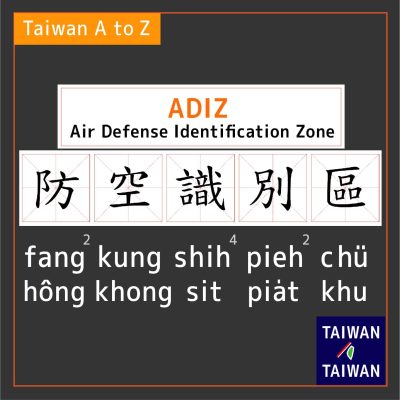
According to official data from Taiwan’s Ministry of National Defense (MND), the scale of these incursions is staggering. In 2025 alone, a record 5,441 sorties of Chinese military aircraft entered Taiwan’s ADIZ, with 3,764 of those sorties crossing the median line or entering Taiwan’s southwestern and eastern ADIZ. 🔗
Is China ready to wage an all-out war? Decades have passed, and at least for now, Beijing has frozen short of crossing that final, irrevocable red line. Yet, that is precisely the point. The ultimate objective of these relentless incursions is not to trigger an immediate kinetic war. Instead, it is a psychological gamble: to intimidate Taiwan’s government and terrorize its people while staying just below the threshold of an all-out military conflict.
Their methods expand far beyond mere military coercion, seamlessly infiltrating the digital domain to weaponize generative AI and short-form video algorithms. By disseminating malicious disinformation, launching cognitive warfare, and widening the internal cleavages of an open society, Beijing orchestrates a relentless, non-stop campaign of “cognitive saturation attacks.” This asymmetric assault is precision-engineered to erode the Taiwanese people’s trust in their public institutions, their armed forces, and the democratic framework itself—systematically dissolving the island’s collective resolve to render its populace a fractured, weakened, and easily subjugated state of internal exile.
According to reports from the V-Dem Institute at the University of Gothenburg 🔗 and numerous international studies, democratic Taiwan remains the world’s most targeted nation for foreign-based disinformation campaigns. This relentless pressure comes primarily from authoritarian China.
In March 2025, President William Lai convened a high-level national security council, delivering a defining open address from the Presidential Office to formally codify and define China as a “Hostile Foreign Power” under the statutory framework of the Anti-Infiltration Act. 🔗
This declaration operated as a hardcore institutional rearmament of state title: it aggressively discarded the decades-long diplomatic sentimentality that muddled cross-strait cross-sections, directly weaponizing existing domestic legal infrastructure to classify the CCP regime—which relentlessly deploys coercion and subversive United Front operations—as an explicit existential threat to Taiwan’s national sovereignty and societal stability.
Yet, this “delayed legal registration of sovereign ownership” came a staggering ten months after May 2024, when Taiwanese civil society mobilized the “Bluebird Movement” 🔗 to protest the authoritarian coalition of the Kuomintang and the Taiwan People’s Party as they rammed through controversial legislations like the “Law Governing the Legislative Yuan’s Power Exercise.”
To preserve the basic functionality of the constitutional framework, the Lai administration, as the reigning executive head, may have possessed an institutional rationale to avoid direct entanglement in raw street protests and recall campaigns. However, the Democratic Progressive Party (DPP)—historically engineered to be the most formidable engine of localized sovereign defense—suffered from a paralyzing institutional fusion, with President Lai concurrently serving as the party chairman. This severe entanglement of party and state meant that the party’s strategic, movement-driven willpower was entirely subsumed by the defensive, risk-averse constraints of the administrative apparatus, completely losing the agile, ferocious, and insurgent capabilities that defined its existence when it operated in the opposition.
Throughout this crucial ten-month strategic vacuum, the party leadership remained passive, failing to canalize the immense, raw anti-subversion energy generated by the Bluebird Movement. When the movement organically metamorphosed into a grassroots “Grand Recall” 🔗 civic mobilization targeting the KMT lawmakers who orchestrated this constitutional vandalism, the DPP failed to execute a full-scale offensive with its party machinery, ultimately causing the Grand Recall campaign to collapse in defeat.
This institutional dysfunction and strategic hesitation—born from the absolute fusion of party and state control—not only snuffed out the domestic democratic immunity, but also insulated the opposition from any accountability for their institutional coup. It left Taiwan’s democratic fortress structurally exposed, forcing its defense into an asymmetric, legalistic rear-guard action amidst the ruins of malfunctioning representative institutions.
This comprehensive grey-zone erosion precisely mirrors the prelude to aggression witnessed on the Eastern European plains: pre-war Ukraine suffered long from deep erosion under Russia’s “Hybrid Warfare”. Pro-Russian politicians and comprador networks legally exploited Ukraine’s democratic elections and representative politics within parliament to stonewall defense modernization, kill pro-EU and pro-NATO legislation, and abuse free speech to aggressively broadcast fierce Euro-skepticism and anti-American narratives.
This is strikingly synchronized with Taiwan’s contemporary constitutional gridlock, where opposition factions leverage investigative powers and budget-freezing mechanisms to orchestrate a systematic institutional self-weakening from within.
Worse still, the frontline of this asymmetric warfare has breached the gates of Taiwan’s own legislature. In a troubling display of political synchronization, opposition lawmakers have repeatedly conducted high-profile group delegations to Beijing, holding closed-door meetings with officials from China’s Taiwan Affairs Office. Upon their return, these elected representatives have systematically leveraged parliamentary procedures to stonewall crucial cross-strait national security legislation, while aggressively slashing the central government’s defense budget and critical arms procurement funds.
Taiwan’s democratic apparatus is being “legally” weaponized by the proxies of an adversarial totalitarian state to systematically execute a strategy of legislative self-weakening.
這顯示,台灣的民主體制,正被敵對極權國家的代理人「合法地」當作武器,在立法層面進行「自我弱化」。
When the newly appointed KMT chairperson, Cheng Li-wun, traveled to Beijing in 2026 under the banner of “anti-war and peace” to capitulate before the Chinese Communist Party and proclaim that “both sides belong to One China,” this act expanded far beyond a flagrant violation of the KMT’s own explicit party charter mandating the “opposition to communism.” Legalistically, it executed an absolute self-liquidation of the party’s historical narrative. It foreign-forensically demonstrated that the regime’s multi-decadal slaughter of localized intellectuals and the relentless confiscation of the Taiwanese majority’s wealth—all executed under the tyrannical pretext of punishing “communist collusion”—were never driven by a noble, anti-totalitarian mission to resist communism or protect Taiwan from autocratic annexation. Instead, it unmasked those historic atrocities as a raw, predatory tyranny executed by an alien military clique solely to entrench its minority privileges.
This is a supreme democratic betrayal against the twenty-three million citizens who have driven the Republic of China’s popular sovereignty since 1996; it systematically deletes the establishment’s singular retroactive excuse for state terror, driving Chiang Kai-shek onto the permanent pillar of historical infamy by its own hands.
Concurrently, Taiwan’s media architecture, social commerce platforms, and encrypted messaging groups remain comprehensively occupied and infiltrated by Beijing’s synchronized narratives [INDEX]. Localized proxies and massive swarms of generative AI bots systematically weaponize the shield of free speech to broadcast fierce anti-American skepticism, degrade democratic values, demonize Taiwanese statehood, and glorify the authoritarian supremacy of Chinese governance.
同一時間,台灣的媒體、社群平台、通訊群組,持續被中國敘事與觀點全面攻佔與滲透,在地代理人以及大量生成的 AI 機器人,以言論自由為名,大肆散播疑美論、貶低民主價值、醜化台灣、宣揚中國治理的強大。
The core strategy is clear: turning your own democracy into a weapon against democracy, and exploiting Taiwan’s hard-won freedoms in a calculated attempt to ultimately extinguish a free Taiwan.
這場混合戰的策略昭然若揭:利用你的民主,對付你的民主;利用台灣的自由,企圖,最終消滅自由的台灣。
This precarious paradox transforms Taiwan into a sobering case study for open societies worldwide, posing a haunting, unprecedented question: Is it possible for a nation that has achieved advanced democratic consolidation to utilize the very mechanisms of representative politics to voluntarily forfeit its citizens’ lives, assets, and liberties, ultimately surrendering its sovereignty to a totalitarian power?
If a democracy can vote away its own survival through the hands of its own elected representatives, then the fragility of the free world is far more profound than any military assessment can ever measure.
Taiwan currently confronts an existential siege led by the Kuomintang (KMT)—the primary opposition party openly aligning with a hostile foreign state—and an opposition alliance wielding its absolute parliamentary majority, operating with ferocious intensity to systematically weaken Taiwan’s state governance and obliterate the citizenry’s clarity of friend-versus-foe recognition. While the ruling administration has advanced numerous legislative frameworks to safeguard Taiwan’s statehood, these national security blueprints have been entirely blocked and liquidated under the blue-white coalition.
Most damningly, the 2026 central government general budget, paralyzed by persistent opposition obstruction, remains entirely frozen and has yet to be referred to committee for legislative review. Furthermore, within the special defense budgets advanced by the Ministry of National Defense, critical appropriations indispensable to Taiwan’s next-generation deterrence architecture—including automated AI air defense command networks, independent domestic drone production lifelines, and synchronized Taiwan-US ammunition supply chains—have been ruthlessly zeroed out by the opposition.
例如 2026 年的中央政府總預算,在藍白杯葛下,至今仍未交付委員會審查。再例如台灣國防部提出的特別預算,其中攸關下一代防衛架構的關鍵資金包括防空 AI 指揮系統、本土無人機產線、台美合作的彈藥供應鏈等,全數遭到在野黨刪除。
To take even one more step back would be to plunge into the abyss. Yet for the people of Taiwan, in whose veins flows a deeply rooted maritime DNA, the vast and boundless ocean represents not a dead end, but the ultimate sanctuary and salvation when there is nowhere left to retreat.
再退一步就是海。但對流淌著海洋基因的台灣人來說,寬闊的海洋正是退無可退之後的活路。
In the deep shadow of institutional gridlock, Taiwan’s civil society and localized capital are autonomously initiating a “Whole-of-Society Defense” asymmetric counter-cut. For instance, Kuma Academy has aggressively drawn from the wartime experiences of Ukraine, systematically deploying modern civil defense education, tactical medicine, and survival competencies across the populace.
Concurrently, I-Mei Foods, a major domestic enterprise, has leveraged its deep industrial infrastructure to cross directly into the development of defense-grade unmanned aerial vehicles (UAVs) and critical supply chains, transforming domestic economic assets into strategic sovereign assets possessing independent anti-access and area-denial (A2/AD) capabilities during naval blockades or saturation onslaughts.
Most pivotally, TSMC—the absolute juggernaut anchoring the global AI epoch—has engineered its strategic expansion into Japan and the United States to operate as a global “Silicon Redoubt.” 🔗 This grand realpolitik maneuver ensures that in the absolute dark contingency of the island’s physical capitulation, the free world’s F-35 fighter jets, aircraft carriers, and autonomous unmanned systems retain an uninterrupted, non-stop supply of critical, high-end semiconductor intelligence indispensable to sustaining long-range counter-strikes and ultimately recapturing Taiwanese sovereign jurisdiction.
而作為全球 AI 時代最核心命脈的晶圓大廠台積電,已經戰略佈局日本與美國作為「矽反擊堡壘」,確保萬一台灣真的陷落,在那極端黑暗的時刻,自由世界的 F-35、航母、無人機系統,仍有源源不絕的關鍵高階晶片可用,確保有奪回島嶼主權的能力。
Confronted by fluctuating regional powers in every historical era, the Taiwanese people are inevitably condemned to execute an ultimate, high-stakes choice for survival within the span of every generation.
面對區域裡每個時代的不同強權,註定了台灣人必須在每一代人的時間裡,做出攸關生存的終極抉擇。
Yet, after four centuries of successive foreign colonial rule, the island’s pivotal global status situated at the absolute core of the Western Pacific’s First Island Chain has decisively emerged. The people of Taiwan have achieved self-determination, rising as a nation deeply rooted in popular sovereignty and interlocked inseparably with the global order through the ties of trade and values—the populace on this island fortress no longer fights a lonely war.
History has demonstrated that a unified Taiwanese populace possesses the absolute power to dictate their own destiny. If the people of Taiwan manifest an unyielding, non-negotiable will to refuse the erasure of their own future, the entire free world will undoubtedly stand shoulder to shoulder with them in defiance.