The Century Showdown at Shangri-La: How the US and Japan Deter Totalitarian Expansion
香格里拉對話的世紀攤牌:美日重裝嚇阻西太平洋極權擴張
In May 2026, at the Shangri-La Dialogue in Singapore, Japanese Defense Minister Shinjiro Koizumi fired back at a Chinese delegate who questioned whether Japan was reverting to militarism: “Think about it. There’s a country that has a huge arsenal of nuclear weapons and strategic bombers. Japan has neither of such weapons, and yet Japan is labelled ‘new militarism’ Isn’t it strange?” [🔗]
Earlier at the Shangri-La Dialogue, U.S. Secretary of Defense Pete Hegseth emphasized that what the Trump administration seeks is a lasting and favorable balance of power driven by strength, under which no nation—including China—can impose its hegemony or threaten the security and prosperity of the United States and its allies. Hegseth declared: “As directed by America’s National Security Strategy and National Defense Strategy, our strategic core in the Pacific lies in establishing deterrence by denial along the First Island Chain.” Crucially, he highlighted the concrete defense commitments already executed by nine regional nations—South Korea, the Philippines, Japan, Australia, Singapore, Malaysia, Thailand, Vietnam, and India—demonstrating that this defensive perimeter has evolved past a unilateral U.S. security umbrella into a synchronized, multilateral wall of collective burden-sharing. [🔗]
稍早,也是在「香格里拉對話」,美國戰爭部長赫格塞斯(Pete Hegseth)在致詞時強調,川普政府所尋求的,是一種建立在實力之上的持久權力平衡,在此平衡下,任何國家——包括中國——都不能強加其霸權,亦無法威脅美國與盟友的安全或繁榮。赫格塞斯並宣告:「正如美國《國家安全戰略》與《國家防衛戰略》所指示,我們在太平洋地區的戰略核心,在於沿第一島鏈建立拒止性嚇阻(Deterrence by Denial)。」更重點介紹了包括韓國、菲律賓、日本、澳洲、新加坡、馬來西亞、泰國、越南及印度在內等 9 個國家已做出的硬核國防承諾,證明這條防禦鐵壁已不再是美國單方面的流血承諾,而是多邊盟友共同分擔、自主築起的鋼鐵長城。
While Japanese Defense Minister Shinjiro Koizumi maintained diplomatic restraint by avoiding direct names, Secretary Hegseth’s explicit, public targeting of China during his address shattered any remaining strategic ambiguity—signaling a definitive, open showdown in the West Pacific. From Beijing’s militarization of the South China Sea, incessant sorties harassing Taiwan, and joint “circumnavigation patrols” with the Russian Navy around Japan, to Xi Jinping’s mandate for the PLA to be ready for a military takeover of Taiwan by 2027—and even deploying fleets to test-fire missiles into waters near Australia and New Zealand—the empirical evidence leaves no room for interpretation. China’s aggressive posture has made it crystal clear to the entire world that the sole adversary the United States, Japan, and the nine-nation alliance intend to decisively deter is a Beijing determined to dominate the West Pacific.
The First Island Chain, once a Cold War bastion built to contain communism, has surged back to the forefront of global security. As China lays bare its expansionist ambitions, the irreplaceable value of this maritime perimeter to the free world has resurfaced with absolute clarity.
The First Island Chain and the Unsinkable Carrier: Defeating the “Semiconductor Abandonment” Narrative
第一島鏈與不沉的航母:破解「半導體拋棄論」的失敗主義耳語
In the ongoing information warfare waged by China against Taiwan, a persistent rumor circulates on social media: “The Americans only care about Taiwan’s semiconductors! Once TSMC moves its advanced manufacturing nodes to the U.S., Taiwan will lose its strategic value and will be instantly abandoned by Washington.“
This cognitive warfare campaign deliberately reduces Taiwan to an isolated outpost with ‘nothing but factories.’ It preys upon the lingering trauma of the 1979 diplomatic rupture with the United States, seeking to plant seeds of betrayal among the Taiwanese public and induce a fatalistic despair—convinced that surrender to Beijing is the only logical conclusion.
Yet, in the face of China’s information warfare, the Taiwanese people have grown resilient and discerning: they have learned that what Beijing wants them to be anxious about and resentful of is mostly lies or trivialities. The real truth lies in what the Party-State desperately scrambles to hide—much like their initial cover-up when they falsely claimed that the coronavirus outbreak in Wuhan could not be transmitted between humans.
Within this defeatist narrative—which insists that “Taiwan has nothing but semiconductor fabs and is destined to be abandoned by America”—what Beijing conspicuously omits is Taiwan’s irreplaceable strategic position along the First Island Chain. Taiwan is a non-sinking aircraft carrier, sitting atop deep-water trenches that serve as the ultimate, undetectable gateway for submarines to slip silently into the vast expanses of the Pacific Ocean.
In fact, the primary reason Taiwan has been able to transform into an economically prosperous, free, and democratic nation is precisely because its geostrategic location along the First Island Chain is too critical to lose. This paramount strategic value existed long before the very first integrated circuit chip was ever invented.
This traces back to the post-WWII regional dynamic that the Kuomintang (KMT) routinely glosses over. In December 1949, utterly defeated in the Chinese Civil War, President Chiang Kai-shek retreated his government and military remnants to Taiwan, inaugurating nearly 40 years of brutal military martial law.
When the National Government took over Taiwan in 1945, the island was treated merely as a hinterland supply base to bankroll their civil war on the mainland. This hyper-exploitation triggered severe resource depletion and catastrophic hyperinflation. In June 1949, after the unbridled overprinting of Old Taiwan Dollars spun completely out of control, the government issued the New Taiwan Dollar (NTD) to replace the old currency. The life savings of Taiwanese citizens vanished in an instant; 40,000 Old Taiwan Dollars deposited in banks were arbitrarily slashed to just 1 New Taiwan Dollar.
Even though the retreating regime managed to ship 2.97 million taels of treasury gold from the Central Bank of China in Shanghai to Taiwan—managed by the Bank of Taiwan and valued at roughly NT$8.32 billion at the time—this wealth was heavily romanticized. If converted entirely into the price of rice, that gold could only purchase 55% of Taiwan’s domestic rice production for a single year.
With government expenditures almost entirely cannibalized by the fantasy of “retaking the mainland,” the state budget bled profusely, foreign exchange reserves evaporated, and hyperinflation raged unabated. By the end of 1949, Taiwan’s annual consumer price index had skyrocketed by a staggering 2,631%.
Initially, thoroughly repulsed by the systemic corruption of the “Chiang-Soong-Kung” clans, the U.S. government was firmly unwilling to extend further aid to the Republic of China in its fight against the Chinese Communist Party. Concurrently, Washington harbored deep anxieties that any American intervention in the Chinese Civil War would inadvertently drive Beijing permanently into the strategic embrace of the Soviet Union. Consequently, then-U.S. President Harry S. Truman issued a definitive public declaration: the United States had absolutely no intention of intervening in the Chinese Civil War, nor would it provide any military aid or strategic counsel to the collapsing Nationalist government.
Yet, the outbreak of the Korean War in 1950 changed everything. The Chinese Communist Party entered the conflict, Beijing pivoted strategically entirely toward Moscow, and communist forces aggressively expanded across East Asia. The free world’s primary adversaries were no longer Japan and Germany, but rather the autocratic communism spearheaded by the Soviet Union and China.
It was during this defining crisis that legendary U.S. General Douglas MacArthur, staring intently at the map, first crystallized Taiwan’s strategic value for the free world, famously dubbing it “the unsinkable aircraft carrier.” He forcefully warned that should this strategic pivot fall into Communist hands, it would instantly be weaponized as a “springboard for authoritarian expansion.”
Washington suddenly came to a stark realization: if the communist regime were allowed to seize Taiwan, this “unsinkable aircraft carrier” would become an enemy forward operating base, directly threatening Guam, the Philippines, Hawaii, and the United States’ entire defensive perimeter in the Pacific.
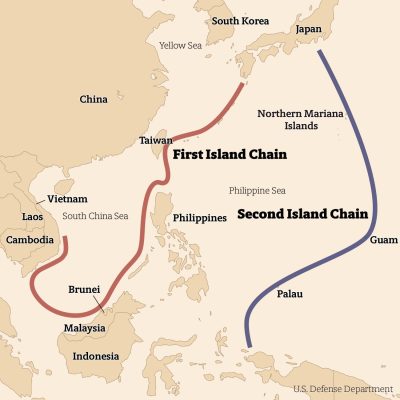
This development completely shattered America’s original blueprint, which had excluded both Taiwan and South Korea from its Pacific defense perimeter. Driven by this historical imperative, the United States formalized its grand strategy to contain communist expansion, constructing the “First Island Chain”—a strategic maritime perimeter anchoring from Japan, the Ryukyu Islands, Taiwan, and the Philippines, all the way down to the Greater Sunda Islands.
This was far more than a localized conflict; it marked the formal crystallization of the global Cold War.
這不只是一場區域戰爭,更標誌著冷戰格局的正式成形。
The First and Second Island Chains 第一島鏈與第二島鏈
This marked a historic turning point for the nearly collapsed Chiang regime, which by then had exercised de facto rule over Taiwan for five years. Because Taiwan sat squarely at the epicenter of the First Island Chain, the Republic of China in Taiwan was instantly pulled back from the brink of total abandonment. It transformed overnight into a critical vanguard of American strategic backing and protection—the absolute frontline in containing totalitarian expansion.
This also marked the very first time the free world formally validated the paramount importance of Taiwan’s strategic position in the West Pacific.
這也是自由世界首次確認,台灣在西太平洋戰略位置的重要性。
President Truman officially declared that the legal status of Taiwan was ‘undetermined.’ He stated that ‘the determination of the future status of Formosa must await the restoration of security in the Pacific, a peace settlement with Japan, or consideration by the United Nations.’ [🔗]
This historic pronouncement carried profound implications in international law: it signaled that the United States did not recognize post-WWII Taiwan as an integral part of China. Consequently, Beijing was stripped of any legal foundation to assert sovereignty over Taiwan under the pretext of “inheriting Chinese territory.”
To back this legal stance with military resolve, Washington immediately dispatched the U.S. Seventh Fleet into the Taiwan Strait. Their mission was to protect this post-war territory of undetermined status, enforcing what became strategically known as the “neutralization of the Taiwan Strait” to freeze any military cross-strait conflict.
Paradoxically, while President Truman’s “undetermined status” doctrine and the Seventh Fleet’s “neutralization of the strait” shielded Chiang Kai-shek’s regime from Communist annexation, it simultaneously castrated his core political myth—the obsolete claim of being the sole legal government of all China and the grand vow to “recover the mainland.” This legal snub provoked furious rage from Chiang, who fiercely counter-asserted: “Taiwan is an inseparable part of China’s territory! The Government of the Republic of China possesses absolute sovereignty over Taiwan! This position shall never change!”
This historic doctrine of “undetermined status,” decreed by President Truman of the United States—the preeminent victorious power of World War II—operated as a brutal forensic audit under international law: it systematically stripped Chiang Kai-shek’s regime of any a priori, legitimate sovereign claim over Taiwan. Legalistically, it demonstrated that the KMT’s military occupation and iron-fisted governance of the island was merely a temporary “post-war military trusteeship” authorized by the Allied Powers via Douglas MacArthur’s General Order No. 1, rather than a valid transfer of territorial title. The subsequent Allied-led Treaty of San Francisco, engineered predominantly by the United States, strictly mandated that Japan renounce all rights, titles, and claims to Taiwan and the Pescadores without assigning permanent ownership to any specific Chinese government. This calculated omission instantly exposed the foundational myth of the KMT’s authoritarian “ruling legitimacy” as a legal vacuum and a castle in the air.
Though Chiang possessed the physical machinery of the state and bayonets on the ground, his regime never acquired a clean, registered sovereign title over Taiwan on the grand chessboard of international realpolitik. This legal severance thoroughly dismantled the alien autocracy’s continental mythology, leaving a profound international legal void that the Taiwanese populace, half a century later through self-determination and deep integration with the global order, would resolutely occupy—permanently re-registering that “undetermined state” into an ironclad, locally sovereign asset.
Yet, despite his immense fury, Chiang confronted a chilling, inescapable reality. With the Chinese Communist forces heavily amassing along the southeastern coast, poised to launch a bloody invasion to liquidate Taiwan, the dictator knew with absolute clarity that without the U.S. Seventh Fleet and the massive infusion of American dollars, his regime would disintegrate and collapse within a matter of months. Trapped in this geopolitical stranglehold, Chiang pragmatically submitted to the U.S. strategic framework. He begrudgingly traded a degree of sovereign clarity for the absolute guarantee of his political survival underneath the American military and financial umbrella.
Ultimately, the massive influx of U.S. aid became the absolute lifeline that prevented a total societal collapse, thoroughly breaking the back of the catastrophic hyperinflation. Bypassing the broke Nationalist authorities, Washington poured vital commodities directly into the dry supply chains of the Taiwanese market. Shipments of American wheat, raw cotton, soybeans, and chemical fertilizers arrived in a non-stop maritime pipeline, saturating the parched domestic market.
Through the sophisticated financial engineering of the “U.S. Aid Counterpart Fund”, the government successfully absorbed the rampant excess liquidity floating in the market. This structural mechanism instantly restored public confidence in the currency, firmly anchored the exchange value of the New Taiwan Dollar, and successfully forged a stable, unshakeable macroeconomic shield for the island’s subsequent industrial takeoff.
The United States did not merely station troops along the First Island Chain to establish a maritime security ring; it transformed this geopolitical barrier into a robust industrial chain and a global trade network. Under the American-led maritime order, Japan, South Korea, and Taiwan were granted access to U.S. capital, technology, and consumer markets, gradually evolving into some of the most successfully industrialized regions on Earth.
It is fair to say that the post-WWII global order, pioneered by the United States, was largely engineered upon this maritime network. Because of Taiwan’s indispensable geostrategic position and its status as a non-sinking aircraft carrier for the free world, Washington maintained its security commitments through the Taiwan Relations Act even after the severance of formal diplomatic ties. Moving forward, the United States consistently facilitated Taiwan’s integration into the global trading system while fostering its transformation toward a robust champion of human rights and democratization.
The strategic prominence of the First Island Chain only waned when the Chinese Communist Party temporarily convinced the world it had abandoned its revolutionary ambitions in favor of joining the global rules-based order.
In April 1974, Deng Xiaoping stood before the United Nations General Assembly and delivered a famously solemn pledge to the world: “China is not a superpower, nor will it ever seek to be one. If one day China should change her color and turn into a superpower, if she too should play the tyrant in the world and everywhere subject others to her bullying, aggression, and exploitation, the people of the world should identify her as social-imperialism, expose it, oppose it, and work together with the Chinese people to overthrow it.“
Throughout the post-Cold War era, this declaration was repeatedly cited by Western Sinologists and policymakers as definitive proof that China’s rise was fundamentally “defensive” and “peaceful.” For decades, this pledge served as the absolute cornerstone of Beijing’s “hide your strength and bide your time” (Taoguang Yanghui) strategy.
Mired in the quagmire and frustration of the Vietnam War at the time, the United States adjusted its global strategy accordingly: aligning with China to counterbalance the Soviet Union, while creating favorable conditions for a dignified American withdrawal from Vietnam. This geopolitical realignment ultimately led the United States to establish official diplomatic relations with the People’s Republic of China (PRC) in 1979, resulting in the severing of formal ties with Taiwan and the withdrawal of U.S. military forces from the island.
By launching a military assault on Vietnam—a staunch ally of the Soviet Union—Beijing demonstrated its strategic utility to the anti-Soviet coalition, proving beyond doubt that the Sino-Soviet split was irreversible. This calculated gambit earned China the essential political trust of Washington and the West, subsequently unlocking decades of Western capital, technology, and trade support.
Decades later, in 2001, the United States championed China’s entry into the global trading system. Then-President Bill Clinton envisioned that economic prosperity would inevitably steer China toward democratization. During that golden era of globalization, geopolitics seemed to fade into the background, and the term “First Island Chain” was temporarily forgotten by the world.
Under this illusion, capital and technology from the free world flowed relentlessly into China. Consequently, the First Island Chain was downgraded in the eyes of multinational conglomerates from its Cold War status as a “fortress of defense” to a mere “commercial shipping lane.” During this period of global integration, Taiwan, Japan, and South Korea were increasingly pressured to bind their economic survival to a deep symbiosis with the Chinese market.
However, the grand Western vision—that ushering China into the global trading architecture would inevitably steer Beijing toward political democratization and the rule of law—failed to materialize. Instead, Beijing reinforced its centralized power and authoritarian rule, actively exposing its expansionist desires.
Deconstructing Xi’s “Divide the Pacific” and the Thucydides’s Trap Smokescreen
解構習近平的「分治太平洋」與修昔底德陷阱的外宣煙幕
The moment Xi Jinping consolidated absolute authority over China’s party-state capitalism, Beijing systematically tore away this peaceful facade to spearhead a relentless campaign of imperial expansion.
在習近平全面鞏固黨國資本主義的絕對權力後,中國系統性地撕下了這層和平假面,開始全力推進帝國擴張。
This aggressive ideological pivot was laid bare on the eve of his February 2012 visit to the United States. In a written interview with The Washington Post, Xi pointedly asserted: “The vast Pacific Ocean has ample space for China and the United States.” He revived and amplified this exact revisionist rhetoric in June 2013 during his informal summit with President Barack Obama at the Annenberg Estate in California, reiterating that “the broad Pacific Ocean has enough space to accommodate both China and the United States.” [🔗]
In 2015, satellite imagery exposed 🔗 China’s massive construction and militarization of artificial islands in the South China Sea. Defending the expansion, Xi asserted that these maritime features were sovereign Chinese territory, claiming they had “belonged to China since ancient times.”
The geopolitical pressure shifted directly toward Taiwan in 2019, when Xi unilaterally declared that Taiwan and China “belong to one China” under a “One Country, Two Systems” framework, while explicitly vowing that Beijing “makes no promise to renounce the use of force.”
This gathering threat was brought into sharp focus in February 2023, when CIA Director William Burns revealed at a Georgetown University event that American intelligence had intercepted a direct mandate from Xi Jinping, ordering the People’s Liberation Army to be prepared to launch a military invasion of Taiwan by 2027.
This verified timeline cross-referenced perfectly with earlier military assessments. In March 2021, Admiral Philip Davidson, then-Commander of the U.S. Indo-Pacific Command, testified before the U.S. Senate, parsing the empirical data of Beijing’s skyrocketing defense budgets, the aggressive expansion of the PLA Rocket Force, and a naval shipbuilding spree that resembled “dropping dumplings into boiling water.” Davidson issued a stark warning that China was highly likely to attempt a forced annexation of Taiwan within six years—by 2027—a critical strategic flashpoint now formalized in military circles as the “Davidson Window.”
China’s imperial expansionism is by no means confined to Taiwan and the South China Sea; it is a cross-regional offensive systematically engineered to dominate the entire West Pacific.
中國的帝國擴權野心絕非止步於台海與南海,而是一場意圖主宰整個西太平洋的跨區攻勢。
In September 2024, the PLA Rocket Force shattered a four-decade precedent by test-firing a DF-31AG intercontinental ballistic missile into the open waters of the South Pacific. Commanding a range of up to 11,700 kilometers, the missile possesses the capabilities to directly strike the U.S. mainland and Hawaii. Through this launch, Beijing demonstrated to the free world that its strategic strike capabilities can seamlessly penetrate both the First and Second Island Chains (Guam) to project a direct threat into the deep Pacific—a provocative maneuver that triggered severe diplomatic tremors and widespread condemnation from New Zealand, Australia, and Pacific island nations.
Concurrently on the seas, the PLA Navy’s Liaoning and Shandong carrier strike groups routinely breach the Miyako and Bashi Straits to conduct advanced dual-carrier combat drills in the Philippine Sea, while Chinese capital destroyer fleets executed a strategic circumnavigation around Australia, broadcasting Beijing’s capability to project hard power directly into the traditional Euro-American rear guard.
Meanwhile, Chinese and Russian naval forces have abandoned their separate exercises in favor of highly integrated joint fleet formations, routinely transiting the Tsugaru and Osumi Straits and even pushing near Alaska’s Aleutian Islands to enforce a de facto maritime encirclement of the Japanese home islands. This is reinforced by routine, joint strategic bomber patrols cutting through the Sea of Japan and the East China Sea, directly challenging U.S. and Japanese Air Defense Identification Zones (ADIZ).
Beyond conventional military deployment, Beijing has leapfrogged the First Island Chain by employing a predatory grey-zone strategy that blends economic enticement with military coercion across the South Pacific. Beijing is aggressively courting nations like the Solomon Islands and Kiribati, leveraging infrastructure loans and opaque security pacts to establish strategic maritime ports and aviation facilities.
Crucially, these atolls are the exact geostrategic lifelines where American and Japanese forces engaged in brutal, existential combat during World War II to secure the vital sea lines of communication. Beijing’s long-term placement in this theater is explicitly designed to isolate the region and sever America’s primary reinforcement corridors from the continental United States to the First Island Chain during a crisis.
This has forced Washington to pivot its diplomatic and defense resources decisively back to the Pacific, propelling the strategic importance of the First Island Chain back to the forefront of global security. Situated at the very nexus of this perimeter—and commanding the vital maritime chokepoints between the East and South China Seas—Taiwan has once again emerged as the absolute focal point of safety for the free world.
When confronted by the free world’s collective awakening, Beijing frequently invokes the grand narrative of the “Thucydides’s Trap,” attempting to cloak its imperial expansionism in a veneer of historical inevitability. This discourse oversimplifies the West Pacific confrontation into an unavoidable collision between a rising power and an established hegemon, implying that China’s military aggression in the South China Sea, the Taiwan Strait, and the South Pacific is merely the natural expansion of an emerging superpower.
This represents the next evolution of Chinese deception; much like how Deng Xiaoping’s promise that “China will never seek hegemony” was weaponized to market a “defensive and peaceful rise,” Beijing has once again brilliantly co-opted Western scholars and media to propagate a sophisticated smokescreen for its imperial ambitions.
It is a meticulously engineered campaign of cognitive cloaking designed to sanitize a totalitarian regime’s predatory assault against maritime democracies into a value-neutral balance-of-power game, thereby concealing the raw truth: a revisionist power expanding forcefully to dominate the West Pacific.
Xi Jinping, of course, avoids explicitly stating his ambition to dominate the West Pacific; instead, he orchestrates a historical grievance narrative to frame this expansion as a defensive correction of past wrongs. Under this state-sanctioned propaganda, because the Qing Empire suffered the legacy of the Eight-Nation Alliance, a century of national humiliation, and the subsequent Japanese invasion, China’s contemporary wealth and power mean that “the great rejuvenation of the Chinese nation must be realized, and no one will ever oppress China again.”
Setting aside the historical and legal fact that the true successor state to the Qing Empire is the Republic of China—not the People’s Republic of China—the ROC legally assumed this sovereignty through the 1912 imperial abdication edict [🔗], whereas the CCP was founded only in 1921 and established its state in 1949.
When deconstructing the physical layout of the East Asian coastline, any ambition to achieve maritime hegemony must instantly confront inescapable geographical choke points. If Beijing intends to project naval supremacy into the deep blue waters of the global commons, its forces must first negotiate a series of heavily fortified maritime barriers.
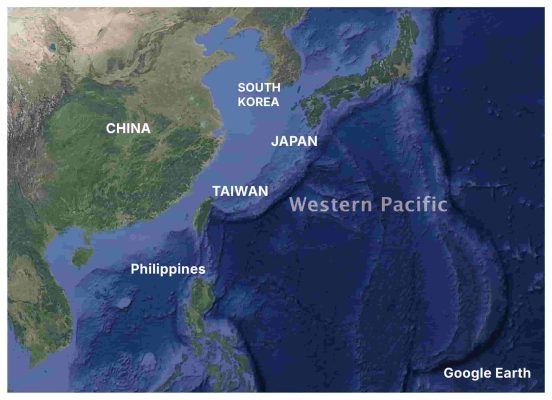
Although China has a long coastline, from a geographical perspective, its navy is actually penned into the shallow waters of the continental shelf close to its shores. The coastal waters of the Yellow Sea, East China Sea, and Taiwan Strait average a mere 50 to 100 meters in depth, transforming these maritime zones into a transparent fishbowl where the thermal, magnetic, and acoustic signatures of massive Chinese nuclear submarines are instantly exposed.
For Chinese submarines seeking to enter the open Pacific Ocean, they are restricted to a few narrow chokepoints: the Miyako Strait, the Bashi Channel south of Taiwan, and the exits of the South China Sea. All of these areas have long been under the intense, continuous surveillance of the United States and Japan.
For submarines, what truly matters is never sheer quantity or firepower; it is remaining undetected. The ultimate strategic value of ballistic missile submarines (SSBNs) lies in a nation’s second-strike capability—the ability to launch a retaliatory nuclear strike from the ocean depths even if its mainland has been completely devastated. When a submarine is tracked by satellites, pinned by sonar arrays, and hunted by anti-submarine aircraft the moment it clears port, its strategic deterrence evaporates.
This reality elevates Taiwan’s physical geography into an irreplaceable strategic prize. Just off Taiwan’s eastern coast, the shallow continental shelf abruptly plummets into deep-water trenches plunging 4,000 to 6,000 meters into the abyss. Swept by the heavy acoustic masking of the roaring Kuroshio Current, this deep-ocean frontier provides the ultimate, undetectable sanctuary for submarines to vanish into the Pacific.
Consequently, the Bashi Channel—plunging over 2,000 meters deep between Taiwan and the Philippines—functions as the definitive “submarine corridor.” This makes the First Island Chain an indispensable geographic trap—a natural maritime wall that denies Chinese vessels undetected entry into the blue waters of the Pacific.
This is precisely why Taiwan stands as the crown jewel of this defensive perimeter—the definitive, hyper-critical battleground where totalitarianism and maritime democracy collision.
這就是為什麼台灣是這條防禦陣線上的璀璨明珠,極權主義與民主自由陣營的必爭之地。
Therefore, when Xi Jinping declares that Beijing “makes no promise to renounce the use of force” to unify Taiwan, this is never an abstract dispute over historical legitimacy; it is a brutal, existential confrontation over tangible property and geostrategic leverage.
Militarily, this declaration is tantamount to an open announcement of Beijing’s intent to forcefully annex the Taiwan Strait—the vital energy and trade lifeline for Japan and South Korea—into a localized inner sea of the Chinese party-state. Simultaneously, it represents the ultimate, indispensable gateway through which China’s strategic nuclear submarines intend to permanently shatter the geographic trap of the First Island Chain, slipping undetected into the deep trenches of the Pacific Ocean to hold the free world hostage.
If Taiwan were to be annexed, its deep-water east coast would immediately become a forward operating base for the Chinese military. From there, China’s nuclear submarines could slip silently and flawlessly into the abyssal depths of the Pacific, posing an immediate, unmonitored threat to Guam, Hawaii, and the United States mainland itself.
The Strait of Globalization and the AI Paradigm Shift: TSMC as the Silicon Shield and the Silicon Spear
全球化航線與 AI 浪潮下的島鏈重組:半導體是矽盾 更是自由世界奪回台灣時的矽矛
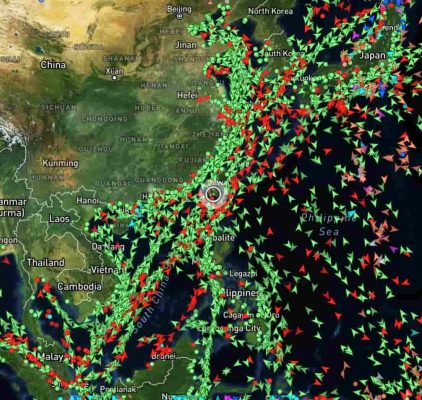
Today, the Taiwan Strait is vastly different from what it was during the Korean War era. Globalization has transformed this narrow strip of water into one of the busiest maritime shipping lanes in the world, carrying over 20% of global container commerce. Should China gain control over the Taiwan Strait, it would effectively grasp the jugular vein of Taiwanese, Japanese, South Korean, and even global trade.
The Taiwan Strait is now one of the busiest shipping lanes in the world. 台灣海峽如今已是全球最繁忙的貿易航道之一。
Furthermore, the nations along the First Island Chain are now heavily clustered with high-tech supply chains. Electronic components, semiconductor products, and vital energy shipments must all transit through the Taiwan Strait. Following the onset of the artificial intelligence wave that swept the globe after 2022, high-end semiconductors have become the definitive core of AI infrastructure. Taiwan sits at the absolute epicenter of this chip supply chain, manufacturing over 90% of the world’s advanced microprocessors.
而且整個第一島鏈如今佈滿高科技供應鏈,電子零組件、半導體產品、能源運輸都必須經過台灣海峽。2022 年後人工智慧浪潮席捲全球,而 AI 的核心,正是高階半導體晶片。而生產全球超過 90% 高階晶片的台灣,正是半導體供應鏈的核心。
The dawn of the AI era has rendered the First Island Chain far more critical than it ever was during the Cold War. In this new paradigm, whoever controls the advanced semiconductor supply chain wields the leverage to dictate the technological hegemony of the next era.
AI 的出現讓第一島鏈的重要性更勝於冷戰時期,因為誰控制先進晶片供應鏈,誰就能大幅影響下個時代的科技主導權。
Consequently, safeguarding Taiwan’s sovereign independence and ensuring freedom of navigation through the Taiwan Strait—preventing it from being downgraded into “China’s internal sea”—has escalated into a matter of existential importance for the entire global economy.
維持台灣的主權獨立,維持台灣海峽的自由航行、不淪為「中國的內海」,已成為全球經濟至關重要的課題。
At this juncture, it is vital to shatter a twin propaganda narrative driven by Beijing: “Now that TSMC is establishing fabs in the United States, Japan, and Germany, advanced manufacturing nodes are being decentralized, and Taiwan will lose its protective ‘Silicon Shield’—we must not let TSMC turn into America-SMC!” Setting aside the fact that TSMC’s global expansion is a perfectly standard commercial response to the risk-diversification demands of its massive American and Japanese clients, this global footprint, far from weakening the Silicon Shield, represents the democratic alliance’s deepest level of total-war readiness.
Consider the ultimate scenario: if Taiwan were to temporarily fall into Beijing’s hands due to the psychological hypnosis of the “China is strong, Taiwan is weak” narrative and internal subversion, would the free world simply acquiesce and not fight to retake this First Island Chain nexus? In that critical hour, must TSMC not serve as the free world’s Silicon Spear and technological arsenal? When that day comes, the very F-35 fighters, uncrewed systems, and military AI architectures required to launch a counter-offensive to crush totalitarian expansion will demand an uninterrupted supply of high-end chips. Is it not blindingly obvious that this advanced manufacturing capacity must exist in secure sanctuaries outside the island, ensuring the free world can sustain its counter-strike even if the Taiwan Strait is completely blockaded? This is not abandonment; it is the ultimate existential redundancy engineered to guarantee that the fire of democratic resistance never runs cold.
試想,若台灣真的因為「中國強、台灣弱」的敘事催眠與內部滲透成功,而暫時落入中共之手,自由世界難道不用將這座第一島鏈中樞奪回來嗎?台積電難道不用成為自由世界反擊的「矽矛」嗎?屆時自由世界反擊極權擴張所仰賴的 F-35 戰機、無人機與軍用 AI 系統,其核心的高階晶片,難道不需要在台灣海峽遭到全面封鎖時,在自由世界的其他安全陣地維持源源不絕的自主製造能力嗎?這不是拋棄,這是確保反擊之火永不熄滅的終極戰備。
The Shifting Geopolitics: Allies Align for a Shared Destiny 地緣政治新局:命運共同體
The shift in the strategic landscape is best illustrated by the tangible, concrete actions of our allies.
戰略局勢的轉變,盟友的實際動作最清楚。
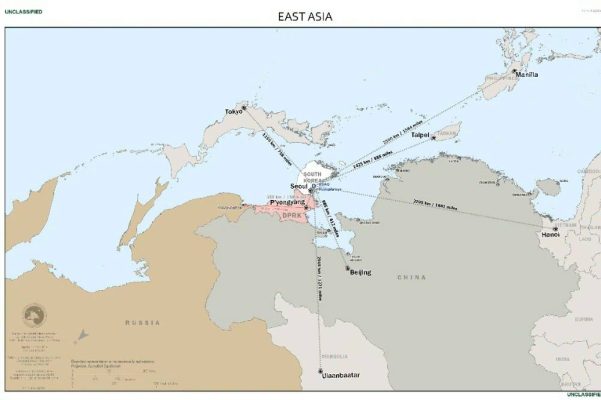
In the past, the singular core mission of the U.S. Forces Korea (USFK) was to deter North Korean aggression. In recent years, however, the USFK has formally extended its strategic horizon to encompass the entire First Island Chain. This evolution is visually captured in the official “Inverted Map” released by the U.S. military. By completely turning the traditional map upside down with South Korea at its center, this fresh perspective makes the pivotal, interlocking positions of the Taiwan Strait and the First Island Chain instantly clear. The inverted map sends an unmistakable signal to the world: should a conflict erupt in the Taiwan Strait, South Korea will no longer be a mere bystander. Instead, the USFK possesses the strategic flexibility and forward-deployment potential to act swiftly from its Korean bases.
The East-Up Map: Revealing Hidden Strategic Advantages in the Indo-Pacific 以東為上的地圖:揭示印太地區隱藏的戰略優勢
Under PM Sanae Takaichi and Defense Minister Shinjiro Koizumi, Japan is executing its most radical military transformation since WWII, moving beyond its passive, exclusive defense posture. This involves deploying long-range precision missiles—including 1,000-km-range Type-12s and 1,600-km-range Tomahawks [🔗] —and establishing a new mid-range air defense missile unit on Yonaguni Island [🔗] to push its defense perimeter forward and monitor the Taiwan Strait, just 110 km away. Concurrently, the Takaichi Cabinet enacted the most sweeping relaxation of arms export rules since WWII, authorizing the export of lethal weapons for the first time as tangible diplomatic and defensive leverage.
Under this framework, Tokyo plans to transfer decommissioned Abukuma-class frigates and advanced hardware to Manila via resale or grants, fortifying the southern flank and extending the defensive line southward.
As the critical nexus of the perimeter, Taiwan’s definitive objective is to forge a highly resilient force engineered to survive China’s initial waves of saturating air and missile strikes, ensuring the capability to decisively crush any invading fleet or blockade. Backed by a defense budget that has soared to historic heights, Taipei is synthesizing a lethal asymmetric grid leveraging U.S.-made Harpoon missiles, indigenous Hsiung Feng anti-ship platforms, and vast swarms of uncrewed aerial systems (UAS). The operational core of this forward denial is uncompromisingly precise: to blow invading PLA warships clean into two sections before they can cross the Taiwan Strait, or at any designated flashpoint between the shores of China and Taiwan. [🔗]
Facing relentless Chinese grey-zone harassment and coercion in the South China Sea, the Philippines has secured a powerful U.S. military footprint. Beyond high-intensity joint exercises like the Balikatan drills, this perimeter has been engineered into a U.S. land-based bastion for long-range asymmetric strikes. Washington has permanently deployed the “Typhon” mid-range missile system [🔗] in strategic areas like Luzon. Capable of launching Tomahawk and SM-6 missiles, this mobile system boasts a fire-control range exceeding 2,500 km, effectively blanketing China’s southern coast, illegal military outposts in the South China Sea, and the entire Taiwan Strait, choking off expansionist corridors from the south.
According to a Bloomberg report on a classified memo submitted to lawmakers by INDOPACOM Commander Admiral Samuel Paparo, the PLA is undergoing a “historic expansion across all domains.” Its training is heavily focused on two primary missions: forcing the unification of Taiwan and countering U.S. and allied defensive capabilities, aiming for full combat readiness by 2027. [🔗]
In response, Admiral Paparo detailed a forward denial strategy leveraging funding from the record $1.5 trillion defense budget request. He demanded over $1 billion to upgrade two devastating asymmetric capabilities: the “Quicksink” anti-ship system, designed to detonate beneath hulls and snap the keels of heavy enemy warships, and an advanced rapid-deployment mine system capable of completely sealing off key shipping lanes (Miyako, Bashi, Taiwan Strait) in less than half a day.
The First Island Chain has officially bound itself into a single community of shared destiny. Ultimately, the friction between Taiwan and China has never been a mere cross-strait issue. It is a critical battle over whether the entire post-WWII maritime order in the Western Pacific will be completely subverted. This is not merely due to microchips, but because of Taiwan’s position as the geopolitical lynchpin of the First Island Chain.
If one compares TSMC to Taiwan’s sovereign “Protector Mountain” range towering nearly four thousand meters above sea level, and views it in tandem with the precipitous plunge of the island’s eastern trenches dipping five to six thousand meters into the abyss, a stark geostrategic truth emerges: this ten-thousand-meter monolithic fortress—anchored above by a silicon citadel and below by a deep-ocean submarine bastion—stands as a colossal tech-fortress forged along the rim of the Western Pacific.
Should Taiwan fall and this perimeter succumb to totalitarian control, this massive fortress would violently pivot to constrict the primary energy and trade artery of Japan and South Korea—the Taiwan Strait—as well as the indispensable lifeblood of today’s global AI technology. Any destabilization of Japan would instantly fracture the very core of America’s post-war global interests and maritime order.
一旦台灣失守,落入極權之手,這座要塞將反過來直接扼住日本與南韓的能源與貿易生命線——台灣海峽,以及如今全球 AI 科技的命脈;而日本的動搖,將直接觸動美國戰後在全球最核心的秩序與利益。
The Blood-Bought Order: Why the Free World Will Never Yield
自由世界有可能退讓嗎?以鮮血與生命鑄成的戰後秩序
Although the Chinese Communist Party is widely recognized by its infamous maxim that “political power grows out of the barrel of a gun,” a cold review of history reveals that its military victories have been scored almost exclusively from within. Its record consists of winning a domestic civil war, forcefully invading peaceful Tibet, crushing university students under tanks in Tiananmen Square, executing the cultural genocide of the Uyghurs, and clamping an iron fist over the free, lawful, yet entirely unarmed people of Hong Kong.
Conversely, Beijing’s external military campaigns have rarely yielded honorable conclusions. The party-state’s true core competency has never been a head-on military showdown on the global commons, but rather its relentless execution of espionage, predatory subversion, propaganda, information warfare, and psychological manipulation targeting the Free World.
This forces us to crawl through the heavy crossfire of cognitive warfare, journeying straight back to the World War II battlefield that forged our modern global order, to ask a raw, unfiltered question that pierces the very core: What price, then, did the United States truly pay to safeguard the Free World back then?
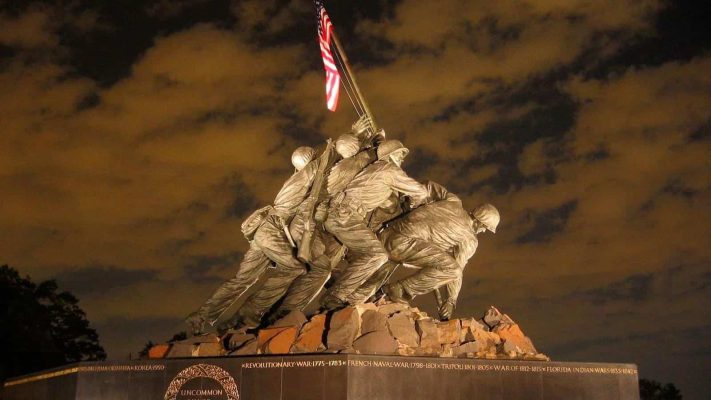
Today, they rest in eternal peace at Arlington National Cemetery near Washington, D.C. Nearby stands the Marine Corps War Memorial [🔗] —the iconic Iwo Jima monument—honoring the Marines who laid down their lives to defend freedom.
Therefore, instead of asking whether the United States will abandon Taiwan and the First Island Chain, the real question you should ask is this: If you were the United States, would you willingly abandon the global economic system and maritime order that you built with the blood, sweat, and treasure of your own people since World War II?
If the answer is a resounding no, then as long as the map remains unchanged, and as long as the laws of Earth science and maritime geopolitics hold true, Taiwan—sitting at the absolute nexus of the First Island Chain—will forever remain the red line of defense from which the free world can never retreat.